
Introduction
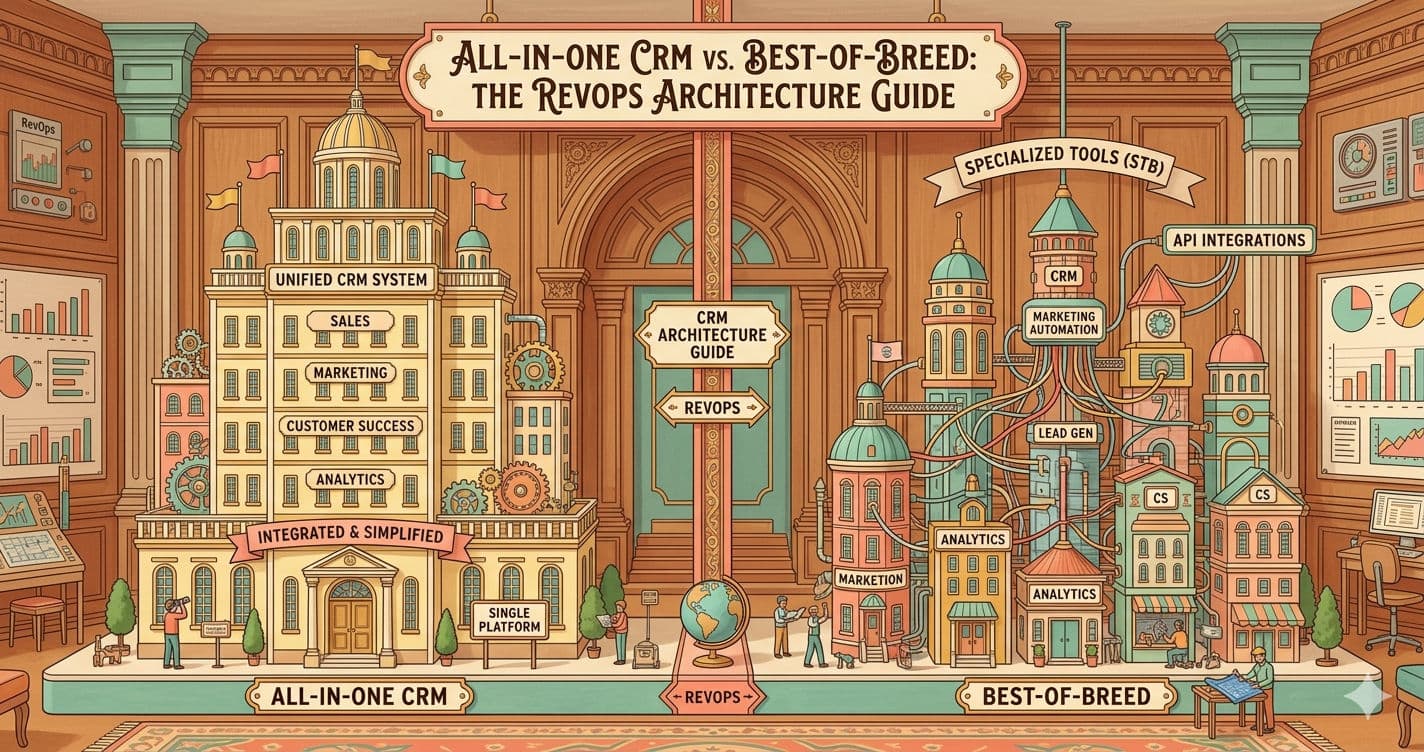
Finding the best enterprise CRM 2026 requires looking beyond basic contact management. Today's Marketing Operations (MOPs) and Growth Leads need the best CRM with built-in marketing automation 2026 to orchestrate complex, autonomous workflows. Whether you are upgrading from a legacy system or searching for the best enterprise marketing automation platforms 2025 2026, the goal is the same: unifying your tech stack to drive revenue without bloated costs.
Streamline your software evaluation process
By 2026, the landscape has shifted from linear drip campaigns to predictive behavioral modeling. The CRM is no longer just a system of record; it is a system of action. With the global marketing automation software market projected to exceed $8 billion in 2026, the pressure to choose a platform that scales is immense. The cost of technical debt—caused by poor data hygiene, API rate limits, and disjointed attribution models—can cripple a scaling company’s unit economics.
The most significant shift is the economic pressure on Total Cost of Ownership (TCO). Growth teams must prove efficiency, making the search for the best CRM for marketing automation 2025 2026 critical. It is no longer acceptable to pay for a bloated suite where 40% of features sit unused. The modern stack must be lean, composable, and integrated directly with the Modern Data Stack (MDS).
If you are evaluating the best CRM for enterprise 2026 or simply want the best CRM with built-in marketing automation 2025 2026, this guide provides a deep-dive technical evaluation of the top platforms. We move beyond surface-level feature lists to analyze workflow logic, API extensibility, and the migration frameworks necessary for high-growth teams.
Key Takeaways
The best CRM for marketing automation in 2026 depends heavily on your data infrastructure. HubSpot remains the gold standard for native, all-in-one growth stacks, while Salesforce (via Marketing Cloud and Data Cloud) is the top choice for complex, enterprise-level customization and schema management.
Best enterprise marketing automation platforms 2026: Beyond the big two, ActiveCampaign excels at behavioral tracking and split-test automation, Zoho CRM offers extensive custom scripting for global teams, HighLevel dominates the agency space with snapshot automation, Keap provides streamlined lifecycle logic for scaling businesses and Creatio delivers unified CRM + BPM with low‑code automation for faster enterprise scaling.
AI and Data Privacy: The landscape has shifted from linear workflows to AI-driven orchestration. Selecting a platform now requires evaluating its ability to handle Reverse ETL, enforce data governance, and adapt to strict privacy-first mandates.
Top Software Picks
HubSpot CRM — best for unified automation and composable marketing workflows.
Salesforce — best for advanced data flexibility and enterprise‑level customization.
ActiveCampaign — best for integrated email marketing and customer journey automation.
HighLevel — best for agency‑focused CRM and client management tools.
Keap — best for small‑business automation and lead nurturing.
Zoho CRM — best for affordable, scalable CRM with strong workflow automation.
Creatio — best for Low-Code CRM and workflow automation that unifies sales, marketing, and service.
Software covered in this article
For learning and reference, this listicle presents the best crms for marketing automation:






The State of Marketing Automation in 2026
The fundamental requirement for a CRM today is supporting composable architecture. Rather than walled gardens, growth teams need central nervous systems integrating seamlessly with data warehouses like Snowflake. When evaluating the best composable CRM platforms for enterprise architecture, technical leaders prioritize modularity and real-time activation. Additionally, the shift toward AI orchestration means the best autonomous CRM 2026 solutions now self-optimize routing, execute multi-channel campaigns, and manage schema drift with minimal human intervention.
1. The Rise of Reverse ETL and the Activation Layer
In the past, the CRM was the single source of truth. Today, the data warehouse holds that title. The CRM's role has shifted to becoming the "activation layer." Tools like Hightouch and Census—known as Reverse ETL solutions—now pipe modeled data from the warehouse directly into CRM fields to trigger automation.
If your chosen CRM cannot handle high-velocity API calls from a Reverse ETL process, or if it lacks the schema flexibility to accept computed traits (e.g., "LTV_Last_30_Days"), it will become a bottleneck. The best platforms in 2026 treat data ingestion as a first-class citizen, ensuring that your marketing automation is powered by the same rigorous data models used by your finance and product teams.
2. From Linear Workflows to AI Orchestration
Traditional rule-based automation is becoming obsolete. In the past, a marketing manager would manually map out a decision tree: "If user clicks link A, wait 2 days, then send email B." Today, AI-native orchestration engines within platforms like Salesforce and HubSpot utilize generative AI and predictive analytics to determine the next best action dynamically. These systems analyze thousands of signals—including site behavior, support ticket sentiment, and firmographic data—to adjust the journey in real-time without manual intervention.
3. The Privacy-First Mandate
With 2026 ushering in even stricter global privacy regulations, the "wild west" of third-party cookies is dead. Your CRM must act as a compliant Customer Data Platform (CDP), ensuring that consent management is baked into every automation trigger. The best platforms now enforce governance at the schema level, preventing non-compliant data from ever entering a workflow.
Core Evaluation Criteria for Automation-First CRMs
When auditing a CRM for a sophisticated growth stack, standard review sites often miss the technical nuances that frustrate engineers. Here are the critical vectors for evaluation:
1. Workflow Logic and Branching Complexity
Does the visual builder support complex, multi-path conditional logic? Can you nest conditions (e.g., "If Lead Score > 80 AND (Industry = SaaS OR Revenue > $5M)"?)? Tools like ActiveCampaign have historically excelled here, but enterprise contenders are catching up with programmable automation that allows for custom JavaScript or Python execution within the workflow.
2. API Extensibility and Webhooks
For the Growth Engineer, the API documentation is more important than the UI. You need to assess:
Rate Limits: Will the CRM throttle your requests during a high-volume product launch? Standard limits often cap at 10 requests per second, which is insufficient for 2026 scale.
Webhook Latency: How close to "real-time" is the data sync? Latency benchmarking is critical for trigger-based transactional messaging.
Bi-directional Sync: Can the CRM accept custom objects and events from your proprietary app without breaking the schema?
3. Attribution and Reporting
Marketing automation is useless if you cannot measure impact. The top platforms in 2026 offer multi-touch attribution out of the box, moving beyond "Last Touch" to algorithmic models that credit every interaction in the lifecycle. This is essential for aligning Marketing and Sales data to calculate accurate Customer Lifetime Value (CLV) and Customer Acquisition Cost (CAC).
4. Data Governance and Schema Enforcement
A critical but often overlooked criterion is how the CRM handles "dirty data." In a high-growth environment, data enters from dozens of sources—web forms, enrichment tools, sales entry, and product events.
Does the CRM allow you to define strict types for fields (e.g., enforcing E.164 format for phone numbers or ISO-8601 for dates)? If a tool allows any string to be dumped into a date field, your automation logic will break. The best platforms for 2026 offer "Schema Enforcement" at the API gate, rejecting malformed data before it can trigger a false positive in a workflow.
1. HubSpot: The Gold Standard for Integrated Growth Stacks
HubSpot has evolved from a simple inbound marketing tool into a robust enterprise platform. In 2026, its Marketing Hub Enterprise combined with Operations Hub represents the gold standard for teams that want power without the steep learning curve of legacy enterprise tools.
Advanced Workflow Orchestration
HubSpot’s standout feature for technical teams is Programmable Automation (available in Operations Hub). This allows developers to write custom JavaScript actions within a standard workflow. For example, you can write a script to query an external database, validate an email address against a third-party fraud API, and normalize the capitalization of a name field—all before the lead is routed to sales. This eliminates the need for middleware like Zapier for internal data hygiene.
HubSpot vs. The Modern Data Stack
One of HubSpot's strongest value propositions in 2026 is its native integration with the Modern Data Stack. Through Data Sync and its native Snowflake Data Sharing integration, HubSpot allows you to query your CRM data directly from your warehouse without building complex ETL pipelines.
This is a game-changer for attribution. Instead of exporting CSVs to blend data in Excel, analysts can join HubSpot campaign data with product usage data in Snowflake using SQL, creating a live dashboard of "Revenue by Feature Usage." This level of interoperability makes HubSpot a favorite among technical marketing teams.
Best For: Scale-ups and Mid-Market companies (50-1000 employees) prioritizing ease of use alongside technical power.

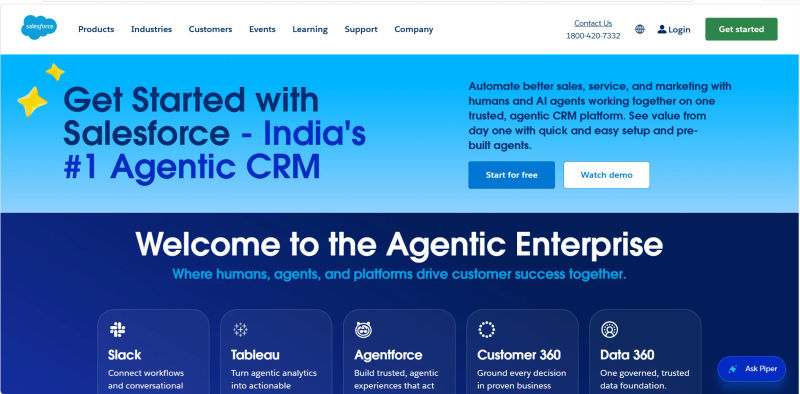
2. Salesforce: Enterprise-Level Customization and Data Synergy
Salesforce remains the heavyweight champion and the best CRM for large enterprises in 2026. When evaluating the best enterprise CRM suites with automation and analytics for 2025 and 2026, Salesforce’s Marketing Cloud and Data Cloud provide unrivaled depth. It is widely considered the best CRM for customization enterprise workflows in 2025 and 2026, allowing teams to build highly complex, multi-channel journeys. As one of the best CRM and sales automation platforms for enterprise in 2026, Salesforce demands a significant investment in engineering resources but delivers unparalleled data synergy, advanced analytics, and scalable architecture.
Leveraging Marketing Cloud for Complex Journeys
Salesforce Marketing Cloud (SFMC) is less of a tool and more of a development environment. Its Journey Builder is capable of handling millions of transactions per hour, making it the go-to for B2C giants. In 2026, the integration of Einstein GPT has significantly reduced the friction of creating complex segments. Marketers can now describe a target audience to the AI, and Einstein will generate the SQL query needed to pull that list from the Data Cloud.
Data Cloud and Handling Schema Drift
Salesforce’s Data Cloud (formerly Genie) is designed to ingest real-time data streams from websites, mobile apps, and connected devices, harmonizing them into a single graph.
A critical advantage here is how Salesforce handles Schema Drift—the phenomenon where an external data source changes its format (e.g., a field name changes from user_id to userId). Salesforce's Data Cloud mapping allows engineers to re-map these streams dynamically without breaking the downstream marketing journeys. This resilience is vital for enterprise organizations where data stability is non-negotiable.
Best For: Enterprise organizations with dedicated engineering resources and complex, high-volume data requirements.
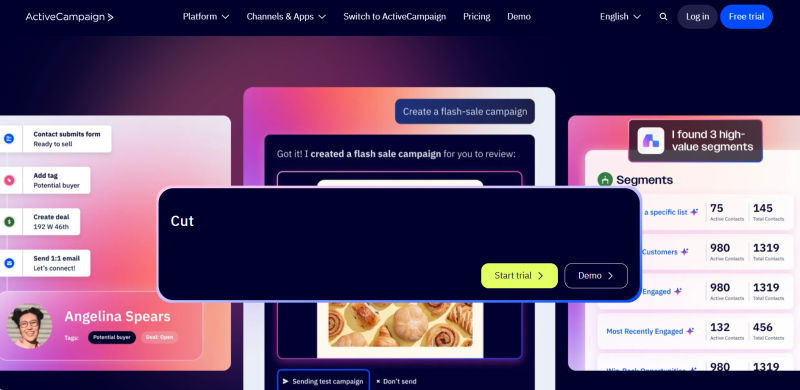
3. ActiveCampaign: Precision Automation and Behavioral Tracking
ActiveCampaign has carved out a massive niche by focusing relentlessly on the automation builder itself. It is often cited by Growth Hackers as the best balance between price and power. It doesn't try to be a monolithic ERP; it tries to be the best automation engine on the market.
CXA: Customer Experience Automation
ActiveCampaign coined the term "Customer Experience Automation" (CXA). Their platform excels at tracking behavioral events—site visits, video views, app usage—and using those signals to trigger hyper-personalized sequences. Unlike other CRMs where setting up "site tracking" requires developer intervention, ActiveCampaign’s implementation is lightweight and robust.
The Split-Test Automation
One of the most powerful features for growth teams is the ability to split-test entire automation paths, not just emails. You can send 50% of your leads down Path A (SMS + Email) and 50% down Path B (Email only), and let the system automatically route future leads to the winning path based on conversion goals. This algorithmic optimization is crucial for squeezing efficiency out of paid traffic.
The Trade-off: Custom Object Limitations
However, in the spirit of a fair technical review, it must be noted that ActiveCampaign's handling of Custom Objects is less robust than HubSpot or Salesforce. While they have improved this feature, the schema is more rigid. If your business model relies on complex many-to-many relationships (e.g., a "Student" related to multiple "Classes," "Campuses," and "Instructors"), you may find the data modeling capabilities limiting compared to the enterprise giants.
Best For: D2C brands, digitally native SMBs, and sophisticated marketers who live in the automation builder.
Find Perfect Software For Your Business
4. Zoho CRM: Unified Marketing Automation for Global Teams
Zoho is often underestimated, but in 2026, the Zoho One ecosystem offers an incredible value proposition. It provides a unified stack that replaces dozens of disparate SaaS subscriptions, offering a holistic view of the customer from lead to cash.
Custom Scripting with Deluge
For the technical marketer, Zoho’s proprietary scripting language, Deluge, is a superpower. It allows for deep customization of the CRM backend without needing full-stack developers. You can write scripts to fetch data from external APIs, update related modules, or calculate complex lead scores based on custom logic.
The Hiring Challenge
The downside to Deluge is the "Silo Risk." Because Deluge is proprietary to Zoho, finding talent with this specific skill set is harder than finding a JavaScript developer for HubSpot or an Apex developer for Salesforce. Teams choosing Zoho must be aware that they are committing to a niche ecosystem, and they may need to train developers internally rather than hiring from a broad talent pool.
Canvas Builder
User adoption is often a hurdle in CRM implementations. Zoho’s Canvas builder allows MOPs teams to completely redesign the CRM interface for different internal roles. You can create a minimalist view for sales reps that only shows the "Next Best Action" and a data-heavy view for analysts. This UI flexibility helps reduce churn and improves data entry compliance.
Best For: Cost-conscious scaling companies and teams comfortable with low-code customization.

5. HighLevel: The All-in-One Engine for Growth Agencies
HighLevel (GoHighLevel) has exploded in popularity among marketing agencies and franchise models. By 2026, it has matured into a legitimate competitor for direct business usage, particularly for those needing to manage multiple locations or sub-accounts.
Snapshot Automation
The "Snapshot" feature is revolutionary for agencies or franchise operations. It allows you to build a perfect automation setup—landing pages, workflows, calendar settings, SMS templates—and "snapshot" it. You can then deploy this entire infrastructure to a new client or location in one click. This solves the scalability problem for businesses that manage hundreds of distinct accounts, ensuring that every franchise location is running the exact same high-performing automation logic.
Unified Communication Stream
HighLevel excels at unifying conversation channels. It aggregates SMS, Email, WhatsApp, Facebook Messenger, and Instagram DMs into a single conversation stream. For local businesses or high-touch service models, this ensures that automation doesn't feel robotic; a human can intervene in the flow seamlessly at any point, preserving the customer experience.
Best For: Marketing Agencies, Franchises, and Local Service Businesses requiring multi-location management.

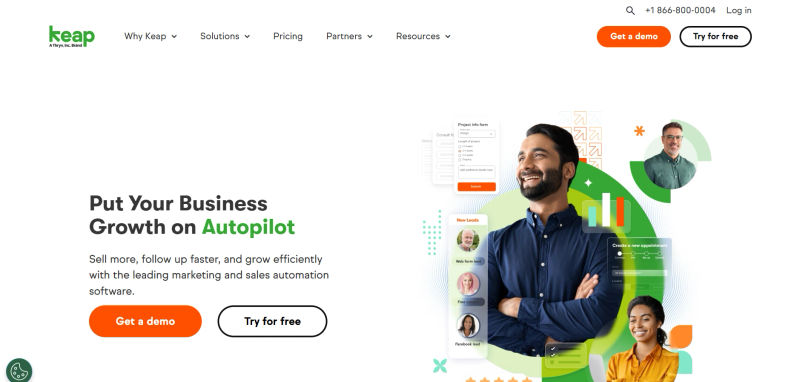
6. Keap: Simplifying Sales Funnels for Small Business Scale
Formerly Infusionsoft, Keap has successfully rebranded and refocused on "Lifecycle Automation" for small businesses and service providers. While it may lack the enterprise API depth of Salesforce, it handles the "Chaos" of small business growth better than most.
Lifecycle Automation Logic
Keap’s philosophy revolves around the "Perfect Customer Lifecycle." Their automation builder is designed to move leads through distinct stages—collect, convert, close, and delight. In 2026, Keap has enhanced this with AI features that automatically suggest the next step in the lifecycle based on peer data. For a service business (e.g., consulting, coaching), Keap’s ability to integrate appointment scheduling directly into the automation workflow is seamless and reduces the need for tools like Calendly.
Easy Automations vs. Max Classic
Keap offers two distinct experiences. "Easy Automations" allows non-technical founders to set up logic in minutes using natural language. However, the legacy power of Infusionsoft lives on in "Max Classic," which supports complex tagging structures and affiliate management. This duality allows businesses to start simple and unlock complexity as they scale, though users should be wary of the interface differences between the two modes.
Best For: Service-based SMBs, Coaches, and Consultants.
7. Creatio: AI-Native Workflow Automation Across CRM and Marketing Ops
Creatio is emerging as one of the best CRM for enterprises that need marketing automation tied directly into sales and service workflows rather than living in a separate cloud. When evaluating the best enterprise CRM suites with automation and analytics for 2026, Creatio's AI-native platform stands out for combining Sales, Marketing, and Service on a single data model instead of the multi-cloud architecture Salesforce and Microsoft require. It is widely considered a strong option for enterprise teams that want the customization depth of Salesforce without the engineering overhead, delivering campaign orchestration, lead routing, and AI agents on one composable, no-code foundation.
AI Agents Orchestrating Marketing Ops Workflows
Creatio's Business Studio and AI Studio give marketing operations teams a visual environment for building multi-step campaign logic, lead scoring, and segmentation, then handing off qualified leads to Sales through the same platform. AI Agents are embedded across the CRM - for lead scoring, campaign generation, and next-best-action - and run natively inside these workflows rather than as a bolt-on module, which shortens the path from "design the automation" to "it's live and self-optimizing."
One Data Model Instead of a Data Cloud
Where Salesforce relies on Data Cloud and MuleSoft to harmonize data across clouds - and to manage Schema Drift as source systems change - Creatio avoids the problem structurally by running Sales, Marketing, and Service on one unified data model from the start. There's no separate mapping layer to maintain as fields or objects change upstream, which reduces the engineering resources needed to keep marketing automation and CRM data in sync. According to Nucleus Research, organizations that moved from Salesforce and Microsoft to Creatio saw a 37% lower total cost of ownership and 70% faster implementation, largely attributable to this reduced integration overhead.
Best For: Mid-market and enterprise organizations that want Salesforce-level workflow customization without a dedicated Data Cloud/MuleSoft engineering investment.

Other Enterprise Marketing Automation Platforms to Consider
When searching for the best enterprise marketing automation platform 2026, Salesforce vs Adobe vs Oracle vs HubSpot is the most common architectural debate. While HubSpot and Salesforce offer highly integrated CRM and marketing ecosystems, legacy stalwarts like Adobe Marketo Engage and Oracle Eloqua often operate as highly complex, standalone automation engines layered over external databases.
For B2B organizations evaluating the best enterprise marketing automation platforms 2026, Salesforce Pardot, HubSpot, Oracle Eloqua, Act-On are frequently shortlisted together. Oracle Eloqua remains a powerhouse for granular lead routing, custom data objects, and strict IT governance. Conversely, Act-On provides a more accessible middle-ground for mid-market to enterprise teams that need robust multi-channel capabilities without the steep developer learning curve of Eloqua or Marketo.
Finally, IT-heavy organizations deeply entrenched in the Microsoft ecosystem often compare the best enterprise marketing automation platforms 2026: Pardot, HubSpot, Dynamics, Zoho. Microsoft Dynamics 365 Marketing is the logical choice for teams already utilizing Azure AI and Power BI. However, it demands significantly more technical overhead and custom configuration to achieve workflow parity with out-of-the-box solutions like Zoho or HubSpot.
2026 CRM Migration Framework: A 5-Step Guide
Switching CRMs is akin to performing a heart transplant on a running marathon runner. To avoid data loss and operational downtime, follow this 2026-ready migration framework:
The "Dirty Data" Audit: Before you export a single record, audit your current data. Use tools like Insycle or DemandTools to merge duplicates and standardize formatting. Migrating bad data to a new system just accelerates the chaos.
Schema Mapping & Custom Object Definition: Map every field from your legacy system to the new CRM. Pay special attention to Custom Objects. If you are moving from Salesforce to HubSpot, ensure you have defined the relationships (One-to-Many vs. Many-to-Many) correctly in the new environment.
API & Webhook Stress Testing: Do not rely on native integrations alone. Set up a sandbox environment and stress-test the API. Send 10,000 dummy requests in a minute to see if the new CRM throttles your connection. Test your webhooks to ensure they fire with acceptable latency.
The Parallel Run: For 2-4 weeks, run both systems simultaneously. Ingest leads into both, but keep the automation active only in the legacy system. Compare the data entry in both systems to identify "Schema Drift" or missing fields.
The Cutover &DNS Switch: Once data parity is confirmed, switch your DNS records (DKIM/SPF) to the new provider and activate the automation. Turn off the legacy system only after a full billing cycle has passed to ensure no recurring reports are missed.
Choose automation tools that scale with growth on Authencio.com
Total Cost of Ownership (TCO) Deep Dive
When evaluating these platforms, the license fee is just the tip of the iceberg. To identify the best enterprise marketing automation pricing models for your stack, you must understand how vendors structure their core costs. Otherwise, the hidden costs of marketing automation can balloon your 2026 budget.
Core Pricing Models
Contact-Based (HubSpot, ActiveCampaign): Costs scale with the number of marketable contacts. Best for B2B enterprises targeting smaller, high-value accounts.
Consumption-Based (Salesforce Data Cloud): Costs scale via API calls, data storage, or compute credits. Ideal for high-volume B2C enterprises processing massive transactional data.
Seat-Based/Flat-Rate (Zoho CRM, HighLevel/Creatio): Costs depend on user seats and feature tiers rather than database size. Best for businesses with massive contact lists but lower engagement rates.
Hidden TCO Factors
API Overages: High-frequency Reverse ETL syncs can quickly max out tiered API limits (common in Salesforce and HubSpot), forcing expensive bandwidth upgrades.
Data Storage: Behavioral data grows exponentially. Salesforce charges premiums for extra storage, whereas ActiveCampaign bundles it into contact tiers.
Engineering: Zoho has lower license fees, but hiring specialized Deluge developers increases personnel costs. HubSpot's vast agency ecosystem often lowers external support costs.
Premium Support: Mission-critical "Premier" 24/7 support packages can add 20-30% to your annual contract value.
2026 CRM Comparison Matrix: Feature Parity and Pricing
For teams actively searching for a CRM marketing automation comparison 2026, the table below breaks down the trade-off between "Time-to-Value" and "Customization Depth." This weighted comparison highlights how these platforms stack up for a typical Series B growth team.
CRM | Workflow Logic | Time-to-Value | Dev Experience (DX) | AI Orchestration | Pricing Model | Best For |
HubSpot | High (Programmable) | Fast | Excellent | Native (ChatSpot) | Contact Tiers (High) | Scale-ups |
Salesforce | Very High (Scriptable) | Slow | Complex | Advanced (Einstein) | Seat + Add-ons (Very High) | Enterprise |
ActiveCampaign | High (Visual) | Fast | Good | Moderate | Contact Tiers (Mid) | D2C / E-comm |
Zoho CRM | Medium (Deluge) | Medium | Moderate | Moderate | Per User (Low) | Value / Custom |
HighLevel | Medium | Very Fast | Moderate | Moderate | Flat Fee (Low) | Agencies |
Keap | Medium | Fast | Limited | Basic | Contact Tiers (Mid) | Service SMBs |
Creatio | High (Low-code Designer) | Medium-Fast | Good (Low-code Studio) | Advanced (AI Forecasting, Journey Mapping) | Per User / Modular Add-ons | Enterprises needing low-code workflow automation |
Implementation Jargon: API Hooks, Webhooks, and Data Normalization
Before signing a contract, your technical lead needs to audit the platform's ability to handle data ingress and egress. In 2026, "Seamless Integration" is a buzzword; the reality lies in the documentation.
1. Webhooks
Ensure the CRM supports outbound webhooks for every standard object event (Create, Update, Delete). If Keap, Creatio or HighLevel only allows webhooks on specific triggers, it limits your ability to sync data to a warehouse or trigger external microservices.
2. Idempotency
When syncing data between Salesforce and an external app, does the API support idempotency keys? An idempotent operation is one that can be applied multiple times without changing the result beyond the initial application. This is critical to prevent duplicate records during network retries or timeouts.
3. Schema Drift
This occurs when the structure of your data source changes—for example, a new field is added to your signup form. A robust CRM like HubSpot (via Operations Hub) can often detect and adapt to these changes, whereas rigid legacy systems might fail silently, leading to data loss.
4. Data Normalization
Zoho and HubSpot offer tools to format phone numbers (E.164 standard) and capitalize names automatically. Without this, your SMS automation will fail, and your emails will look unprofessional. In 2026, relying on third-party tools like Zapier for this basic hygiene is considered an architectural flaw; it should be native to the CRM.
Try AuthenCIO
Move to faster, smarter software evaluation with AI
Conclusion: Future-Proofing Your Marketing Tech Stack
The best CRM for marketing automation in 2026 is not the one with the most features; it is the one that fits your specific growth stage and technical maturity.
If you are an Enterprise needing granular control and have a dedicated dev team, Salesforce remains the king. If you are a high-growth scale-up needing power without the bloat, HubSpot is the definitive choice. For pure automation logic and D2C focus, ActiveCampaign wins, while HighLevel and Keap dominate their specific niches of agencies and service businesses. For enterprises prioritizing low-code workflow automation, Creatio offers a unified CRM + BPM approach.
A Final Warning on Migration: The most common cause of failure in 2026 is not the software itself, but the migration process. Do not underestimate the complexity of moving logic. The best tool is often the one you can implement effectively, not the one with the longest feature list. Audit your workflows, clean your data, and choose a partner that prioritizes open APIs and composable architecture.