.webp&w=64&q=75)
Introduction
By 2026, the Revenue Operations (RevOps) landscape has shifted fundamentally from the "growth at all costs" mentality of the early 2020s to a rigorous focus on "efficiency per employee." For technical founders and RevOps leaders, the debate between adopting an All-in-One CRM suite versus assembling a Best-of-Breed modular stack is the defining architectural decision of the year. As organizations actively seek viable alternatives to complex enterprise CRM suites that often suffer from feature bloat and slow deployment, this choice dictates your company’s data integrity, AI readiness, and Total Cost of Ownership (TCO).
Streamline your software evaluation process
The era of the "Franken-stack"—where disparate tools were hastily duct-taped together via brittle middleware—is ending. Today, the choice is between a unified platform ecosystem that promises a single source of truth (but risks vendor lock-in) and a highly specialized modular stack that offers feature depth (but demands significant engineering overhead). This guide analyzes the technical trade-offs, integration taxes, and scalability factors required to make an informed decision between integrated CRM vs point solutions in 2026.
Furthermore, the strategic imperative has moved from simple "Lead-Gen" to full "Customer Lifecycle" management. In this new paradigm, data silos are not just annoying; they are revenue leaks. Whether you are orchestrating a complex enterprise sales motion or a high-velocity product-led growth (PLG) model, your underlying architecture determines your agility.
Key Takeaways: Pros, Cons, and Trade-offs
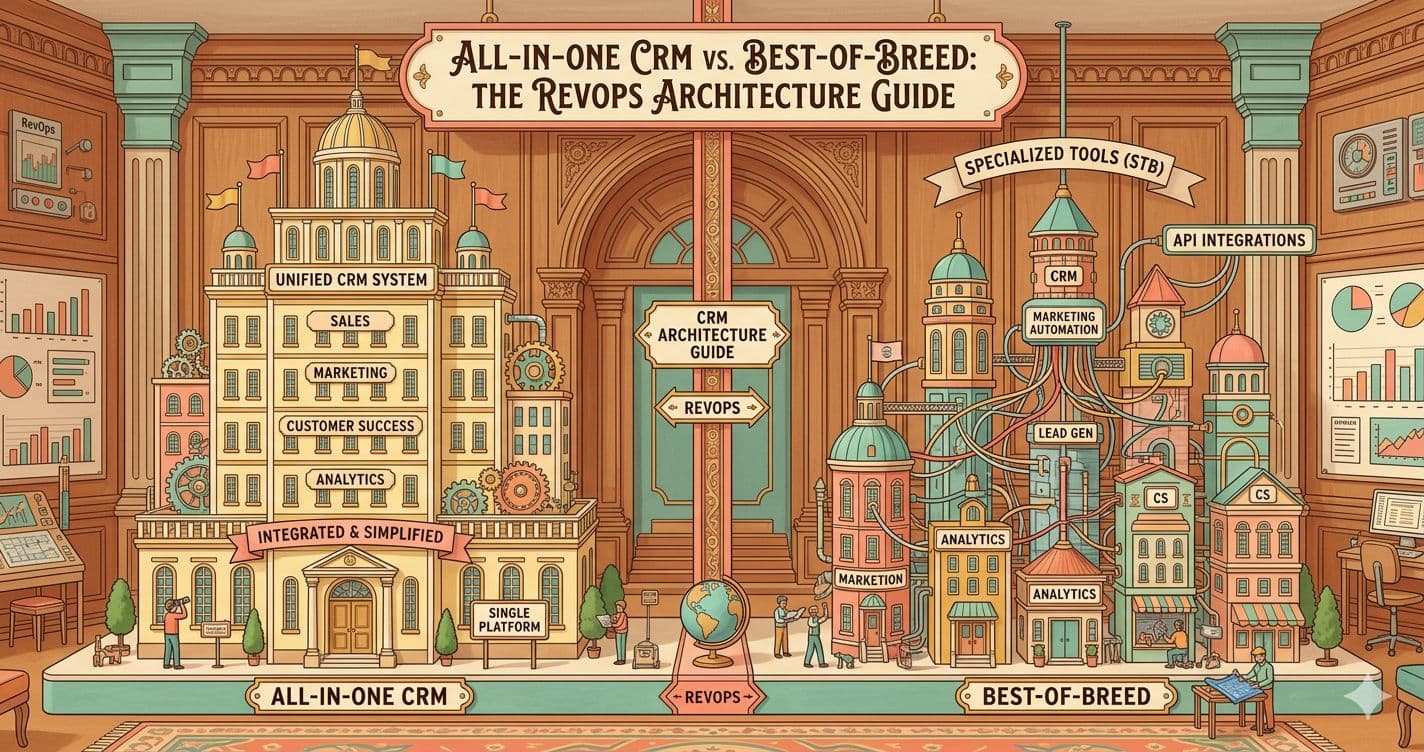
When evaluating an all-in-one sales platform vs best-of-breed point solutions, the primary tradeoff comes down to operational simplicity versus specialized capability. Unified platforms offer seamless data flow and lower maintenance overhead, while best-of-breed stacks provide unmatched feature depth and agility at the cost of complex integrations.
All-in-One Platforms (Unified Ecosystems)
Pros: Native data synchronization, single vendor relationship, predictable pricing, and a unified user interface that accelerates team onboarding.
Cons: Feature compromises (the "jack-of-all-trades" dilemma), vendor lock-in, and slower adoption of niche, cutting-edge innovations.
The Trade-off: You sacrifice deep, specialized functionality in areas like advanced CPQ or predictive AI scoring for the sake of a frictionless, centralized data model.
Best-of-Breed Tools (Modular Stacks)
Pros: Access to purpose-built, category-leading features, the flexibility to swap out underperforming tools, and precise alignment with specific departmental workflows.
Cons: High API maintenance, risk of fragmented data silos, complex vendor management, and overlapping subscription costs.
The Trade-off: You gain superior, specialized capabilities but must accept the heavy technical burden of maintaining complex API orchestrations and resolving cross-platform data hygiene issues.
Ultimately, understanding what the tradeoffs are between best-of-breed tools and an all-in-one platform depends on your RevOps maturity. Lean teams often benefit from a unified platform's speed to value, while organizations with dedicated data engineering resources can safely leverage the modularity of best-of-breed tools.
Software covered in this article
To help you understand crm in the right context, this article refers to a carefully curated set of key players:






The RevOps Dilemma in 2026: Architectural Fragmentation vs. Feature Depth
In 2026, the definition of a CRM encompasses the entire Go-To-Market (GTM) motion, including marketing, sales execution, and revenue intelligence. When evaluating all-in-one vs best-of-breed sales technology, technical leaders must balance specialized feature depth against integration friction.
Should you consolidate sales tools or keep best of breed? The decision hinges on distinct operational trade-offs. Consolidating onto one platform—even with some feature gaps—drastically reduces integration fatigue, simplifies user permissions, and eliminates cross-system data latency. Conversely, using best-of-breed tools for each channel delivers superior, specialized functionality but introduces severe "architectural fragmentation." This fragmentation increases the administrative burden of managing API rate limits, schema drift, and vendor sprawl. Ultimately, teams must decide whether the operational cost of maintaining a fragmented stack outweighs the benefits of niche capabilities.
The Rise of Warehouse-Native Architecture
A major disruptor in this debate is the "Warehouse-Native" approach. In this model, the CRM is no longer the ultimate source of truth. Instead, a cloud data warehouse like Snowflake or BigQuery holds the master customer record, and the CRM acts merely as an interface (UI) for sales reps to view that data.
For example, a company might ingest product usage data via Fivetran into Snowflake, model it with dbt, and then "Reverse ETL" it into Salesforce using tools like Hightouch or Census. While this offers immense power, it fundamentally changes the role of the CRM. If you choose a Best-of-Breed stack, you are implicitly signing up to build and maintain this data infrastructure. If you choose an All-in-One, you are betting that the platform's internal data model is robust enough to negate the need for a warehouse-first approach until you reach massive scale.
The Case for the All-in-One Platform Ecosystem
The primary value proposition of the All-in-One platform in 2026 is the "Unified Data Model." In this architecture, Marketing, Sales, and Customer Success (CS) objects share the same underlying database tables. For organizations asking which CRM platforms with a unified data model allow standardizing processes across marketing, sales, and CS (¿qué plataformas crm con modelo de datos unificado permiten estandarizar procesos entre marketing, ventas y cs?), ecosystems like HubSpot, Zoho, and Freshworks lead the market. With no synchronization latency or middleware to maintain, teams can enforce standardized workflows—such as automated handoffs from marketing to sales, or sales to CS—without data silos.
HubSpot remains the archetype of this model. By 2026, it has evolved from a marketing-first platform into a comprehensive customer platform. For a technical founder, the appeal of HubSpot is the elimination of the "Integration Tax." When a marketing contact becomes a sales lead, the data doesn't move; it simply changes state. This unified architecture allows for seamless attribution modeling. Furthermore, for e-commerce brands wondering if an all-in-one platform is better than a web of best-of-breed Shopify apps, consolidation often wins. Replacing fragmented Shopify plugins (for email, SMS, loyalty, and support) with a single unified CRM reduces schema drift, lowers subscription costs, and provides a single source of truth for customer behavior.
Similarly, Zoho offers the "operating system for business" approach with Zoho One. While often viewed as a cost-effective alternative, Zoho’s technical depth has matured, offering a massive suite of interconnected apps that communicate natively. For bootstrapped or lean startups, the ability to turn on a project management module or a helpdesk module within the same ecosystem drastically reduces the Time to Value (TTV).
Freshworks has also carved out a significant niche by offering a unified suite that rivals legacy enterprise players in usability. Their approach focuses on minimizing the friction between customer support (Freshdesk) and sales (Freshsales), ensuring that support tickets and upsell opportunities are visible to all revenue teams simultaneously to standardize the post-sale CS process.
The "Walled Garden" Risk
However, technical leaders must acknowledge the trade-off: the Walled Garden. When you commit to an All-in-One suite, you are bound by their schema limitations. If HubSpot’s "Deal" object doesn't support a specific many-to-many relationship required by your business model, you cannot simply patch it with code as easily as you might in a modular environment. Furthermore, exporting your entire data history—including email engagement logs, call recordings, and note timestamps—can be notoriously difficult if you ever decide to migrate away. You are trading control for convenience.
The Case for the Best-of-Breed Modular Stack
Despite the allure of unification, the Best-of-Breed approach persists for a reason: hyper-specialization. As companies scale, specific departments often outgrow the generic capabilities of a suite. The Best-of-Breed architecture treats the CRM as a central hub (System of Record) that orchestrates data flow between specialized "Systems of Action."
Salesforce is the undisputed king of this model. It is less of a product and more of a Platform as a Service (PaaS). A technical RevOps leader chooses Salesforce not for what it does out of the box, but for what it can be engineered to do. In this architecture, Salesforce acts as the core relational database, but the actual work happens in specialized satellites.
For example, a sophisticated marketing team might reject a generic marketing hub in favor of ActiveCampaign. ActiveCampaign’s specialized focus on complex automation logic and email deliverability offers a level of granularity that generalist tools struggle to match. The RevOps team then uses middleware or native connectors to pipe this data into Salesforce. The architectural trade-offs of a best-of-breed DXP vs. an all-in-one platform follow a similar pattern, centering on agility versus orchestration. A modular DXP lets teams swap headless CMS or personalization engines without vendor lock-in. The trade-off is the engineering burden required to sync fragmented data back to the CRM, whereas all-in-one suites offer a pre-unified, though less flexible, data model.
Similarly, in the customer support arena, Zendesk is often preferred over built-in CRM ticketing systems. Zendesk’s robust routing engines, SLA management, and omnichannel capabilities are necessary for high-volume contact centers. The trade-off is that the engineering team must ensure that ticket data flows back into the CRM so sales reps aren't blind to ongoing support issues.
For project management and post-sales delivery, Monday has become a critical part of the modular stack. While CRMs handle the "deal," tools like Monday handle the "delivery." Integrating Monday with the CRM allows for a seamless handoff from Sales to Implementation, triggering project boards automatically when a contract is signed. But is it better to go all-in on Atlassian or mix best-of-breed tools? An all-in-one Atlassian stack (Jira, Confluence) provides deep interoperability for engineering-heavy orgs, minimizing integration overhead. However, mixing tools—using Monday for client-facing delivery and Jira strictly for backend development—maximizes user adoption across non-technical teams at the cost of added integration complexity.
The Semantic Layer Challenge
The hidden struggle in a modular stack is maintaining a consistent "Semantic Layer." If Salesforce defines "ARR" (Annual Recurring Revenue) based on closed-won opportunities, but your billing system defines it based on invoices sent, and ActiveCampaign estimates it based on lead value, you have no single source of truth. In a Best-of-Breed stack, RevOps must build a governance layer—often using tools like dbt—to normalize these definitions across the stack, adding significant overhead.
Technical Comparison: Data Hygiene and API Orchestration
When evaluating these architectures in 2026, the discussion must move beyond features to the technical reality of API orchestration. The hidden killer of the Best-of-Breed model is the "Integration Tax"—the literal and figurative cost of maintaining connections between tools.
1. Webhooks vs. Polling: The Latency Trap
In a modular stack (e.g., Salesforce + ActiveCampaign + Zendesk + Monday), data synchronization is rarely real-time. Many legacy integrations still rely on "Polling," where the middleware checks for updates every 5 or 15 minutes. This introduces Data Latency. If a user upgrades their plan on your website, but the CRM sync runs on a 15-minute poll, a support agent might deny them service because their dashboard still shows the old plan.
Modern "Webhook" architectures solve this by pushing data instantly, but they are fragile. If the receiving endpoint (e.g., Salesforce) is down for maintenance or experiencing high latency, the webhook might fail silently. You then need a retry mechanism or a "Dead Letter Queue" to catch failed syncs. All-in-One platforms like HubSpot or Zoho generally do not face this issue because the data isn't moving via API; it's querying the same database.
2. API Rate Limits and Schema Drift
Furthermore, API Rate Limits become a serious bottleneck. Every time your marketing automation tool updates a lead score, it burns an API call to your CRM. If you have 100,000 leads and you run a re-scoring algorithm, you might hit your Salesforce API limit by noon, freezing all other integrations until the next 24-hour window opens.
Then there is the issue of Schema Drift. If the sales team changes a dropdown field in the CRM from "Enterprise" to "Strategic Account," but the RevOps engineer forgets to update the mapping in the middleware (like Zapier or Workato) connecting to the marketing tool, the sync fails. These "silent failures" lead to data silos where reports in one system contradict reports in another, destroying trust in the data.
Find Perfect Software For Your Business
Total Cost of Ownership (TCO) Analysis
Founders often miscalculate TCO by looking only at license fees. In 2026, the TCO equation must include Implementation Velocity, Administration Overhead, and Technical Debt.
When evaluating an AI revenue workflow platform vs best of breed cost comparison, what's better depends heavily on your integration and administration budget.
License Costs: On the surface, Best-of-Breed often looks cheaper initially since you buy only what you need. However, as you scale, the cumulative cost of separate licenses for Salesforce, Zendesk, ActiveCampaign, and Monday—plus third-party AI add-ons—often exceeds the bundled price of an AI-native revenue workflow platform like HubSpot Enterprise or Zoho One.
Implementation & Maintenance: This is where the divergence is massive. An All-in-One suite typically has a lower implementation cost because the "plumbing" is pre-built. Conversely, a robust Best-of-Breed stack requires a dedicated RevOps engineer or a high-retainer agency to maintain the middleware and troubleshoot sync errors.
The Middleware Cost: Don't forget the cost of the glue. Enterprise-grade automation platforms (like Workato or Tray.io) can cost as much as a core software license. In a HubSpot or Freshworks environment, this cost is largely zero for core objects.
TCO Calculators: To accurately project these hidden expenses, RevOps leaders should leverage the best TCO calculators Salesforce vs alternatives provide. When running the best TCO calculators Salesforce vs alternatives unified platforms, unified systems consistently demonstrate lower 3-year costs by eliminating middleware and reducing administrative headcount.
Opportunity Cost of Delayed Implementation
Perhaps the largest hidden cost is the CRM consolidation strategy timeline. A complex Best-of-Breed implementation can take 6 to 9 months to reach full maturity, involving data mapping workshops, API testing, and user acceptance testing across multiple interfaces. An All-in-One suite can often be deployed in 6 to 8 weeks. That difference of 4-6 months represents lost revenue, slower sales velocity, and delayed insights. For a high-growth startup, speed is often more valuable than perfection.
AI Readiness: The New Battleground
When asking how do ai platforms that handle the full sales workflow compare to best-of-breed point solutions, the primary differentiator is data unification. By 2026, AI models are the engine of RevOps, but their predictive accuracy relies entirely on the datasets they process.
In any ai platforms full sales workflow vs best-of-breed point solutions comparison, all-in-one systems hold a distinct architectural advantage. In a unified ecosystem like HubSpot or Zoho, the AI natively accesses the entire customer journey. Because the data shares a common schema, an AI agent can simultaneously analyze marketing email open rates, sales call transcripts, and support ticket sentiment to predict churn without complex data normalization pipelines. This unified dataset allows AI to execute cross-functional workflows instantly.
Conversely, achieving this level of "Agentic AI" in a best-of-breed stack is exponentially harder. To get an AI to analyze and act on data scattered across point solutions like Salesforce, ActiveCampaign, and Zendesk, organizations must build a centralized semantic layer. This typically requires an ETL (Extract, Transform, Load) process to move data into a warehouse, normalize the schemas, and run custom AI models on top. While this "Composable RevOps" approach offers ultimate feature depth, it demands dedicated data engineering resources to prevent AI hallucinations caused by fragmented context.
Data Privacy and Governance in AI
As AI agents become more autonomous, data governance becomes critical. In a fragmented stack, ensuring that an AI agent in your marketing tool doesn't accidentally access sensitive contract data in your CRM is a nightmare of permission management. All-in-One platforms simplify this by centralizing Identity and Access Management (IAM). You can define a policy once—"Marketing AI cannot read Contract Value"—and it propagates across the entire suite, reducing the risk of internal data leaks.
Understand total stack complexity before choosing on Authencio.com
Security and Compliance: The Hidden Vulnerability of Fragmentation
Comparing an "all-in-one" security platform against a stack of best-of-breed security tools within RevOps requires analyzing attack surface reduction, compliance orchestration, and integration overhead.
Every new tool expands your attack surface. In a Best-of-Breed RevOps stack (e.g., Salesforce, Monday, Zendesk, ActiveCampaign), you manage multiple credentials, SOC2 reports, and GDPR workflows. Securing this requires assembling best-of-breed security tools, such as specialized identity providers and API monitors. This offers deep, specialized protection but demands high engineering overhead to secure the seams between APIs. If a customer requests a GDPR or CCPA "Right to be Forgotten," a modular environment requires manual deletion across every tool. If one API call fails, you are legally non-compliant.
Conversely, all-in-one security platforms and unified CRMs (HubSpot, Zoho) offer centralized compliance dashboards. While they may lack niche security capabilities, they eliminate integration gaps. Deleting a contact cascades automatically across all modules.
Businesses must weigh internal security engineering capacity against compliance needs. For enterprise or government vendors facing strict security questionnaires, demonstrating a consolidated, minimized data footprint through an all-in-one approach often provides a stronger competitive advantage than managing a fragmented best-of-breed security stack.
Evaluating Vendor Roadmaps: All-in-One vs. Best-of-Breed
When asking how to evaluate vendor roadmaps for an all-in-one platform vs best-of-breed, RevOps leaders must analyze feature delivery velocity, acquisition history, and API commitment. The core difference lies in their trajectory: all-in-one vendors prioritize horizontal integration and unified user experiences, while best-of-breed vendors focus on vertical feature depth and specialized capabilities.
Evaluating vendor roadmaps all-in-one platform vs best-of-breed requires a standardized framework:
R&D Allocation and Acquisition History: Check if an all-in-one vendor builds features organically or acquires them. Heavy acquisitions often signal future technical debt and disjointed data models. For best-of-breed tools, verify their core R&D isn't easily commoditized by upcoming native features in your primary CRM.
API and Ecosystem Commitment: Best-of-breed vendors must show a roadmap of deepening data portability, such as native warehouse connectors and GraphQL support. Conversely, all-in-one platforms should demonstrate an expanding, open marketplace rather than closed-ecosystem restrictions.
AI and Automation Trajectory: In 2026, specialized tools often lead in agentic AI for specific workflows, whereas unified platforms excel in cross-object data reasoning. Evaluate whether the vendor's AI roadmap solves your specific operational bottlenecks or merely checks a generic generative AI box.
Decision Framework: When to Choose Which?
To choose between an all-in-one sales platform and best-of-breed point solutions, evaluate your GTM complexity. The best RevOps stack for a Series B company combines an all-in-one CRM with specialized tools, whereas the top RevOps planning platforms for enterprises require best-of-breed architecture. Use this framework to guide your enterprise CRM comparison 2026.
1. The All-in-One Matrix
Choose an All-in-One (HubSpot, Zoho, Freshworks) if:
Team Size: Seed to Series C (10-500 employees).
Technical Resources: Limited. You have a RevOps manager but not a team of data engineers.
Sales Motion: High velocity, transactional, or standard B2B SaaS.
Priority: Speed of implementation and ease of use.
Data Philosophy: You value a "Single Source of Truth" over granular feature depth.
2. The Best-of-Breed Matrix
Choose a Modular Stack (Salesforce + Specialized Tools) if:
Team Size: Late Series C to Enterprise (500+ employees).
Technical Resources: Robust. You have dedicated Salesforce administrators and data engineers.
Sales Motion: Highly complex, multi-layered enterprise sales with custom CPQ needs.
Priority: Granular control and specific feature depth in every department.
Data Philosophy: You are building a "Warehouse-Native" architecture where the CRM is just one of many inputs.
3. The Hybrid Matrix
Choose a Hybrid Model if:
Scenario: You are a mid-market company with one highly specific need.
Example: You use HubSpot for Marketing, Sales, and CMS (80% of the stack) but integrate Zendesk for support because your support team requires enterprise-grade routing that HubSpot Service Hub cannot yet match.
Strategy: This minimizes the "Integration Tax" to a single, manageable pipe while retaining competitive advantage in a key functional area.
Architecture at a Glance: The 2026 Comparison
Feature | All-in-One CRM | Best-of-Breed |
Data Model | Unified, single schema | Fragmented, requires mapping |
Implementation | Weeks (6-8 weeks avg) | Months (6-9 months avg) |
Maintenance | Low (Admin focus) | High (Engineer focus) |
API Dependency | Low (Internal native sync) | High (Heavy middleware usage) |
AI Readiness | High (Native cross-object AI) | Medium (Requires Data Warehouse) |
Compliance | Centralized (Single deletion) | Distributed (Complex audit trail) |
TCO (3 Years) | Lower (Bundled pricing) | Higher (Licenses + Middleware + Headcount) |
Try AuthenCIO
Move to faster, smarter software evaluation with AI
Conclusion: Future-Proofing Your Stack
As we move deeper into 2026, the convergence of tools is accelerating. The "Integration Tax" of the Best-of-Breed model is becoming harder to justify for all but the most complex enterprises. For the majority of technical founders and RevOps leaders, the smart money is on simplifying the stack to amplify the data.
While tools like Salesforce will always have a place for the Fortune 500, the efficiency gains provided by unified platforms like HubSpot, Zoho, and Freshworks allow leaner teams to punch above their weight. The future of RevOps is not about how many tools you can stitch together, but how effectively you can orchestrate a seamless customer experience from a clean, unified dataset.
Your Next Step: Before signing a contract, conduct a "Data Latency Audit." Ask your potential vendors exactly how long it takes for a data point to move from Marketing to Sales to Service. If the answer involves "batch syncing" or "polling," calculate the cost of that delay on your customer experience. In 2026, simplicity doesn't just scale—it speeds you up.