
Introduction
Your Customer Relationship Management (CRM) system is the central hub powering your sales, marketing, and service efforts. However, as businesses grow, a system that cannot scale quickly becomes a strategic liability. When evaluating official CRM scalability evidence, data volume limits are often the first breaking point. For instance, official CRM scalability rows local evidence demonstrates that poorly architected databases severely degrade in performance once they hit specific row-count thresholds, causing reports to stall and workflows to fail. You hit the "CRM wall."
This isn't just a technical headache; it's a crisis that stifles productivity and caps your potential. According to Forrester, the total cost of a forced CRM migration, including lost productivity, can be up to six times the initial software cost. The stakes are incredibly high.
Streamline your software evaluation process
This how-to and best practices guide provides a clear, strategic framework for planning CRM scalability. We will move beyond simply adding more users to explore the architectural, functional, and financial pillars of a truly future-proof CRM. You will learn actionable steps to assess your needs, evaluate vendors, and implement a system that grows with you, ensuring your CRM remains a lasting investment.
Key Takeaways
Scalability is a necessity, not a luxury: Failing to plan for CRM growth leads to data silos, decreased productivity, and expensive system migrations.
Cloud architecture is the foundation: Cloud-based CRMs provide the essential flexibility and infrastructure needed to support rapid data and workforce expansion.
Integrations drive continuous growth: A future-proof CRM must easily connect with your evolving tech stack through a robust API ecosystem.
Evaluate vendors on future potential: Choose providers based on their long-term innovation roadmaps, transparent growth pricing, and commitment to AI and machine learning.
Implementation requires a phased approach: Secure long-term success through thorough discovery, pilot programs, and continuous performance monitoring.
Software Covered in this Article
To help you understand CRM in the right context, this article refers to a carefully curated set of key players:






Why CRM Scalability is Non-Negotiable for Modern Businesses
With the CRM market surpassing $82 billion in 2025 and continuing its rapid expansion in 2026, simply having a system is table stakes. The real competitive advantage lies in deploying a scalable CRM for future growth. Scalability is not a luxury feature; it is a fundamental requirement for any business expanding its team, customer base, or market presence. A system that scales ensures your technology adapts to increasing data volumes without creating operational bottlenecks.
1. The Cost of Neglecting Scalability: Common Pitfalls
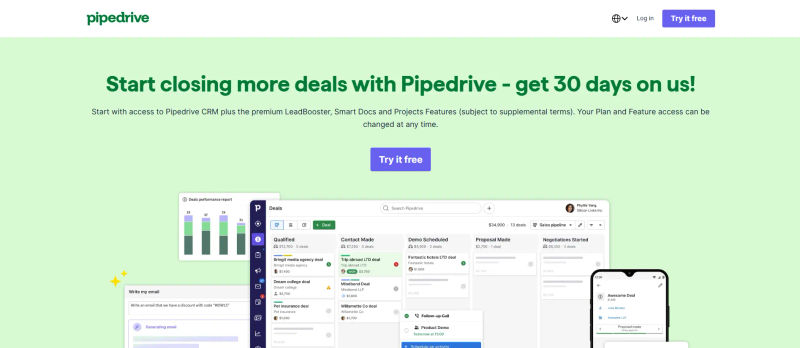
Imagine a mid-sized e-commerce company that built its success on a simple, sales-focused CRM like Pipedrive. It worked perfectly for their initial 10-person sales team. But after a successful funding round, they doubled their staff, expanded into customer service with Freshdesk, and launched a new marketing automation platform.

Suddenly, their once-beloved CRM became a bottleneck. Its API couldn't handle the volume of data from the new tools, creating data silos. The system slowed to a crawl under the weight of new users and a 10x increase in customer interaction data. The team started resorting to spreadsheets, data integrity plummeted, and the initial ROI of their CRM was completely eroded. This scenario is all too common and highlights the tangible costs of poor scalability planning:
Operational Drag: Slow load times, system crashes, and cumbersome workarounds directly translate to wasted hours and frustrated employees.
Data Chaos: When teams create manual workarounds, data becomes siloed, inconsistent, and unreliable, undermining your ability to make informed decisions.
Missed Opportunities: When your CRM can't support new business processes or integrations, you lose the agility to respond to market changes.
Discover scalable CRM solutions tailored to your business—Let AuthenCIO help you get started!
2. Understanding Business Growth Trajectories and CRM Impact
Your CRM strategy must mirror your business strategy. A company planning to expand internationally has different needs (multi-currency, multi-language) than one launching a new subscription service (complex billing integrations). Your growth trajectory—whether it’s steady and linear or rapid and exponential—dictates the level of scalability you need from platforms ranging from the flexible Zoho or HubSpot to the enterprise-grade power of Salesforce or Microsoft Dynamics.
Key Pillars of a Scalable CRM Strategy
True CRM scalability is a multi-dimensional concept. It’s the system's inherent capacity to handle growth across various vectors without compromising performance or usability. Let's break down the core components.
1. Architectural Considerations: Cloud vs. On-Premise Scalability
With approximately 87% of CRM systems now cloud-based, the market has spoken. Cloud-native (SaaS) platforms offer inherent scalability advantages:
Elasticity: Resources are managed by the vendor, allowing the system to handle usage spikes without manual intervention.
Lower Maintenance Overhead: The vendor handles infrastructure, security, and updates, freeing up your IT resources.
Accessibility: Secure access from anywhere is standard, which is critical for modern teams. Sales teams using mobile CRM, for instance, are 150% more likely to exceed their goals.
While on-premise solutions offer maximum control, they place the entire burden of managing, securing, and scaling the infrastructure squarely on your shoulders—a significant and costly undertaking.
2. Data Management and Migration Strategy for Growth
As your business grows, your data will grow exponentially. A common failure point is underestimating this growth; contact and activity data can easily increase tenfold in just a few years, crippling a CRM not architected for that volume. A scalable CRM is built on a robust data architecture that can:
Handle Volume: Process complex queries across millions of records without faltering.
Offer Flexibility: Allow for the creation of custom objects and fields to model your unique business processes, a feature where platforms like CRMOne or Monday.com may differ from more extensible systems.

3. Integration Ecosystem: Ensuring Seamless Connectivity
Your CRM doesn't exist in a vacuum. Its value multiplies when it serves as a central hub connected to your entire tech stack. This depends on a robust API (Application Programming Interface) ecosystem.

Think of an API as a universal adapter that lets different software talk to each other. A scalable CRM must have a well-documented, reliable API with high API call limits—the number of data requests the system can handle in a period. Low limits can cripple your operations as transaction volumes grow. The trend towards composable architecture means businesses now seek a core CRM like Close that integrates seamlessly with best-of-breed tools, rather than a single monolithic system.
4. User Adoption and Training: Scaling Your Workforce
A scalable system must be usable. As your team grows, you'll have a wider range of technical skills and a greater need for clear, role-based permissions. The system must be intuitive enough for quick onboarding but powerful enough for advanced users. Low-code/no-code customization tools are a key trend, empowering non-developers to adapt workflows and dashboards, which is crucial for scaling user adoption alongside headcount.
5. Security and Compliance in a Growing CRM Environment
As you collect more customer data and potentially expand into new regions (like the EU with GDPR), your security and compliance requirements become more complex. A scalable CRM provides granular security controls, detailed audit trails, and certifications to ensure your data is protected and you meet your regulatory obligations.
Find Perfect Software For Your Business
Evaluating CRM Vendors for Long-Term Scalability
How to evaluate scalability of CRM DevOps platforms for growing teams? Evaluating scalability of CRM DevOps platforms for growing teams requires testing pipeline concurrency and automated provisioning. Knowing how to evaluate scalability of CRM DevOps platforms for growing teams prevents infrastructure bottlenecks when evaluating vendors.
1. Assessing Vendor Roadmaps and Innovation Cycles
You're not just buying the software of today; you're investing in its future. Ask to see the product roadmap for the next 12-18 months. Are they investing in AI, predictive analytics, and other innovations that align with your goals? A forward-thinking vendor is a strong indicator of a scalable partnership.
2. Understanding Pricing Models and Growth Costs
Scalability comes at a cost, but it should be predictable. Analyze the Total Cost of Ownership (TCO), which includes:
Per-user license fees
Data storage costs
API access tiers
Implementation and customization fees
Costs for premium support or features
Beware of pricing models with steep, unexpected jumps between tiers. A transparent pricing structure allows you to budget for growth effectively.
3. Key Questions to Ask Potential CRM Providers
Arm yourself with these questions during vendor demos to cut through the sales pitch and assess true scalability, particularly for enterprise-level growth.
A Practical Checklist for Evaluating CRM Scalability
Performance & Architecture:
Can you provide performance benchmarks for clients with data and user volumes matching our 3-year forecast?
How do you prevent performance degradation in a multi-tenant cloud? Do you offer dedicated instances for enterprise processing demands?
What are your uptime SLAs, and how do you handle multi-region data residency for global scaling?
Data & Customization:
How do we create custom objects and fields, and what are the hard limits?
What are the data and file storage limits, and what are the overage costs?
How many sandbox environments do you provide for testing large-scale enterprise deployments without disrupting production?
Integrations & API:
What are your standard API rate limits, and what are the costs to increase them for high-volume enterprise data ingestion?
Can you provide API documentation and a list of native integrations for our existing tech stack?
Cost & Governance:
Can you provide a detailed breakdown of your pricing tiers and what triggers a move to the next level?
What enterprise-grade security features (e.g., advanced Role-Based Access Control, SSO, audit logging) are included natively?
What tools do you provide to monitor our usage of storage, API calls, and other limits?
What is the process and cost for getting a full export of our data if we choose to leave your platform?
Practical Steps for Implementing a Scalable CRM Plan
When evaluating how to integrate a scalable CRM solution for enterprise growth best practices require a methodical approach. Similarly, mastering how to integrate a scalable CRM for enterprise growth best practices prioritizes phased planning, testing, and user buy-in.
Phase 1: Discovery and Requirements Gathering
Before you look at any software, look inward. Map your current processes and identify bottlenecks. Then, work with stakeholders from sales, marketing, and service to define your future-state requirements. Translate your 3-to-5-year business goals into specific CRM functionalities.
Phase 2: Pilot Programs and Phased Rollouts
Avoid a risky 'big bang' launch. Start with a pilot program for a single department or a small group of tech-savvy users. This allows you to gather real-world feedback, refine your configuration, and build a team of internal champions before a company-wide rollout.
Phase 3: Ongoing Optimization and Performance Monitoring
Launching your CRM is the starting line, not the finish. Continuously monitor system performance, user adoption rates, and data quality. Conduct a formal system audit at least once a year to prune unused features, optimize slow processes, and ensure the CRM remains aligned with your evolving business needs.
Common Challenges and How to Overcome Them
Challenge | Solution |
Managing data volume and performance degradation | Implement data governance, archive old records, and use CRM's performance tools to optimize reports and automations. |
Navigating complex integrations and APIs | Prioritize CRMs with pre-built integrations, vet APIs, and budget for middleware like Zapier or iPaaS. |
Ensuring user buy-in across growing teams | Involve users early, develop ongoing training, highlight role-specific benefits, and drive change management. |
Overcome CRM integration hurdles—Try the AI-powered advisor for personalized recommendations.
The Future of CRM Scalability: Trends and Innovations
The definition of scalability is evolving. The most forward-thinking CRMs are leveraging technology to deliver not just more capacity, but more intelligence.
1. AI, Machine Learning, and Predictive Analytics
AI and big data adoption in CRM is projected to increase by 97% between 2026 and 2030. This is the next frontier of scalability. AI-driven features are automating routine tasks, providing predictive lead scoring, forecasting sales, and identifying at-risk customers—all of which allow your teams to work smarter, not just harder, as the business grows.
2. Hyper-personalization at Scale
Modern customers expect personalized experiences. Scalable CRMs are becoming platforms for hyper-personalization, using data to trigger unique customer journeys and interactions across all touchpoints. This allows you to deliver a one-to-one feel even when you have a one-to-many customer base.
Try AuthenCIO
Move to faster, smarter software evaluation with AI
Conclusion: Your Roadmap to a Future-Proof CRM
Planning for CRM scalability is one of the most impactful strategic decisions a growing business can make. It’s a continuous process of aligning your technology with your ambition. By shifting your evaluation from a short-term feature comparison to a long-term assessment of architecture, integration, and adaptability, you can choose a platform that will serve as a foundation for growth, not a ceiling to it.
This proactive planning saves immense time, money, and operational friction. It empowers your teams with a tool that evolves with them, allowing them to build more meaningful, lasting relationships with your customers.
Choosing a CRM that can scale with your vision is critical, but navigating vendor claims and complex technical details can be overwhelming.