
Introduction
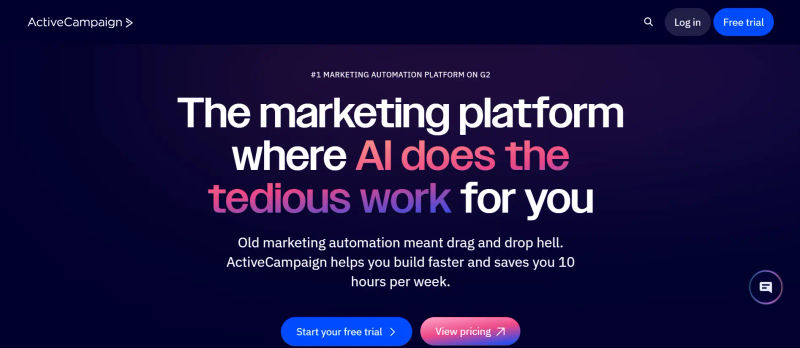
ActiveCampaign is a hybrid marketing automation and Customer Relationship Management (CRM) platform designed for small to medium-sized businesses (SMBs) that need to orchestrate complex, personalized customer journeys. Rather than serving as a passive digital rolodex, ActiveCampaign champions Customer Experience Automation, combining email marketing, sales pipelines, and service tools into a single, highly customizable visual builder.
Streamline your software evaluation process
In 2026, the challenge for marketers isn't just finding a CRM, but adopting a platform capable of AI-driven hyper-personalization to build loyalty and drive growth.
This 2026 review provides a comprehensive, answer-first analysis of ActiveCampaign. We dissect its powerful automation features, break down its latest pricing tiers, evaluate its core pros and cons, and compare it against top alternatives to help you determine if it is the right CRM investment for your business this year.
Key Takeaways: ActiveCampaign Review 2026
Automation-focused CRM: Combines CRM, email marketing, and sales automation in one platform.
Powerful automation: Its visual builder supports complex, behavior-based customer journeys.
Strong personalization: Advanced segmentation, lead scoring, and behavioral data enable targeted campaigns.
Excellent email marketing: Offers A/B testing, personalization, and detailed campaign reporting.
Flexible sales automation: Automates lead qualification, deal management, follow-ups, and sales tasks.
Steep learning curve: Its extensive automation capabilities can be overwhelming for beginners.
ActiveCampaign — What Works & What Doesn’t
What Works
Powerful automation: Builds complex workflows for marketing, sales, and customer journeys.
Strong email marketing: Offers segmentation, personalization, A/B testing, and campaign analytics.
Effective lead nurturing: Lead scoring and behavioral tracking help businesses engage prospects at the right time.
Good integrations: Connects with a wide range of business and marketing tools.
What Doesn’t
Steep learning curve: Advanced automation features can take time to master.
Pricing complexity: Costs vary based on contacts, features, and plan.
Can be overwhelming: The large number of features may be more than small teams need.
Limited focus as a traditional CRM: Businesses seeking a purely sales-focused CRM may prefer specialized alternatives.
Verdict: A powerful marketing automation platform with CRM capabilities, ideal for businesses focused on automated customer journeys and lead nurturing.
Best For: SMBs, agencies, e-commerce businesses, and marketers that rely heavily on email marketing, automation, and lead nurturing.
Software Covered in this Article
To help you understand CRM in the right context, this article refers to a carefully curated set of key players:








What is ActiveCampaign CRM?
In 2026, ActiveCampaign is a cloud-based platform integrating email marketing, marketing automation, sales automation, and CRM into a unified solution. Unlike traditional CRMs that bolt on marketing tools, ActiveCampaign is built with automation at its core.
An activecampaign crm small business features review 2026 highlights its ability to solve the common issue of having customer data siloed across separate sales and support apps. The evolution of activecampaign crm small business features 2025 2026 shows a continued focus on accessible AI and pre-built automation recipes. Today, standout activecampaign crm small business features 2026 include integrated omnichannel messaging, predictive lead scoring, and automated pipeline management, allowing lean teams to execute sophisticated customer lifecycle marketing without enterprise-level resources.
1. A Brief History and Evolution
Founded in 2003, ActiveCampaign began as a provider of on-premise contact management software. Recognizing the shift towards SaaS, the company pivoted into the cloud-based, all-in-one platform available today. This evolution focuses heavily on expanding automation capabilities, establishing the brand as a leader in Customer Experience Automation (CXA).
This journey reflects a broader industry trend where nearly 87% of businesses now use cloud-based CRM systems. Driven by this demand for scalable solutions, the ActiveCampaign market share in 2026 has grown to approximately 9.5% of the global marketing automation and SMB CRM sector, cementing its position as a top-tier competitor.
2. Core Philosophy: Automation Meets Personalization
The central thesis of ActiveCampaign is that true scale is achieved not by treating all customers the same, but by automating personalized experiences. The platform is designed to capture customer data from multiple touchpoints—website visits, email engagement, purchase history, support tickets—and use that data to trigger highly relevant, timely communications. This philosophy enables a small marketing team at an e-commerce brand, for example, to automatically send a follow-up email with a specific discount to a customer who viewed a product page twice but didn't purchase, creating a one-to-one feel at a one-to-many scale.
Deep Dive into ActiveCampaign's Automation Features
ActiveCampaign's reputation relies on deep, flexible logic. When reviewing ActiveCampaign CRM small business marketing automation features 2026, the platform outpaces basic email tools. Last year, users ran 2.5 million automations, highlighting its core value for SMBs.
To fully grasp ActiveCampaign CRM small business features automation 2026, we will examine its customer journey and pipeline tools. We also assess ActiveCampaign automation features strengths weaknesses, weighing its advanced branching capabilities against the steeper learning curve small businesses face.
1. Visual Automation Builder: Crafting Customer Journeys
The heart of the platform is its visual automation builder. This drag-and-drop interface allows users to map out complex workflows based on a wide array of triggers and actions. You can start an automation when a contact subscribes to a list, submits a form, visits a specific webpage, opens an email, or clicks a link.
From there, you can build intricate logic paths using if/else conditions, wait steps, and goals. For instance, a software company could create a workflow that sends a welcome email series to new trial sign-ups. If a user clicks a link about a specific feature, the automation can branch off, sending them targeted content about that feature while simultaneously notifying a sales rep to follow up. This level of granularity allows for the creation of dynamic, responsive customer journeys that adapt to individual user behavior.
2. Email Marketing Automation: Beyond Basic Campaigns
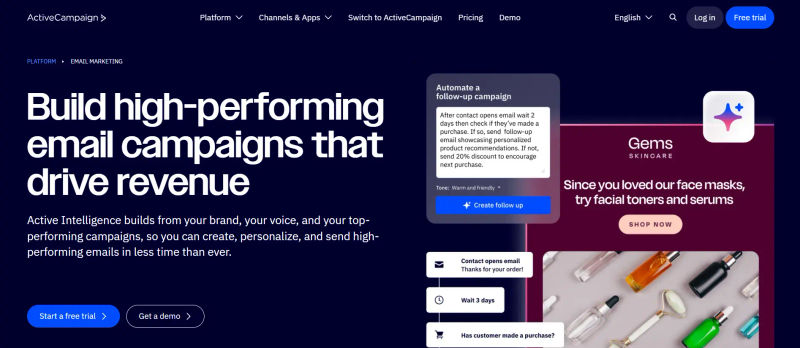
In this ActiveCampaign email marketing CRM features review 2025 2026, the platform stands out for providing a level of sophistication that blurs the line between marketing and a fully integrated CRM. This is why the platform reported sending over 109 billion emails in the past year.
Before vs. After ActiveCampaign: A Lead Nurturing Example
Before: An SMB manually sends a generic monthly newsletter to all leads. Engagement is low, and sales-ready leads get lost in the noise because the sales team has no insight into who is actually interested.
After: An ActiveCampaign automation triggers when a lead downloads an ebook. It sends a series of 5 educational emails over two weeks. If the lead clicks on a pricing link in email #3, they are tagged as 'Interested,' their lead score increases by 20 points, and a task is created for a sales rep to call them. This is a prime example of a lead nurturing automation CRM in action.
3. ActiveCampaign Personalization and Segmentation Strengths Weaknesses
ActiveCampaign's core advantage lies in its ability to segment audiences on the fly using tags, custom fields, and behavioral data. When evaluating ActiveCampaign personalization and segmentation strengths weaknesses, the platform offers distinct advantages alongside a few learning curves:
Strengths: The platform excels at hyper-personalization at scale. You can create granular segments for 'highly engaged leads,' 'customers awaiting a feature update,' or 'users who abandoned their cart.' Instead of just using a contact's first name, a B2B service provider can send an email that references the specific blog post the contact read, the number of times they visited the pricing page, and their industry—all automated through dynamic content blocks.
Weaknesses: The sheer volume of tagging and custom field options can quickly lead to a disorganized database if you lack strict data governance. Furthermore, setting up highly complex dynamic content rules requires a steep learning curve and can occasionally slow down the email builder interface for users managing massive datasets.
4. A/B Testing and Optimization for Email Campaigns
Continuous improvement is built into the workflow. ActiveCampaign allows for robust A/B testing not just of subject lines, but also of email content, sender information, and even entire automation paths. You can test two different welcome series against each other to see which one leads to a higher conversion rate over 30 days. This data-driven approach moves beyond simple open and click rates, focusing on the tangible business outcomes of your campaigns.
5. Sales Automation: Streamlining Your Pipeline
ActiveCampaign includes a built-in sales CRM with deal pipelines, contact management, and task automation. When evaluating ActiveCampaign lead nurturing features, strengths and weaknesses emerge based on your team's technical expertise and sales focus.
Lead Scoring and Nurturing Workflows
Strengths: Lead scoring is a standout feature. You can assign points to contacts based on actions: +10 for opening an email, +25 for visiting the pricing page, +50 for requesting a demo. Once a threshold is reached, an automation instantly creates a deal, assigns a rep, and sends a notification, ensuring reps focus on highly qualified leads.
Weaknesses: Advanced lead nurturing workflows can be complex for beginners. Building multi-dimensional scoring models involves a steep learning curve, and the platform lacks the out-of-the-box predictive lead scoring capabilities found in enterprise CRMs.
CRM Task Automation and Deal Management
Automations can manage the pipeline directly. Moving a deal from 'Contact Made' to 'Proposal Sent' can trigger a follow-up task. If a deal stagnates, automations can send internal alerts or re-engagement emails.
Strengths: This eliminates manual administrative work and prevents opportunities from slipping away, seamlessly bridging marketing and sales.
Weaknesses: The sales CRM interface is less intuitive than dedicated sales tools, and sales activity reporting can feel rigid compared to ActiveCampaign's advanced marketing analytics.
6. Service Automation: Enhancing Customer Experience
Automation extends beyond acquisition and conversion to the post-purchase experience. By integrating with help desk software or using its own forms, ActiveCampaign can trigger automations based on customer support interactions. For example, after a support ticket is resolved, an automation can send a satisfaction survey. Based on the response, it can either thank the customer for positive feedback or, in the case of a negative review, create a task for a customer success manager to reach out personally, turning a potentially negative experience into an opportunity for retention.
ActiveCampaign Pricing: Understanding the Tiers and Costs
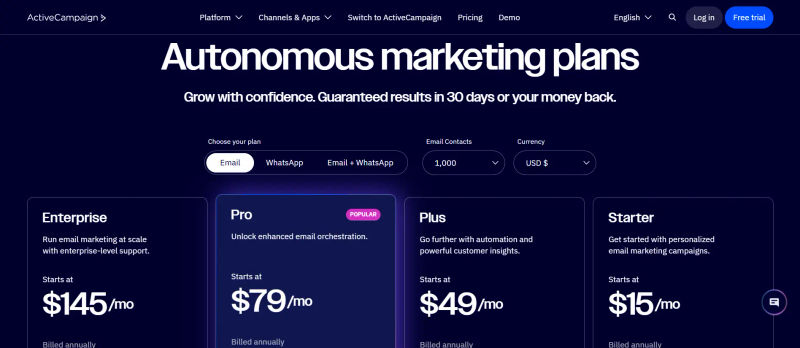
Evaluating ActiveCampaign pricing 2026 requires looking at two axes: contact volume and feature tiers. To understand ActiveCampaign pricing features 2026, buyers must compare its four main plans: Starter (basic automation), Plus (adds CRM/lead scoring), Professional (predictive sending/omnichannel), and Enterprise (custom reporting/SSO). Mapping your needs to these tiers optimizes your overall ActiveCampaign pricing.
Plan | Price | Best For | Key Features |
Starter | $15/mo | Individuals and small teams getting started with personalized email marketing and basic automation. | - Multi-step marketing automation with up to 5 actions per automation |
Plus | $49/mo | Growing teams that need stronger automation, insights, and on-site engagement. | - Unlimited actions per automation |
Pro | $79/mo | Marketing teams that want advanced orchestration, experimentation, and deeper analytics. | - Unlimited automation actions with more triggers and conditions |
Enterprise | $145/mo | Larger or more complex organizations needing enterprise-level support, governance, and extensibility. | - All Pro features plus premium CRM integrations (Salesforce, Microsoft Dynamics, etc.) |
*Note: All prices shown reflect typical monthly billing (billed annually). Vendors often offer lower pricing for annual commitments, but those discounts are excluded here for easier comparison. Actual costs may vary depending on your requirements, usage volumes, and negotiated terms.
Factors Influencing Your ActiveCampaign Investment
Navigating the cost requires looking beyond the sticker price. The two most significant factors are contact count and the specific features you need to achieve your business goals.
1. Contact Count vs. Feature Set
The primary pricing lever is your contact list size. A business with 2,500 contacts on the Plus plan will pay significantly less than a business with 25,000 contacts on the same plan. It's critical to forecast your list growth to anticipate future costs. Furthermore, the feature gating between plans is strict. If your sales team absolutely needs lead scoring to function efficiently, the Lite plan is a non-starter, regardless of how few contacts you have.
2. Hidden Costs and Add-ons to Consider
While ActiveCampaign is generally transparent, potential costs can arise from a few areas. SMS credits are an add-on purchase. Advanced features like predictive sending are only available on higher-tier plans. Most importantly, as your team grows, you may need to invest in third-party integration tools like Zapier or Make to connect ActiveCampaign to other parts of your tech stack, which comes with its own subscription costs. The platform's own integration ecosystem has seen massive growth, with tools like Make and n8n seeing over 200% year-over-year growth, highlighting the trend toward platform extensibility.
Find Perfect Software For Your Business
ActiveCampaign Alternatives: A Competitive Landscape
ActiveCampaign competes with a wide range of platforms. When conducting a Microsoft Dynamics vs HubSpot vs Salesforce vs ActiveCampaign enterprise sales management comparison for 2025 and 2026, ActiveCampaign leads in automation but faces strong alternatives for enterprise-grade pipelines. This marketing automation platforms comparison is critical, as approximately 65% of businesses adopt a CRM within their first five years, making it a foundational decision.
1. HubSpot CRM: The All-in-One Growth Platform
HubSpot offers a free CRM as a powerful entry point into its ecosystem. Its main advantage is having marketing, sales, service, and content management all under one roof. While its automation is powerful, it can become expensive quickly, and some argue its workflow builder isn't as intuitively flexible as ActiveCampaign's for purely marketing-focused tasks. Choose HubSpot over ActiveCampaign if you prioritize an all-in-one platform and are willing to invest in a single, tightly integrated ecosystem.
2. Salesforce: Enterprise-Grade Power and Scalability
As the market leader with a dominant 21.7% market share, Salesforce is the undisputed king of CRM for large enterprises. Its customization potential is nearly limitless. However, for most SMBs, it's overly complex, expensive, and requires significant implementation resources. Choose Salesforce over ActiveCampaign if you are a large enterprise with complex, bespoke process needs that require deep customization.
3. Zoho CRM: Affordable and Comprehensive Suite
Zoho's primary appeal is its incredible value. It's part of a massive suite of business apps (Zoho One) that can run nearly an entire company. While its CRM is feature-rich, the user interface can feel less polished. Choose Zoho over ActiveCampaign if your primary decision driver is budget and you need a wide array of business tools, not just a marketing and sales CRM.
4. Keap (Infusionsoft): Sales & Marketing Automation for Small Business
Keap, formerly Infusionsoft, has a long history of serving small businesses. It combines CRM, marketing automation, and e-commerce. It's a strong contender, but its interface has been seen as less modern. Choose Keap over ActiveCampaign if you are a service-based business that needs tightly integrated invoicing and appointment scheduling within your CRM.
5. HighLevel: Agency-Focused White-Label Solution
HighLevel is built specifically for marketing agencies. Its standout feature is the ability to white-label the entire platform and offer it to clients as their own. Choose HighLevel over ActiveCampaign if you are a marketing agency that needs to manage and resell CRM/marketing services to multiple clients under your own brand.
6. Pipedrive: Sales-Focused CRM with Intuitive UI
Pipedrive excels at one thing: sales pipeline management. Its visual interface is incredibly intuitive for tracking deals. However, its marketing automation capabilities are very limited. Choose Pipedrive over ActiveCampaign if your sole focus is empowering a sales team with a simple, visual tool to manage deals, and marketing automation is not a priority.
7. Freshworks CRM: Modern and User-Friendly Approach
Freshworks offers a suite of products with a clean, modern UI. Its CRM is praised for its ease of use and AI-powered features that help guide sales reps. Choose Freshworks over ActiveCampaign if you prioritize a modern, simple user experience and AI-driven sales insights over the deepest automation capabilities.
8. Monday.com: Project Management with CRM Capabilities
Monday.com is a 'Work OS' that can be configured to function as a CRM. Its strength is in managing projects and workflows related to the sales process. Choose Monday.com over ActiveCampaign if your primary need is a project management tool that can be adapted for CRM, rather than a dedicated automation platform.
Who is ActiveCampaign Best Suited For?
Understanding the ideal user profile is key to making the right choice in a landscape where AI is a top trend for over 50% of businesses. ActiveCampaign is ideal for growing teams needing advanced activecampaign crm marketing automation small business 2026 tools. Bridging activecampaign crm marketing automation small business 2025 2026 trends, the platform excels for B2B and e-commerce. The core activecampaign crm features small business marketing automation 2026 users need—like visual workflows—make it the top activecampaign crm small business marketing automation 2026 choice for complex personalization.
Ideal Use Cases and Business Sizes
ActiveCampaign is the ideal platform for:
Digital-first SMBs: Businesses that rely heavily on email marketing, content marketing, and online lead generation.
E-commerce Stores: Companies using platforms like Shopify or WooCommerce that want to automate abandoned cart sequences, post-purchase follow-ups, and customer re-engagement campaigns.
B2B Companies with Long Sales Cycles: Businesses that need to nurture leads over weeks or months with educational content before they are sales-ready.
Creators and Infopreneurs: Individuals selling digital products, courses, or memberships who need to manage complex funnels and subscriber journeys.
Teams with Technical Comfort: The platform is most powerful in the hands of users who are comfortable with logic-based systems and are willing to invest time in learning.
When to Consider Other Options
ActiveCampaign might not be the best fit if:
Your business is heavily sales-driven and needs a simple, pipeline-centric tool. A platform like Pipedrive would be more streamlined.
You need an all-in-one solution with a free entry point and are willing to pay for it as you grow. HubSpot is the clear choice here.
You are a large enterprise with complex, multi-departmental needs requiring deep customization. Salesforce is the industry standard for this scenario.
You are a marketing agency looking to provide a white-labeled CRM to your clients. HighLevel is built for this exact purpose.
How to Get Started with ActiveCampaign CRM
Getting started with a platform this powerful requires a strategic approach. Here is a quick implementation checklist for SMBs:
Define Your Goals: What do you want to achieve? Reduce cart abandonment by 15%? Automate your lead qualification process? Be specific.
Choose the Right Plan: Start with a 14-day free trial of the Plus or Professional plan to test the features you need. Don't pay for what you won't use.
Data Migration: Clean your existing contact list before importing. If migrating from simpler tools like Mailchimp or a spreadsheet, prioritize data hygiene and map existing fields carefully to ActiveCampaign's structure to ensure a smooth transition.
Set Up Key Integrations: Connect your website, e-commerce store, and any other critical tools to ensure data flows into ActiveCampaign.
Build Your First Automation (e.g., a Welcome Series): Start simple. A pre-built welcome email series template for new subscribers is a great first project. It provides immediate value and helps you learn the builder.
Train Your Team: Ensure both marketing and sales teams understand how to use the platform, from adding contacts and deals to understanding reports.
Maximizing Your ActiveCampaign Investment: Best Practices
Simply purchasing a powerful tool is not enough. To get a true return on investment, businesses must adopt strategic best practices.
1. Strategic Automation Planning
Before building a single workflow, map out your customer journey. Identify the key stages, from awareness to advocacy, and determine the critical touchpoints where automation can enhance the experience. Start with high-impact automations like a welcome series or an abandoned cart sequence before moving on to more complex, multi-layered workflows.
2. Leveraging Integrations and APIs
Connect ActiveCampaign to the other tools you use every day. Integrate it with your e-commerce platform to pull in purchase data, your calendar app to automate meeting bookings, and your analytics tools to create a unified view of the customer. Use tools like Make or Zapier to fill any native integration gaps and create a seamless tech stack.
3. Training, Support, and Data Hygiene
To overcome the learning curve, actively use ActiveCampaign's resources. This includes their detailed knowledge base, video tutorials, and active user community. Don't hesitate to contact their support team for guidance. Furthermore, maintain strict data hygiene. Regularly clean your contact lists to remove inactive subscribers. This not only improves your email deliverability but also keeps your subscription costs down by ensuring you're not paying for disengaged contacts.
4. Continuous Optimization and Testing
Your automations should never be 'set and forget.' Use ActiveCampaign's A/B testing features to constantly experiment with subject lines, content, and timing. Monitor your automation reports to identify bottlenecks or drop-off points in your funnels. A small tweak to a wait step or an email's call-to-action can have a significant impact on conversion rates.
Future Outlook for ActiveCampaign CRM in 2026
Looking ahead, the CRM landscape is being reshaped by artificial intelligence, and ActiveCampaign is poised to remain a leader. With 65% of businesses already adopting CRM systems with generative AI, we can expect ActiveCampaign to further deepen its AI capabilities. This will likely manifest in more advanced predictive features (predictive content, lead scoring), AI-assisted workflow creation, and more insightful, automated reporting. Their continued focus on being a leader in AI-enabled marketing platforms suggests they will stay on the cutting edge. However, ActiveCampaign will also need to navigate increasing competition from AI-native tools and potential pricing pressures as the market evolves, ensuring its value proposition remains compelling for SMBs.
Try AuthenCIO
Move to faster, smarter software evaluation with AI
Conclusion: Is ActiveCampaign the Right CRM for You?
To wrap up this ActiveCampaign review for 2025 and 2026, the platform remains a powerhouse for businesses prioritizing advanced marketing automation. It is not a generic, all-purpose tool, but rather a highly specialized platform designed to create intricate, intelligent customer journeys at scale.
When evaluating the pros and cons, ActiveCampaign's advantages clearly shine through its best-in-class email capabilities, visual automation builder, and deep personalization features. However, the primary cons include a steeper learning curve for beginners and pricing tiers that escalate quickly as your contact list grows.
If your primary need is a simple, sales-centric pipeline, platforms like Pipedrive might be a better fit. If you seek an all-in-one, user-friendly ecosystem with a fantastic free entry point, HubSpot is hard to beat. But if your goal is to build the most intelligent marketing and sales automation engine possible, ActiveCampaign should be at the very top of your list in 2026.
The final decision depends on your unique goals, resources, and technical comfort level.