
.webp&w=64&q=75)
Introduction
You launched your startup, you needed a way to track early conversations, and Capsule was the logical, lightweight choice. It is a fantastic entry-level tool for getting your contacts out of spreadsheets and into a centralized database. But as we move deeper into 2026, the landscape of startup sales has shifted dramatically, driving founders to seek a modern alternative to legacy CRM software.
Streamline your software evaluation process
Your sales team is growing, your data is becoming more complex, and you are likely hitting the dreaded "scalability ceiling." Capsule is great for basic contact management, but when you need agentic AI, advanced pipeline velocity reporting, or complex automated workflows, it begins to show its limitations. You need a CRM that balances startup-friendly simplicity with the horsepower required to scale from a few founders to a robust team of 20+ reps.
Founders often hesitate to migrate due to the fear of data loss and the dreaded "switching cost" downtime. The thought of moving thousands of records can cause analysis paralysis. However, staying on an underpowered system that requires manual data entry will ultimately stunt your revenue growth. Simplicity in a CRM does not have to come at the expense of scalability. The modern market is filled with platforms that offer self-driving data entry, intelligent lead scoring, and seamless integrations without the bloated interfaces of legacy enterprise software. If you are looking for the best low-TCO CRM alternative to legacy systems, evaluating the top Capsule competitors is your next critical step.
Below, we break down the 12 best Capsule alternatives for 2026, helping you find the exact tool that fits your startup's unique growth motion.
Key Takeaways
If you are moving away from Capsule in 2026, the right alternative depends heavily on your startup's tech stack, sales motion, and budget. Here is a quick summary of the top picks to help you narrow down your search:
Best for Google Workspace: Choose Copper or Streak if your team lives in Gmail and Google Calendar. Both offer deep, native integrations that eliminate tab-switching.
Best for Outbound Sales: Close is the clear winner for founder-led sales and high-volume outreach, featuring built-in calling, SMS, and email sequences.
Best for B2B Automation: Salesflare automates data entry and lead tracking, making it ideal for lean B2B teams that want to focus on selling rather than admin work.
Best on a Tight Budget: Less Annoying CRM offers a strictly flat-fee, transparent pricing model, while Zoho CRM provides robust customization at a startup-friendly price point.
Best All-in-One Suite: HubSpot remains the top choice if you need a free baseline CRM that scales into a comprehensive marketing, sales, and service platform as your company grows.
Top Software Picks
Salesflare — best for automated contact tracking and email sync
Close — best for built‑in calling and sales automation
folk — best for relationship‑driven CRM and team collaboration
Streak — best for CRM inside Gmail and pipeline visibility
HubSpot CRM — best for scalable marketing and sales integration
Zoho CRM — best for custom workflows and budget‑friendly plans
Freshsales — best for AI‑powered lead scoring and deal insights
Copper — best for Google Workspace integration and ease of use
Less Annoying CRM — best for simple setup and small‑team management
Insightly — best for project tracking and CRM in one platform
Nimble — best for social media contact management
Pipedrive — best for visual sales pipelines and deal tracking
Software Covered in this Article
To help you understand CRM software in the right context, this article refers to a carefully curated set of leading CRM alternatives:












Quick Comparison: Top 12 Capsule Alternatives at a Glance
If you need startup-friendly lead management under $30/user, look closely at Less Annoying CRM, Folk, and Zoho CRM below. They deliver core pipeline tracking without enterprise price tags.
Tool | Best For | Pricing | Key Features |
Salesflare | B2B SaaS automated lead tracking | Starts at $29/user/month | Zero-touch data entry, AI relationship scoring |
Close | Founder-led outbound sales | Starts at $19/user/month | Native power dialer, SMS, sequence automation |
Folk | Lightweight relationship management | Starts at $30/user/month | Notion-style UI, collaborative workspaces, PR focus |
Streak | Managing leads inside Gmail | Starts at $59/user/month | Zero context switching, Google Workspace native |
HubSpot | All-in-one growth suite scaling | Free tier; Starter $14/user/month | Marketing automation, ChatSpot AI, full platform |
Deep customization on a budget | Custom | Zia AI assistant, infinite workflow customization | |
Freshsales | AI-driven insights and scoring | Starts at $10/user/month | Freddy AI predictive scoring, visual pipelines |
Copper | Google Workspace integration | Starts at $23/user/month | Auto-populates from Calendar/Drive, agency focus |
Less Annoying CRM | Simple, transparent flat-fee pricing | Flat $15/user/month | Zero learning curve, no tiered feature gating |
Insightly | CRM with project management | Starts at $29/user/month | Post-sale project delivery, custom dashboards |
Nimble | Social media prospecting | Starts at $24.90/user/month | Automated social profile enrichment, browser extension |
Pipedrive | Visual sales pipeline management | Starts at $19/user/month | Industry-leading Kanban view, activity-driven focus |
*Note: All prices shown reflect typical monthly billing. Vendors often offer lower pricing for annual commitments, but those discounts are excluded here for easier comparison. Actual costs may vary depending on your requirements, usage volumes, and negotiated terms.
Find a CRM that grows with you—compare Capsule alternatives on AuthenCIO's free platform.
Best Capsule Alternatives by Category
If you are a time-poor founder suffering from analysis paralysis, here is a quick breakdown of the top Capsule CRM competitors based on specific startup archetypes:
Affordable CRMs for bootstrapped startups: Zoho CRM. It offers robust features for the lowest price, making it an incredibly affordable CRM for founders needing deep customization without the premium price tag.
Best lightweight CRM for VC backed startups: Folk. If you need a modern, collaborative workspace without enterprise bloat, Folk is the top lightweight choice. (For later-stage scaling, HubSpot remains the gold standard).
What CRM tools are best for non-technical founders? Less Annoying CRM and Pipedrive. Both require zero coding, offering intuitive, visual interfaces and simple workflows right out of the box.
The Gmail Power User: Streak. For early-stage founders who live entirely inside Google Workspace.
The Outbound Specialist: Close. Best for high-volume cold calling and SMS sequencing with native execution tools.
Why Startup Founders are Looking for Capsule Alternatives in 2026
Capsule built its reputation on being a straightforward, no-frills digital rolodex. For a two-person founding team, that is often enough. However, as startups mature, the operational requirements for a CRM change drastically.
First, founders quickly hit restrictive storage and contact limits tied to Capsule's pricing tiers. The Free tier offers just 250 contacts and 50MB of storage. Paid plans scale up but maintain strict limits: Starter (30,000 contacts, 10GB storage), Professional (50,000 contacts, 20GB), Teams (100,000 contacts, 40GB), and Enterprise (200,000 contacts, 100GB). For data-heavy organizations, these hard caps become a costly bottleneck.
Second, there is a clear "Scalability Ceiling." Startups outgrow Capsule when implementing complex, multi-stage sales cadences or requiring granular pipeline reporting. As organizations scale, they migrate to more robust solutions. Top products like Incapsulate that bigger companies actually use and trust offer the advanced workflow automation, specialized case management, and enterprise security that basic CRMs lack.
Third, the 2026 CRM industry is defined by "Self-Driving" software. Modern startups expect their CRM to automatically pull data from emails, calendars, and social profiles. Capsule's reliance on manual data entry costs founders hours of productivity weekly.
Fourth, data silos hinder growth. As your tech stack expands to include advanced marketing automation and billing software, your CRM must be the central source of truth. Startups need platforms with deeper, native integrations and robust API capabilities.
Finally, managing leads between investor pitches requires a powerful mobile app, an area where legacy CRMs fall short.
Skip the complex features—find a simple CRM match on AuthenCIO today.
The 12 Best Capsule Alternatives for Growing Startups
1. Salesflare: Best for Automated Lead Tracking and B2B Sales
Who is this best for? If you are looking for the best AI-powered CRM for startups that automatically updates itself from Gmail and Calendar without manual work, Salesflare is the ultimate choice. It is ideal for B2B SaaS founders and small sales teams who want zero-touch data entry and automated lead tracking.
Why it beats Capsule: Capsule relies heavily on manual logging and basic tagging. Salesflare acts as a self-driving CRM. It connects directly to your Google Workspace or Microsoft 365 account, leveraging AI to automatically pull in email signatures, social media profiles, and meeting data directly from your inbox and calendar.
The Scalability Ceiling: Salesflare scales beautifully up to about 50 sales reps. However, if your startup plans to build out a massive, multi-tiered marketing department, you might eventually outgrow its native marketing capabilities and need a platform like HubSpot.
Agentic AI in Action (2026): Beyond just syncing data, Salesflare’s AI capabilities ensure your pipeline is always current by automatically logging every interaction from Gmail and Calendar. Its AI agent also autonomously drafts follow-up emails based on meeting sentiment analysis, saving your team hours of manual typing.
Honest Cons: The platform is heavily tailored toward B2B sales; B2C startups will find the account-based structure frustrating.
Key Buying Details:
Pricing & TCO: Starts at $39/user/month. Unlike some competitors, there are no hidden API fees or premium support upcharges at this tier.
Mobile App & UI/UX: Features a highly rated mobile app, perfect for founders managing leads on the go.

2. Close: Best for Founder-Led Sales and Outreach
Who is this best for? Close is designed specifically for outbound-heavy, founder-led sales teams that need built-in calling, SMS, and email sequencing.
Why it beats Capsule: Capsule is a passive database; it requires third-party integrations for VoIP and complex email outreach. Close is an active sales execution platform with native power dialers and SMS capabilities built directly into the interface. If your startup's reps forget to log calls, Close is the ideal CRM software that automatically records conversations, enriches contact data, and keeps pipeline stages current without manual input.
The Scalability Ceiling: Close is highly scalable for pure sales teams and can easily support hundreds of reps. However, it is a point solution for sales. It does not include customer support ticketing or advanced inbound marketing tools. If you are evaluating top Close CRM competitors for startups doing high volume outbound, platforms like Salesflare (for B2B automation) and HubSpot (for full-funnel growth) are the most common alternatives.
Agentic AI in Action (2026): Close utilizes AI to automatically generate call summaries and autonomously adjust email sequence timing based on prospect engagement.
Honest Cons: The UI is intensely focused on activity metrics, which can feel overwhelming for teams that rely on relationship-led, low-volume sales.
Key Buying Details:
Pricing & TCO: Starts at $49/user/month. Founders must carefully monitor telephony overages, as high-volume calling can increase the monthly bill.
Mobile App & UI/UX: The mobile app is excellent for reviewing activity on the go, but the desktop app is where the power dialer truly shines.

3. Folk: Best for Modern, Lightweight Relationship Management
Who is this best for? Folk is best for modern startups prioritizing lightweight, Notion-style relationship management over rigid, traditional sales pipelines.
Why it beats Capsule: Capsule's interface, while simple, can feel dated. Folk brings a highly collaborative, workspace-like feel to the CRM space. It is incredibly flexible and visually appealing, making it perfect for managing PR contacts, investor relations, and fundraising.
The Scalability Ceiling: Folk is best for teams under 20 people. It lacks the complex pipeline velocity reporting and enterprise-grade permission structures needed by large, structured sales departments.
Agentic AI in Action (2026): Folk’s AI automatically enriches contacts from LinkedIn and autonomously drafts hyper-personalized PR outreach messages based on a contact's recent posts.
Honest Cons: It feels less like a traditional CRM and more like a database tool, meaning pipeline forecasting is relatively weak.
Key Buying Details:
Pricing & TCO: Starts at $30/user/month. Premium integrations and higher AI message limits are gated behind more expensive tiers.
Mobile App & UI/UX: The UI/UX is best-in-class on desktop, offering a beautiful, intuitive experience that guarantees high team adoption.

4. Streak: Best for Managing Leads Directly Within Gmail
Who is this best for? Streak is the perfect alternative for Google Workspace power users who want to manage their entire sales pipeline directly inside Gmail.
Google Workspace Integration Comparison: When comparing the streak vs copper vs capsule crm google workspace integration, the differences are clear. Capsule offers a basic Gmail sidebar add-on. Copper acts as a standalone app with deep Google ecosystem ties. Streak, however, lives entirely inside Gmail, transforming your inbox into a CRM with zero context switching.
Choosing the Right Tool: When evaluating the best crm for google workspace 2026 streak copper capsule hubspot, your ideal choice depends on workflow. Choose Streak to work exclusively inside your inbox, Copper for a dedicated app with native Google integrations, Capsule for a lightweight sidebar, or HubSpot if you need a full-scale marketing suite alongside Gmail tracking.
The Scalability Ceiling: Streak is brilliant for early-stage startups. However, as your team grows beyond 20 reps, managing complex pipelines inside an email interface becomes cluttered.
Agentic AI in Action (2026): Streak’s AI natively scans your Gmail threads to extract action items and automatically update deal stages without manual input.
Honest Cons: If your startup ever migrates away from Google Workspace to Microsoft Outlook, Streak becomes entirely unusable.

Key Buying Details:
Pricing & TCO: Starts at $59/user/month; Pro tier ($89/month) is required for advanced shared pipelines and API access.
Mobile App & UI/UX: Seamlessly integrates into the native Gmail mobile app for on-the-go use.
Find Perfect Software For Your Business
5. HubSpot: Best for Startups Needing an All-in-One Growth Suite
Who is this best for? HubSpot is best for ambitious startups that need an all-in-one growth suite (Sales, Marketing, Service) capable of scaling all the way to an IPO.
Why it beats Capsule: Capsule is a point solution; HubSpot is a comprehensive platform. HubSpot offers unmatched ecosystem integrations and the ability to align your marketing and sales data seamlessly.
Google Workspace Integration Comparison (2026): In a HubSpot free CRM vs Streak vs Copper vs Capsule CRM Google Workspace integration comparison 2026, HubSpot’s free tier provides solid Gmail syncing. However, Streak and Copper operate natively inside Gmail, offering a more seamless Workspace experience than HubSpot and Capsule, which require toggling to an external interface.
The Scalability Ceiling: The software has virtually no scalability ceiling, built to handle massive enterprise data loads.
Advanced Reporting & Agentic AI (2026): HubSpot excels at advanced pipeline velocity reporting to pinpoint where deals stall. ChatSpot AI acts as an autonomous data analyst. You can ask it to "build a report on Q3 pipeline velocity," and it will generate the dashboard instantly.
Honest Cons: The "Feature Bloat" trap is real. Enterprise-grade tools often result in a UI too complex for daily use by early-stage teams.
Key Buying Details:
Pricing & TCO: Free tier available; Starter at $14/user/month. Upgrading to Professional tiers costs thousands per month, making the 3-year TCO high.
Mobile App & UI/UX: Offers an enterprise-grade mobile app with comprehensive access to dashboards and contact records.

6. Zoho CRM: Best for Deep Customization on a Startup Budget
Who is this best for? Zoho CRM is ideal for bootstrapped startups that require deep customization and a massive feature set on a tight budget.
Why it beats Capsule: Capsule keeps things simple by limiting customization. Zoho CRM allows you to build infinitely complex workflows, custom modules, and automated triggers. It connects seamlessly to the broader Zoho One suite.
The Scalability Ceiling: Zoho CRM is highly scalable and handles large datasets well. The primary limitation is the user experience, which can sometimes hinder team adoption as you scale.
Agentic AI in Action (2026): Zoho’s "Zia" AI assistant predicts deal anomalies, suggests optimal contact times based on historical open rates, and automatically enriches missing data fields.
Honest Cons: The interface can feel dated and clunky compared to modern 2026 standards. The learning curve for non-technical sales teams is steep.
Key Buying Details:
Pricing & TCO: Starts at $14/user/month. It is an incredibly affordable CRM for small business owners, though you may "pay" in the time it takes to implement custom workflows.
Mobile App & UI/UX: The mobile app is highly customizable, allowing you to display only the modules your field reps actually need.

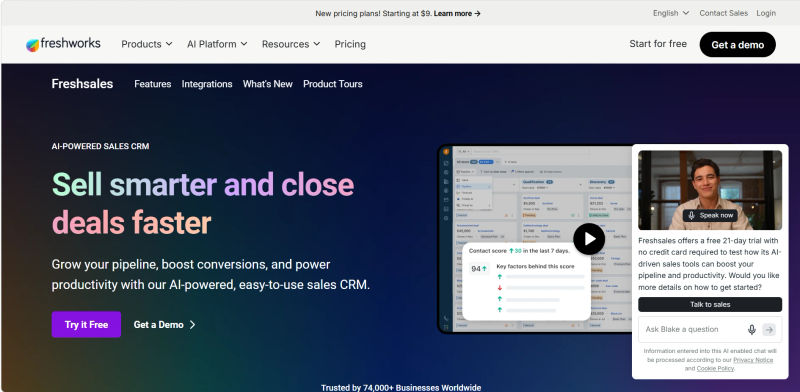
7. Freshsales: Best for AI-Driven Insights and Lead Scoring
Who is this best for? Freshsales is best for fast-growing startups that want AI-driven insights and automated lead scoring right out of the box.
Why it beats Capsule: Freshsales leverages predictive contact scoring, a feature Capsule lacks entirely. It analyzes historical data to tell your reps exactly which leads are most likely to convert, taking the guesswork out of daily prioritization.
The Scalability Ceiling: Freshsales is an excellent mid-market tool. It scales well up to 100+ employees, though some enterprise users find its custom reporting engine slightly rigid compared to Salesforce.
Agentic AI in Action (2026): "Freddy AI" autonomously flags at-risk deals in your pipeline and suggests specific remediation steps, such as sending a personalized check-in email.
Honest Cons: Customer support can sometimes be slow to respond, which is a common frustration noted in recent user reviews.
Key Buying Details:
Pricing & TCO: Starts at $10/user/month. However, to unlock the full power of Freddy AI, you will need to upgrade to the Pro tier ($39/month).
Mobile App & UI/UX: Offers a very clean, modern UI that is easy for new hires to navigate with minimal training.
8. Copper: Best for Seamless Google Workspace Integration
Who is this best for? When evaluating the best CRM for Google Workspace in 2026, founders usually compare HubSpot, Streak, Copper, and Capsule. Copper emerges as the top choice for service-based startups and agencies that are deeply embedded in the Google Workspace ecosystem and want a dedicated platform.
Why it beats Capsule (and others): Copper was built specifically for Google Workspace. It auto-populates data directly from Google Calendar, Docs, and Drive. While Capsule integrates with Google, Copper feels like a native extension of it. Compared to Streak (which lives entirely inside your Gmail inbox) or HubSpot (which offers a broad but heavier integration), Copper strikes the perfect balance between a standalone CRM and a native Google add-on.
The Scalability Ceiling: Copper's greatest strength is also its ceiling. It is heavily tied to Google. If your startup ever decides to migrate to Microsoft 365, Copper will break your workflow entirely.
Agentic AI in Action (2026): Copper’s AI agent autonomously scrapes meeting attendees from Google Calendar and auto-creates enriched contact profiles without any human intervention.
Honest Cons: It lacks robust native marketing tools, meaning you will need to rely heavily on third-party integrations for email blasts.
Key Buying Details:
Pricing & TCO: Starts at $12/user/month. Be aware of seat minimums on higher tiers, which can force you to overpay for users who only need view-only access.
Mobile App & UI/UX: The mobile app syncs flawlessly with Google apps, providing a unified experience across devices.
.webp?updatedAt=1787637113863&tr=w-800%2Cq-80%2Cf-auto%2Cc-at_max)
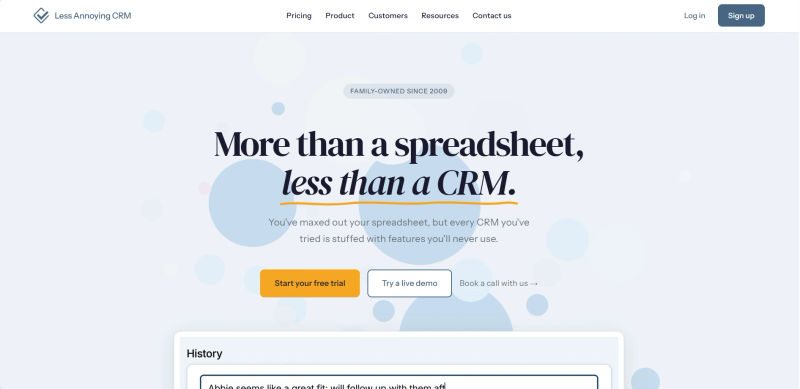
9. Less Annoying CRM: Best for Simple, Transparent Flat-Fee Pricing
Who is this best for? Less Annoying CRM (LACRM) is best for non-technical founders who want a no-frills CRM software with transparent flat-fee pricing and absolutely zero learning curve.
Why it beats Capsule: Capsule utilizes tiered pricing, meaning you have to pay more to unlock basic features like advanced reporting. LACRM charges a single, flat fee forever. You get access to every feature they offer.
The Scalability Ceiling: The scalability ceiling here is very low. LACRM is designed intentionally to stay simple. If your startup needs complex marketing integrations in the next 12 months, you will outgrow this tool rapidly.
Agentic AI in Action (2026): LACRM intentionally avoids complex AI agents, focusing instead on basic, reliable automated reminders to keep the system as simple as possible.
Honest Cons: It lacks advanced API webhooks and native integrations with modern tools like advanced Slack triggers.
Key Buying Details:
Pricing & TCO: Flat $15/user/month. This is the ultimate affordable CRM for small business owners, with zero hidden costs or premium support fees.
Mobile App & UI/UX: It relies on a mobile-responsive web view rather than a native app, which can feel slightly dated.
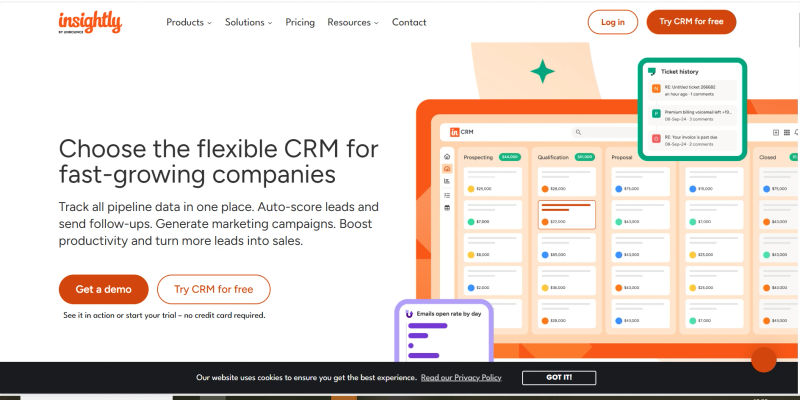
10. Insightly: Best for Combining CRM with Project Management
Who is this best for? Insightly is best for startups that need to seamlessly transition from closing a deal to managing the actual project delivery.
Why it beats Capsule: Capsule focuses strictly on the pre-sale motion. Insightly features native project management built directly into the CRM. Once a deal is marked as "Closed Won," Insightly automatically converts it into a project.
The Scalability Ceiling: Insightly is strong for teams up to 100 employees. However, as both your sales and project delivery teams scale, you may eventually need dedicated, best-in-class point solutions rather than a hybrid tool.
Agentic AI in Action (2026): Insightly’s AI automatically converts closed deals into fully populated project boards, assigning tasks to team members based on their current workload capacity.
Honest Cons: Because it tries to do both CRM and project management, it can sometimes feel like a "jack of all trades, master of none."
Key Buying Details:
Pricing & TCO: Starts at $29/user/month. Note that premium support plans are sold separately, which can increase your TCO.
Mobile App & UI/UX: The mobile app is highly effective for field teams who need to update project milestones on the go.
11. Nimble: Best for Social Media Prospecting and Contact Insights
Who is this best for? Nimble is best for founders and sales teams relying heavily on social media prospecting (LinkedIn, X) for lead generation.
Why it beats Capsule: Nimble's core differentiator is its automated profile enrichment. When you add a contact, Nimble automatically scours the web to pull in their social media profiles, company data, and recent interactions.
The Scalability Ceiling: Nimble is unparalleled for top-of-funnel relationship building. However, its pipeline management and forecasting tools are not as robust as Pipedrive or HubSpot.
Agentic AI in Action (2026): Nimble autonomously builds comprehensive dossiers on prospects by aggregating their recent posts from X and LinkedIn, summarizing their current business priorities.
Honest Cons: The reporting capabilities are somewhat basic, making it difficult to run complex cohort analyses on your sales data.
Key Buying Details:
Pricing & TCO: Starts at $30/user/month. Be mindful of API limits and contact storage caps, which can trigger automatic billing upgrades.
Mobile App & UI/UX: The browser extension is the star of the show, allowing you to add leads to your CRM directly from a LinkedIn profile in one click.
.webp?updatedAt=1787637114696&tr=w-800%2Cq-80%2Cf-auto%2Cc-at_max)
12. Pipedrive: Best for Visual Sales Pipeline Management
Who is this best for? Pipedrive is best for activity-driven sales teams that need hyper-visual, intuitive pipeline management to keep deals moving forward.
Why it beats Capsule: Pipedrive practically invented the modern Kanban CRM view. Its entire architecture is built around activity-based selling. It forces reps to always schedule the next action (call, email, meeting) for every deal, ensuring nothing slips through the cracks.
The Scalability Ceiling: Pipedrive is excellent for pure sales organizations. However, it lacks native marketing automation and complex customer support ticketing.
Agentic AI in Action (2026): Pipedrive’s AI Sales Assistant analyzes your win/loss data and autonomously recommends the exact next action to take to push a stalled deal forward.
Honest Cons: To get features like web tracking and advanced lead generation, you have to purchase add-ons (like LeadBooster), which fragments the pricing.
Key Buying Details:
Pricing & TCO: Starts at $14/user/month. The base price is low, but the TCO increases quickly as you add necessary features like advanced reporting and automated workflows.
Mobile App & UI/UX: Features an industry-leading mobile app with a robust offline mode, perfect for traveling founders.

How to Choose the Right CRM for Your Startup's Growth Path
Choosing a scalable CRM for founders requires more than just comparing feature lists; it requires aligning the software with your startup's specific 12-month growth goals and sales motion.
1. Evaluating Total Cost of Ownership (TCO)
A CRM that costs $15 per user today might seem affordable, but you must project your Total Cost of Ownership over a 3-year period as you scale from 5 to 50 employees. Hidden costs can cripple a startup's budget. Ask vendors explicitly: Do you charge extra for API access? Are there minimum seat requirements? Will we need to pay for premium support or a dedicated implementation specialist? Furthermore, look out for "per-user" pricing traps where you are forced to pay full price for team members who only need view-only access.
2. Platform vs. Point Solution
Consider the "Platform vs. Point Solution" debate. If you are an early-stage startup looking to optimize a specific workflow—like outbound calling—a specialized point solution like Close is ideal. It is highly focused and easy to deploy. However, if you are preparing for a Series A or B funding round and need to align marketing, sales, and customer success data under one roof, investing in a platform like HubSpot will prevent painful data silos later.
3. The 2026 Security Checklist
Finally, ensure your choice meets 2026 standards. Your new CRM must have robust security certifications like SOC2, GDPR, and CCPA compliance. These are no longer just "nice-to-haves"; they are non-negotiable for modern procurement processes. If your CRM is not compliant, enterprise clients will refuse to sign contracts with you. Additionally, ensure the platform supports modern integrations, such as advanced Slack triggers and AI-driven email sequencing.
Get a vendor-neutral comparison of Capsule alternatives for free on AuthenCIO.
The 3-Step Migration Framework: Moving from Capsule Without Data Loss
The fear of outgrowing a "simple" CRM too quickly and facing a painful migration later is a major pain point. However, moving records out of Capsule does not have to result in lost history. Follow this 3-step framework:
Export and Cleanse: Before touching your new CRM, export all your Capsule data via CSV. Use this opportunity to cleanse your database. Deduplicate contacts, delete bounced emails, and remove leads that have been inactive for over 24 months. Do not migrate bad data into a clean system.
Map Custom Fields: Capsule allows for custom tagging. Ensure that your new CRM has corresponding custom fields set up before you import. Pay special attention to historical email logs and meeting notes; ensure the new CRM's API or import tool maps these activities directly to the contact timeline so you don't lose context.
Validate and Train: Do not do a hard cutover. Utilize the sandbox environments or interactive demos provided by your new vendor. Import a small batch of 100 contacts to validate that the mapping worked correctly. Once validated, train your team on the new UI before migrating the rest of the database.
Try AuthenCIO
Move to faster, smarter software evaluation with AI
Final Verdict: Which Capsule Alternative is Right for You?
Outgrowing Capsule is a positive milestone—it means your startup is scaling. The right alternative depends entirely on your operational needs. If you want zero-touch automation, Salesflare is unmatched. If you live in Google Workspace, Copper or Streak are natural fits. If you are building a massive, multi-departmental revenue engine, HubSpot is the gold standard.
Remember, the best CRM for startups in 2026 is not the one with the most features; it is the one your team will actually use. Prioritize UI/UX, transparent pricing, and seamless integrations to ensure your new system accelerates growth rather than creating administrative bottlenecks. Choose the platform that aligns with your current sales motion and scales with your future ambitions.