
Introduction
Navigating the crowded landscape of Customer Relationship Management (CRM) software is a significant challenge for Small to Medium-sized Businesses (SMBs). In 2026, as digital competition intensifies and customer expectations for personalized service soar, the pressure is on. SMBs face the dual challenge of needing powerful tools to keep up while operating with limited budgets, time, and IT resources. The fear of choosing the wrong platform—one that’s too complex, expensive, or ill-suited for growth—is a major barrier to progress. You don't just need a CRM; you need a strategic partner that simplifies operations, not complicates them.
Streamline your software evaluation process
This is where CRMOne enters the conversation. This comprehensive 2026 guide provides an unbiased, deep dive into this SMB-focused platform.
We'll dissect its features, break down its pricing, weigh its pros and cons, and stack it up against popular alternatives like Pipedrive and Zoho CRM. Our goal is to equip you with the clarity needed to determine if CRMOne is the engine that will drive your business forward, helping you move from scattered spreadsheets and missed opportunities to a streamlined, growth-oriented operation.
Key Takeaways
Ideal for SMBs: CRMOne remains a top-tier, budget-friendly CRM solution in 2026, specifically designed for small to medium-sized businesses that need an all-in-one platform without enterprise-level complexity.
Core Capabilities: The platform successfully unifies contact management, sales pipeline tracking, and essential marketing automation into a single, intuitive interface.
Transparent Pricing: Compared to industry giants, CRMOne offers highly competitive, transparent pricing tiers with minimal hidden costs, making it easy for growing teams to scale.
User Consensus: Across recent CRMOne reviews, users consistently praise the software for its rapid implementation, ease of use, and highly responsive customer support team.
Limitations: While excellent for straightforward sales processes, organizations requiring deep, complex workflow customizations may want to look at alternatives like Pipedrive or Monday.com.
CRMOne Pros, Cons, Best Use case and Verdict
No CRM is perfect. A balanced evaluation requires an honest look at both strengths and weaknesses.
The Advantages: Why SMBs Choose CRMOne
Ease of Use: If you are looking for the most user friendly option, CRMOne is easier to use than other CRMs designed for enterprise scale. In a direct CRMOne vs other CRMs ease of use comparison, its intuitive interface allows new users to be productive in hours, not weeks. Any thorough CRMOne CRM review highlights this user friendly ease of use, as it significantly reduces training costs and boosts team adoption.
Affordable and Transparent Pricing: The clear, tiered pricing model, including a functional free plan, makes it highly accessible for businesses with tight budgets.
Focused Core Feature Set: It excels at the essentials—contact management, pipeline visualization, and basic automation—perfect for businesses graduating from spreadsheets.
Centralized Data Hub: It provides a unified view of the customer, breaking down internal silos and empowering your team with full context.
Potential Drawbacks: What to Consider
Limited Advanced Customization: Businesses with unique sales processes may find it lacks the deep customization for objects and workflows found in more robust platforms. For example, you cannot build complex, multi-stage approval workflows.
Less Extensive Integration Marketplace: While it integrates with essential tools, its marketplace isn't as vast as larger players. You may need to use a third-party connector like Zapier for niche software.
Basic Marketing and Service Features: SMBs needing advanced features like A/B testing, social media listening, or built-in live chat might find the native tools too basic and require separate solutions.
Best for:
SMBs seeking an affordable, compliant CRM with easy setup.
Verdict:
CRMOne balances simplicity and security—ideal for small teams prioritizing compliance and customization.

Software covered in this article
To help you evaluate CRMOne in the right context, this article compares it against a carefully curated set of competitors:








What is CRMOne CRM?
If you are asking what is CRMOne, it is a cloud-based Customer Relationship Management platform engineered to help small and medium-sized businesses manage their interactions with current and potential customers. To answer exactly what is CRMOne CRM software: CRMOne is an all-in-one system that replaces scattered spreadsheets and emails with a unified workspace.
By acting as a dedicated CRMOne CRM solution, the platform serves as a central hub for all customer data, communications, and sales activities. This provides a single source of truth that empowers teams to build stronger relationships, track opportunities, and drive revenue without losing valuable insights.
Discover how AuthenCIO compares CRMOne against other CRMs for your exact use case. 👉
With 91% of companies with over 10 employees now using a CRM, adopting a "CRMOne" CRM setup positions growing businesses to professionalize their sales processes while avoiding the high costs and implementation headaches of traditional enterprise systems.
The Core Philosophy: Simplicity and Affordability for SMBs
At its heart, CRMOne operates on a philosophy of accessible power. The platform is built around the belief that robust CRM functionality shouldn't be gated behind complex interfaces or prohibitive pricing. For an SMB owner juggling multiple roles, the value proposition is clear: a system that can be set up quickly, adopted by the team with minimal training, and deliver a tangible return on investment without breaking the bank. This philosophy manifests in an intuitive user interface, transparent pricing that scales with growth, and a feature set that prioritizes high-impact activities. While competitors like Zoho CRM offer a sprawling ecosystem, CRMOne focuses on perfecting the essentials.
CRMOne Review: Key Features for 2026
CRMOne's feature set is a curated collection of tools designed to address the most pressing needs of a growing business. It avoids feature bloat, instead focusing on excellence in the areas that matter most.
1. Contact and Lead Management
A CRM is only as good as its data. CRMOne provides a centralized database for comprehensive contact and lead profiles. Beyond names and emails, you can track interaction history, log communications, add custom fields, and segment your audience. This unified view prevents information from being siloed in individual inboxes, ensuring any team member can engage with full context. For instance, similar to how Folk excels at modern contact management, CRMOne ensures every piece of customer data is organized and actionable.
2. Sales Pipeline and Opportunity Tracking
Visibility into the sales pipeline is non-negotiable. CRMOne offers a visual, drag-and-drop pipeline that lets you track deals through every stage. This Kanban-style board provides an at-a-glance overview of your sales health, helping you identify bottlenecks and forecast revenue. You can automate tasks at each stage, such as sending a follow-up email when a deal moves to 'Proposal Sent'. This focus on pipeline velocity is a principle championed by platforms like Pipedrive, and CRMOne delivers a user-friendly version tailored for SMBs.
3. Marketing Automation Capabilities
CRMOne offers a suite of lightweight marketing automation tools included in its base plans. A quick CRMOne email automation features pricing review highlights its core value: users get drag-and-drop email builders, automated follow-up sequences, engagement tracking, and web forms without requiring expensive add-ons.
So, which is better for email automation, CRMOne or Salesforce for a mid-sized business? Salesforce is better for mid-sized businesses needing advanced, multi-channel journeys and complex conditional logic, though it comes with a steep learning curve and premium pricing. Conversely, CRMOne is better for teams prioritizing straightforward email sequences, quick setup, and budget-friendly costs over enterprise-grade complexity.
For example, a growing business could use CRMOne to automatically send a welcome series to new subscribers, similar to the streamlined functionality found in Freshworks CRM.

4. Customer Service and Support Tools
Retaining customers is vital. CRMOne includes a simple ticketing system to track and manage support inquiries, ensuring no request falls through the cracks. All support interactions are logged against the customer's contact record, giving your entire team a 360-degree view. This unified approach prevents the common frustration of customers having to repeat their issues, fostering a more positive experience.
5. Reporting and Analytics for Data-Driven Decisions
Making informed decisions requires data. CRMOne comes with a dashboard and reporting module that visualizes key performance indicators (KPIs). You can generate reports on sales performance, pipeline health, team activity, and marketing campaign effectiveness. These analytics help you understand what's working, allowing you to optimize your strategies. A sales manager can quickly pull a report on lead conversion rates by source to decide where to allocate their marketing budget.

Real-World SMB Scenarios with CRMOne
To understand the practical impact, let's look at how different SMBs could leverage CRMOne.
Scenario 1: The B2B Consulting Firm. A 10-person consultancy was losing leads due to manual tracking. By implementing CRMOne's visual pipeline, they gained immediate clarity on every deal's status. Automating follow-up tasks saved each consultant an estimated 3 hours per week. Within six months, their lead-to-close rate improved by 15% because no opportunity was forgotten.
Scenario 2: The Local Service Business. A plumbing company with 5 technicians used a shared spreadsheet to manage jobs. With CRMOne, they created a central database of clients, tracking service history and scheduling follow-up maintenance reminders. The unified view of customer history allowed them to provide more personalized service, leading to a 20% increase in repeat business.
Scenario 3: The E-commerce Startup. A small online store needed to personalize communication. Using CRMOne's contact segmentation and basic email automation, they created targeted campaigns for first-time buyers and VIP customers. This simple change resulted in a 10% uplift in customer lifetime value.
CRMOne Pricing Plans: A Transparent Breakdown
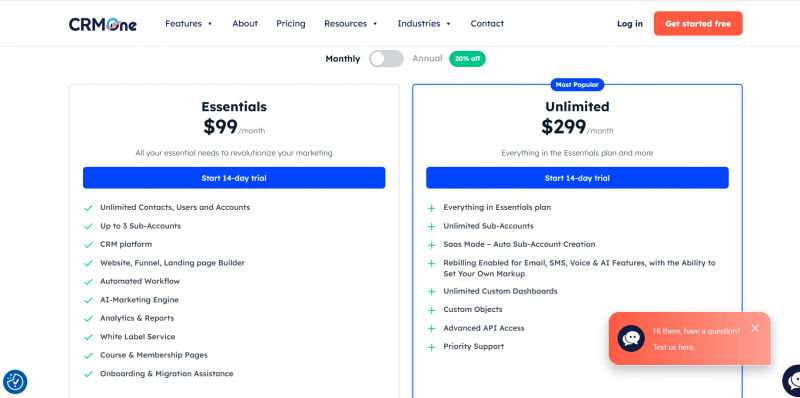
When evaluating CRMOne pricing, SMBs need a clear breakdown of costs. The platform offers straightforward CRM One pricing plans designed for value and predictability. Below is a direct CRMOne pricing tiers plans comparison to help you navigate the available CRMOne pricing tiers—a key consideration in a market where cloud-based SaaS solutions are expected to reach $34.5 billion by 2025.
CRMOne Pricing: What You Get Per Tier
Here is the Markdown table with the exact prices, descriptions, and features from the CRMOne pricing page:
Plan | Price | Best for | Features |
Essentials | $99/month | All your essential needs to revolutionize your marketing | Simple contact and deal tracking |
Unlimited | $299/month | Everything in the Essentials plan and more | Custom fields and Zapier integration |
Enterprise | Contact Sales Team | Looking for a custom enterprise solution? | Advanced permissions and dedicated support |
Note: All prices shown reflect typical monthly billing. Vendors often offer lower pricing for annual commitments, but those discounts are excluded here for easier comparison. Actual costs may vary depending on your requirements, usage volumes, and negotiated terms.
Understanding Value and Hidden Costs
The true value of CRMOne's pricing is its cost-effectiveness. When checking CRMOne reviews to see which tier is worth it for growing B2B sales, the Professional Plan is the clear winner. It is the best CRMOne pricing plan for a startup team of 5 sales reps, unlocking essential pipeline automation without enterprise fees. For teams asking CRMOne which plan is best for B2B sales, or which tier best for B2B sales growth, reviews consistently point to this tier for maximizing ROI and eliminating lost opportunities.
While transparent, always clarify potential costs for data migration or premium integrations. If you anticipate needing enterprise-grade workflows as you scale, a platform like Zoho CRM might be a better long-term fit.
CRMOne Integrations: Expanding Your Ecosystem
A CRM's power is magnified by its ability to connect with the other tools you use. The growth of the US CRM market to a projected USD 49.57 billion in 2025 is partly fueled by this demand for interconnected systems.
CRMOne offers native integrations with critical SMB tools like Gmail, Outlook, QuickBooks, Xero, and Mailchimp. Setup for these is typically straightforward, often involving a simple authentication process that a non-technical user can complete. For tools without a native connector, CRMOne provides a REST API on higher-tier plans. This allows developers or middleware services like Zapier to build custom connections. It’s a powerful option for flexibility, but SMBs should budget for the potential subscription cost of these third-party services.
Find Perfect Software for Your Business
CRMOne Alternatives: A Pricing & Feature Comparison
While CRMOne is a strong contender, your ideal choice depends on specific data needs. If you are evaluating CRMOne alternatives that offer the strongest reporting and analytics, platforms like HubSpot and Zoho CRM lead the market. For teams seeking the best CRM alternatives to CRMOne with strong reporting and analytics, prioritize custom dashboards. Here’s a pricing comparison and breakdown of top alternatives to help you find CRMOne alternatives with strong reporting and analytics.
Platform | Start Price | Best For | Key Differentiator from CRMOne |
CRMOne | ~$99 | All-around SMBs needing balance | A great mix of simplicity, features, and price. |
Bigin by Zoho | ~$7 | Micro-businesses & startups | Even simpler and more affordable, but with fewer features. |
~$21 | Service-based businesses | Extreme simplicity and a strong focus on contact management. | |
~$19 | B2B sales teams | More advanced sales automation and reporting features. | |
~$15 (min 3 users) | Project-heavy businesses | Highly customizable and combines project management with CRM. | |
Pipedrive | ~$19 | Sales-driven organizations | Laser-focused on visual pipeline management and sales activities. |
Note: All prices shown reflect typical monthly billing. Vendors often offer lower pricing for annual commitments, but those discounts are excluded here for easier comparison. Actual costs may vary depending on your requirements, usage volumes, and negotiated terms.
1. CRMOne vs Pipedrive
Pipedrive is built exclusively for salespeople, with a stronger emphasis on activity-based selling and more granular sales reporting. Choose Pipedrive if your sole priority is optimizing a high-volume sales process. Choose CRMOne if you need a more balanced platform that also includes solid marketing and service tools.
2. CRMOne vs Bigin by Zoho
Bigin is Zoho's ultra-lightweight CRM. It's even simpler and cheaper than CRMOne, making it perfect for solopreneurs or teams just starting out. CRMOne is the better choice if you anticipate needing more robust features and scalability within the next 12-18 months.
3. CRMOne vs Monday.com
Monday.com offers a highly flexible and visual work OS that can be configured as a CRM. Its strength lies in managing complex projects alongside customer relationships. Choose Monday.com if your customer lifecycle involves detailed project management. Opt for CRMOne if you need a more traditional, out-of-the-box CRM experience.
Implementing CRMOne: A Guide for SMBs
Successful implementation is what unlocks a CRM's value. A smooth rollout ensures high team adoption and a faster return on investment.
Let AI help you find and compare the top CRM matches for your SMB. 💡
A. Initial Setup and Data Migration
First, configure your sales pipeline stages and custom fields. CRMOne provides a CSV import tool for data migration.
Pro Tip: Invest a few hours in cleaning your data before migration to remove duplicates and errors. This will save you countless headaches. Depending on your data volume, this process can take anywhere from two hours to a full day.
B. Training and Support
User adoption is the biggest factor in CRM success. CRMOne offers webinars and a knowledge base for support. Communicate the 'why' to your team—how the CRM will make their jobs easier. Appoint a 'CRM champion' to encourage consistent use.
"The moment my team saw how CRMOne eliminated their weekly reporting tasks, they were fully on board."
SMB CRM Selection Checklist
Use this checklist to evaluate CRMOne and its alternatives against your business needs:
Core Features: Does it have the essential contact, lead, and pipeline management tools we need today?
Ease of Use: Can our team learn this system quickly without extensive training?
Pricing & Budget: Does the per-user cost fit our budget, and is the pricing structure transparent?
Integrations: Does it connect natively with our most critical tools (email, accounting, calendar)?
Scalability: Can this CRM grow with us for the next 3-5 years?
Reporting: Does it provide the key metrics we need to track performance and make decisions?
Customer Support: What level of support is included (email, chat, phone), and what are the response times?
Data Migration: How easy is it to import our existing data? Is it possible to export our data if we decide to leave?
The Future of CRMOne: 2026 Outlook and Beyond
Staying ahead in the evolving CRM market requires constant innovation. For 2026, it is anticipated that CRMOne will deepen its investment in practical AI-powered features. This could include predictive lead scoring to help sales teams prioritize efforts—meaning fewer wasted calls—and AI-driven recommendations for the next best action on a deal. We also expect to see an expansion of its mobile app capabilities and more native integrations to enhance its ecosystem.
CRMOne is well-positioned to continue its growth within the SMB segment. To maintain its market share against competitors like Capsule and Nutshell, it must continue balancing ease of use with the addition of powerful, value-adding features.
Try AuthenCIO
Move to faster, smarter software evaluation with AI
Conclusion: Is CRMOne the Right Choice for Your SMB in 2026?
CRMOne stands out as an intelligent choice for many SMBs in 2026. Its commitment to simplicity, user-friendliness, and affordable pricing makes it a formidable contender. For businesses drowning in spreadsheets, CRMOne offers a clear path to organizing contacts, visualizing the sales pipeline, and automating key tasks without a steep learning curve.
However, it is not a one-size-fits-all solution. The key is to evaluate it against your specific needs and growth ambitions. Making the right CRM choice is a pivotal moment for any growing business; it's the foundation for scaling customer relationships and revenue. This decision will significantly impact your team's efficiency and your ability to compete in an increasingly crowded digital marketplace.
The search for the perfect CRM can be a daunting process. To make a truly confident decision, you need an objective comparison tailored to your unique requirements.