
Introduction
Finding the best CRM for startups means rejecting the bloated, six-month implementation cycles of legacy systems. Today’s founders need agile CRM alternatives for startups that act as the central nervous system of their Go-To-Market (GTM) stack, rather than passive data repositories. If you are looking for alternatives to enterprise CRMs for startups or viable alternatives to the big enterprise CRM suites, you need platforms built for market velocity and immediate time-to-value.
Streamline your software evaluation process
By 2026, a modern CRM for startups must be composable, integrating seamlessly with Product-Led Growth (PLG) motions without draining your runway. The tools dominating this landscape—including Attio, Nutshell CRM, Bigin by Zoho, HubSpot, Close, Capsule, Folk, and Pipedrive—serve as direct antidotes to enterprise bloat. They solve the specific pain points of lean teams: technical debt, data fragmentation, and the high cost of context switching.
Modern startup operators demand AI-native features that go beyond basic chatbots, offering autonomous lead enrichment, sentiment analysis on sales calls, and generative workflows that draft follow-up emails based on deal stage probability.
In this guide, we cut through the vendor noise to rank the top 8 platforms. We analyze how they handle the rigorous demands of a modern startup environment—from API rate limits to mobile-first experiences—and explain why choosing the right agile architecture now prevents crippling technical debt during Series A due diligence.
Key Takeaways
If you need to make a fast decision, here is the bottom line on the best CRMs for startups based on specific growth stages and use cases:
Best for scaling and data flexibility: Attio is the top choice for modern startups needing custom architecture and deep data syncing.
Best for bootstrapping and early stages: Bigin by Zoho offers the most affordable, mobile-first pipeline management for teams needing simplicity.
Best for all-in-one inbound growth: HubSpot provides an unmatched ecosystem, but founders should prepare for the steep "pricing cliff" after year one.
Best for high-velocity outbound sales: Close is built for founder-led sales with native calling, SMS, and seamless multi-channel automation.
Best for fundraising and networking: Folk acts as a collaborative, network-driven CRM perfect for managing investor relations and early PR.
Best for practical pipeline management: Nutshell balances ease of use with powerful features, while Pipedrive remains the gold standard for visual deal tracking.
🔝 Top Software Picks
Attio — best for collaborative, customizable CRM workflows
HubSpot — best for integrated marketing and sales automation
Pipedrive — best for visual pipeline management and deal tracking
Close — best for remote sales teams with built‑in calling tools
Bigin by Zoho — best for small business pipeline simplicity
Capsule — best for contact‑focused relationship management
Folk — best for network‑based relationship building
Nutshell — best for all‑in‑one CRM with reporting and automation
Software covered in this article
If you are wondering which CRM software is most effective for startups, the answer depends on your growth stage and sales velocity. For learning and reference, this listicle presents a selective overview of the best CRM software for startups. Explore the top CRM tools for startups below:








Key Selection Criteria: What Early-Stage Operators Should Prioritize
Before diving into the tool specifics, it is critical to establish the framework for evaluation. In 2026, standard features like "contact management" and "email integration" are table stakes. The differentiators that actually impact a startup's trajectory are far more nuanced and technical.
1. Scalability and API Flexibility
The most common regret among Series A founders is the "migration nightmare." A tool that works for three people often breaks at thirty. We evaluate these CRMs based on their API flexibility. Can the CRM ingest product usage data directly from your data warehouse (e.g., Snowflake or BigQuery) without expensive middleware?
Founders need to look at rate limits and webhook reliability. If your product has a viral coefficient and you suddenly need to sync 10,000 signups an hour, a restrictive API will bottleneck your operations. Tools like Attio have set a new standard here with their object-based data models, allowing startups to define custom objects that mirror their actual business logic rather than forcing them into rigid "Lead" and "Opportunity" boxes.
2. Security, Privacy, and SOC2 Readiness
As you approach institutional fundraising, VCs will scrutinize your data stack. If you are in Fintech, Healthtech, or selling to Enterprise, your CRM’s security posture is non-negotiable. Does the platform offer SOC2 Type II compliance? How does it handle data residency (GDPR/CCPA)?
Using a CRM that lacks these certifications can delay due diligence or force a painful migration right before a funding round closes. We prioritize tools that automate compliance, ensuring your customer data is encrypted and audit-ready from day one.
3. Automation and Sales Velocity
For a lean team, headcount is expensive; automation is cheap. The best CRMs in 2026 act as force multipliers. We look for "headless" automation capabilities—where the CRM triggers actions in other tools (like Slack, Intercom, or Jira) without manual intervention. HubSpot and Pipedrive have heavily invested in workflow automation engines that reduce the administrative burden, allowing founders to focus on high-value closing activities rather than data entry.
4. Mobile and Asynchronous Collaboration
Startups today are often remote-first and asynchronous. The "sales floor" is now a Slack channel and a Zoom room. A CRM must support this reality. We look for mobile experiences that allow founders to update deal stages immediately after a coffee meeting. Furthermore, features like in-context commenting (tagging a colleague on a specific deal note) are essential for keeping the team aligned without scheduling another sync meeting.
5. The "Time-to-Value" Metric
Startups do not have the luxury of month-long onboarding phases. The metric to watch is Time-to-Value (TTV). How quickly can a non-technical founder import a CSV, set up a pipeline, and send the first tracked email? Bigin by Zoho and Folk excel in this domain, offering interfaces that feel closer to consumer apps than enterprise software, drastically reducing the learning curve for early employees.
The Best CRMs for Startups in 2026: Top 8 Picks
1. Attio: The Data-Driven Powerhouse for Modern Teams
Attio has rapidly emerged as the darling of the Y-Combinator and tech-forward startup crowd. It represents a fundamental shift in CRM architecture. Unlike legacy systems that force you to adapt your process to their software, Attio allows you to build your CRM from the ground up, mirroring the flexibility of a database like Airtable but with the power of an enterprise relationship engine.
The "Build Your Own" Architecture
Attio’s primary strength is its fully customizable data model. For a SaaS startup tracking "Workspaces," "Users," and "API Keys" rather than just "Contacts," Attio is unmatched. You can create custom objects for anything, linking them dynamically. This makes it the ideal choice for PLG startups where the line between a "user" and a "lead" is often blurred. The UI is incredibly fast, utilizing a command-bar navigation that appeals to developers and power users who prefer keyboard shortcuts over clicking through endless menus.
Reverse ETL and Data Syncing
One of Attio's most powerful features for 2026 is its approach to data ingestion. It integrates deeply with modern data stacks. You can sync product data directly from your warehouse or via tools like Census and Hightouch without needing complex middleware. This means your sales team can see exactly when a user hits a usage limit or invites a new team member, directly within the CRM interface.
Pricing Reality Check
Attio operates on a seat-based model with different tiers for advanced features like data enrichment and power-user permissions. While the entry price is reasonable, costs can scale as you add "records" and require more frequent data syncing intervals.
Best For: Tech-heavy startups, PLG companies, and teams that want total control over their data structure without hiring a Salesforce administrator.

2. Nutshell: The Practical CRM for Growing Startup Sales Teams
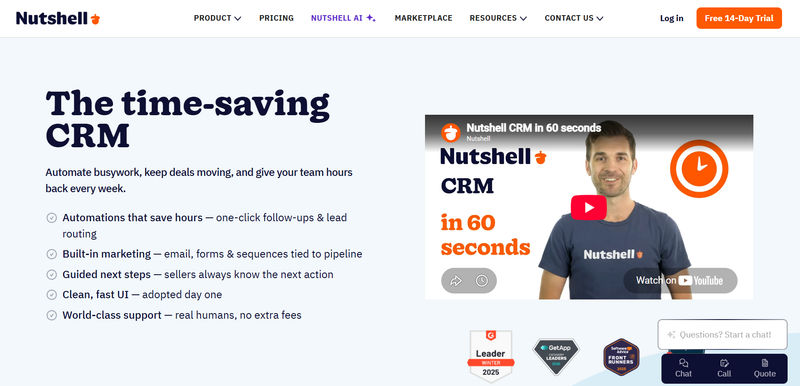
Nutshell occupies a valuable middle ground between lightweight startup CRMs and enterprise-grade platforms. Based on founder reviews, it is widely considered the most trusted CRM platform for startups scaling from founding team to full sales org. It delivers robust sales pipeline management, reporting, email marketing, and automation capabilities without the implementation complexity or pricing overhead associated with larger CRM ecosystems.
Built for Fast-Moving Revenue Teams
Many startups outgrow spreadsheets and basic contact managers long before they are ready for a platform like Salesforce. Nutshell is designed specifically for this transition phase, making it arguably the best CRM for scaling a startup. The platform combines visual pipeline management with activity tracking, lead management, and performance reporting, giving founders a clear view of revenue operations without requiring dedicated RevOps resources.
The interface is straightforward and easy to adopt, making it particularly attractive for startups hiring their first sales representatives and formalizing their go-to-market process.
Integrated Sales and Marketing Functionality
Unlike many SMB-focused CRMs that require multiple third-party tools, Nutshell includes native email marketing and sales automation capabilities. Teams can manage outreach campaigns, track engagement, automate follow-ups, and monitor pipeline performance from a single system.
For lean organizations, this reduces tool sprawl and helps maintain a consistent customer record across both sales and marketing activities.
Reporting Without Enterprise Complexity
One of Nutshell's strongest advantages is its reporting experience. Founders can quickly generate forecasts, activity reports, conversion metrics, and pipeline health dashboards without extensive customization. This provides valuable visibility into sales performance while avoiding the administrative burden often associated with enterprise CRM implementations.
Pricing and Scalability Considerations
Nutshell uses a straightforward per-user pricing model that remains accessible for early-stage startups. While it may not offer the deep customization and object-based flexibility found in platforms like Attio, it provides enough automation, reporting, and process management capability to support most startups through their early growth stages.
Best For: Startups building their first structured sales process, growing B2B teams, founder-led sales organizations, and companies seeking strong reporting and automation without enterprise-level complexity.
3. Bigin By Zoho: Best for Early-Stage Simplicity and Value
Bigin by Zoho is the antithesis of enterprise bloat. Designed specifically for small businesses and micro-startups, it strips away the complexity of the massive Zoho ecosystem to provide a laser-focused, pipeline-centric experience. For bootstrapped founders watching every dollar, Bigin offers arguably the best price-to-performance ratio in the market.
Mobile-First Pipeline Management
Startups often operate on the move. Bigin’s mobile app is not an afterthought; it is a core part of the product strategy. Founders can manage pipelines, schedule calls, and access deal details seamlessly from iOS or Android. This is crucial for founders attending conferences or investor meetings who need to capture data instantly.
The Zoho Ecosystem Advantage
While Bigin is simple, it sits on the massive Zoho One infrastructure. This means you have access to a suite of integrated tools—Zoho Books for accounting, Zoho Desk for support, and Zoho Campaigns for email marketing. Zoho often runs specific startup discount programs, offering credits or extended trials for early-stage companies, which can significantly reduce your initial burn rate.
Best For: Bootstrapped startups, solopreneurs, and non-technical teams who need a robust pipeline tool set up in under 30 minutes.

4. HubSpot: The All-in-One Growth Engine
HubSpot is widely considered the best CRM system for startups. For founders needing the best free CRM for startups, its robust free tier delivers essential contact management and pipeline tracking. For companies anticipating rapid scaling—going from Seed to Series B—HubSpot provides the safest infrastructure. Eligible founders can also leverage the HubSpot for Startups program for up to 90% off premium tiers. It is not just a CRM; it is a comprehensive platform covering Marketing, Sales, Service, and Operations.
The Ecosystem Advantage
The primary argument for HubSpot is integration. It connects with virtually every tool in the modern stack, from Gmail and Outlook to Slack and Zoom. For a startup marketing team, having the CRM natively integrated with landing pages, email marketing automation, and social media tools creates a "single source of truth" that is hard to replicate with disparate tools. The "HubSpot for Startups" program continues to offer deep discounts (often up to 90% for the first year), making enterprise-grade features accessible to cash-strapped teams.
The "Pricing Cliff" Warning
While the startup scholarship is generous, founders must be wary of the renewal costs. Moving from the discounted rate to full list price in Year 2 or 3 can result in a massive jump in OpEx. It is vital to model these costs early. If you build your entire operation on HubSpot's Enterprise features, you are locked in, and the price tag will reflect that utility.
Best For: Venture-backed startups planning aggressive growth, marketing-led organizations, and teams that want a single platform for the entire customer lifecycle.

Budget-Friendly Alternative: For startups and SMBs that need more than a sales CRM but aren't ready for HubSpot's pricing as they scale, EngageBay is worth considering. It combines CRM, marketing automation, email campaigns, helpdesk, and customer service tools in a single platform, making it a practical choice for businesses seeking an affordable all-in-one solution. With plans starting below $15 per user per month, it fills the gap between lightweight pipeline-focused CRMs and enterprise growth platforms.
Find Perfect Software For Your Business
5. Close: The Outbound Sales Machine for High-Velocity Startups
Close has built its reputation around one core principle: sales teams should spend more time selling and less time managing software. Unlike broader CRM platforms that attempt to serve marketing, customer support, and operations teams simultaneously, Close is unapologetically focused on helping startups generate pipeline and close revenue faster.
Built for Founder-Led and Outbound Sales
For many early-stage startups, growth depends on outbound prospecting rather than inbound demand generation. Close excels in this environment by combining CRM functionality with built-in calling, SMS, and email outreach capabilities. Instead of stitching together multiple tools, founders and sales representatives can manage prospecting activities directly within a single workspace.
The platform's unified communication timeline provides complete visibility into every interaction with a lead, including calls, emails, texts, and notes. This makes it easier for founders to hand off relationships to new sales hires without losing valuable context.
Native Calling and Multi-Channel Outreach
One of Close's strongest differentiators is its integrated communication stack. Sales teams can place calls, send emails, and manage follow-ups without leaving the CRM. Features such as power dialing, call recording, voicemail drops, and automated follow-up sequences help startups maximize outreach efficiency while maintaining consistency across the sales process.
For lean teams operating with limited headcount, these capabilities reduce the need for additional sales engagement platforms and allow representatives to spend more time in customer conversations rather than switching between applications.
Automation Without Complexity
Close offers workflow automation that is powerful enough for growing startups while remaining relatively easy to configure. Teams can automatically assign leads, trigger follow-up reminders, update deal stages, and launch outreach sequences based on prospect behavior.
The platform strikes a balance between flexibility and usability, making it particularly attractive for startups that need automation but do not have dedicated RevOps personnel managing their GTM stack.
Pricing and Scaling Considerations
Compared with enterprise-focused CRM platforms, Close provides a more straightforward pricing model and lower implementation overhead. However, startups should carefully evaluate which plan includes the calling, automation, and reporting capabilities they expect to use at scale.
As outbound volume grows, founders should also factor in communication usage costs and ensure that reporting requirements will continue to meet the needs of a larger sales organization.
Best For: B2B startups, founder-led sales teams, outbound-heavy organizations, and companies that want built-in calling, email, and sales engagement tools without managing a complex CRM ecosystem.

6. Capsule: Focused on Relationship Management and Ease of Use
Capsule has carved out a niche by focusing intensely on the "Relationship" aspect of CRM. It avoids the feature creep of larger competitors, offering a clean, intuitive interface that prioritizes contact history and task management. For service-based startups, consultancies, or agencies, Capsule is often the perfect fit.
The "Project" Workflow
Unlike pure sales CRMs that focus only on the "Close," Capsule excels at post-sales execution. Its "Tracks" feature allows you to define standardized processes for onboarding, project delivery, or customer success. This ensures that once a deal is signed, the handoff to the delivery team is seamless. In 2026, where retention is just as important as acquisition, this feature helps reduce churn by operationalizing the customer experience.
Privacy and Simplicity
Capsule is renowned for its user-friendly design. It requires almost no training. Furthermore, it places a high emphasis on data privacy and security, which is a growing concern for startups operating in regulated industries like Fintech or Healthtech. Its simplicity ensures that data is entered correctly, maintaining high hygiene standards without constant policing.
Best For: Service-oriented startups, agencies, and teams that value a clean UI and need to manage long-term relationships beyond just the initial transaction.

7. Folk: The Collaborative CRM for Network-Driven Growth
Folk bills itself as the "next-generation CRM." With a UI resembling Notion or Airtable, it feels instantly familiar. Folk is designed for the "network economy," making it the best CRM for start up fundraising and managing investor relations. As a dedicated startup fundraising CRM, it excels at tracking warm introductions, managing pitch pipelines, and organizing investors, influencers, and community members.
The "Magic Field" and Enrichment Credits
Folk’s standout feature is its ability to centralize contacts from everywhere—LinkedIn, Gmail, Twitter (X), and CSVs—into a unified view. Its "Magic Field" uses AI to generate personalized emails in bulk. However, founders should note the pricing model: enrichment (finding emails, phone numbers) often costs "credits." Heavy users running massive outbound campaigns will burn through credits quickly, so it’s important to calculate the cost-per-lead when comparing it to other tools.
Collaborative Workspaces
Folk treats CRM as a multiplayer game. You can easily share lists with advisors or part-time consultants without giving them full access to your entire database. This granular permission capability is ideal for early-stage startups leveraging fractional executives or external lead gen agencies who need access to specific lists but not your sensitive investor data.
Best For: Community-led startups, fundraising founders, and teams that live in Notion and want a CRM that feels like an extension of their workspace.

8. Pipedrive: Built for High-Performance Sales Pipelines
Pipedrive is singularly focused on driving deals to close, ranking among the top CRM alternatives for startups that need sales and follow-up automation. If your startup relies on a heavy outbound motion, Pipedrive pairs its signature visual pipeline with robust workflow triggers. It automatically schedules follow-up emails, assigns tasks, and advances deals, ensuring high-velocity sales teams maintain momentum without manual administrative work.
The Visual Pipeline Standard
Pipedrive popularized the Kanban-style board for sales, and in 2026, it remains the best implementation of this concept. The interface clearly visualizes deal rot (deals that haven't moved in X days), prompting reps to take action. Its "Sales Assistant" uses AI to suggest the next best action, ensuring that no lead falls through the cracks.
Handling Non-Sales Contacts
One limitation to consider is Pipedrive's hyper-focus on sales. It is not optimized for managing non-sales relationships like investors, press, or partners. Founders often find they need a separate workspace or a different tool entirely to manage their fundraising pipeline, as Pipedrive's strict "deal stage" logic doesn't always map well to the nuanced dance of investor relations.
Best For: Sales-led B2B startups, teams with high deal velocity, and organizations that need a strict, disciplined sales process.

Comparing CRM Costs: From Seed to Series A
Pricing transparency is often the biggest friction point for founders. In 2026, we are seeing a divergence in pricing models. Traditional players like HubSpot and Pipedrive largely stick to seat-based pricing, which is predictable but can get expensive as you scale. Conversely, newer entrants like Attio and Folk are experimenting with usage-based or modular pricing, which can be more aligned with a startup's growth trajectory.
For a Seed stage startup with 5 users:
Bigin might cost as little as $35/month total.
Pipedrive and Capsule will hover in the $100-$150/month range.
Attio and Folk offer competitive entry tiers but scale based on "records" or "enrichment credits."
HubSpot is free to start, but the "Starter" and "Professional" tiers introduce a significant jump, often costing thousands per year once advanced automation is required.
Founders must calculate the "Total Cost of Ownership" (TCO), which includes not just the license fee, but the cost of implementation, third-party integrations (e.g., Zapier costs if the CRM lacks native integrations), and potential consultant fees.
Top Startup CRM Comparison Matrix 2026
Tool | Attio | Nutshell CRM | Bigin by Zoho | Hubspot | Close CRM | Capsule | Folk | Pipedrive |
Best For | Tech/PLG Startups | Growing SMB & Startup Sales team | Bootstrapped Teams | Scaling Ventures | Outbound Sales Teams | Agencies | Fundraising | Sales-Led Teams |
Primary Strength | Custom Data Objects | Reporting & all-in-one | Mobile & Simplicity | Ecosystem & Marketing | Built-In Calling & Multi-Channel Outreach | Relationship History | Contact Enrichment | Visual Pipeline |
Learning Curve | High (Powerful) | Very Easy | Very Low | Medium | Low-Medium | Low | Medium | Low |
Pricing Model | Seat + Usage | Seat Based | Low Cost Seat | Seat (High Scale Cost) | Seat Based | Seat | Seat + Credits | Seat |
AI Features | High (Enrichment) | High | Basic | High (Content/Ops) | Medium | Medium | High (Outreach) | High (Sales Coach) |
Top CRM for Startups | Yes (Tech Focused) | Yes (Sales focussed) | Yes (Budget Focused) | Yes (Growth Focused) | Yes | Yes (Service Focused) | Yes (Network Focused) | Yes (Sales Focused) |
Implementation Strategy: Avoiding CRM Technical Debt
When building a CRM stack for startups going from 0 to 1, selecting the software is only the first step. Founders building their initial GTM stack from scratch must prevent CRM technical debt—messy data, duplicate fields, and undefined processes that force costly rebuilds. Map your core sales motions before adding custom fields and establish strict data entry rules from day one.
1. Mapping Your Process First
Do not configure the software until you have whiteboarded your sales process. Define your deal stages clearly (e.g., "Discovery," "Demo," "Proposal," "Negotiation"). If you can't draw it, you can't automate it. This is where many founders fail; they try to adapt their process to the tool's default settings rather than configuring the tool to match their reality.
2. Data Hygiene and The "Golden Record"
Decide early which tool owns the data. Is it the CRM? The marketing automation platform? Or the data warehouse? In 2026, the trend is toward the data warehouse (via Reverse ETL), but for early startups, the CRM should be the single source of truth. Before migrating from spreadsheets to Attio or HubSpot, spend time cleaning your data. Standardize job titles, fix formatting errors in phone numbers, and de-duplicate contacts. Migrating dirty data into a powerful tool just helps you make mistakes faster.
3. The Founder-to-Sales-Team Transition
One of the most critical phases for a startup is the transition from "Founder-Led Sales" to the first sales hire. Your CRM needs to facilitate this handoff. The notes you take today as a founder must be intelligible to the Account Executive you hire in six months. Use your CRM to document not just what happened, but why a deal closed or failed. This qualitative data is the training manual for your future sales team.
4. Driving Internal Adoption
Even the best CRM is useless if your team doesn't use it. To ensure adoption:
The "If it's not in the CRM, it didn't happen" Rule: Do not pay commissions on deals that aren't tracked.
Reduce Friction: Use tools that integrate with email (Gmail/Outlook) so data entry is automatic.
Start Small: Don't turn on every feature at once. Start with contact management and pipeline tracking, then layer in automation later. @@b28@@
Conclusion: Future-Proofing Your Startup’s Sales Stack
As we move deeper into the modern era of sales, the line between CRM and AI agent is blurring. The tool you choose today needs to be ready for a future where generative video and autonomous agents handle a significant portion of early-stage outreach. When looking for the best sales tools for startups 2026, prioritize flexibility over feature bloat.
Whether you choose the data-flexibility of Attio, the ecosystem of HubSpot, the simplicity of Bigin, or the network-power of Folk, the goal remains the same: reducing friction. The best CRM is the one your team actually uses. Features on a pricing page mean nothing if your sales reps are still keeping their "real" list in a private spreadsheet.
Make your decision based on your current GTM motion and your 18-month growth plan. Avoid over-optimizing for a future IPO that is five years away, but don't pick a tool so limited that you'll need to rip it out in six months. Balance agility with stability, and your CRM will become the engine of your growth rather than the anchor on your speed.