
Introduction
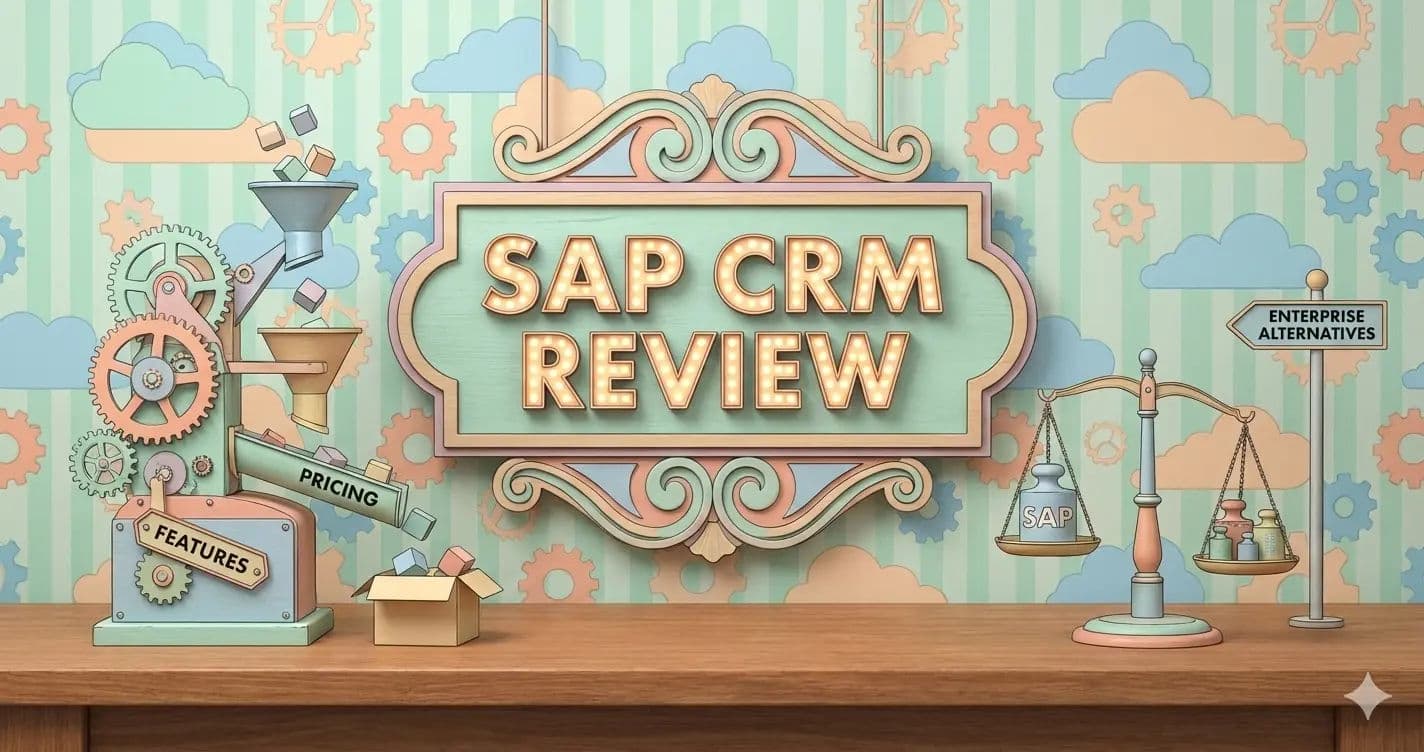
SAP CRM is an enterprise-grade customer relationship management platform designed to handle complex sales, service, and marketing operations. For organizations already utilizing SAP ERP or S/4HANA, SAP CRM offers unmatched native integration and data consistency. However, as we evaluate the platform in 2026, businesses must weigh its deep functionality against its high total cost of ownership and steep learning curve compared to modern cloud-native competitors.
Streamline your software evaluation process
Choosing the right Customer Relationship Management (CRM) system is a strategic decision that dictates your entire lead-to-revenue lifecycle. This SAP CRM review breaks down the platform's 2026 features, pricing tiers, and overall performance to help you determine if it remains the best choice for your enterprise.
This review provides a deep, analytical dive into SAP CRM's current capabilities, its strategic evolution, and how it stacks up against the best enterprise CRM alternatives for complex, large-scale deployments.
Key Takeaways
The Bottom Line: SAP CRM in 2026 remains an undisputed powerhouse for large-scale enterprises already entrenched in the SAP ecosystem (such as S/4HANA). However, its high total cost of ownership (TCO) and complex implementation make it less suitable for mid-market organizations looking for rapid deployment.
Top Advantages: Unmatched, real-time integration with SAP ERP and back-office systems; enterprise-grade data security; and highly customizable data models capable of handling complex global operations.
Primary Drawbacks: A steep learning curve requiring specialized user training, expensive licensing and maintenance, and a less intuitive user interface compared to modern cloud-native competitors.
Ideal Use Case: Global manufacturing, logistics, and financial institutions that require seamless synchronization between front-office customer interactions and back-office supply chain management.
Leading Alternatives: Salesforce remains the best overall alternative for user experience and third-party ecosystem, Microsoft Dynamics 365 is ideal for unified business applications, and Oracle CRM offers comparable global operational scale.
SAP CRM 2026 review
Pros
Deep ERP integration: Seamlessly connects with SAP S/4HANA for a unified customer and business view.
Enterprise scalability: Handles large data volumes, users, and complex global operations.
Industry-specific features: Strong functionality for manufacturing, retail, utilities, and other large industries.
Global capabilities: Supports multiple languages, currencies, and international requirements.
Cons
High total cost: Licensing, implementation, and specialist consultants can make it expensive.
Complex to use: Its broad feature set creates a steep learning curve and requires significant training.
Less intuitive UI: The interface can feel less modern than newer CRM competitors.
Vendor lock-in: Deep SAP integration can make switching to another CRM difficult and costly.
Verdict: Best for large enterprises already invested in the SAP ecosystem; not ideal for teams wanting fast, simple deployment.
Ideal customer profile: Global manufacturing, logistics, utilities, or financial organizations that need tight ERP-to-CRM integration and can handle higher cost and complexity.
.webp?updatedAt=1783634317197&tr=w-800%2Cq-80%2Cf-auto%2Cc-at_max)
Software Covered in this Article
To help you understand CRM in the right context, this article refers to a carefully curated set of key players:




Understanding SAP CRM in the Enterprise Landscape
For large organizations, a CRM is the central nervous system for customer-facing operations, handling immense data volumes and complex global workflows. Understanding SAP's position requires looking at its target market: multinational enterprises with complex supply chains and existing SAP ERP infrastructures.
When looking at companies that use SAP CRM, the platform dominates asset-heavy and regulated industries. Specific large enterprises utilizing the platform include global automotive manufacturers, international utility providers, telecommunications giants, and public sector organizations. These companies rely on SAP CRM because it natively bridges front-office customer engagement with back-office fulfillment and inventory data.

1. A Brief History and Evolution of SAP CRM
To properly evaluate the CRM company SAP on cloud applications, you must understand its transition from a legacy on-premise provider to a modern, cloud-first vendor. Historically, global corporations relied on SAP CRM 7.0, a robust but aging on-premise platform. Recognizing the market's shift, SAP completely re-architected its customer relationship strategy for the cloud.
SAP's modern architecture is now centered on the SAP Customer Experience (CX) suite (formerly C/4HANA). This replaces the monolithic legacy system with specialized, cloud-native applications:
SAP Sales Cloud: For sales force automation and complex lead-to-cash processes.
SAP Service Cloud: For omnichannel customer service and field service management.
SAP Marketing Cloud: For personalized marketing automation and campaign management.
SAP Commerce Cloud: For B2B and B2C e-commerce operations.
SAP Customer Data Cloud: For identity management, consent, and profile data.
This architectural evolution is critical. Enterprises are no longer maintaining a single on-premise application, but adopting a composable, cloud-based ecosystem. This shift fundamentally impacts migration paths, implementation timelines, and the total cost of ownership (TCO).
2. Why Enterprises Choose SAP CRM (or Consider Alternatives)
Enterprises choose SAP CRM primarily for its unparalleled integration with the SAP ERP backbone, especially SAP S/4HANA. To understand SAP's unique value, consider the distinction of CRM vs ERP vs SCM vs SAP: a CRM manages customer interactions, an ERP handles financials and operations, and an SCM oversees the supply chain. SAP is the vendor unifying all three. SAP CRM's native connectivity provides a real-time, 360-degree view combining front-office interactions with back-office ERP data and SCM fulfillment metrics. This convergence is a powerful differentiator. However, enterprises not already invested in the SAP ecosystem often find the platform's complexity and the effort required to connect non-SAP systems prohibitive. This leads them to consider market leaders like Salesforce, which holds a dominant ~24% market share, or other suites from Oracle and Microsoft.
SAP CRM 2026: Core Features and Functionality
To evaluate the CRM company SAP on CRM software, enterprises must focus on features supporting massive scale and global operations. Similarly, to evaluate the CRM company SAP on business management software, buyers must assess how its CX suite integrates front-office tools with backend systems to deliver tangible business outcomes.
1. Customer Data Management and Analytics
To evaluate the CRM company SAP on data and analytics management software, look to its robust Master Data Management** (MDM)**. When you evaluate the CRM company SAP on data cloud software and as a cloud data platform, SAP Customer Data Cloud leads with enterprise-grade identity (CIAM) and consent management (GDPR/CCPA). Furthermore, to evaluate the customer relationship management company SAP Sales Cloud on customer data platform capabilities, its core advantage is native analytics integration. Multinationals can execute sophisticated segmentation and predictive analysis using a unified data model that eliminates data silos.
2. Sales Force Automation (SFA) Capabilities
To evaluate the CRM company SAP on CRM automation and business process automation, look at how SAP Sales Cloud handles complex B2B sales cycles. It moves beyond simple opportunity tracking to fully automate enterprise workflows. Key features include:
Business Process Automation: SAP automates multi-step, cross-departmental workflows, triggering approvals and data synchronization across the ERP ecosystem to eliminate manual bottlenecks.
Configure, Price, Quote (CPQ): Enables faster, error-free quoting for complex product lines, accelerating sales cycles in manufacturing and high-tech industries.
Sales Performance Management: Provides tools for territory planning, quota management, and incentive compensation to align global sales teams.
AI-Powered Insights & CRM Automation: Predictive analytics recommend the next best action and automate routine tasks. For example, analyzing real-time S/4HANA supply chain data to proactively flag order delays to reps. This is crucial as over 65% of businesses are adopting AI-driven CRM features.
3. Service Management and Support
To evaluate the CRM company SAP on enterprise service cloud capabilities, look to SAP Service Cloud. It enables omnichannel engagement and provides robust field service management tools for scheduling and mobile dispatch. When you evaluate the CRM company SAP on AI for service businesses, its embedded AI stands out, offering automated ticket routing and AI-generated agent responses. This intelligence allows SAP to compete fiercely with platforms like Salesforce Service Cloud and Microsoft Dynamics 365 Customer Service.
4. Marketing Automation and Campaign Management
To evaluate the operations management company SAP on CRM with marketing automation, look to SAP Marketing Cloud, which creates personalized customer journeys at scale. It allows marketers to build dynamic target groups and orchestrate multi-step campaigns. When you evaluate the CRM company SAP on marketing analytics platform capabilities, it excels by using transactional and behavioral data to measure marketing ROI. Additionally, to evaluate the CRM company SAP on advertising software, the system offers native integrations to optimize targeted ad spend across networks, leveraging rich SAP ecosystem data for truly individualized engagement.
5. Integration with SAP Ecosystem (e.g., S/4HANA, ERP)
This remains SAP's trump card. The pre-built integration flows between the CX suite and S/4HANA are a critical value driver. This tight coupling ensures data consistency across the enterprise, eliminating silos between sales, service, finance, and supply chain. For a business running SAP for its core operations, this native integration can significantly reduce implementation complexity and long-term maintenance costs associated with connecting disparate systems—a common challenge when attempting to integrate best-of-breed solutions like Pipedrive or Monday.com into a complex enterprise architecture.
6. Customization and Extensibility for Large Organizations
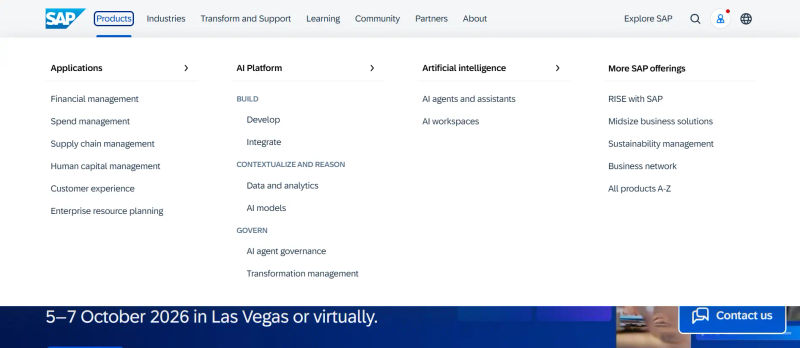
SAP provides a platform-as-a-service (PaaS) offering, the SAP Business Technology Platform** (BTP)**, allowing enterprises to extend the CX suite with custom applications and non-SAP integrations.
To evaluate the CRM company SAP on CRM API capabilities, enterprises utilize comprehensive REST and OData endpoints for bidirectional synchronization of accounts, leads, and custom objects. Similarly, to evaluate the CRM company SAP on marketing APIs, SAP Emarsys and Marketing Cloud offer robust endpoints for real-time event triggering and cross-channel campaign execution. This API-driven extensibility is crucial for large businesses unsuited for out-of-the-box constraints.
SAP CRM Pricing Models and Cost Considerations for Enterprises
SAP CRM pricing in 2026 is entirely quote-based and customized to your organization's scale. While standard per-user rates are not publicly listed, costs depend on your choice of cloud subscription tiers versus on-premise licensing. Determining your exact investment goes beyond base fees; decision-makers must conduct a thorough Total Cost of Ownership** (TCO)** analysis accounting for implementation, integration, and indirect costs.
A. Licensing Structures and Tiers
SAP's cloud solutions are typically sold on a subscription basis, with pricing often tied to metrics like the number of users, contacts, or transaction volumes. The various clouds (Sales, Service, etc.) are often licensed separately, adding complexity to procurement. It is crucial to negotiate enterprise agreements that account for future growth and understand long-term contract implications. Comparing SAP's modular pricing to the 'all-in-one' licensing of some competitors can be difficult and requires careful modeling.
B. Implementation and Maintenance Costs
This is where many CRM implementation challenges for a large enterprise reside. Implementation of SAP CX is a significant project requiring highly specialized SAP consultants, data migration specialists, and change management professionals. Hidden costs can include:
Integration: While SAP-to-SAP integration is strong, connecting to third-party systems will require custom development.
Data Migration: Moving decades of customer data from legacy systems is a high-risk, high-cost endeavor.
Indirect Costs: Lost productivity during the transition and the cost of user training must be factored in.
C. ROI and TCO Analysis for SAP CRM
A credible business case for SAP CRM requires looking at ROI from multiple angles: increased sales productivity, improved customer retention, reduced service costs, and operational efficiencies gained from ERP integration. The TCO must include not just software licenses and implementation but also internal staffing, training, and the cost of ongoing customization and support. For many, the justification for SAP's premium cost lies in the strategic value of a single, unified data model that spans the entire enterprise.
Plan/Edition | High-Level Positioning | Key Features Included | Common Add-Ons |
SAP Sales Cloud (Core subscription) | Cloud CRM for B2B/B2C sales teams, sold via subscription with custom pricing. | Lead and opportunity management, account & contact management, activities and tasks, pipeline & forecast management, quotes, orders, configurable sales processes, reporting & dashboards, mobile apps, integrations to SAP S/4HANA and other SAP CX solutions. | Intelligent Sales (AI‑driven forecasts and insights), Guided Selling, Dynamic Visit/Field Sales (route planning, visit planning), additional integration packages, extensibility via SAP BTP. |
SAP Sales Cloud Version 2 | Newer generation, modern UX and deeper AI focus; offered as part of Sales Cloud with separate deployment track. | Modern UI, improved performance, AI‑powered opportunity scoring, sentiment analysis, workflow automation, real‑time alerts, embedded SAP Analytics Cloud reporting, 360° customer view, tighter integration with SAP Marketing Cloud and Service Cloud, enhanced security and access governance. | Same add‑on family (Intelligent Sales, Guided Selling, visit/field extensions), side‑by‑side custom apps and mashups via SAP BTP and extension framework. |
Intelligent Sales Add‑On | AI layer on top of core Sales Cloud. | AI‑powered sales forecasts, pipeline visualisation, opportunity scoring, recommended next best actions. | Typically combined with core Sales Cloud; can be extended with custom analytics via SAP Analytics Cloud or external BI. |
Guided Selling Add‑On | Process support and deal coaching. | Guided workflows from lead to deal closure, deal health indicators, recommended steps, playbooks. | Often packaged with Intelligent Sales to create a more prescriptive, AI‑assisted selling environment. |
Dynamic Visit / Field Sales Extension | For field and route‑based sales teams. | Mobile selling, route planning and optimisation, visit planning and tracking, activity capture in the field. | Used alongside core Sales Cloud for industries with heavy in‑person selling (CPG, pharma, manufacturing). |
Refer here for latest pricing.
Find Perfect Software For Your Business
Top Enterprise CRM Alternatives to SAP CRM
To evaluate the primary storage platforms company SAP on shortlist, and evaluate the marketing automation company SAP on comparisons & alternatives, enterprises must benchmark against viable alternatives to enterprise CX suites.
1. Salesforce Sales Cloud & Service Cloud: The Market Leader
Salesforce is renowned for its user-friendly interface, extensive AppExchange, and powerful AI (Einstein). It excels at driving sales execution speed. However, for an enterprise running on SAP ERP, achieving the same level of deep back-office integration requires significant investment in middleware and custom connectors, often using platforms like MuleSoft, which adds cost and complexity.
2. Oracle CRM: Comprehensive Suite for Global Operations
Like SAP, Oracle leverages its massive database and ERP customer base. Oracle's strengths lie in its robust data management capabilities and unified advertising and marketing platforms (Fusion Cloud CX). It is a direct competitor to SAP in large enterprise accounts, offering its own deeply integrated ecosystem for organizations standardized on Oracle technology.
3. Microsoft Dynamics 365: Unified Business Applications
Microsoft's key advantage is the seamless integration of Dynamics 365 with Office 365, Teams, and Power BI. This creates a highly productive environment for users. For enterprises heavily invested in the Microsoft technology stack, Dynamics 365 presents a compelling and often more cost-effective alternative, unifying CRM and ERP capabilities in a single platform.
4. HubSpot Enterprise: Scalable Growth Platform
HubSpot has made significant inroads into the enterprise market, prized for its exceptional ease of use. While it may lack the deep industrial-strength capabilities of SAP for complex manufacturing, large organizations in sectors like technology and business services find its user-centric design a powerful driver of user adoption, though they must carefully vet its scalability for global operations.
5. Zoho CRM Plus: Affordable Yet Powerful for Growing Enterprises
Zoho offers an incredibly broad suite of applications at a competitive price. For large, cost-sensitive organizations or divisions that don't require SAP's full complexity, Zoho is a powerful alternative. However, global corporations must rigorously vet its ability to scale to millions of records and support complex security and compliance requirements.
6. Freshworks CRM: Modern and User-Friendly
Freshworks competes on providing a modern, intuitive, AI-driven CRM experience to simplify user adoption. While it may not have the deep back-office integration of SAP, its focus on a unified customer record makes it an attractive option for service-centric organizations.

7. Monday.com CRM: Flexible Workflow Management
Monday.com is a flexible Work OS that can be configured for CRM. Its strength is its visual and customizable workflow management. It is best suited for specific departments within a large enterprise rather than as a comprehensive, enterprise-wide CRM suite.
8. Pipedrive: Sales-Focused CRM for Efficiency
Pipedrive is laser-focused on sales pipeline management. While excellent for its intended purpose, it is not a comprehensive enterprise CRM platform and lacks the integrated service, marketing, and deep customization capabilities required by most large organizations.
SAP CX Suite: Key Features & Competitor Comparison
Compare SAP CX Suite with leading enterprise CRM platforms across core strengths, ideal use cases, architecture, ecosystem, complexity, and pricing models.
This comparison highlights which CRM best fits different enterprise needs and technology environments.
Feature | SAP CX Suite | Salesforce | Oracle | Dynamic 365 |
Core Strength | Deep ERP/S/4HANA Integration | Sales Execution & Ecosystem | Data Management & Adtech | Microsoft Ecosystem Integration |
Ideal Use Case | Manufacturing, CPG, Utilities | High-growth Sales Teams | Data-intensive B2C/B2B | Organizations standardized on Microsoft |
Architecture | Composable Cloud Suite | Cloud-Native (Multi-tenant) | Integrated Cloud Suite | Unified Cloud Platform (CRM+ERP) |
Ecosystem | Strong Partner Network | Largest App Marketplace | Strong Consulting Presence | Growing AppSource Marketplace |
Complexity | High | Medium-High | High | Medium-High |
Pricing Model | Premium / Modular | Premium / Per User | Premium / Suite-based | Competitive / Per App |
Key Factors for Enterprises When Choosing a CRM System
The decision matrix for an enterprise CRM is multifaceted. Beyond a feature-for-feature comparison, strategic factors must take precedence.
1. Scalability and Performance Requirements
As one of the most critical scalable CRM platforms, the chosen system must support thousands of concurrent users and billions of records without performance degradation. This requires a robust, cloud-native architecture and a proven track record in large-scale deployments.
2. Integration Capabilities with Existing Systems
This is arguably the most critical factor. The CRM must integrate seamlessly with core ERP, data warehouses, and other legacy systems. A mature API-first strategy, robust middleware capabilities, and a strong marketplace of pre-built connectors are essential.
3. Data Security, Compliance, and Governance
Enterprises must ensure the vendor meets stringent security standards (e.g., ISO 27001, SOC 2) and can support global data privacy regulations like GDPR and CCPA. The ability to manage data residency, implement complex user permissions, and maintain a clear audit trail is non-negotiable.
4. Customization and Industry-Specific Needs
Out-of-the-box functionality is rarely sufficient. The platform must be customizable to support unique business processes without creating technical debt that complicates future upgrades.
5. Change Management and User Adoption
Even the best system will fail if users don't adopt it. A successful CRM strategy must include a robust plan for change management, user training, and governance to drive adoption across diverse departments and geographies.
6. Vendor Support and Ecosystem
A strong vendor relationship, a clear product roadmap, robust service level agreements (SLAs), and a healthy ecosystem of skilled implementation partners are crucial for long-term success.
The Future of Enterprise CRM and SAP's Position
The CRM market is evolving rapidly, driven by advancements in AI and a strategic shift towards holistic customer experience management.
1. AI, Machine Learning, and Predictive Analytics in CRM
To evaluate the CRM company SAP on data analytics software, look to its embedded machine learning and generative AI copilot, Joule, which proactively automate report summaries and personalized outreach. Furthermore, when you evaluate the CRM company SAP on data analysis software, its core advantage is SAP HANA. This engine processes massive enterprise datasets in real-time, delivering predictive analytics and intelligent process automation that give SAP a significant competitive edge over standalone platforms.
2. Cloud-Native vs. Hybrid CRM Deployments
While SaaS/cloud CRM dominates, many large enterprises will continue to operate in a hybrid model due to data security, regulatory requirements, or complex legacy integrations. CRM platforms must offer the flexibility to support these hybrid environments.
3. The Role of Customer Experience (CX) in CRM Strategy
The focus has shifted from managing relationships to orchestrating the entire customer experience. This requires a composable architecture where data and processes are unified across marketing, sales, commerce, and service to deliver a single, seamless brand experience.
Try AuthenCIO
Move to faster, smarter software evaluation with AI
Conclusion: Is SAP CRM the Right Choice for Your Enterprise in 2026?
For large enterprises deeply invested in the SAP ecosystem, the SAP Customer Experience (CX) suite remains a powerful and strategically sound choice for 2026. Its core strength—unparalleled, native integration with SAP S/4HANA—creates a unified data and process foundation that is incredibly difficult for competitors to replicate, making it a top contender for the best CRM for a large business in manufacturing, logistics, or complex retail.
However, SAP is not the default choice for every enterprise. The platform's high TCO, inherent complexity, and steep learning curve are significant hurdles. Market leaders like Salesforce offer superior usability, while Microsoft Dynamics 365 provides compelling value for organizations standardized on its tech stack. The decision requires a rigorous, vendor-neutral evaluation of not just features, but also architecture, scalability, and long-term strategic partnership.
Choosing an enterprise CRM is one of the most critical technology investments a company can make. Overcoming the vendor marketing, complex pricing, and internal biases to find the right fit is the primary challenge.