
Introduction
In the expansive world of enterprise technology, Salesforce remains a digital backbone for customer-facing operations. As we look towards 2026, IT leaders are not just asking if a CRM is necessary, but are seeking a comprehensive review of salesforce crm software to determine if it remains the undisputed heavyweight champion. With the global CRM market projected to surpass $138 billion in 2026, consulting detailed cloud crm reviews is critical before making a major enterprise investment.
Streamline your software evaluation process
To properly evaluate the enterprise software company salesforce on crm, we must first look at its ongoing market dominance. According to IDC's Worldwide Semiannual Software Tracker, Salesforce held 20.7% of the global CRM market share, maintaining its top provider status into 2026. When industry analysts evaluate the saas company salesforce on crm, they consistently highlight its cloud-native, platform-as-a-service (PaaS) model as a primary driver of its success. Furthermore, to evaluate the martech company salesforce on customer relationship management (crm), one must consider its 'Customer 360' platform, which provides a 'single source of truth' (SSOT) across marketing, sales, and service channels.
However, this power comes with inherent complexity. As organizations evaluate the customer relationship management company salesforce on crm, they often grapple with fears of spiraling costs, complex implementations, potential vendor lock-in, and an evolving regulatory landscape. Ultimately, to evaluate the crm company salesforce on crm software requires balancing these operational challenges against the platform's unparalleled customizability and sprawling feature set.
This review is not a sales pitch; it's a strategic deep dive designed to dissect the Salesforce platform for the enterprise context of 2026. We will analyze its core features, deconstruct its pricing, weigh its pros and cons, and benchmark it against formidable alternatives to help you determine if it's the right strategic investment for your organization's future.
Key Takeaways
Overall Verdict: In 2026, Salesforce remains the undisputed leader in enterprise CRM, offering unparalleled scalability, advanced AI capabilities through Einstein, and a comprehensive suite of interconnected cloud modules.
The Pros: It delivers unmatched customization, a massive ecosystem of third-party integrations via the AppExchange, and robust industry-specific solutions tailored for complex enterprise workflows.
The Cons: The platform comes with a steep learning curve, complex implementation requirements, and a high Total Cost of Ownership (TCO) that often necessitates hiring dedicated administrators or external consultants.
Pricing Reality: While entry-level tiers exist, enterprise organizations should expect premium pricing. Costs escalate quickly when factoring in essential add-ons, increased API limits, and advanced support tiers.
Top Alternatives: If Salesforce's complexity or price tag is a barrier, Microsoft Dynamics 365 is the top choice for Microsoft-centric enterprises, HubSpot CRM excels in marketing-led growth, and SAP CRM is ideal for large-scale ERP integrations.
Pros & Cons of Salesforce CRM for Enterprise Users
No platform is perfect. An objective assessment requires a balanced view of Salesforce's strengths and weaknesses in an enterprise context.
Advantages: Scalability, Ecosystem, Innovation, Customization, Security
Unmatched Scalability: Salesforce is architected to support the world's largest companies, handling massive data volumes and user loads without performance degradation.
Vast Ecosystem: The AppExchange and the extensive partner network provide unparalleled flexibility to extend the platform's capabilities.
Continuous Innovation: Salesforce invests heavily in R&D, consistently rolling out new features, particularly in AI (Einstein) and analytics (Tableau).
Deep Customizability: The ability to tailor every aspect of the platform to specific business processes is arguably its greatest strength for complex enterprises.
Robust Security & Compliance: Salesforce maintains a wide array of security certifications (e.g., ISO 27001, SOC 2) and features that help enterprises meet compliance standards like GDPR and HIPAA, a non-negotiable for many industries.
Disadvantages: Cost, Complexity, Learning Curve, Vendor Lock-in
High Total Cost of Ownership: Salesforce is one of the most expensive CRM solutions on the market. The combination of licensing, implementation, and ongoing administration makes it a significant financial commitment.
Steep Complexity: The platform's power is a double-edged sword. Its vast feature set can be overwhelming, and successful implementation requires specialized expertise.
Significant Learning Curve: End-users can find the interface less intuitive than more modern competitors like Freshworks. Proper training and change management are non-negotiable.
Vendor Lock-in: The deep customization that makes Salesforce so powerful also makes it incredibly difficult and expensive to migrate away from.
Data Governance Challenges: In a highly customized environment, maintaining data quality and establishing clear governance protocols can be a significant ongoing challenge.
Verdict: Powerful and scalable, but expensive and complex to implement.
Ideal Customer Profile: Mid-market and enterprise organizations with complex workflows, large teams, and advanced CRM needs.
Software Covered in this Article
To help you understand CRM in the right context, this article refers to a carefully curated set of key players:








Key Features & Capabilities of Salesforce CRM
Salesforce's functionality is vast, segmented across various 'Clouds' that can be bundled or purchased separately. For enterprise evaluation, the focus must be on the depth and scalability of these features.
A. Sales Cloud: Driving Revenue Growth
When you evaluate the business/productivity software company Salesforce on CRMs for sales teams, Sales Cloud emerges as its flagship solution. Designed to manage and automate the entire sales cycle, its enterprise value lies far beyond basic contact management by directly boosting rep productivity and revenue visibility.
Lead Management & Opportunity Tracking: Enterprise sales cycles are rarely linear. Salesforce allows for the creation of complex, multi-stage sales processes with custom fields, validation rules, and approval workflows. Its lead routing capabilities can handle intricate territory hierarchies, ensuring high-value leads are actioned by the right teams instantly. For example, a global manufacturing firm can use Sales Cloud to automatically route leads based on product interest, geographic location, and deal size. Furthermore, AI-powered lead scoring (Einstein) automatically prioritizes leads based on historical conversion data, a significant step up from the manual scoring in many competing CRMs.
Sales Forecasting & Analytics: Accurate forecasting is a cornerstone of enterprise sales operations. Salesforce offers customizable forecasting that can be configured by territory, product line, or any other custom dimension. Teams can submit and adjust forecasts, and leaders can view roll-ups with real-time data. This capability, combined with granular pipeline inspection tools, provides a level of predictive insight that is critical for large-scale revenue planning. This contrasts with tools like Pipedrive, which excel at pipeline visualization but lack the deep, hierarchical forecasting capabilities required by global corporations.
Sales Automation & Productivity: To maximize selling time, Sales Cloud automates repetitive administrative tasks. Features like automated email logging, activity tracking, and seamless calendar integrations ensure sales reps focus on closing deals rather than manual data entry.
B. Service Cloud: Enhancing Customer Experience
To evaluate the CX and customer service software company Salesforce on customer experience software, look directly at Service Cloud. As a comprehensive customer experience software solution, it provides the infrastructure for delivering scalable, world-class support in an era where CX is a primary competitive differentiator.
Omnichannel Support & Case Management: Enterprises must meet customers on their preferred channels. Service Cloud's Omni-Channel feature intelligently routes cases from any channel to the best-suited agent based on skill set and availability. Its case management system is highly configurable, allowing for the creation of complex entitlement processes and Service Level Agreements (SLAs). For instance, an international financial institution can leverage Service Cloud to manage multi-channel customer support with stringent, contractually-obligated response times, ensuring compliance and customer satisfaction.
Knowledge Management & Self-Service Portals: Deflecting common support inquiries is key to scaling service operations efficiently. Salesforce Knowledge allows companies to build a comprehensive, AI-powered knowledge base that serves both internal agents and external customers via self-service portals built on Experience Cloud. Einstein can automatically recommend relevant articles to agents and customers, reducing resolution times and elevating the overall customer experience.
C. Marketing Cloud: Personalized Customer Journeys
When you evaluate the CRM company Salesforce on email automation in CRM, Marketing Cloud stands out as a premier enterprise suite. Its core engine, Email Studio, powers dynamic campaigns using AI-driven send-time optimization and personalized content blocks that adapt to individual subscriber profiles.
This email automation integrates directly with Journey Builder, a tool that allows marketers to design and automate complex, 1-to-1 customer journeys across multiple channels. It triggers automated email sequences and actions based on real-time customer behavior and CRM data, enabling a level of personalization that is difficult to achieve with less integrated systems.
Find Perfect Software For Your Business
D. Commerce Cloud: Unified E-commerce Solutions
Commerce Cloud provides a scalable platform for managing digital storefronts across B2B and B2C enterprises. When you evaluate the e-commerce platforms company Salesforce Commerce Cloud on ecommerce business ideas, it excels by supporting diverse models—from direct-to-consumer (D2C) subscriptions to complex wholesale portals. Its true power is realized when integrated with the Customer 360 platform, driving personalized shopping experiences based on a customer's full history, spanning past service interactions and marketing engagement.
E. Analytics Cloud (Tableau CRM): Data-Driven Insights
To evaluate the business/productivity software company Salesforce on AI CRM and autonomous CRM capabilities, look to Einstein AI and Tableau CRM. Salesforce embeds autonomous CRM features that automatically capture data, forecast behavior, and trigger workflows without human intervention. This AI-powered platform allows businesses to create sophisticated dashboards, combining CRM data with external sources to uncover trends, predict outcomes, and deliver actionable, AI-driven insights directly within user workflows.
F. Integration & Customizability: Tailoring Salesforce to Your Business
When you evaluate the CRM software company Salesforce on integrations & ecosystem, its architecture is built to serve as the central hub of a complex enterprise tech stack.
Integrations & Ecosystem: The Salesforce AppExchange is the industry's largest cloud marketplace, providing thousands of pre-built applications to extend core functionalities across finance, HR, and marketing.
CRM API Capabilities: To evaluate the CRM company Salesforce on CRM API strength, enterprises rely on its robust REST, SOAP, and Bulk APIs for high-volume data synchronization. For deeper connectivity with legacy systems or ERPs, Salesforce's MuleSoft offers a powerful API-led integration platform to connect disparate databases seamlessly.
CRM Automation: When you evaluate the CRM company Salesforce on CRM automation, the platform delivers industry-leading low-code tools. Administrators use Flow Builder to design complex, multi-step automated workflows, while Einstein Automate handles AI-driven task reduction.
Advanced Customization: Developers can bypass low-code limits using Apex (a Java-like language) and Lightning Web Components to build bespoke functionalities, ensuring the CRM evolves without requiring costly future re-platforming.
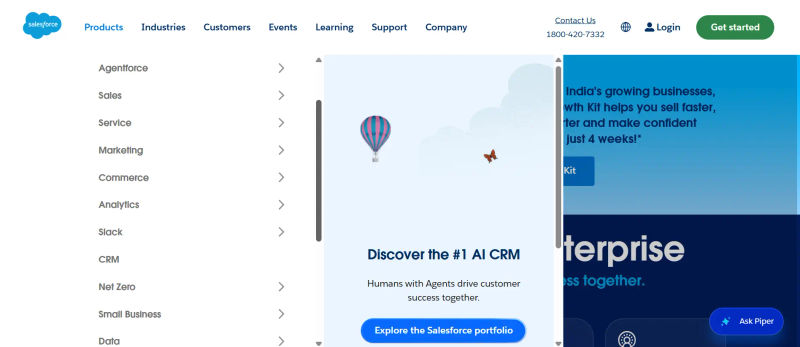
Salesforce Cloud Modules: A Deeper Dive
Beyond the core clouds, Salesforce offers a growing portfolio of solutions tailored to specific industries and business functions, further enhancing its appeal for large-scale businesses with specialized needs.
1. Exploring Industry-Specific Clouds & Other Key Modules
To address unique regulatory and operational challenges, Salesforce has developed Industry Clouds. These are pre-configured versions of the platform with industry-specific data models and processes. Key examples include:
Health Cloud: Provides a 360-degree view of the patient, incorporating electronic health record (EHR) data and facilitating personalized patient engagement while adhering to HIPAA compliance.
Financial Services Cloud: Tailored for wealth management, banking, insurance, and venture capital (VC). When evaluating the business and productivity software company Salesforce on CRM for VCs, this cloud excels by providing specialized tools for deal flow management, Limited Partner (LP) relationship tracking, portfolio company monitoring, and fundraising pipelines, all while ensuring strict regulatory compliance.
Other critical modules for enterprise include Experience Cloud, for building sophisticated digital portals for partners and customers, and Revenue Cloud, which handles complex Configure-Price-Quote (CPQ) and billing processes. These solutions can dramatically reduce implementation time compared to building the same functionality from scratch.
2. Salesforce Ecosystem & Partner Network
The value of Salesforce extends beyond its software. It is supported by a massive global ecosystem of implementation partners and certified professionals. For enterprises, this means access to a deep pool of talent for implementation, customization, and ongoing management. However, this talent comes at a premium; the cost of skilled consultants and the importance of selecting the right partner are critical factors in a successful deployment.
Salesforce CRM Pricing: Plans, Costs & Value for Enterprise
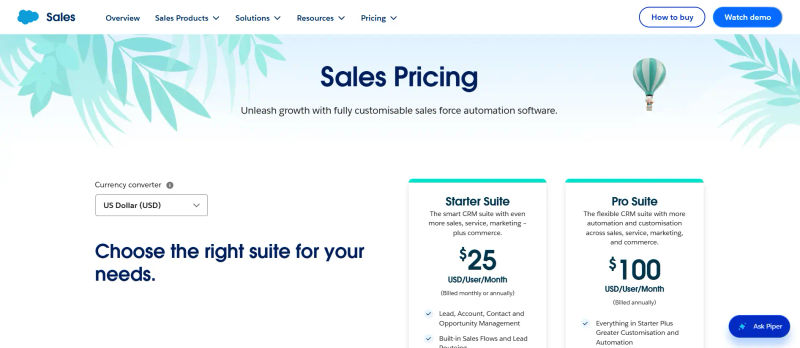
To evaluate the CRM software company Salesforce on pricing models, buyers must navigate a tiered, per-user, per-month subscription structure. Is Salesforce expensive compared to other CRMs? Yes. While list prices are a starting point, mandatory add-ons and implementation fees create a Total Cost of Ownership (TCO) that is substantially higher than most competitors.
Plan | Price | Best For | Key Features |
Free Suite | $0 USD/user/month (2 users included) | Very small teams that want a simple, no‑cost CRM with core sales, service, and basic marketing. | - Lead, Account, Contact, and Opportunity Management |
Starter Suite | $25 USD/user/month (starting price; billed monthly or annually, transaction fees apply) | Small businesses needing a simple, unified CRM for marketing, sales, service, and commerce. | - Lead, Account, Contact, and Opportunity Management |
Pro Suite | $100 USD/user/month (starting price; billed annually, contract required, transaction fees apply) | Growing teams that need more powerful, flexible CRM with deeper automation and customization. | - Everything in Starter Suite |
1. Understanding Total Cost of Ownership (TCO) for Enterprise Deployments
Calculating the true TCO for Salesforce requires looking far beyond the per-user, per-month license fees. As a general rule, large-scale businesses should expect to spend 3-5 times their annual license cost in the first three years on associated services. Enterprise decision-makers must factor in:
Implementation Costs: Partner consulting fees for a large-scale deployment can range from tens of thousands to millions of dollars.
Customization & Integration: Building custom applications and integrating with ERPs like SAP or Microsoft Dynamics 365 requires significant investment.
Third-Party Apps: Costs for essential apps from the AppExchange can add up quickly.
Administration & Maintenance: Enterprises typically require a dedicated team of Salesforce administrators and developers.
Training & Change Management: Ensuring user adoption across a large organization is a critical and often underestimated expense.
Compliance & Data Residency: Global enterprises must account for costs associated with meeting various data regulations like GDPR.
2. Negotiating Salesforce Contracts & Licensing Models
Enterprises have significant leverage when negotiating Salesforce contracts. It's crucial to secure multi-year discounts, negotiate license types (e.g., full access vs. platform licenses), and clearly define terms for future license additions. Be wary of automatic renewal clauses and ensure you have a clear understanding of the costs associated with data storage and API call limits, which can be 'hidden costs' for large, active deployments.
Top Enterprise Alternatives to Salesforce CRM
While Salesforce is the market leader, a host of powerful competitors offer compelling alternatives, each with unique strengths.
1. HubSpot CRM: Best for Integrated Marketing & Sales
HubSpot has evolved into a legitimate enterprise contender with its CRM Suite. Its primary strength is its user-friendly interface and tightly integrated platform.
Best fit for: Enterprises prioritizing ease of use and strong marketing/sales alignment out-of-the-box. However, its depth of customization for highly complex business processes still lags behind Salesforce.
2. Microsoft Dynamics 365: Strong Integration with Microsoft Ecosystem
For organizations heavily invested in the Microsoft stack (Office 365, Azure, Power BI), Dynamics 365 is a powerful alternative.
Best fit for: Microsoft-heavy tech stacks and regulated industries seeking deep ERP integration. It is a direct competitor in feature depth, often at a more competitive price point.
3. SAP CRM: Robust for Large-Scale ERP Integration
SAP's CRM solution, part of its C/4HANA suite, is a formidable choice for enterprises that run on SAP's ERP systems.
Best fit for: Large-scale businesses that need seamless, native integration between front-office customer data and back-office SAP operational data. However, it is often perceived as more rigid than Salesforce.
4. Oracle CRM: Comprehensive Suite for Global Enterprises
A standard Oracle CRM review highlights Oracle's Siebel and its newer Fusion Cloud (CX) offerings as major Salesforce competitors. While Salesforce leads in cloud innovation, Oracle excels in deep back-office data integration.
Best fit for: Global corporations seeking a single-vendor ecosystem to unify CRM, ERP, and HCM. Compared to Salesforce, Oracle offers a comprehensive, albeit complex and expensive, data architecture.
5. Zoho CRM: Cost-Effective & Feature-Rich for Growing Businesses
Zoho CRM's enterprise edition has matured significantly, offering impressive customization and a wide feature set at a compelling price.
Best fit for: Budget-conscious mid-market companies or enterprise departments that don't require the extreme scalability and ecosystem of Salesforce but still need deep functionality.
6. Freshworks CRM: Modern UI & AI-Driven Insights
Freshworks has gained traction with its modern, intuitive user interface. Its primary focus is on growing mid-market, with focused approach to some segments of enterprise clients.
Best fit for: Companies prioritizing speed-to-value and user experience over deep, bespoke customization. It provides a unified platform that is generally easier to implement and adopt than Salesforce.
Other Niche Solutions for Specific Workflows: Monday.com & Pipedrive
These platforms are not direct Salesforce competitors. Pipedrive is a sales-focused CRM renowned for its simplicity. Monday.com is a flexible 'Work OS' that can be configured for sales pipelines. Enterprises might choose these for specific teams that need an agile, focused solution.
For specialized use cases, consider these alternatives:
Aurea CRM vs Salesforce: Aurea focuses on deep industry verticalization (e.g., life sciences) and customer experience, whereas Salesforce provides a broader, universally adaptable ecosystem.
Salesforce vs SuiteCRM: SuiteCRM is an open-source alternative offering deep code-level customization and lower TCO (no per-user licensing fees), contrasting with Salesforce's premium, proprietary model.
Agile CRM vs Salesforce: Agile CRM provides an affordable, all-in-one platform for SMBs but lacks the enterprise-grade scalability, complex integrations, and advanced AI of Salesforce.
Choosing the Right CRM for Your Enterprise: Key Considerations
Selecting an enterprise CRM is a major strategic decision. A thorough evaluation process is critical.
1. Assessing Your Business Needs & Future Growth
Start by mapping your current and future business processes. Choose a platform that can scale and adapt to where your business will be in five to ten years. Evaluate a platform's architectural flexibility, not just its current feature list.
2. Implementation Strategy & Change Management
A successful CRM implementation is only 20% technology and 80% people and process. Develop a clear implementation roadmap with a trusted partner and invest heavily in change management, including executive sponsorship and comprehensive user training to drive adoption.
3. Data Strategy and Governance
Before implementation, establish a clear data strategy. This includes defining data ownership, quality standards, and governance policies to ensure your CRM remains a single source of truth rather than a repository of unreliable information.
4. Vendor Relationship & Support
Evaluate the vendor's support structure for enterprise clients. How responsive are they? What are their support tiers and escalation paths? A strong long-term partnership is as important as the technology itself.
5. ROI & Long-Term Value Assessment
To evaluate the enterprise software company Salesforce on selection & evaluation criteria, you must build a robust financial model. When you evaluate Salesforce on and business case metrics, project potential ROI using factors like increased sales productivity and reduced customer churn. Finally, weigh the long-term value of this unified platform against integrating multiple best-of-breed solutions.
Try AuthenCIO
Move to faster, smarter software evaluation with AI
Conclusion: Is Salesforce CRM Right for Your Enterprise in 2026?
As we look ahead to 2026, Salesforce remains the market leader in the enterprise CRM space for a reason. Its unparalleled scalability, deep customizability, and a comprehensive ecosystem make it the default choice for large, complex organizations seeking a single source of truth. For businesses with unique operational workflows, global scale, and the need for a platform that can be molded into a true competitive advantage, Salesforce is often the only solution with the required depth and flexibility.
However, its dominance does not make it the automatic right choice for everyone. The platform's significant cost, inherent complexity, and steep learning curve are formidable barriers. The rise of powerful, more user-friendly, and cost-effective alternatives like Microsoft Dynamics 365 and HubSpot means that a thorough evaluation is more critical than ever. Enterprises must be brutally honest about their internal resources, technical expertise, and appetite for a complex, multi-year implementation journey.
The final verdict is this: If your organization has the budget, the strategic vision, and the commitment to resource a proper implementation, Salesforce provides a technological foundation that can scale to virtually any demand. But if your needs are more standardized, or if speed-to-value and ease of use are higher priorities, the competitive landscape offers a wealth of compelling alternatives that should not be overlooked.