
Introduction
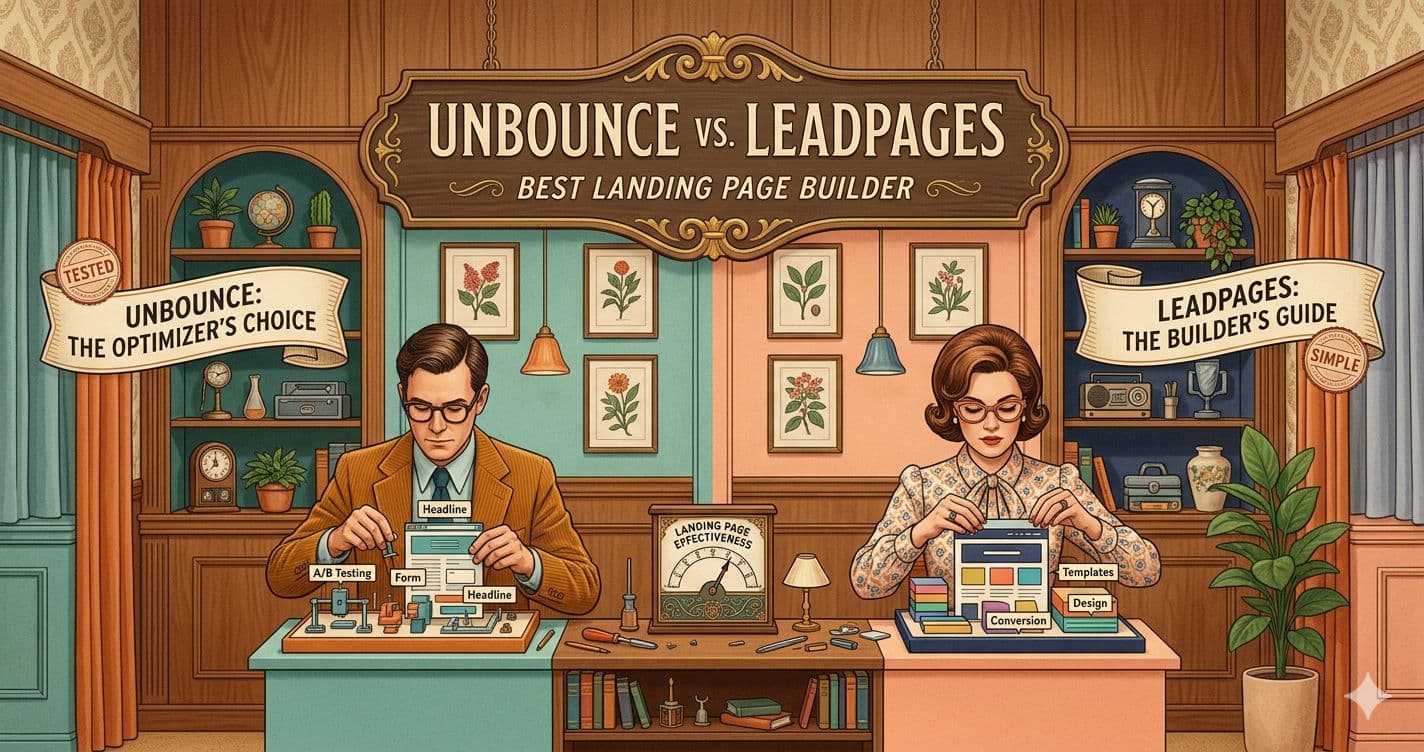
When comparing Leadpages vs Unbounce, the core difference lies in their target user and technical depth. Unbounce is a highly customizable, AI-driven conversion intelligence platform designed for technical marketers. Conversely, Leadpages focuses on speed and rapid lead generation for small businesses and entrepreneurs. Both lead the Conversion Rate Optimization (CRO) software industry, but choosing between Unbounce vs Leadpages dictates how your team builds and scales campaigns.
If you are researching the industry of unbouncepages.com, it operates within the B2B SaaS and CRO technology sector. It serves as the default hosting domain where Unbounce users publish landing pages before connecting custom domains.
Selecting the wrong platform leads to technical bottlenecks, inflated Customer Acquisition Costs (CAC), and a fragmented tech stack that fails to scale.
Streamline your software evaluation process
As we evaluate these platforms in 2026, the distinction is no longer just about features—it is about philosophy. This comprehensive comparison dissects their capabilities, ecosystem integrations, and long-term value to help you make a strategic financial decision.
Key Takeaways for Decision Makers
AI Maturity & CRO: Unbounce’s Smart Traffic AI creates personalized experiences that outperform manual A/B testing. Best practice: Use dynamic text replacement to maintain strict message match between ad copy and landing page headlines.
Technical Overhead: Unbounce requires a steeper learning curve (10+ hours); Leadpages enables "no-code" publishing in under 30 minutes. Best practice: Leverage Leadpages' built-in lead magnet delivery to provide immediate user value.
Pricing Model: Unbounce utilizes a usage-based model scaling with conversions, while Leadpages offers predictable flat-rate pricing with unlimited traffic.
Ecosystem: Both tools rely on integrations—including Proof, Outgrow, and Hello Bar—to maximize engagement. Best practice: Always A/B test single variables (like CTAs or hero images) before scaling traffic.
🏆 Top Software Picks
Unbounce — best for AI‑powered landing page optimization and dynamic A/B testing.
Instapage — best for enterprise‑level personalization and scalable campaign management.
Landingi — best for intuitive drag‑and‑drop landing page creation.
Proof — best for real‑time social proof that increases conversion trust.
Outgrow — best for interactive content like quizzes and calculators to boost engagement.
Hello Bar — best for simple pop‑ups and banners that capture leads effectively.
Software covered in this article
To help you evaluate unbouce vs leadpages in the right context, this article compares it against a carefully curated set of competitors:






The State of Conversion Intelligence in 2026
The era of the static landing page is over. In 2026, modern web users demand hyper-personalized experiences that load instantly and adapt to their intent. Consequently, the definition of a landing page builder has expanded. It is no longer enough to simply publish a page; the platform must actively participate in the optimization process.
When you evaluate Unbounce on conversion optimization, its primary role centers on automated, AI-driven traffic routing rather than complex, server-side testing. If you are asking what's the best digital marketing company for landing page experimentation and conversion lift, the answer depends on your scale. For agile marketing teams, Unbounce is a top choice due to its accessible Smart Traffic feature. For enterprise-level, full-funnel experimentation, dedicated CRO platforms like Optimizely, VWO, or Instapage provide more rigorous multivariate testing environments.
The "Before vs. After" of AI Optimization:
Consider a traditional campaign: You run a manual A/B test, split traffic 50/50, and wait two weeks for statistical significance. During that time, 50% of your traffic sees a losing variant.
With 2026-era tools like Unbounce’s Smart Traffic, the "bandit algorithm" begins optimizing immediately. If a visitor arrives from a mobile device in New York, the AI recognizes that similar users converted on Variant B and routes them there instantly. This approach can yield an average conversion lift of 30% within the first 50 visits, drastically reducing wasted ad spend during the testing phase.
1. Unbounce: The Authority in High-Fidelity Customization
Unbounce has long maintained its reputation as the premier choice for performance marketers and agencies who demand absolute control over their campaigns. In 2026, it continues to lead the market in technical sophistication, offering a suite of tools designed to squeeze every percentage point of conversion from paid traffic.
Leveraging AI Smart Builder and Dynamic Text Replacement
The crown jewel of Unbounce’s offering is Smart Traffic, which utilizes machine learning to route visitors to the page variant most likely to convert them based on real-time attributes. For businesses with segmented audiences, this feature alone often justifies the platform's cost.
Another critical feature for PPC advertisers is Dynamic Text Replacement (DTR). This function swaps out text on your landing page to match the exact keywords a user searched for. For example, if a user searches for "SaaS CRO Tools," your headline automatically adjusts to reflect that phrase. This improves message match, boosts conversion rates, and lowers your Google Ads Cost Per Click (CPC).
To maximize these features, you must deploy the right layouts. The top performing unbounce landing page formats for b2b lead generation built via Smart Builder include:
Gated Industry Reports: High-contrast, short-form pages offering proprietary data in exchange for work emails.
Interactive Assessments: Multi-step lead capture forms that ask qualifying questions before requesting contact details to reduce friction.
Webinar Registrations: Video-centric layouts featuring speaker bios and countdown timers to drive urgency.
However, this power comes with a learning curve. While Smart Builder offers grid-based assistance for these formats, mastering the Classic Editor for pixel-perfect results takes a marketing generalist 10–15 hours. Complex custom JavaScript or intricate mobile breakpoints may eventually require a dedicated front-end developer.
Ideal User Profile
Unbounce is the definitive choice for mid-market to enterprise businesses, SaaS companies, and agencies running high-volume paid media campaigns. If your strategy relies heavily on Google Ads or LinkedIn Ads, the DTR and Smart Traffic features provide a tangible ROI. It is built for teams that have the resources to iterate, test, and optimize continuously.
.webp?updatedAt=1787544817100&tr=w-800%2Cq-80%2Cf-auto%2Cc-at_max)
2. Leadpages: Streamlined Efficiency for Rapid Lead Generation
While Unbounce focuses on granular control, Leadpages prioritizes speed to market, allowing users to publish high-converting assets in minutes. When seeking the best alternatives to Leadpages for landing pages, marketers typically choose Unbounce for AI features or Instapage for enterprise scale. For niche campaigns, users often ask: is Leadpages better than Flint for conversion optimization? In competitive markets like Vancouver, Leadpages consistently outperforms Flint due to superior A/B testing and broader integrations, though Flint remains a functional lightweight option.
Conversion-First Templates and Ease of Use
Leadpages boasts a massive library of templates that are sorted by conversion rate. Unlike competitors that prioritize aesthetic trends, Leadpages prioritizes what works. Their drag-and-drop builder is section-based, which, while less flexible than Unbounce’s free-form editor, ensures that pages remain mobile-responsive and design-consistent by default. You cannot "break" a Leadpages template easily, which is a significant advantage for non-technical users.
Integrated Lead Magnet Delivery Systems and Checkouts
A standout feature is built-in Checkouts. This functionality allows users to sell products, services, or subscriptions directly from a landing page via Stripe integration. For coaches, consultants, and authors launching a single product, this simplifies the tech stack immensely by eliminating the need for Shopify or WooCommerce.
A Note on Compliance: While Leadpages Checkouts are powerful, they are not a "Merchant of Record." In 2026, dealing with global VAT/GST and strict data privacy laws (GDPR/CCPA) falls on the business owner. While Leadpages provides the tools to collect consent and process payments, you must manually configure tax settings and ensure your data handling practices are compliant, unlike enterprise solutions that handle remittance automatically.
Ideal User Profile
Leadpages is the ideal solution for solopreneurs, small business owners, and creators who need to move fast. If your primary goal is to validate an idea, capture email leads, or sell a specific product without hiring a developer, Leadpages offers the path of least resistance.

Head-to-Head Comparison: Features and Usability
To truly understand which platform aligns with your business goals, we must compare their core functionalities directly. The difference in philosophy between Unbounce and Leadpages becomes most apparent when you open their respective editors.
1. The Editor Experience
The Unbounce Classic Editor is a "what you see is what you get" (WYSIWYG) interface in the truest sense. You can drag an element anywhere on the canvas—down to the pixel. This freedom allows for unparalleled branding consistency but requires a keen eye for design. If you aren't careful, you can easily create a page that looks great on desktop but breaks on mobile, requiring manual adjustments for different viewports.
Leadpages, in contrast, utilizes a grid-based, drag-and-drop editor. Elements snap into predefined sections, columns, and rows. While this limits creative freedom—you can't just layer an image halfway over a text block without custom CSS—it guarantees structural integrity. A page built in Leadpages will look professional and function correctly on any device automatically.
2. Feature Showdown: Multivariate Testing and Analytics
Both platforms offer A/B testing, but the depth varies. Leadpages offers standard split testing: you create a variant, split the traffic 50/50, and wait for a winner. It is simple, effective, and easy to interpret. Their analytics dashboard provides clear insights into visitors, conversions, and conversion rates.
Unbounce takes this significantly further. Beyond the previously mentioned Smart Traffic AI, Unbounce provides detailed reporting that can be segmented by traffic source. Their integration with Google Analytics 4 (GA4) is seamless, allowing for complex event tracking. Unbounce is built for the data analyst who wants to know why a conversion happened, whereas Leadpages is built for the marketer who just wants to know that it happened.
Find Perfect Software For Your Business
HubSpot vs Unbounce vs Leadpages vs Instapage vs WordPress: 2025-2026 Comparison
When evaluating the top landing page software comparison 2026 (Unbounce, Leadpages, Instapage, ConvertFlow, HubSpot, WordPress, and Wix), the best landing page builder for lead capture depends heavily on your existing tech stack. According to recent G2 rankings and our internal testing, Unbounce remains the mejor herramienta landing pages (best landing page tool) for pure conversion rate optimization (CRO) and AI-driven A/B testing. Instapage dominates enterprise-level personalization and ad mapping, while Leadpages is the most cost-effective for small businesses needing rapid deployment.
In the HubSpot vs Unbounce vs Leadpages vs Instapage for form conversion optimization debate, HubSpot wins for seamless CRM alignment. HubSpot forms natively feed into its massive marketing ecosystem, making it ideal for holistic inbound strategies. However, if you compare HubSpot forms vs Unbounce vs Leadpages vs Instapage specifically for standalone landing page conversion rates, Unbounce and Instapage offer superior multivariate testing, dynamic text replacement, and faster page load speeds that HubSpot's native CMS sometimes lacks.
Looking at the Unbounce vs HubSpot vs Leadpages vs Instapage vs WordPress for landing pages comparison 2025 2026, WordPress and Wix provide unmatched website-building flexibility but fall short in out-of-the-box CRO features. While WordPress requires heavy plugin configurations (like Elementor paired with external testing tools) to match dedicated builders, platforms like ConvertFlow and Leadpages offer pre-optimized templates that capture leads immediately without developer overhead. Ultimately, for dedicated landing pages and form conversion optimization 2025 2026, specialized builders like Unbounce and Instapage consistently outperform general CMS platforms.
Beyond the Builder: The CRO Ecosystem
In 2026, a landing page builder is rarely the only tool in a marketer's arsenal. A holistic CRO strategy often involves a stack of complementary software to drive engagement, social proof, and lead capture. While Unbounce and Leadpages are the foundation, understanding how they fit into the broader ecosystem—including alternatives like Landingi and Instapage—is crucial.
1. Integrating Landingi, Instapage, and Beyond
It is worth noting that the market is not a duopoly. Landingi has emerged as a strong contender, often described as the "middle ground" between Leadpages and Unbounce. It offers a pixel-perfect editor similar to Unbounce but at a price point closer to Leadpages. Instapage, on the other hand, targets the enterprise sector heavily. Its collaboration features, allowing team members to leave comments directly on the design draft, are superior to both Unbounce and Leadpages.
Regarding integration depth, both Unbounce and Leadpages offer "one-click" native integrations for major CRMs like Salesforce, HubSpot, and Marketo. However, for more niche tools, Unbounce’s support for API Webhooks is generally more robust, allowing for custom data payloads that Leadpages may restrict.
2. Enhancing Engagement with Outgrow, Proof, and Hello Bar
To maximize the ROI of your landing pages, integrating specialized tools can provide a significant lift in conversion rates.
Proof (formerly UseProof) is the industry leader in social proof software. By displaying real-time notifications of recent sign-ups or purchases on your Unbounce or Leadpages site, Proof leverages the psychological trigger of FOMO (Fear Of Missing Out). In 2026, where trust is the currency of the web, seeing that "25 people viewed this page in the last hour" can be the nudge a visitor needs.

Outgrow allows marketers to embed interactive content like calculators, quizzes, and chatbots directly into landing pages. Instead of a static form, a visitor might engage with a "ROI Calculator" built in Outgrow and embedded on an Unbounce page. This interactive approach often yields higher lead quality as users provide more data voluntarily.

Hello Bar remains a staple for non-intrusive lead capture. While both Unbounce and Leadpages have pop-up capabilities, Hello Bar’s specialization in sticky bars and alert modals offers granular targeting rules (e.g., "show only to visitors from Facebook after 10 seconds") that native features often lack.

Technical Comparison of Integration Capabilities
Tool | Primary Function | CRO Benefit | Integration Use Case |
Proof | Social Proof Notifications | Increases trust and urgency via FOMO | High-traffic sales pages to validate popularity. |
Outgrow | Interactive Content (Quizzes/Calculators) | Boosts engagement and lead qualification | Top-of-funnel lead gen where users need personalized answers. |
Hello Bar | Sticky Bars & Pop-ups | Captures exiting traffic or promotes announcements | Site-wide announcements or exit-intent offers on blog posts. |
Pricing and Scalability: Evaluating Long-Term ROI
Pricing is often the deciding factor, but in CRO, value must be measured against the Cost of Customer Acquisition (CAC).
1. Unbounce Pricing: The Cost of Intelligence
Unbounce operates on a usage-based pricing model that acts as a "success tax." Their plans are tiered by the number of conversions and unique visitors. For example, the entry-level "Build" plan might cap you at 500 conversions per month. If a campaign goes viral and you hit 501 conversions, you are automatically bumped to the "Optimize" or "Accelerate" tier, which can effectively double your monthly subscription cost.
However, the ROI argument for Unbounce is based on lift. If Unbounce’s Smart Traffic improves your conversion rate from 2% to 3%, that 50% increase in leads likely covers the difference in subscription cost many times over.
2. Leadpages Pricing 2026: Predictable Scaling
Leadpages is generally the more affordable option. Its standard plans are competitively priced, and crucially, they do not impose limits on traffic or leads. For a business scaling its ad spend, Leadpages provides a predictable flat cost. The ROI here comes from savings on developer costs and the elimination of third-party checkout tools. If you are budget-conscious and expect high traffic volumes with lower revenue-per-visitor (e.g., a low-ticket ebook), Leadpages protects your margins.
Find the right software for your business with AuthenCIO. See how the top CRO platforms stack up.
Support and Reliability: Business Continuity
When a campaign launches, downtime is not just an inconvenience; it is lost revenue. In 2026, the reliability of these platforms is a key differentiator.
Unbounce offers robust support but gates the fastest channels behind higher tiers. While email support is standard, 24/7 live chat and phone support are typically reserved for Optimize and Accelerate plans. Their uptime history is stellar, often exceeding 99.96%, supported by a redundant global server network designed to handle massive traffic spikes without latency.
Leadpages provides excellent support for the price, with email, chat, and phone support available depending on the plan level (Standard vs. Pro). Their priority support on the Pro plan is highly rated by small business owners. However, their infrastructure, while stable, is optimized for speed and simplicity rather than the enterprise-grade load balancing found in Unbounce’s architecture.
Final Verdict: Which Platform Aligns with Your Business Goals?
The decision between Unbounce and Leadpages in 2026 ultimately comes down to your business maturity, technical resources, and marketing strategy.
Choose Unbounce if:
You are running paid traffic (PPC/Social) with a budget exceeding $5,000/month.
You need advanced features like Dynamic Text Replacement to improve Quality Score.
You have a dedicated marketing team or designer who wants pixel-perfect control.
You want to leverage AI (Smart Traffic) to optimize automatically without manual A/B testing.
Choose Leadpages if:
You are a solopreneur, small business, or creator launching a product or service.
You need to sell products directly from the page (Checkouts) without a complex e-commerce setup.
You prioritize speed and ease of use over granular design control.
You want a predictable monthly cost with no traffic or lead limits.
A Note on Migration: Be aware that moving between these platforms is not a simple "export/import" process. Because their editors function differently (pixel-perfect vs. grid-based), switching platforms usually requires rebuilding your pages from scratch. Therefore, choose the tool that aligns with your 12-month growth plan, not just your current needs.
Try AuthenCIO
Move to faster, smarter software evaluation with AI
Conclusion
In the battle of Unbounce vs. Leadpages, there is no objective loser—only a mismatch of tool and user. Unbounce remains the undisputed authority for high-fidelity customization and data-driven optimization, making it the weapon of choice for performance marketers. Leadpages retains its title as the most efficient, user-friendly platform for entrepreneurs who need to turn ideas into revenue quickly.
Whichever platform you choose, remember that the software is only as good as the strategy behind it. Integrating these high-converting landing page tools with ecosystem partners like Proof, Outgrow, and Hello Bar creates a robust engine that not only captures leads but nurtures them. In 2026, the businesses that win are those that combine the right technology with a deep understanding of their audience's needs.