.webp&w=64&q=75)
Introduction
When evaluating what makes a good landing page, 2025 and 2026 best practices dictate that it must be a precision-engineered asset designed to reduce cognitive load, match user intent perfectly, and guide visitors toward a singular goal. In a hyper-competitive digital landscape, mastering these strategies is the difference between scaling a business and burning through ad budget. For marketing managers, the pressure to lower Customer Acquisition Costs (CAC) and increase Return on Ad Spend (ROAS) means the battle is won or lost in the first three seconds after a click.
Streamline your software evaluation process
Conversion Rate Optimization (CRO) has evolved from simple A/B testing of button colors to a sophisticated discipline involving behavioral psychology, predictive AI, and hyper-personalization.
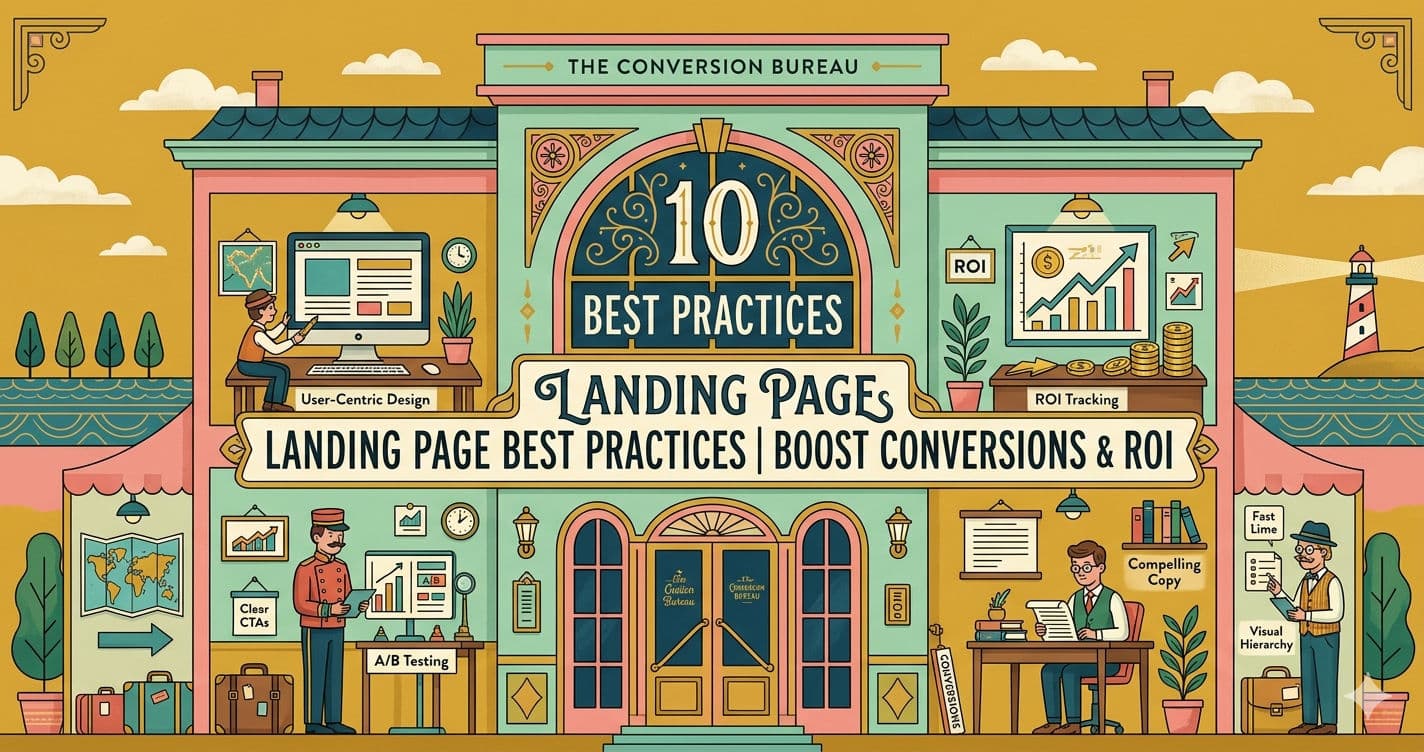
If your pages are not performing, you are paying premium rates to leak high-intent traffic. To stop this leakage, marketers must implement the latest best practices for landing page optimization and conversion rate in 2026. This guide explores ten advanced strategies—covering the essential best practices for landing page conversion rate optimization (CRO) in 2026—to maximize your ROI and future-proof your lead generation.
Key Takeaways: CRO Best Practices for Landing Pages
If you are looking for the most effective landing page optimization tips for higher conversion rates 2026, mastering the fundamentals of user experience and relevance is essential. Bridging the gap between recent years requires moving beyond basic design to hyper-personalized, frictionless experiences.
To maximize your campaign ROI, focus on these essential landing page conversion optimization tips 2026:
Maintain a 1:1 attention ratio: Remove external navigation links to keep users focused on a single primary call-to-action (CTA).
Implement Dynamic Text Replacement (DTR): Match your landing page copy directly to the user's search intent and ad click for maximum relevance.
Prioritize mobile-first Core Web Vitals: Fast load times and seamless mobile architecture are non-negotiable for modern audiences.
Use progressive profiling: Break long forms into multi-step "breadcrumbs" to reduce friction and capture higher-quality leads.
Leverage AI-driven testing: Move beyond simple A/B tests by using predictive traffic routing to serve the highest-converting variations in real-time.
Implementing these core CRO best practices for landing pages 2025 2026 will ensure your campaigns remain highly competitive and adapt to evolving user expectations.
Leading Conversion Rate Optimization Solutions to Know
While this guide explores key industry insights, seeing these principles in action requires the right platform. Here is a snapshot of the most recognized Conversion Rate Optimization solutions currently shaping the market.




1. Precision Value Propositions and Message Match
The concept of "Message Match" remains the single most critical factor in reducing bounce rates. Message match refers to the visual and textual alignment between the pre-click experience (your ad or email) and the post-click experience (the landing page or sales page).
When evaluating best practices for optimizing landing pages for higher conversions 2025 2026, message match is foundational. If a user clicks an ad promising "Enterprise-Grade Cybersecurity," and lands on a generic "Welcome to TechCorp" page, cognitive dissonance triggers an immediate bounce. Your headline must mirror the ad copy almost verbatim.
This applies equally to lead capture and direct sales. For those implementing best practices for optimizing sales pages 2025 2026, precision value propositions are mandatory. Unlike simple lead-gen pages, sales pages require articulating the exact ROI immediately "above the fold." You must answer the user's implicit question: "What is in it for me?" by replacing corporate jargon with benefit-driven copy that addresses specific pain points.
B2B Headline Example:
Before (Feature-Focused): "The Best CRM for Sales Teams."
After (Outcome-Focused): "Close 30% More Deals with AI-Driven Lead Scoring."
2. The 'One Goal' Ratio: Eliminating Navigation Leaks
A fundamental rule of high-converting landing pages is the maintenance of a 1:1 Attention Ratio. This ratio represents the number of actionable elements on the page compared to the number of conversion goals. On a standard homepage, the ratio might be 40:1—forty links, buttons, and menu items competing for the user's attention against the one desired action.
On an optimized landing page, this ratio must be 1:1. This means systematically removing the global navigation bar, the footer links, and any social media outbound links. The only clickable element on the page should be the Call to Action (CTA) button. By removing navigation, you eliminate "exit ramps" for your traffic, mitigating the Paradox of Choice and funneling attention solely toward the conversion event.
Pro-Tip: Balancing SEO and CRO
Marketing managers often face pushback from SEO teams regarding the removal of footer links. To resolve this, use a "collapsible" footer that keeps the visual interface clean or apply noindex tags to dedicated PPC landing pages. This ensures the page is treated purely as a conversion engine without diluting your site's internal linking structure.
3. Mobile-First Architecture and Core Web Vitals
With mobile traffic accounting for the majority of web visits in 2026, "mobile-responsive" is no longer a feature; it is the baseline. However, high-converting pages go beyond responsiveness—they are designed with a mobile-first architecture. This means considering the "thumb zone" for CTA placement and ensuring that touch targets are large enough to prevent frustration.
Crucially, page speed has become a dominant factor in both SEO rankings and conversion rates. Google's Core Web Vitals metrics—specifically Largest Contentful Paint (LCP) and Cumulative Layout Shift (CLS)—are direct indicators of user experience. Research indicates that every second of load time delay beyond the first five seconds can drop conversion rates by over 4.42%.
To optimize for this, marketing managers must ensure their landing page builders are generating clean, lightweight code. Heavy scripts, uncompressed images, and third-party tracking pixels must be audited regularly. A slow page is a silent revenue killer; users will abandon the page before they even see your headline if the load time lags.
4. Visual Hierarchy and Directional Cues
Visual hierarchy is the arrangement of elements in a way that implies importance and guides the user's eye through the content in a logical flow. In 2026, the best landing pages utilize sophisticated eye-tracking principles to manipulate user attention subconsciously.
One powerful technique is the use of directional cues. These can be explicit, such as arrows pointing directly at a form or CTA button, or implicit, such as a hero image where the subject is looking towards the conversion element. Human beings are biologically wired to follow the gaze of others; if a person in your hero image is looking at the "Sign Up" button, the user's eyes will naturally drift there as well.
Additionally, structuring content using F-patterns (for text-heavy pages) or Z-patterns (for pages with alternating text and media) ensures that the user scans the most critical information. Breaking up dense text with bullet points, bold subheadings, and ample whitespace reduces cognitive load, making the page feel easier to consume and the offer more accessible.
5. Dynamic Text Replacement (DTR) for Ad Relevance
Dynamic Text Replacement (DTR) swaps page copy in real-time based on a user's search query, ensuring exact message match. As one of the best landing page conversion optimization techniques 2025 2026 has seen, DTR dominates competitive niches. For instance, the best poker bot landing pages 2026 conversion optimization strategies rely on DTR to instantly change headlines from "Texas Hold'em AI" to "Omaha Poker Bot" based on user search terms. This exact-match personalization directly aligns ad intent with page experience, maximizing ROI.
1. The Mechanics of Personalization
For example, if you are running a PPC campaign for a project management tool, one user might search for "marketing task software" while another searches for "engineering project tracker." Using platforms like Unbounce or Instapage, you can configure the H1 headline to dynamically change to match these search terms exactly. The user searching for marketing tools sees "The #1 Marketing Task Software," while the engineer sees "The #1 Engineering Project Tracker." This level of specificity drastically increases relevance and trust, signaling to the user that you have exactly what they are looking for.
2. Mitigating Technical Risks
While powerful, DTR carries technical risks. If a URL parameter is missing or malformed, the headline could appear broken or blank. It is essential to configure "default" fallback text. For instance, if the dynamic parameter fails, the headline should automatically revert to a strong, generic value proposition like "The #1 Project Management Software." This ensures a consistent user experience regardless of the traffic source.
6. Real-Time Social Proof Integration
Social proof is a psychological phenomenon where people assume the actions of others in an attempt to reflect correct behavior for a given situation. While static testimonials and logo bars are standard, 2026 best practices demand real-time, authentic social proof to trigger FOMO (Fear Of Missing Out).
This is where tools like Proof (specifically their Pulse feature) become invaluable. Proof allows you to display live notification bubbles on your landing page that show recent activity, such as "Sarah from New York just signed up for a demo" or "150 people are viewing this page right now."

These notifications validate the decision to convert by showing that the offer is active and popular. Unlike static reviews which can be viewed with skepticism, live data streams create a sense of urgency and community. For B2B lead generation, seeing that peers in relevant industries are actively engaging with the content can be the tipping point that convinces a hesitant prospect to fill out the form.
Find Perfect Software For Your Business
7. Frictionless Form Design and Conversion Rate Optimization
The form is the moment of truth, and it is also where the most friction occurs. Every additional field you ask a user to fill out reduces the conversion rate. The best practice is to ask for the absolute minimum amount of information required to qualify the lead.
1. Progressive Profiling and Breadcrumbing
Marketing teams often need rich data for segmentation, but asking for it all at once is a conversion killer. The solution is progressive profiling. Instead of asking for name, email, company size, budget, and role all at once, you use smart forms that remember returning visitors. On the first interaction, you might just ask for an email. On the second visit, the form auto-fills the email and asks for the job title. Additionally, using a "breadcrumbing" technique—asking low-threat questions first (e.g., "What is your goal?") before asking for contact info—leverages the psychological principle of consistency to boost completion rates.
2. Privacy-First Lead Gen and Social Login
In 2026, data privacy is paramount. Forms must be fully compliant with GDPR, CCPA, and other global standards. This means including clear, un-ticked consent checkboxes for data processing. To counterbalance this added friction, implement Social Login (e.g., "Sign up with LinkedIn" or "Continue with Google"). This reduces the manual effort of typing and often provides verified data directly from the provider, improving lead quality while simplifying the user experience.
8. Deploying Interactive Lead Magnets
The era of static legacy pages and PDF whitepapers is waning. In 2026, users value immediate, personalized insights over generic reading material. Interactive content, such as calculators, quizzes, and assessments, generates significantly higher engagement and conversion rates than static lead magnets.
Platforms like Outgrow specialize in enabling marketers to build these interactive experiences without coding. For instance, instead of offering a guide on "How to Save on SaaS Costs," you could build a "SaaS Savings Calculator" using Outgrow. The user inputs their current spend and team size, and the tool calculates their potential ROI. To get the detailed report, the user provides their email address.

Effort vs. Impact Assessment:
While interactive lead magnets require a higher initial build effort than a standard PDF, their shelf-life and conversion impact are significantly higher. They provide the sales team with rich, declared data about the prospect's specific situation, allowing for highly targeted follow-up conversations that static content simply cannot generate.
9. Video and Rich Media Integration
Video content continues to dominate consumption habits. Including an explainer video on your landing page can increase conversion rates by up to 80%. Video is particularly effective for complex B2B SaaS products where text alone may fail to convey the utility of the software.
Best practices for landing page video include keeping it short (under 90 seconds), ensuring it works without sound (using captions), and placing a CTA directly next to or inside the video player. The goal of the video is to increase dwell time and build trust quickly. It humanizes the brand and allows you to deliver a high-density of information in a format that requires low effort from the user.
However, care must be taken to ensure video embeds do not negatively impact the Core Web Vitals mentioned earlier. Lazy-loading video elements so they only load when the user scrolls to them is a technical necessity for maintaining page speed.
10. Continuous A/B and Multivariate Testing
The final, and perhaps most enduring, best practice is the commitment to data-driven optimization. There is no such thing as a "perfect" landing page, only one that is currently performing well. Consumer behaviors shift, competitors adjust their tactics, and ad platforms evolve.
Ensuring Statistical Significance
Marketing managers must cultivate a culture of continuous testing. This goes beyond simple A/B tests (Headlines A vs. Headline B). However, a common pitfall is stopping tests too early. You must ensure statistical significance (usually 95% confidence) before declaring a winner. Stopping a test based on a small sample size can lead to false positives and long-term revenue loss.
Leveraging AI-Driven Traffic Routing
In 2026, we are moving beyond manual analysis. AI-driven testing tools, such as Unbounce's Smart Traffic, can automatically route visitors to the variant of the page most likely to convert them based on their specific attributes (device, location, browser). This allows you to optimize for conversions while the test is still running, rather than waiting weeks for a result. This "bandit testing" approach maximizes ROI during the testing phase itself.
Comparison: Static vs. Dynamic Landing Page Elements
To visualize the shift in best practices, the table below outlines the difference between traditional landing page elements and the optimized, dynamic approach required in 2026.
Features | Static Landing Page | Dynamic Landing Page |
Headline Strategy | One generic headline for all traffic sources. | Dynamic Text Replacement (DTR) matches ad copy/search terms. |
Social Proof | Static quote or logo carousel. | Real-time notifications via Proof (e.g., "John signed up 5m ago"). |
Lead Magnet | Static PDF Ebook download. | Interactive Calculator or Quiz via Outgrow. |
Form Length | Long, static form asking for all details. | Progressive Profiling or multi-step forms based on user intent. |
Navigation | Full website menu included. | 1:1 Attention Ratio (No navigation links, only CTA). |
Optimization | Occasional manual A/B testing. | AI-driven traffic routing (e.g., Unbounce Smart Traffic). |
Global CRO: Landing Page Optimierung für Mehr Conversions
Expanding into the DACH region requires localized strategies that go beyond simple translation. Implementing effective landing page optimierung für mehr conversions best practices 2025 2026 means adapting cultural nuances, trust signals (like an Impressum and strict GDPR compliance), and localized copy to resonate with German-speaking audiences. To capture this high-value market, your landing page optimization für mehr conversions best practices 2025 2026 must prioritize data security and detailed technical specifications over purely emotional appeals.
When scaling internationally, marketers must blend global frameworks with regional expectations. Executing landing page optimierung conversion rate optimization best practices 2025 2026 ensures your message match remains precise across different languages. Furthermore, teams should continuously audit localized assets using landing page optimierung conversion rate 2025 2026 best practices to refine CTA buttons, trust badges, and form fields specifically for German users.
Ultimately, mastering these regional nuances is critical for long-term success. By applying landing page optimierung conversion rate best practices 2025 2026 alongside landing page optimierung conversion rate optimierung best practices 2025 2026, brands can significantly lower acquisition costs. Sticking to these proven landing page optimierung für mehr conversions best practices 2026 will solidify your international ROI and maximize lead generation across European markets.
Best Landing Page Optimization Strategies for Startups
Startups operating on lean budgets must prioritize high-impact, low-cost tactics to maximize their limited ad spend. The best landing page optimization strategies for startups 2025 2026 focus on speed, message clarity, and authentic trust signals rather than expensive custom web development. By mastering these foundational landing page conversion rate optimization best practices 2025 2026, emerging brands can effectively compete with established market leaders.
To drive immediate ROI without inflating customer acquisition costs, early-stage companies should implement these cost-effective strategies:
Hyper-Specific Message Matching: Instead of driving traffic to a generic homepage, use affordable landing page builders to duplicate pages and tailor the headline to match specific ad keywords perfectly.
Scrappy Social Proof: Skip the high-production corporate videos. Embed raw, user-generated content (UGC) or screenshot actual customer emails and social media mentions to build immediate, authentic trust.
Micro-Commitment Forms: Reduce friction by splitting lead capture into two steps. Ask only for an email address on the first click, ensuring you capture the lead even if they abandon the subsequent, more detailed form fields.
AI-Assisted Iteration: Utilize built-in AI tools within modern CRO platforms to rapidly generate and A/B test alternative headlines and call-to-action (CTA) variants without hiring dedicated copywriters.
Building Your CRO Tech Stack
Executing these best practices requires more than just good copywriters and designers; it requires a robust technology stack. Attempting to build high-converting pages using standard CMS templates often leads to technical bottlenecks and limited flexibility.
For rapid deployment and testing, dedicated landing page builders like Unbounce and Instapage are industry standards. They provide the agility marketing teams need to launch campaigns without waiting on engineering resources. They also natively support the dynamic features discussed, such as DTR and mobile responsiveness.
To layer on psychological triggers and engagement, integrating specialized tools is necessary. Proof handles the social credibility aspect by injecting real-time activity signals that static pages lack. Outgrow transforms passive readers into active participants through interactive content, significantly increasing lead quality.
When selecting your stack, integration capabilities are key. Your landing page builder must talk to your CRM, your analytics platform, and your marketing automation tools seamlessly. The goal is a unified ecosystem where data flows freely, allowing for closed-loop reporting on which pages are actually driving revenue, not just leads.
Try AuthenCIO
Move to faster, smarter software evaluation with AI
Conclusion: Future-Proofing Your Lead Generation
Implementing the top landing page conversion rate optimization best practices 2026 remains the linchpin of digital marketing. By adopting these ten strategies—from architectural discipline to advanced personalization—marketers can significantly reduce friction and improve conversion rates.
Success requires strict adherence to landing page cro best practices 2026, relying on data-backed decisions rather than guesswork. When you integrate landing page conversion optimization best practices 2026, you build a resilient lead generation engine. Transitioning from the best practices landing page conversion rate optimization 2025 2026 era means focusing heavily on user psychology and removing technical barriers.
Mastering landing page best practices 2026 conversion optimization and landing page optimization best practices for higher conversions 2025 2026 requires prioritizing user experience, leveraging automation tools like Unbounce or Instapage, and continuously testing.