.webp&w=64&q=75)
Introduction
In the high-velocity world of 2026 digital marketing, the static webpage is effectively dead. For Marketing Managers at small to medium-sized businesses (SMBs), the battleground for customer acquisition has shifted entirely to dynamic, personalized, and high-converting landing pages. The days of relying on an overburdened IT department to hard-code a campaign page are long gone. Today, agility is the currency of Conversion Rate Optimization (CRO).
Streamline your software evaluation process
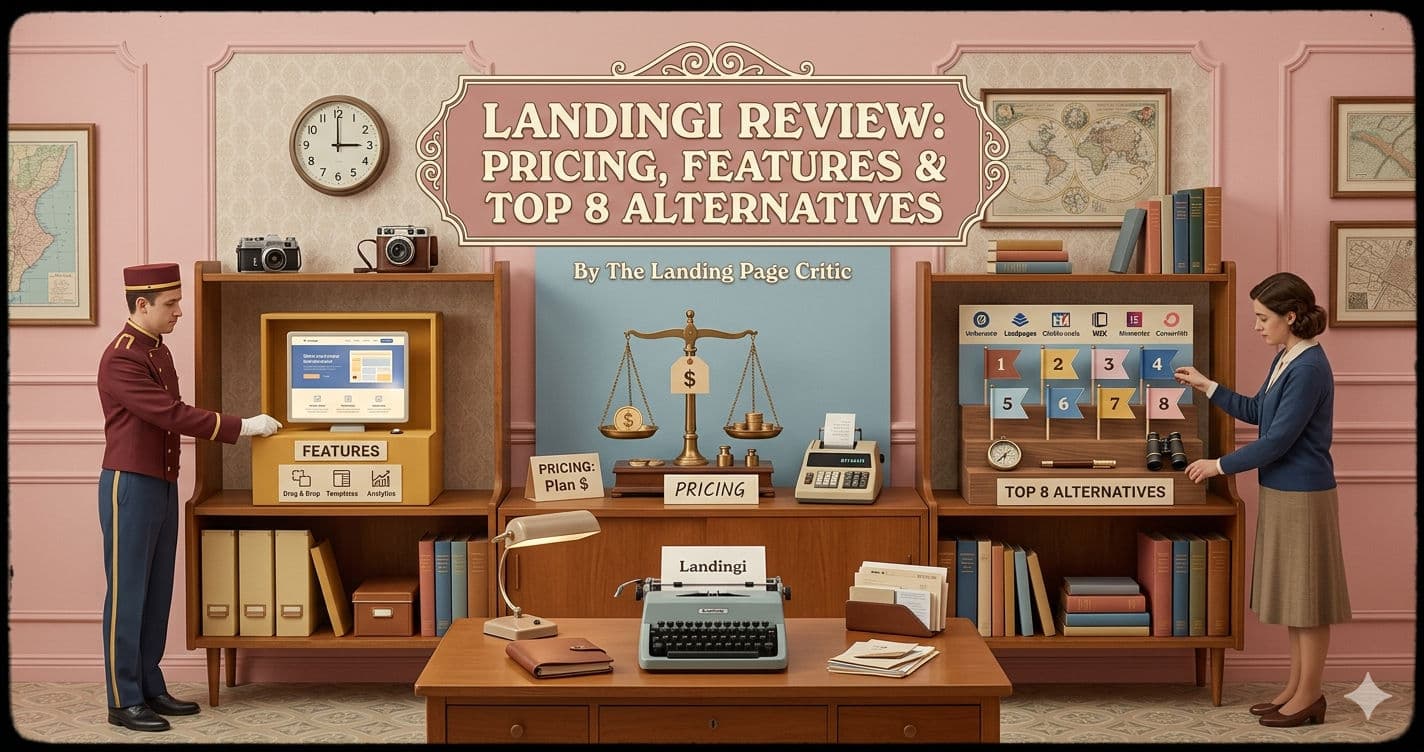
Enter Landingi, a platform that has steadily evolved from a simple drag-and-drop builder into a centralized landing page and lead management platform. As we navigate a landscape dominated by AI-driven design, strict data privacy regulations, and the demand for hyper-personalization, the question remains: Is Landingi still the most pragmatic choice for the mid-market, or have competitors like Unbounce and Instapage outpaced it in the race for feature supremacy?
This 2026 product overview provides a granular analysis of Landingi’s capabilities, pricing elasticity, and strategic fit for your tech stack. We will dissect its "Smart Section" technology, evaluate its readiness for the post-cookie internet, and pit it against eight formidable competitors ranging from the interactive prowess of Outgrow to the enterprise-grade stability of Instapage.
The Strategic Pros and Cons of Adopting Landingi
No software is perfect. While Landingi excels in many areas, it has limitations that Marketing Managers must weigh against their specific requirements.
Pros:
No-Code Autonomy: The interface is genuinely intuitive. A marketing generalist can build a professional page from scratch without writing a single line of HTML or CSS.
GDPR & Privacy Compliance: Landingi handles the heavy lifting of consent management and data storage compliance, a massive pro for businesses operating in or targeting the EU.
Cost-Effectiveness: Compared to enterprise-heavy tools like Instapage, Landingi offers a very competitive feature-to-price ratio for the Professional plan.
Template Library: The library of 400+ templates is updated regularly to reflect 2026 design trends, ensuring pages don't look dated.
Cons:
Mobile Editor Quirks: While the desktop editor is robust, the mobile view sometimes requires manual tweaking to ensure elements stack correctly. It is not always "automatic."
Advanced Analytics: While good for basic metrics, deep-dive attribution modeling is better handled by dedicated analytics tools rather than Landingi’s native dashboard.
WordPress Overlap: Users often ask, "Is Landingi better than WordPress?" For SEO-heavy content blogs, no. But for pure PPC landing pages, Landingi is superior due to the lack of plugin maintenance and higher security, though this bifurcation can be annoying for some teams to manage.
Best for: Marketing teams and SMBs running PPC or lead‑gen campaigns.
Verdict: Landingi delivers a streamlined, AI‑enhanced landing‑page builder that excels in speed and security.

Software covered in this article
To help you evaluate Landingi in the right context, this article compares it against a carefully curated set of competitors:








Key Takeaways from this 2026 Review:
Market Position: Landingi remains the "Best Landing Page Automation Software 2026" for SMBs requiring enterprise features without enterprise costs.
AI Evolution: New predictive copy and layout tools have significantly reduced time-to-market for campaigns.
Data Integrity: Robust server-side tracking solves the data loss issues caused by modern browser privacy restrictions.
Competitive Landscape: While powerful, specific alternatives like VWO or Outgrow may be better suited for niche interactive or testing needs.
Ready to compare Landingi with other leading CRO platforms? Try AuthenCIO for free!
The Evolution of Landing Page Automation for SMBs in 2026
The landing page software market has exploded, with projections estimating a valuation of USD 6.8 billion by 2033. For the SMB Marketing Manager, this growth presents both a blessing and a curse. The blessing is accessibility; tools that once cost thousands a month are now within reach. The curse is "feature bloat"—the overwhelming density of tools that often leads to analysis paralysis.
In 2026, the definition of a "landing page builder" has expanded. It is no longer just about placing a form on a page. It is about Predictive Content Generation, Server-Side Tracking, and Hyper-Personalization. The shift toward cloud-based solutions has been driven by the need for scalability, allowing businesses to spin up hundreds of campaign-specific assets without crashing their core infrastructure.
Furthermore, the "cookieless" future is now the present. With third-party data collection severely restricted, first-party data capture via optimized landing pages is the lifeblood of digital marketing. Platforms like Landingi have had to pivot from purely aesthetic design tools to data-gathering powerhouses that integrate seamlessly with CRMs like HubSpot and Salesforce. This evolution is critical because, as recent reports indicate, the lead generation software market is growing at a CAGR of 14.55%, signaling that businesses are doubling down on software that doesn't just attract traffic, but captures it intelligently.
The Critical Importance of Server-Side Tracking
One of the most significant shifts in 2026 is the technical requirement for Server-Side Tracking. For the non-technical Marketing Manager, it is essential to understand why this matters. Traditional "client-side" tracking (like the old Facebook Pixel) relies on the user's browser to send data back to the ad platform. However, with the rise of Intelligent Tracking Prevention (ITP) in Safari, Firefox, and the privacy sandbox in Chrome, browsers now routinely block these signals. This leads to a discrepancy where your CRM shows 100 leads, but your ad platform only reports 60, ruining your Return on Ad Spend (ROAS) calculations.
Landingi has addressed this by implementing robust server-side API integrations (CAPI). Instead of relying on the browser, the data is captured by Landingi's server when the form is submitted and sent directly to the ad platform's server (cloud-to-cloud). This bypasses ad blockers and browser privacy restrictions, ensuring that your attribution data remains 99.9% accurate. For SMBs spending significant budget on paid acquisition, this feature alone can justify the platform's cost by recovering "lost" conversion data.
Core Features: Why Landingi Remains a Top Contender
Landingi’s 2026 iteration focuses heavily on reducing "Time-to-Market." For a marketing team of 3-5 people, the ability to launch a campaign in hours rather than weeks is a decisive competitive advantage. Below, we analyze the core features that define its current value proposition.
1. AI-Driven Design and Smart Section Technology
The crown jewel of Landingi’s 2026 feature set is the Smart Section technology. In the past, updating a footer or a testimonial block across 50 active landing pages was a manual nightmare. Smart Sections allow you to update a single global element, and the changes propagate instantly across all pages where that section is deployed. For SMBs managing multiple sub-brands or extensive PPC campaigns, this feature alone can save dozens of man-hours per month.
Complementing this is the platform's AI-driven copy and layout generation. Unlike the rudimentary text spinners of 2024, Landingi’s AI now understands conversion context. The "Pixel-Perfect" editor remains a staple, offering a level of design granularity that grid-based editors (like early versions of Leadpages) often lack. This allows designers to maintain strict brand guidelines without touching CSS.
2. AI in Action: A Conversion Context Example
To illustrate the power of Landingi's 2026 AI capabilities, let's look at a practical "Before and After" scenario for a B2B SaaS company selling project management software.
The Manual Approach (Before): A marketing manager writes a generic headline based on intuition: "The Best Project Management Tool for Teams." This is vague, lacks urgency, and has a low conversion probability.
The Landingi AI Approach (After): The user inputs the industry (SaaS), the goal (Free Trial Sign-up), and the target audience (Remote Teams). Landingi’s AI analyzes millions of high-performing data points and suggests: "Cut Project Delivery Time by 30% with Automated Workflows. Start Your Free Trial."
The AI doesn't just write text; it applies persuasion principles. It shifts the focus from the product to the outcome, a subtle but critical distinction that drives conversion lift. This allows a solo marketer to operate with the sophistication of a dedicated copywriter.
3. Advanced Lead Intelligence and CRM Integration
In 2026, a landing page is only as good as the data it feeds into your stack. Landingi has bolstered its integration capabilities to support complex automation workflows. The platform supports Dynamic Text Replacement (DTR), which aligns landing page copy with the specific keywords a user searched for. If a user searches for "Cheap CRM for Startups," the landing page headline dynamically changes to reflect that exact phrase, drastically improving Quality Score in Google Ads and lowering Cost Per Click (CPC).
The platform integrates natively with major CRM and email marketing tools, ensuring that leads flow directly into nurturing sequences. For example, a form submission can trigger a webhook that not only updates a Salesforce record but also pings a Slack channel for the sales team, reducing lead response time to near zero.
4. Scalable Asset Management for Marketing Teams
One of the primary pain points for growing SMBs is digital clutter. Landingi addresses this with an organized folder structure and granular user permissions. You can assign specific access levels to team members or external agencies, ensuring that a junior copywriter doesn't accidentally break the JavaScript tracking code on a live page.

The platform also includes built-in image optimization and a free SSL certificate for every page, which are critical Core Web Vitals factors. In 2026, page load speed is a direct ranking factor for SEO and a primary determinant of bounce rates on mobile devices. Landingi’s infrastructure utilizes a global Content Delivery Network (CDN) to ensure that pages load instantly, regardless of the user's geographic location.
Find Perfect Software For Your Business
Migration Guide: Moving to Landingi in 2026
For many Marketing Managers, the barrier to switching software isn't the price—it's the migration headache. Moving dozens of live pages from a legacy provider like Unbounce or a custom WordPress setup can feel daunting. Landingi has streamlined this process significantly in 2026.
Step 1: The Asset Audit
Before moving, use Landingi's dashboard to categorize your existing pages. Identify which pages are "evergreen" (always on) and which are temporary campaign pages. This is the time to prune dead weight.
Step 2: The Concierge Import Service
For the Professional and Agency plans, Landingi offers an import tool that is surprisingly accurate. You simply paste the URL of your existing live page (even if hosted on a competitor's platform), and Landingi scrapes the design, images, and text, reconstructing them in the Landingi editor. While not always 100% perfect, it gets you 90% of the way there, requiring only minor tweaks to padding or font weights.
Step 3: Global Element Reconstruction
Once imported, the best practice is to immediately convert headers, footers, and form styles into "Smart Sections." This ensures that future updates are scalable. If you skip this step, you are just replicating the maintenance debt of your old system.
Step 4: Domain and Tracking Switch
Finally, Landingi provides a guided DNS setup wizard. In 2026, this process includes automated SSL provisioning, so there is no downtime where your pages show a "Not Secure" warning. Once the domain is live, you simply toggle your server-side tracking integrations, and the migration is complete.
Landingi Pricing Breakdown 2026: Which Plan Fits Your Budget?
Pricing elasticity is a major factor for SMBs. Landingi’s 2026 pricing structure is designed to scale with your traffic and feature needs. Unlike some competitors that hide pricing behind "Contact Sales" walls, Landingi maintains transparency.
It is important to note the concept of "Unlimited Conversions." Many competitors in 2026 punish success by charging overage fees if you generate too many leads. Landingi (on most plans) allows for unlimited conversions, meaning your costs remain flat even if your campaign goes viral. However, do pay attention to unique visitor caps on lower tiers.
Note for bargain hunters: It is often worth searching for a "Landingi discount code 2026" before checking out, as the company frequently runs promotions for annual commitments.
Plan | Price | Best For | Features |
Build | $29/mo | Solopreneurs & Beginners | Drag-and-drop editor, 10 Landing Pages, Unlimited Conversions, WordPress Plugin, Basic Analytics. |
Optimize | $29/mo | Growing SMBs | Unlimited Landing Pages, Pop-ups, Smart Sections, Integrations (Zapier, HubSpot), A/B Testing. |
Scale | $299/mo | Marketing Agencies | Sub-accounts for clients, White-label capabilities, Audit logs, Priority Support, Unbranded emails. |
Enterprise | $1499/mo | Mid-Market / Enterprise | Custom domain limits, Advanced API access, Dedicated Success Manager, SSO, Custom Development hours. |

*Note: All prices shown reflect typical monthly billing. Vendors often offer lower pricing for annual commitments, but those discounts are excluded here for easier comparison. Actual costs may vary depending on your requirements, usage volumes, and negotiated terms.
Top 8 Landingi Alternatives to Consider for Your Tech Stack
To make an informed decision, you must understand the landscape. Here are eight competitors that serve as viable alternatives, categorized by their specific strengths in the 2026 market.
1. Landingi vs Instapage for Small Business
Instapage is often cited as the direct premium competitor to Landingi. For a small business, the choice often comes down to budget versus collaboration needs. Instapage offers a superior "Collaboration Layer" that allows stakeholders to click and comment directly on the design mockups, streamlining approval processes for large teams. However, Instapage's entry-level pricing is significantly higher than Landingi's. Best For: Large marketing teams with complex legal/compliance approval workflows.
2. Outgrow and POWR: Best for Interactive Content
Outgrow takes a different approach to lead generation. Instead of static forms, Outgrow specializes in interactive content like calculators, quizzes, and chatbots. In 2026, interactive content sees significantly higher engagement rates than passive reading. If your strategy relies on complex lead qualification (e.g., "Calculate your mortgage savings"), Outgrow is superior to Landingi’s standard form capabilities. Best For: High-engagement lead qualification and viral quizzes.
POWR is a plugin library that can supercharge existing sites. If you are happy with your current CMS (like WordPress or Shopify) and just need specific widgets—like a countdown timer, a social feed, or a popup—POWR is a modular alternative. It lacks the full-page building environment of Landingi but offers granular solutions for specific conversion elements. Best For: Adding specific conversion widgets to an existing site without a full builder.
3. Unbounce: Best for High-Volume Enterprise Needs
Unbounce remains a direct rival to Landingi but differentiates itself with its "Smart Traffic" AI. This feature automatically routes visitors to the landing page variant most likely to convert them based on their demographic and behavioral attributes. While Landingi has A/B testing, Unbounce’s algorithmic routing is often faster at achieving statistical significance for high-traffic campaigns. Unbounce is ideal for teams spending over $50k/month on ad spend where every percentage point of conversion lift equals substantial revenue. Best For: High-traffic PPC campaigns requiring algorithmic optimization.
4. VWO, Proof, and Conversion Wax: Best for Conversion Optimization
VWO (Visual Website Optimizer) is not just a landing page builder; it is a full-suite experimentation platform. If your primary goal is scientific testing—multivariate testing, heatmaps, session recordings, and funnel analysis—VWO is the superior choice. Landingi builds the pages, but VWO perfects them. Best For: Advanced CRO managers requiring deep statistical testing capabilities.
Proof leverages the psychological trigger of social proof. It displays real-time notifications (e.g., "Jane from Austin just bought this") on your pages. While Landingi can integrate with Proof, using Proof as a standalone strategy focuses entirely on increasing trust and urgency. It is less of a builder and more of a conversion layer that sits on top of your stack. Best For: E-commerce and SaaS brands needing to manufacture urgency.
Conversion Wax has emerged in 2026 as a niche player focused on behavioral psychology in design. It offers pre-optimized templates based on neuro-marketing principles. While less flexible than Landingi’s drag-and-drop editor, Conversion Wax pages are rigid for a reason: they are structurally designed to guide the eye to the CTA. Best For: Teams wanting scientifically rigid templates that prevent "bad design."
5. Best for Budget-Conscious SMBs: Leadpages
Leadpages is often the first stop for small businesses. It is generally more affordable than Landingi and focuses on speed and simplicity over design freedom. The editor is more grid-based, which limits creativity but ensures that you can't "break" the design. For a Marketing Manager who needs to spin up a webinar registration page in 10 minutes with zero design resources, Leadpages is the most efficient, albeit less powerful, alternative. Best For: Solopreneurs and small teams prioritizing speed and low cost over pixel-perfect design.
Final Verdict: Optimizing Your ROAS with Landingi in 2026
Landingi occupies a strategic "sweet spot" in the 2026 market. It offers 80% of the enterprise power of Instapage or Unbounce but at a price point that is accessible for the mid-market SMB. Its commitment to "Smart Sections" and AI integration shows a roadmap aligned with the future of scalable marketing.
For the Marketing Manager, Landingi is the right choice if you need full design control, manage multiple campaigns, and require deep CRM integrations without the enterprise price tag. However, if your focus is purely on interactive quizzes (Outgrow) or algorithmic traffic routing for massive ad spends (Unbounce), those specialized tools may offer a better ROI.
Ultimately, the best software is the one that fits your specific workflow and budget constraints. Don't rely on guesswork.
Try AuthenCIO
Move to faster, smarter software evaluation with AI
Conclusion
As we move through 2026, the pressure on Marketing Managers to deliver measurable ROI will only increase. Tools like Landingi are no longer optional conveniences; they are essential infrastructure for capturing demand. By leveraging features like Smart Sections and server-side tracking, you can future-proof your lead generation strategy against privacy changes and rising ad costs. Whether you choose Landingi or one of its capable competitors, the key is to start optimizing today.