.webp&w=64&q=75)
Introduction
The digital landscape of 2026 has stabilized into a privacy-first ecosystem. The deprecation of third-party cookies is no longer a transitional phase; it is the operational standard. For Marketing Managers at small to medium-sized businesses (SMBs), this shift has fundamentally altered the playbook for Conversion Rate Optimization (CRO).
Streamline your software evaluation process
Relying on broad, cookie-based retargeting to salvage lost leads is no longer a viable strategy. Today, the battle for customer attention is won through robust first-party data strategies and hyper-relevant, real-time personalization.
In this high-stakes environment, static landing pages are often the primary cause of significant conversion drop-off. Modern consumers expect a "segment-of-one" experience. They anticipate that your website will intuitively understand their intent, whether they are a returning VIP customer or a cold prospect arriving from a LinkedIn ad. If your tech stack cannot adapt content in milliseconds based on user signals, you risk introducing unnecessary friction into the funnel.
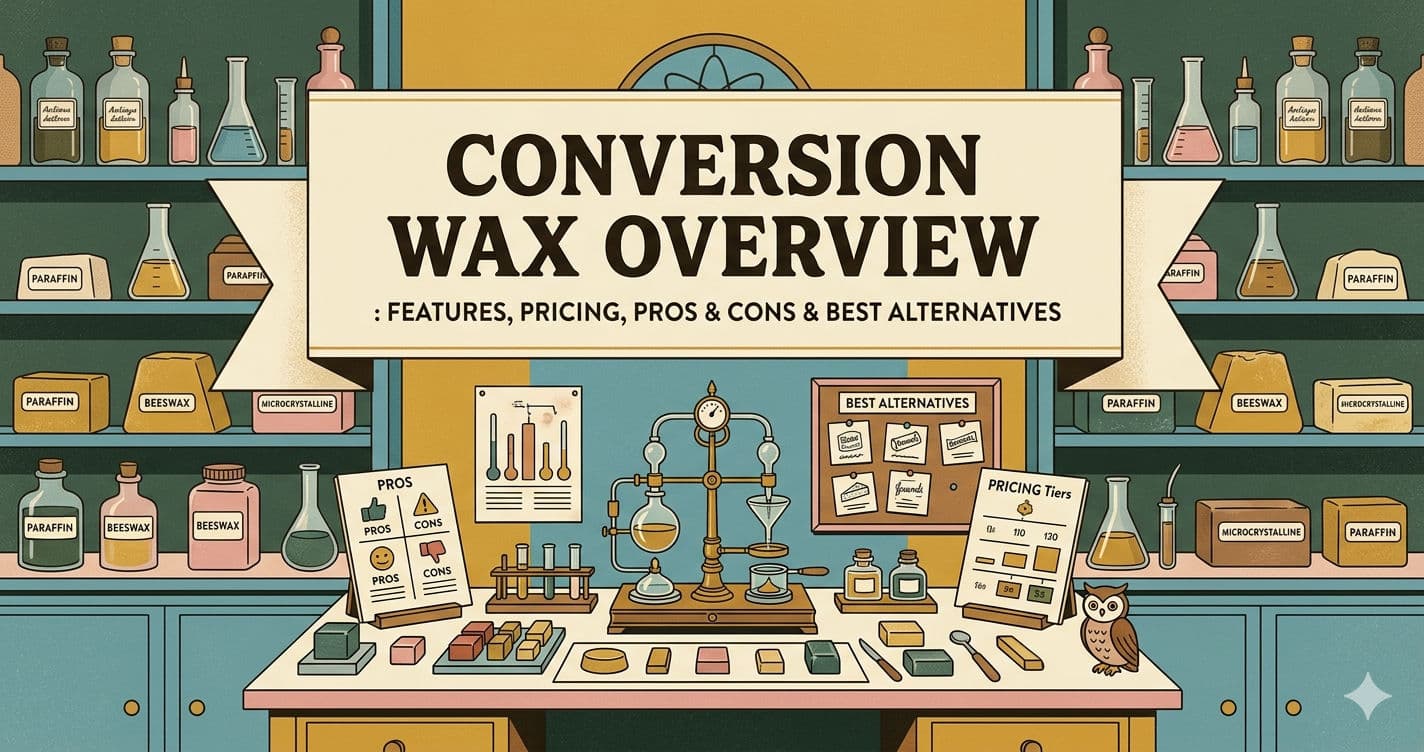
Enter Conversion Wax, a platform that has garnered significant attention in the SaaS market for its promise to democratize enterprise-level personalization for the SMB sector. But is it the right solution for your specific needs? In this detailed Conversion Wax review 2026, we will dissect the platform's capabilities, scrutinize its pricing structure, and measure it against industry titans like Unbounce, Instapage, and other emerging challengers.
Software covered in this article
To help you evaluate Conversion Wax in the right context, this article compares it against a carefully curated set of competitors:









What is Conversion Wax? (Core Value Proposition & Target Market)
Conversion Wax is a cloud-based Conversion Rate Optimization (CRO) platform designed specifically to bridge the gap between simple landing page builders and complex, enterprise-grade experience clouds. Positioned as a flexible solution for the mid-market, it aims to mold your website's user experience (UX) to fit the unique shape of every visitor's intent.
Unlike legacy tools that focus primarily on A/B testing static pages, Conversion Wax specializes in dynamic content injection. It sits as a logic layer on top of your existing CMS—whether you use WordPress, Shopify, or Webflow—and allows marketers to swap out headlines, images, and Calls to Action (CTAs) in real-time without writing code. It effectively functions as one of the most accessible marketing automation tools for small business teams looking to implement behavioral targeting without an engineering squad.
For the SMB Marketing Manager, the core value proposition is agility. Enterprise suites often require dedicated developers and months of implementation time to set up complex personalization rules. Conversion Wax promises a "low-code" environment where a marketing team of one can deploy sophisticated behavioral triggers. It targets businesses generating between $1M and $50M in revenue—companies that have outgrown basic pop-up tools but aren't ready to invest six figures in an Adobe or Salesforce marketing cloud solution.
1. Performance and Site Speed Considerations
A primary concern for any marketing manager adding scripts to their site is latency. Does Conversion Wax slow down your site? In our analysis of the 2026 v4.0 update, the platform utilizes asynchronous loading for its JavaScript snippet. This means the script loads in the background without blocking the rendering of the main page content.
However, dynamic injection can sometimes cause a "Flash of Unstyled Content" (FOUC) or a slight flicker where the original headline is visible for a split second before the personalized version loads. To combat this, Conversion Wax has introduced "Smart-Hiding" technology, which briefly hides the specific element being personalized until the new content is ready.
While this minimizes visual disruption, it is vital to monitor your Core Web Vitals, specifically Largest Contentful Paint (LCP), after installation. For most SMB sites, the impact is negligible (typically under 100ms), but for heavy e-commerce sites, we recommend testing this during the trial phase.
2. Security and Compliance in a Cookieless World
In 2026, handling user data requires strict adherence to global privacy standards. Conversion Wax has matured significantly in this area, boasting SOC2 Type II compliance. Unlike older tools that relied on third-party data scraping, Conversion Wax operates strictly on first-party data.
It anonymizes visitor IP addresses by default and offers a built-in "Consent Manager" that integrates with your existing cookie banner. If a user declines tracking, Conversion Wax defaults to the generic version of the site, ensuring you remain compliant with GDPR, CCPA, and the latest regional privacy regulations. This "privacy-by-design" approach is a critical selling point for SMBs that cannot afford legal exposure.
Conversion Wax Core Features: A Deep Dive into Functionality
To understand if Conversion Wax justifies its cost, we must look under the hood. The platform has introduced several AI-driven features intended to automate the heavy lifting of segmentation.
1. AI-Driven Behavioral Triggering (The "WaxSeal" Engine)
The standout feature is the "WaxSeal" AI engine. This proprietary algorithm moves beyond simple demographic targeting (e.g., location or device type). Instead, it utilizes predictive intent modeling. By analyzing mouse movements, scroll depth, and click velocity, the system assigns a "temperature score" to every visitor in real-time.
For example, if a user is rapidly switching between pricing tabs and your FAQ section, the engine identifies this as "high-intent but hesitant." It can then automatically trigger a specific intervention—such as a chatbot prompt offering a discount code or a modal window highlighting a money-back guarantee—to reduce bounce rates.
The "Cold Start" Reality: It is important to note that this AI is not magic. It requires data to learn. For the predictive modeling to be accurate, the system typically needs to observe between 3,000 to 5,000 unique visitors on your site. For smaller sites, this "cold start" period might last two to four weeks, during which the personalization will rely on manual rules rather than AI predictions.
2. Real-time Dynamic Content Injection
At the heart of Conversion Wax is its ability to alter the DOM (Document Object Model) on the fly. This feature allows you to change the H1 tag of your homepage based on the ad campaign the visitor clicked.
If a visitor arrives via a Google Ad for "Eco-friendly running shoes," your homepage hero text can dynamically change to "Sustainable Footwear for the Modern Runner," while the background image swaps to a trail running scene. For a visitor arriving from a generic "Summer Sale" email, the same page displays "50% Off Summer Styles." This level of message match significantly improves Quality Scores on ad platforms and drastically lowers Cost Per Acquisition (CPA).
3. Attribution Modeling and Analytics
One of the biggest pain points for SMBs is the "Black Box" problem—knowing that conversions increased, but not knowing why. Conversion Wax addresses this with its Attribution Dashboard. Unlike standard Google Analytics 4 (GA4) reports, which can be abstract, this dashboard focuses specifically on personalization events.
It visualizes exactly which dynamic element contributed to the conversion lift. You can see, for instance, that changing the CTA button color to orange increased click-through rates (CTR) by 12% for mobile users in California, but decreased it for desktop users in New York. This granular data empowers Marketing Managers to make evidence-based decisions rather than relying on gut feeling.
Conversion Wax Pricing 2026: Detailed Plan Breakdown
Pricing transparency is a major demand for SMBs in 2026. Conversion Wax has moved away from the opaque "Contact Sales" model for its lower tiers, offering clear, tiered pricing. However, as you scale, the costs can accumulate.
Understanding Overages: A critical detail often overlooked is the overage policy. If you exceed the visitor cap on the Starter or Growth plans, Conversion Wax charges an automatic overage fee of $15 per 1,000 additional unique visitors. For businesses with seasonal traffic spikes, this can lead to surprise invoices, so selecting the right tier is essential.
Plan | Price | Best For | Features |
Starter | $19 / month | Solopreneurs & Micro-teams | • 5k Monthly Page Views |
Growth | $49 / month | Growing SMB Marketing Teams | • 250k Monthly Page Views |
Professional | $149 / month | High-Traffic Sites & Agencies | • 500k Monthly Page Views |
Premier | $299 / month | Large Orgs needing SLA | • 2 Million Monthly Page Views |
*Note: All prices shown reflect typical monthly billing. Vendors often offer lower pricing for annual commitments, but those discounts are excluded here for easier comparison. Actual costs may vary depending on your requirements, usage volumes, and negotiated terms.
Find Perfect Software For Your Business
The Pros and Cons of Conversion Wax for Small to Mid-Sized Businesses
No software is perfect, and while Conversion Wax offers robust features, it is essential to weigh the benefits against the limitations, especially for teams with limited resources.
The Pros
Ease of Implementation: The "visual editor" overlay allows marketers to make changes without waiting for IT or developers. This reduces the time-to-value significantly.
Strong ROI on Ad Spend: By improving message match through dynamic content, users often see an immediate improvement in their Return on Ad Spend (ROAS).
Responsive Customer Support: Unlike many competitors in the SMB space who rely solely on chatbots, Conversion Wax maintains a highly rated human support team for Growth plans and above, with an average response time of under 4 hours during business days.
Contextual Agility: The ability to change content based on weather, location, or referral source gives SMBs a "big brand" feel.
The Cons
Learning Curve for Advanced Features: While basic text swaps are easy, mastering the AI triggers and complex logic flows requires a dedicated learning phase. It is not entirely "plug-and-play" for complex strategies.
Traffic Limitations & Overages: The lower-tier plans have relatively strict traffic caps (10k visitors). For a business with high traffic but low margins (like some e-commerce sites), the pricing can scale uncomfortably fast.
Integration Latency: While generally fast, adding any third-party script to a site impacts load times. On heavy mobile sites, there can still be a slight "flicker" effect before the personalized content loads, despite the "Smart-Hiding" technology.
Top 6 Alternatives to Conversion Wax for Marketing Managers
While Conversion Wax is a strong contender, the CRO market in 2026 is crowded with specialized tools. Depending on your specific goals—whether it's building landing pages from scratch, adding social proof, or creating interactive quizzes—one of these alternatives might be a better fit. We have consolidated the list to the top 6 most relevant competitors.
1. Unbounce (2026 Alternative for AI Optimization)
Best For: Marketers who want AI optimization contained within landing pages.
Unbounce is the direct heavyweight competitor in the landing page space but has evolved into a "Conversion Intelligence" platform. Their Smart Traffic feature uses AI to route visitors to the variant most likely to convert them.
Comparison: If you want AI optimization but prefer to keep it contained within dedicated landing pages rather than your whole website, Unbounce is the industry standard. Conversion Wax is better if you want to personalize your existing homepage or blog.
2. Leadpages (2026 Alternative for Speed)
Best For: Rapid deployment of simple landing pages.
Leadpages remains a dominant force for businesses that need speed. If your primary goal is to spin up high-converting landing pages quickly without touching your main website's code, Leadpages is often superior to Conversion Wax.
Comparison: Leadpages focuses less on personalizing your existing site and more on creating dedicated destinations. It is generally more affordable for entry-level users who do not need dynamic text replacement on their main URL.
3. Instapage (2026 Alternative for Collaboration)
Best For: Large teams and post-click automation.
Instapage focuses heavily on post-click automation and team collaboration. It is positioned slightly upmarket, similar to Conversion Wax's Pro tiers. Instapage’s strength lies in its "Global Blocks" feature, which allows you to update a testimonial or footer across hundreds of landing pages instantly.
Comparison: For large teams managing high-volume campaigns, the workflow efficiency of Instapage beats Conversion Wax. However, Instapage is strictly a landing page builder, whereas Conversion Wax can personalize your Shopify store or WordPress site.
4. Proof (2026 Alternative for Social Proof)
Best For: Driving urgency through real-time notifications.
Proof (specifically their Pulse product) focuses entirely on social proof. It displays real-time notifications like "Jane from Austin just bought this product."
Comparison: While Conversion Wax can simulate this with custom coding, Proof does it out of the box with zero configuration. For e-commerce sites where FOMO (Fear Of Missing Out) is a primary driver, Proof often delivers a higher immediate lift than general personalization.
5. Outgrow (2026 Alternative for Interactive Content)
Best For: Lead qualification through calculators and quizzes.
Outgrow takes a different approach to conversion. Instead of changing headlines, it helps you build calculators, quizzes, and chatbots. In 2026, "interactive content" is seeing massive engagement. A "How much can you save?" calculator often converts better than a personalized static paragraph.
Comparison: If your strategy relies on educating the user through interaction, Outgrow is a better functional choice. Conversion Wax is better for passive personalization (changing content without user input).
6. Hello Bar (2026 Alternative for Simple Capture)
Best For: Top-of-funnel lead capture and announcements.
Hello Bar is the king of the notification bar. It is incredibly effective for simple announcements and lead capture at the top of the screen.
Comparison: If Conversion Wax feels like overkill for simply collecting emails or announcing a sale, Hello Bar is the streamlined alternative. It is far cheaper and simpler to set up.
Technical Implementation: Integrating Conversion Wax into Your Marketing Stack
For the Marketing Manager, the fear of "technical debt" is real. Fortunately, Conversion Wax has prioritized integration in its 2026 roadmap. The implementation process generally follows a standard 30-day roadmap for SMBs.
Phase 1: Installation (Days 1-3)
The setup involves placing a single JavaScript snippet into the <head> of your website. This is compatible with Google Tag Manager (GTM), which is the recommended deployment method to maintain site speed. Once the tag is live, the Attribution Dashboard begins collecting baseline data immediately.
Phase 2: Data Mapping (Days 4-10)
This is the most critical phase. You connect your "Source of Truth"—typically your CRM or Email Service Provider (ESP). Conversion Wax integrates natively with HubSpot, Salesforce, and Pipedrive.
Developer Requirement: For standard integrations, this is a no-code process. You simply authorize the app and select which fields (e.g., "Lifecycle Stage," "Industry," "Last Purchase Date") you want to import. However, if you have custom objects in Salesforce or a proprietary database, you may need a developer for 2-4 hours to configure the API mapping.
Phase 3: The "Soft Launch" (Days 11-20)
Best practice dictates starting with a "Do No Harm" test. You launch a simple A/B test on a high-traffic, low-risk page (like a blog post) to ensure the dynamic injection doesn't break the layout on mobile devices or interfere with other scripts. This is also when you verify that your Core Web Vitals remain stable.
Phase 4: Full Personalization (Days 21-30)
Once stability is confirmed, you roll out your first AI-driven campaign. A common starting point for SMBs is the "Return Visitor" flow—showing a "Welcome Back" message and a shortcut to the pricing page for users who have visited more than three times. By Day 30, you should have enough data to begin seeing statistical significance in your conversion lift.
Final Verdict: Is Conversion Wax the Right Investment for Your 2026 Strategy?
Conversion Wax represents a mature, powerful entry into the SMB personalization market. It successfully bridges the gap between simple page builders and enterprise experience clouds. Its strength lies in its ability to maximize the value of the traffic you are already getting. In an era where ad costs are rising, increasing the yield from every click is vital.
Conversion Wax is a Buy if:
You have a steady stream of traffic (at least 10k/month) but a stagnant conversion rate.
You run paid ads across multiple channels and need to improve message match to lower CPA.
You have a marketing team capable of strategizing segments but lacking coding resources.
Pass on Conversion Wax if:
Your traffic is very low (under 5k/month)—focus on SEO and traffic generation first.
You only need a simple landing page builder (use Leadpages or Unbounce).
You are looking for a dedicated social proof tool (use Proof).
The Middle Ground (Pilot Approach):
If you are on the fence, we recommend the "Growth Sculptor" plan for a 3-month pilot. Focus on a single high-value segment (e.g., "Cart Abandoners" or "LinkedIn Referrals"). If you cannot prove a clear ROI within 90 days that covers the $299/month cost plus the implementation time, the tool is likely overkill for your current stage of growth.
Ultimately, the tool is only as good as the strategy behind it. Personalization requires a hypothesis-driven mindset. If you are ready to move beyond generic marketing and treat every visitor as a unique opportunity, Conversion Wax provides the toolkit to do so.
Try AuthenCIO
Move to faster, smarter software evaluation with AI
Conclusion
As we navigate the complexities of 2026 marketing, the ability to adapt to user needs in real-time is a competitive advantage that cannot be ignored. Conversion Wax offers a compelling mix of power and usability for the mid-market, democratizing features that were once exclusive to the Fortune 500. However, the software landscape is vast. Before committing to an annual contract, it is prudent to test the waters and see how it stacks up against the specific needs of your stack.
Ensure you validate your choice with data. The right tool is the one that fits your workflow, your budget, and your growth goals.