.webp&w=64&q=75)
Introduction
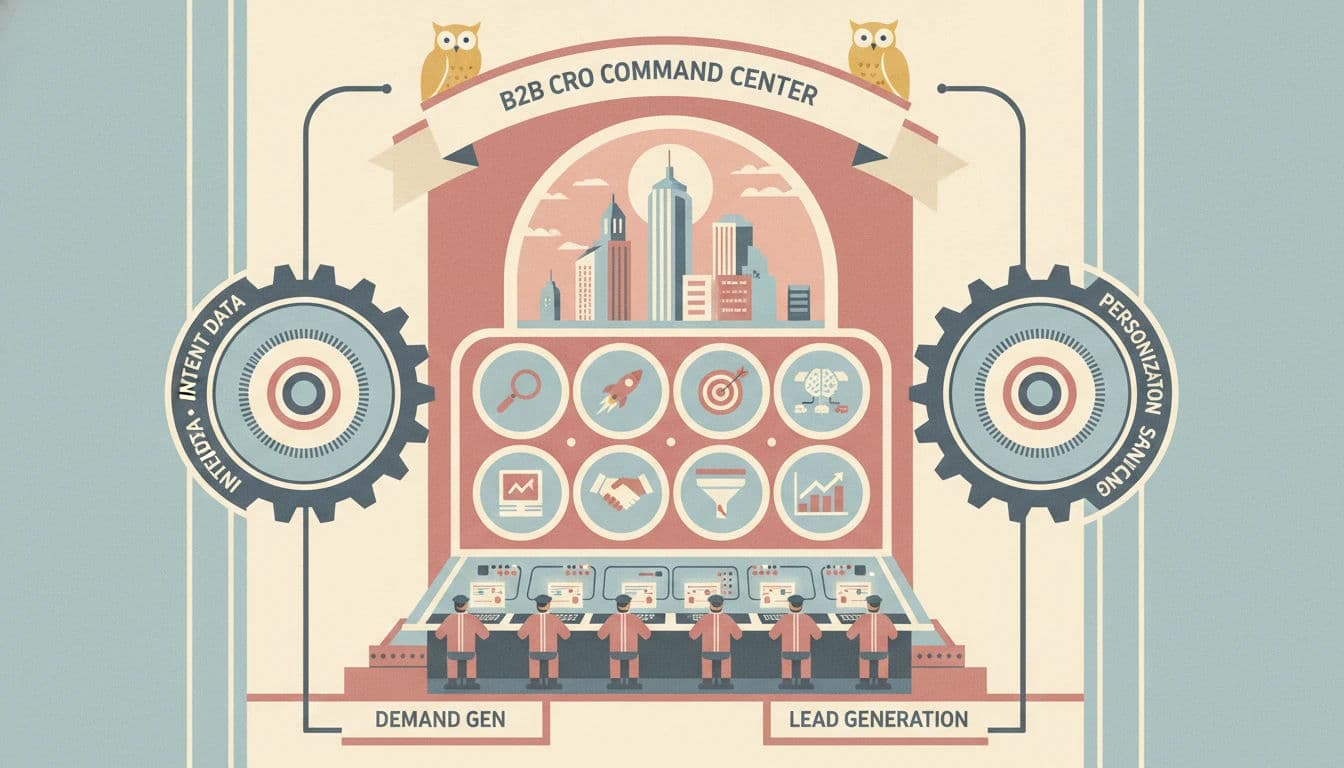
For Demand Generation Managers and Growth Leads, mastering B2B CRO is no longer optional. In 2026, the "growth at all costs" mindset has been replaced by a strict focus on capital efficiency, pipeline velocity, and revenue attribution. The mandate is clear: capture high-intent demand and accelerate it through the funnel. Implementing effective CRO for B2B means moving past high-volume, low-intent MQLs to focus on precision and account-level engagement.
Streamline your software evaluation process
This shift places immense pressure on your landing pages and the broader conversion rate optimization tech stack. Deploying a static form to gate a generic PDF is no longer sufficient. When executing CRO for B2B websites, modern buyers expect hyper-personalized experiences tailored to their firmographic data, industry pain points, and buying stage. If your site feels generic, your conversion rates will suffer.
The primary challenge lies in Signal-to-Conversion Latency. You are likely driving significant traffic through paid search, LinkedIn ads, and programmatic display, yet the time gap between a user showing intent and that data reaching your CRM is often too wide.
In a cookieless future where third-party tracking is obsolete, B2B lead capture tools act as the central nervous system of the growth stack. They must not only convert but also deanonymize and enrich data in real-time to bridge the gap between anonymous traffic and Sales Qualified Leads (SQLs).
In this guide, we move beyond generic website builders to explore the specialized B2B CRO software driving growth in 2026. We focus on top software picks that offer robust integrations, support account-based marketing (ABM) strategies, and provide the security compliance required by enterprise teams.
Key Takeaways
Top Enterprise Performers: Instapage and HubSpot Marketing Hub remain the top choices for large-scale B2B organizations in 2026, offering the best mix of generative personalization and deep CRM integrations.
AI and Intent Data are Non-Negotiable: To capture high-value accounts, modern B2B CRO requires real-time signal orchestration. Platforms like ZoomInfo and Unbounce lead the way in dynamically adapting page content based on firmographic intent data.
Consolidation Drives ROI: With tighter budgets, CFOs favor platforms that combine A/B testing, behavioral analytics (VWO), and interactive lead capture (Outgrow) over fragmented point solutions.
Agility for High-Velocity Campaigns: For teams focused on rapid deployment and high-volume landing page management, streamlined tools like Landingi and Leadpages offer the fastest time-to-value without sacrificing core conversion features.
Top Software Picks
HubSpot Marketing Hub — best for integrated CRM and automated lead nurturing.
ZoomInfo — best for B2B data enrichment and pipeline acceleration.
Unbounce — best for AI‑powered landing page optimization and A/B testing.
Instapage — best for enterprise‑level personalization and campaign scaling.
Leadpages — best for quick, conversion‑ready landing page creation.
Landingi — best for drag‑and‑drop landing pages with flexible templates.
VWO — best for multivariate testing and CRO analytics.
Outgrow — best for interactive content that drives engagement and lead capture.
Software covered in this article
For learning and reference, this listicle presents a selective overview of best b2b conversion rate optimization software:








What Defines 'Enterprise-Ready' CRO Software?
Before evaluating specific platforms, what evaluation criteria should growth and product marketing teams use when selecting CRO tools? To separate basic builders from enterprise-grade software, teams must prioritize five core pillars: intent data orchestration, deep CRM/MAP integrations, advanced personalization (Generative UI), strict security compliance (SOC2/GDPR), and robust collaboration workflows. For demand gen managers handling significant budgets, these criteria guarantee scalability, data integrity, and seamless cross-functional alignment.
1. Signal Orchestration & Intent Data Integration
In 2026, a landing page cannot be an island. The most critical differentiator for enterprise software is Signal Orchestration. Your CRO tool must be able to ingest intent data from providers like 6sense, Demandbase, or Clearbit to deanonymize traffic in real-time.
It needs to recognize that an anonymous visitor is from "Acme Corp" and dynamically adjust the headline, social proof, and CTA to match that account's industry and buying stage. If the tool cannot handle this bidirectional data flow, it is not ready for modern ABM.
2. Deep CRM and MAP Integrations
Data silos are the enemy of revenue. The best CRO tools do not just collect emails; they enrich lead data and pass it seamlessly into your CRM (Salesforce, Microsoft Dynamics) and Marketing Automation Platform (Marketo, HubSpot, Pardot).
This ensures that lead scoring models are triggered instantly, and sales teams have visibility into the prospect's interaction history. Reliance on third-party connectors like Zapier for core functionality is often a red flag for high-volume enterprise needs due to latency and error handling issues.
3. Advanced Personalization (Generative UI)
Static pages are obsolete. Enterprise-ready software must support Dynamic Text Replacement (DTR) and, increasingly, Generative UI. This goes beyond swapping a keyword; it involves AI that re-assembles the page layout, imagery, and value propositions based on the visitor's profile.
The ability to serve a "FinTech" version of a page to a bank and a "HealthTech" version to a hospital using a single URL is a baseline requirement.
4. Security and Compliance (GDPR/CCPA/SOC2)
With data privacy regulations tightening globally, your CRO software must be compliant by design. Enterprise procurement will demand SOC2 Type II compliance, GDPR adherence, and robust data processing agreements. Tools that cannot guarantee this level of security are non-starters for B2B organizations targeting mid-market and enterprise accounts.
5. Collaboration and Workflow Management
Growth teams rarely work in isolation. You have copywriters, designers, and stakeholders who need to review and approve pages. Enterprise tools offer "Audit Logs," role-based access control, and commenting systems that streamline the production process, preventing the bottleneck of relying on a single developer or webmaster.
Need advanced B2B conversion tools? Explore and compare top CRO software on AuthenCIO for free.
Quick Comparison: Top B2B CRO Tools
When evaluating the best conversion rate optimization software for your revenue stack, demand gen managers need clear distinctions. Among the best CRO tools available today, if your primary goal is Account-Based Marketing (ABM) and deep personalization at scale, Instapage is the market leader, though it comes with a premium price tag.
For teams focused on improving top-of-funnel lead quality and enriching outbound targeting with buyer intent data, ZoomInfo stands out as the leading Revenue Intelligence platform for identifying high-fit accounts and accelerating pipeline generation. If you are looking for the best conversion rate optimization tools that deliver speed and AI-driven optimization without heavy design resources, Unbounce offers the best "time-to-value" with its Smart Traffic features.
When comparing dedicated CRO platforms, if your focus is strictly on scientific testing and analytics across existing properties (rather than building new pages), VWO is the superior choice for data-heavy experimentation. Conversely, if you need to engage users through interactive content like calculators to prove ROI before the call, Outgrow is the specialist in that niche.
Finally, for teams needing a balance of volume and management for multiple sub-brands, Landingi offers excellent workflow tools, while Leadpages remains the go-to for high-velocity, simple lead capture where speed beats complexity.
Detailed Review: Top 8 B2B CRO Software Platforms
We have analyzed the market to identify the seven platforms that best serve the needs of B2B demand generation in 2026. These tools range from dedicated landing page builders to comprehensive testing suites and interactive content platforms.
1. Instapage: Leading Enterprise Personalization at Scale
Instapage continues to dominate the enterprise B2B space in 2026, primarily due to its focus on scalability and personalization. For Demand Gen teams running extensive paid media campaigns, Instapage solves the critical disconnect between the ad and the post-click experience.
Unique B2B Benefits: The standout feature for B2B marketers is AdMap®. This feature allows you to visualize and connect your ad campaigns directly to specific landing pages, ensuring message match at scale. Instead of manually tracking URLs in a spreadsheet, AdMap provides a clear view of which ads are driving traffic to which pages, highlighting coverage gaps instantly.
Furthermore, Instapage’s Personalization capabilities are unmatched for ABM. You can create unique page experiences for different audiences within a single URL structure. For example, a visitor from the healthcare industry sees a different headline and case study than a visitor from fintech, all without needing to duplicate pages endlessly. This dynamic content replacement is vital for improving relevance and Quality Score in Google Ads.
Why it works for Growth Leads: The "Global Blocks" feature allows you to manage global templates. If you need to update a footer or a copyright year across 500 landing pages, you do it once, and it propagates everywhere. This eliminates the "developer bottleneck" and ensures brand consistency. In 2026, Instapage has integrated generative AI to suggest layout variations based on conversion data from similar industries, acting as a force multiplier for your design team.
Potential Gotcha:Price and Overkill. Instapage is expensive. If you are a smaller B2B startup running only one or two landing pages, the enterprise features (and the price tag) will be overkill. It is built for scale, not for dipping your toes in the water.

2. ZoomInfo: Turning Revenue Intelligence Into Pipeline Growth
While most CRO platforms focus on optimizing the conversion experience itself, ZoomInfo addresses an equally important challenge upstream: improving the quality of the accounts and contacts entering the funnel in the first place.
For many B2B sales and demand generation teams, prospecting still involves fragmented workflows — manually sourcing leads, cross-referencing LinkedIn profiles, and trying to identify the right stakeholders across complex buying committees. ZoomInfo was built to centralize and operationalize that process.
At its core, ZoomInfo is a Revenue Intelligence platform that provides access to one of the largest B2B contact and company databases available today. However, positioning it purely as a contact database significantly understates its role in the modern GTM stack. Beyond basic enrichment, the platform layers in buyer intent signals, technographic insights, org chart mapping, and real-time account activity alerts to help teams identify not only who to target, but when they are most likely to convert.
Unique B2B Benefits: ZoomInfo’s primary differentiator is the depth and freshness of its data ecosystem. In addition to direct contact information, the platform surfaces buyer intent signals derived from millions of web interactions, helping growth teams identify companies actively researching solutions before competitors engage them.
The platform integrates natively with tools such as Salesforce, HubSpot, Outreach, and Salesloft, allowing prospecting workflows to operate directly inside existing sales and marketing systems rather than through disconnected enrichment processes.
For Account-Based Marketing (ABM) teams, ZoomInfo also supports highly granular targeting using filters such as:
technographic stack
employee headcount
funding stage
revenue band
departmental hiring activity
geographic segmentation
This enables teams to build highly targeted account lists instead of relying on broad outbound outreach strategies.
**Why It Works for Growth Leads: **One of the most overlooked realities in conversion optimization is that CRO software alone cannot compensate for poor top-of-funnel lead quality.
Improving landing page conversion rates, nurture flows, and personalization logic only creates marginal gains if the incoming accounts are fundamentally low-fit. ZoomInfo helps address this upstream quality problem by improving targeting precision before prospects ever reach conversion touchpoints.
For growth-focused teams, this often leads to measurable improvements in:
meeting-to-opportunity conversion rates
pipeline velocity
sales efficiency
account qualification accuracy
When paired with enterprise CRO platforms like Instapage, VWO, or Unbounce, ZoomInfo effectively strengthens the input layer of the revenue engine — ensuring personalization and conversion workflows operate on higher-quality buyer data.
**Potential Gotcha: **ZoomInfo’s pricing reflects its enterprise positioning and can become expensive for smaller sales organizations or early-stage startups. Seat-based licensing scales quickly, and many of the platform’s most advanced capabilities — including intent intelligence, enrichment APIs, and workflow automation — are typically reserved for higher-tier plans.
Additionally, teams expecting a lightweight contact lookup tool may underestimate the operational complexity involved in fully activating the platform. Organizations tend to see the strongest ROI when ZoomInfo is integrated deeply into existing sales operations, CRM workflows, and ABM programs rather than used as a standalone lead database.
.webp?tr=w-800%2Cq-80%2Cf-auto%2Cc-at_max)
3. HubSpot Marketing Hub: Unified Conversion Optimization and Lead Nurturing
HubSpot Marketing Hub occupies a unique position in the B2B CRO landscape because it combines landing page creation, marketing automation, CRM integration, lead nurturing, and attribution reporting within a single platform.
While many CRO tools focus primarily on improving conversion rates at the landing page level, HubSpot extends optimization across the entire buyer journey—from first website visit to qualified pipeline generation.
Unique B2B Benefits
HubSpot's biggest advantage is its native integration with HubSpot CRM. Every form submission, page interaction, email engagement, and workflow activity is automatically tied to a unified contact record. This eliminates data silos and provides demand generation teams with complete visibility into prospect behavior.
For Account-Based Marketing (ABM) initiatives, HubSpot allows marketers to personalize landing pages, CTAs, and email experiences based on lifecycle stage, company attributes, and behavioral signals.
Additional strengths include:
Landing page builder with dynamic content personalization
Advanced marketing automation workflows
Multi-touch attribution reporting
Lead scoring and qualification
Native Salesforce integration
AI-powered content generation and campaign assistance
Extensive ecosystem of third-party integrations
Why It Works for Growth Leads
For organizations seeking to connect conversion optimization directly to revenue outcomes, HubSpot provides a unified operating system for marketing and sales alignment.
Instead of optimizing only for form submissions, growth teams can measure the downstream impact of campaigns on SQL generation, pipeline creation, and closed-won revenue.
The platform is especially valuable for mid-market B2B organizations that want to reduce complexity by consolidating multiple tools into a single ecosystem.
Potential Gotcha
While HubSpot offers broad functionality, costs can increase significantly as contact volumes grow and advanced features are added. Organizations with highly specialized experimentation needs may still require dedicated testing platforms such as VWO, while enterprise ABM teams may seek deeper personalization capabilities from platforms like Instapage.
However, for many B2B companies, HubSpot delivers one of the strongest balances between CRO, automation, reporting, and revenue attribution available in 2026.

4. Unbounce: AI-Driven Conversion Intelligence for Growth Teams
As one of the leading AI-powered conversion rate optimization tools for B2B websites, Unbounce has evolved from a classic drag-and-drop builder into a sophisticated "Conversion Intelligence" platform. In 2026, their heavy investment in machine learning makes it the go-to tool for teams that need to optimize faster than human testing allows, particularly for fast iteration CRO SaaS environments.
Unique B2B Benefits: The standout feature is Smart Traffic. Traditional A/B testing requires large sample sizes and time to reach statistical significance—luxuries that many B2B campaigns with lower traffic volumes cannot afford. Smart Traffic uses AI to route visitors to the page variant most likely to convert for them based on attributes like device, location, and browser. This often yields conversion lifts in days, not months, which is critical for niche B2B segments.
For B2B lead capture, Unbounce’s AI copywriting tools (Smart Copy) help overcome writer's block, generating headline variants that are pre-optimized for conversion. This allows Growth Leads to launch campaigns rapidly without waiting on creative teams for every single iteration.
Why it works for Growth Leads: Unbounce bridges the gap between ease of use and powerful optimization. It is ideal for agile marketing teams that need to spin up campaign-specific pages for webinars, ebook downloads, or PPC ads without navigating complex enterprise CMS environments. Their move toward Generative UI means the builder can now suggest entire page sections based on your campaign goal, significantly reducing build time and supporting fast iteration CRO SaaS workflows.
.webp?updatedAt=1787544817100&tr=w-800%2Cq-80%2Cf-auto%2Cc-at_max)
Potential Gotcha: Reporting Limits. While Smart Traffic is powerful, it can sometimes be a "black box." Growth leads who need to know exactly why Variant A beat Variant B might find the AI-driven routing less transparent than traditional frequentist A/B testing reports found in tools like VWO.
Find Perfect Software For Your Business
5. VWO: Comprehensive A/B Testing and Behavioral Insights
VWO (Visual Website Optimizer) sits at the more analytical end of the spectrum. It is not just a landing page builder; it is a full-stack experimentation platform. For mature Demand Gen teams that are optimizing the entire funnel—from the homepage to the SaaS application interface—VWO is the industry standard.
Unique B2B Benefits: VWO excels in Multivariate Testing and Behavioral Analytics. While other tools focus on the "build," VWO focuses on the "why." Its heatmaps, session recordings, and form analytics are crucial for diagnosing why users are dropping off at the demo request stage. You can see exactly which form field causes friction or how far down the pricing page prospects are scrolling.
In 2026, VWO’s server-side testing capabilities are essential for SaaS companies. This allows you to test product features, pricing models, and onboarding flows deep within your application without affecting site speed or flickering, which is critical for maintaining a premium user experience.
Why it works for Growth Leads: If your primary goal is to scientifically validate hypotheses across your entire digital presence, VWO provides the statistical rigor required. It integrates deeply with Google Analytics 4 (GA4) and segment data, allowing for granular analysis of how different B2B personas interact with your site. It transforms CRO from a guessing game into a data science discipline.
Potential Gotcha:Technical Complexity. VWO has a steep learning curve. To fully utilize its server-side testing and complex multivariate capabilities, you will likely need dedicated developer resources or a data analyst. It is not a "drag-and-drop" solution for a solo marketer.
.webp?tr=w-800%2Cq-80%2Cf-auto%2Cc-at_max)
6. Leadpages: Streamlined Lead Capture for High-Velocity Campaigns
Leadpages remains a strong contender for B2B teams focused on speed and simplicity. While it may lack some of the deep enterprise personalization features of Instapage, it makes up for it with an incredibly low barrier to entry and high-velocity page production.
Unique B2B Benefits: Leadpages is excellent for Lead Magnets and Webinar Registrations. Its built-in lead delivery system allows you to automatically send a whitepaper or guide to a user immediately after they sign up, without needing to configure complex workflows in a separate automation tool. This "native delivery" reduces friction and ensures instant gratification for the prospect.
Additionally, their "Pop-ups" and "Alert Bars" are easy to deploy across your main corporate site (even if it's on WordPress or Drupal) to capture exit-intent traffic or promote upcoming events without involving the IT department.
Why it works for Growth Leads: For smaller growth teams or specific campaigns where speed is the priority (e.g., a sudden partner webinar), Leadpages is the most efficient tool. It offers a "pilot" option in the optimization framework, allowing teams to prove value quickly before investing in more expensive platforms.
Potential Gotcha: Limited Customization. Leadpages relies heavily on templates. If your brand guidelines require pixel-perfect custom designs or complex custom code injections for tracking, you may find the builder restrictive compared to Unbounce or Instapage.

7. Landingi: High-Volume Landing Page Management for B2B
Landingi has carved out a niche as a flexible, agency-friendly platform that scales well for B2B companies managing multiple product lines or sub-brands. It balances the ease of a drag-and-drop editor with robust management features.
Unique B2B Benefits: Landingi shines in Workflow Efficiency. Its "Smart Sections" feature allows you to update specific sections (like a pricing table or a testimonial block) across multiple landing pages simultaneously. For B2B companies with diverse product portfolios, this ensures that pricing updates or new compliance badges can be rolled out instantly across hundreds of active pages.
The platform also offers a unique "PageInsider" AI analysis that predicts where users will look on your page before you even publish it. This predictive eye-tracking helps you position your CTA and key value propositions in the areas of highest visual attention, optimizing the layout before spending a dollar on ad traffic.
Why it works for Growth Leads: Landingi offers a great balance of price and performance. It provides deep integrations with tools like Salesforce and HubSpot at a price point that is often more accessible than enterprise-tier Instapage, making it a smart choice for scaling mid-market companies. Their focus on "micro-conversion" tracking helps identify intent even if the main form isn't filled.

Potential Gotcha: Template Reliance. While flexible, the design capabilities can feel slightly less polished than Instapage's free-form builder. Heavy customization might require more manual CSS tweaking than expected.
8. Outgrow: Boosting Conversions with Interactive Content and Quizzes
Outgrow represents a different approach to CRO. Instead of static forms, Outgrow focuses on Interactive Content. In the saturated B2B market of 2026, passive reading is being replaced by active engagement, and Outgrow is the leader in this space.
Unique B2B Benefits: For B2B, the most powerful tool in Outgrow’s arsenal is the ROI Calculator. B2B buyers are rational; they need to justify the purchase to their CFO. By embedding a calculator that allows prospects to input their own data and see potential savings or revenue gains, you provide immense value while capturing highly qualified leads. These leads are often far more valuable than PDF downloads because the prospect has already mentally committed to the value of your solution.
Outgrow also excels at Recommendation Quizzes (e.g., "Which Enterprise Plan is Right for You?"). These quizzes act as automated sales consultants, guiding the user to the right solution while collecting rich data on their needs, budget, and timeline—data that can be synced directly to your CRM to inform the sales call.
Why it works for Growth Leads: Interactive content sees significantly higher conversion rates than static forms. Outgrow helps you combat "form fatigue" and provides your sales team with rich, contextual data that enables a much warmer, more informed outreach. It shifts the dynamic from "taking data" to "giving answers."
Potential Gotcha: Content Heavy Setup. Building a valuable calculator or logic-jump quiz requires more upfront strategy and content work than a standard landing page. You need to know your math and your customer's logic flow perfectly before building.

2026 B2B CRO Software Comparison Table (Pricing & Features)
To help you evaluate these tools based on your specific budget and feature requirements, we have compiled a comparison of their most popular B2B-focused plans. Prices reflect the standard monthly rates for 2026.
Plan | Price | Best For | Features |
Instapage | Starts at $99/month | Enterprise Scaling & ABM | • AdMap® for ad-to-page relevance |
Zoominfo | Custom | Enterprises | • Enhanced search filters |
HubSpot Marketing Hub | Custom | Revenue Attribution & Marketing Automation | • Landing Pages |
Unbounce | $29/month | AI-Driven Optimization | • Smart Traffic (AI routing) |
VWO | Custom | Data-Driven Experimentation | • Advanced A/B & Multivariate Testing |
Leadpages | $29/month | Speed & Simplicity | • Unlimited Landing Pages |
Landingi | Starts at $29/ month | Flexible Management | • Smart Sections for global edits |
Outgrow | Starts at $14/ month | Interactive Lead Gen | • ROI & Savings Calculators |
*Note: All prices shown reflect typical monthly billing except when stated otherwise. Vendors often offer lower pricing for annual commitments, but those discounts are excluded here for easier comparison. Actual costs may vary depending on your requirements, usage volumes, and negotiated terms.
Software vs. B2B CRO Services and SaaS Partners
Established SaaS businesses should choose B2B CRO services over managing software in-house when internal teams lack the specialized bandwidth for continuous testing, or when conversion rates have plateaued despite having enterprise tools. While CRO software provides the testing infrastructure, the best SaaS CRO partners provide the strategic execution, UX research, and engineering resources required to run complex, high-velocity experiments.
If you are asking, "which CRO service should I choose for an established SaaS business?", look for agencies that specialize specifically in B2B SaaS sales cycles rather than standard e-commerce. A top-tier partner should offer full-funnel optimization—from landing page acquisition to free-trial onboarding and demo requests. They must also seamlessly integrate with your existing revenue stack (like Salesforce or HubSpot) and possess deep expertise in qualitative user research.
Consider outsourcing to B2B CRO services if your organization experiences:
Resource bottlenecks: You have the software but lack dedicated developers or designers to build test variations.
Traffic without conversions: Your demand generation campaigns are driving high-intent traffic, but demo requests or trial sign-ups remain stagnant.
Need for outside perspective: Internal biases are limiting test hypotheses, and you need data-backed insights from external UX experts.
Integrating CRO Tools into the Revenue Stack
Selecting the software is only the first step. To truly drive B2B demand generation, you must integrate these tools strategically into your broader MarTech stack. A common pitfall is treating your CRO tool as an island, resulting in data silos where valuable interaction data never reaches the sales team.
The 'Pilot-Scale-Optimize' Framework
If you are building your stack from scratch, do not jump straight to the most expensive enterprise plan. Start with the "Pilot" phase: use a tool like Unbounce or Leadpages to launch your first set of campaign-specific pages. Focus on message match and basic A/B testing (headlines and CTAs) to establish a baseline.
Once you have proven traction, move to the "Scale" phase. This involves integrating your pages with your CRM (e.g., Salesforce) to pass hidden fields like UTM parameters and GCLID (Google Click ID). This data is essential for offline conversion tracking, allowing you to optimize ads for revenue, not just leads.
At this stage, you should address Dark Social attribution. Use your CRO tool to add a "How did you hear about us?" self-reported attribution field on thank-you pages. This captures qualitative data (e.g., "Slack community," "Podcast") that software tracking often misses.
Finally, the "Optimize" phase involves advanced personalization and interactive content. This is where tools like Instapage (for ABM) and Outgrow (for calculators) come into play. At this stage, you should be using reverse-IP lookup tools to feed firmographic data into your landing pages dynamically, creating a bespoke experience for every target account. This is where Generative UI takes over, automating the creation of variants based on real-time performance signals.
Justifying CRO Spend to the CFO
When presenting these tools to finance, focus on Customer Acquisition Cost (CAC) and Pipeline Velocity. A high-end CRO tool costing $600/month pays for itself if it improves your conversion rate from 1% to 1.5% on a high-ticket B2B product. Frame the cost not as an expense, but as an efficiency multiplier for your existing ad spend.
If you are spending $50,000 a month on ads, a 20% improvement in conversion efficiency is worth $10,000 a month in saved ad spend—far outweighing the cost of the software. Furthermore, emphasize the Risk Mitigation aspect. Enterprise tools with SOC2 compliance protect the company from data breaches and GDPR fines, a language every CFO understands.
Try AuthenCIO
Move to faster, smarter software evaluation with AI
Conclusion: Selecting the Right Software for Your 2026 Revenue Goals
The "best" CRO software for your B2B organization depends entirely on your specific bottlenecks. If your team is struggling to build pages fast enough to keep up with ad campaigns, Unbounce or Leadpages offer the velocity you need. If your primary challenge is low conversion rates on high-traffic pages and you need deep analytical rigor, VWO is the superior choice.
For enterprise teams focused on Account-Based Marketing and scalable personalization, Instapage remains the gold standard, while Outgrow offers a unique edge for engagement through interactive content.
Ultimately, software is an enabler of strategy, not a replacement for it. The most successful Demand Gen Managers in 2026 are those who combine these powerful tools with a deep understanding of their customer's pain points, rigorous testing methodologies, and a relentless focus on lead quality over quantity. Choose the tool that fits your current maturity level, integrate it deeply with your revenue stack, and never stop testing.