
Introduction
By 2026, the landscape of Conversion Rate Optimization (CRO) has matured significantly. For specialists conducting cro a/b testing, the focus has shifted from simple button color changes to extracting deep, replicable insights. With the recent new cro a/b testing tool 2026 launch cycle introducing advanced AI and predictive capabilities, the global A/B testing software market continues to expand. Adopting a new cro a/b testing tool 2026 offers unprecedented ways to run data-driven marketing experiments, but the real differentiator remains the strategic intelligence you extract.
Streamline your software evaluation process
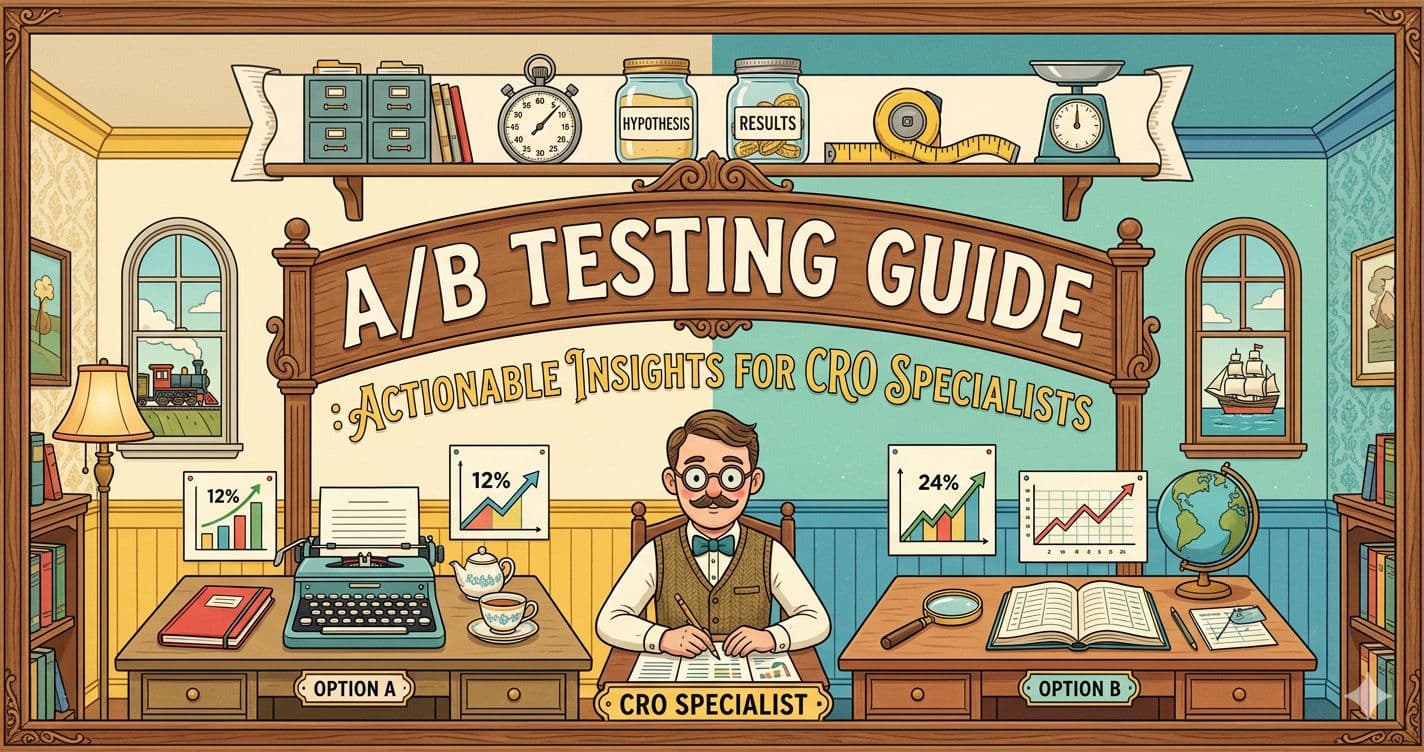
In an era dominated by AI-driven variation generation, a "winning" test that provides no explanation for user behavior is a wasted opportunity. If Variant B beats Variant A by 12% but you cannot articulate why, you cannot replicate that success across other parts of the funnel. This guide provides the best practices and how-to frameworks needed to move from lucky guessing to strategic experimentation. In 2026, the primary goal of A/B testing is not merely to validate a design change but to extract actionable insights that inform your broader marketing strategy, product development, and customer understanding.
We are operating in an environment where user expectations for personalization and interactivity are at an all-time high. The static web is dying, replaced by dynamic experiences that require rigorous testing protocols. To navigate this, we must adopt a scientific approach—moving from ad-hoc split testing to a structured, hypothesis-driven framework. This guide serves as your blueprint for high-velocity, high-insight experimentation.
🔍 Key Takeaways
Structured experimentation: Shift from ad-hoc split tests to hypothesis-driven processes to accelerate learning.
A/B testing landing pages conversion rate optimization CRO tips: Focus on structural layout testing, messaging clarity, and reducing form friction over cosmetic tweaks.
A/B testing advantages in UX and conversion optimization 2025 or 2026: Validating design choices with data mitigates risk and proves UX improvements directly drive revenue.
Prioritize interactivity: Static experiences underperform; use dynamic frameworks to adapt to user behavior.
Experimentation culture: Treat optimization as a scientific process for sustainable growth.
Software covered in this article
Evaluating the best A/B testing tools for CRO 2026? This definitive list covers the top A/B testing tools for conversion rate optimization 2025 2026. Whether you need the best A/B testing software for conversion optimization 2026, the leading A/B testing software for conversion rate optimization 2026, or the best CRO tools for A/B testing experiment automation and user behavior analysis 2025 2026, explore our curated selection of the leading ab testing software for conversion rate optimization 2026 below:






Enterprise Tool Selection & Convert Software Evaluation
When establishing your enterprise A/B testing tool vendor selection criteria in 2026, prioritize platforms that offer robust privacy compliance, server-side experimentation capabilities, and seamless CDP integrations. The most important features in an A/B testing experimentation platform for 2025 and 2026 have shifted from basic visual editors to advanced statistical engines, flicker-free script execution, and cross-device identity resolution. To properly evaluate the A/B testing software for your tech stack, teams must look beyond basic metrics and demand the best A/B testing features in CRO tools, such as advanced audience targeting and automated anomaly detection.
A standout vendor meeting these rigorous demands is the conversion rate optimization software company Convert. In our latest Convert A/B testing CRO software review evaluation, the platform consistently excels at providing enterprise-grade functionality without the typical enterprise bloat. Convert Experiences delivers exceptional value on conversion rate optimization software by offering a privacy-first approach, blink-free testing, and over 90 seamless integrations out of the box.
For CRO specialists, Convert's strict adherence to GDPR/CCPA compliance and its transparent pricing model make it a top-tier choice. It empowers teams to scale their testing velocity and deploy complex, multi-page experiments without compromising site speed or data integrity.
Phase 1: Building a Conversion Rate Optimization Framework
Before a single pixel is changed, the foundation of a valid experiment must be laid through a robust hypothesis. In professional CRO circles, we often see tests fail not because the design was poor, but because the hypothesis was fundamentally flawed or non-existent. A hypothesis is not a guess; it is a predicted outcome based on observed data and psychological theory.
To ensure your tests yield actionable insights, avoid the "If/Then" trap. Instead, structure your hypothesis to include the variable, the predicted outcome, and the rationale. For example: "Because qualitative heatmaps indicate users are experiencing friction at the shipping calculation step (Observation), removing the zip code field in favor of geo-location detection (Change) will reduce cart abandonment by 5% (Prediction) because it lowers the cognitive load required to complete the transaction (Rationale)."
Sourcing Observations: Quantitative vs. Qualitative
A strong conversion rate optimization framework relies on a balance of data sources. You cannot formulate a hypothesis in a vacuum.
Quantitative Data (The What): Utilize analytics platforms (like GA4 or Mixpanel) to identify high-traffic, high-leakage pages. Look for anomalies in the funnel—pages with unusually high exit rates or low time-on-page. This tells you where the problem is.
Qualitative Insights (The Why): This is where you leverage session recordings, heatmaps, and user surveys. Tools that capture user sentiment reveal the friction behind the numbers. For instance, a session recording might show users rage-clicking on a non-interactive element, signaling a UI clarity issue.
Prioritization Frameworks
With finite traffic and resources, you cannot test everything. Utilizing a prioritization framework like the PXL model is essential in 2026. Unlike the subjective ICE (Impact, Confidence, Ease) score, PXL forces you to answer binary questions about the test: Is the change above the fold? Is it noticeable in under 5 seconds? Does it address a specific user pain point discovered in user testing? This objective scoring prevents the "Highest Paid Person's Opinion" (HiPPO) from derailing your testing roadmap.
Phase 2: Optimizing Landing Page Architecture
Once your hypothesis is solidified, the next step in conversion rate optimization (CRO) is designing variations that isolate the variables you intend to test. When A/B testing landing pages, structural modifications directly impact user behavior. In 2026, complex web architectures require tools that handle sophisticated changes without introducing latency or "flicker"—the brief flash of original content that ruins test validity.
Structural Testing with Instapage
When testing macro-conversions on landing pages, structural changes often yield higher lifts than cosmetic tweaks. This is where Instapage becomes a critical asset in your stack. For a CRO specialist, the ability to test distinct page layouts without needing developer intervention is paramount.
Audience Segmentation: You might hypothesize that a long-form sales letter performs better for cold traffic, while a concise, video-led page works better for retargeting audiences. Instapage allows you to clone and modify these environments rapidly.

Global Blocks: If you validate a winning element (like a specific testimonial section), you can propagate it across hundreds of pages instantly using Global Blocks, operationalizing your insight at scale.
Messaging and Micro-Conversions with Hello Bar
Not all tests require a full page redesign. Often, the actionable insight lies in understanding how users respond to urgency or specific value propositions. Hello Bar is instrumental for testing high-visibility notification bars, modals, and sliders that sit on top of your existing content.
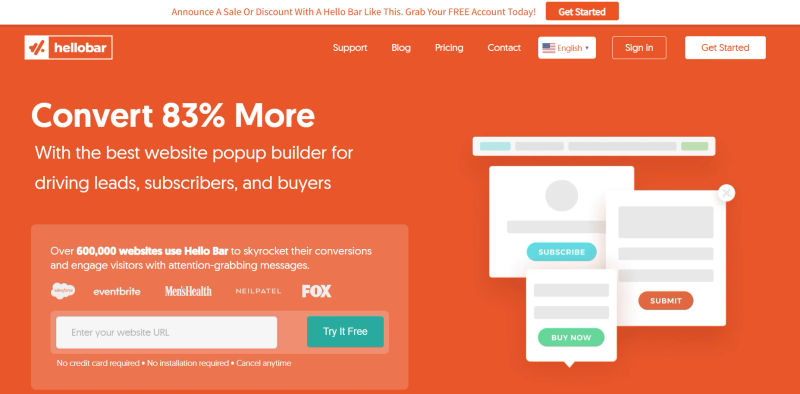
A powerful use case is testing "lead magnets" or CTA messaging. You might run a test where Variant A offers a "Free E-book" and Variant B offers a "15-Minute Consultation." If Variant B wins with statistical significance, the insight isn't just about the bar; it tells you that your audience currently values access to expertise over content consumption. This insight should then influence your email marketing, ad copy, and sales scripts.
Performance Note: Mitigating Latency
Adding third-party scripts like Hello Bar or testing overlays can negatively impact Core Web Vitals if not managed correctly. In 2026, site speed is a ranking factor and a conversion driver. When implementing these tools, ensure they are loaded asynchronously. Use a Tag Manager with strict firing rules—only load the testing script on the specific pages where the experiment is running. Avoid "tag bloat" by auditing and removing scripts from concluded tests immediately.
Phase 3: Optimizing Form Interactions and Interactivity
Execution is where strategy meets technical reality. The goal is to manipulate the DOM (Document Object Model) or the server-side response to serve variations while tracking engagement metrics accurately.
Reducing Friction with POWR
Forms are the ultimate friction point in any conversion funnel. Testing form length, field labels, and submission logic is non-negotiable. POWR offers a suite of customizable plugins that integrate directly into your CMS.
When using POWR for A/B testing, focus on the "Psychology of the Form":
Multi-Step vs. Single-Step: A common hypothesis is that breaking a long form into three smaller steps increases completion rates by utilizing the "sunk cost fallacy."
Field-Level Drop-off: By deploying two different POWR form configurations, you can measure the drop-off rate at each field. If users consistently abandon the form at the "Phone Number" field in Variant A, the actionable insight is clear: privacy concerns are outweighing the perceived value of the offer.
Testing Interactive Content with Outgrow
When determining which CRO tools support dynamic content in A/B testing, Outgrow is a leading choice for interactive elements, alongside platforms like VWO and Optimizely which handle dynamic site personalization. Static content is increasingly being outperformed by these dynamic, interactive experiences. Outgrow allows marketers to build and test dynamic content such as calculators, quizzes, and recommendation engines. The engagement metrics from these tools are often far richer than standard landing pages.
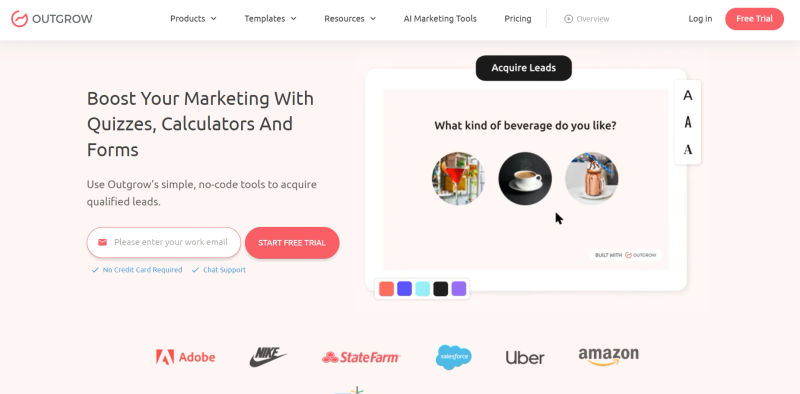
A sophisticated test involves pitting a static "Request a Quote" page against an Outgrow "Cost Estimator" calculator. The hypothesis here is that providing immediate value through dynamic content (a real-time price estimate) builds trust and reciprocity. If the Outgrow variant wins, the insight is that your users are in the "research" phase and prefer self-service over speaking to a sales rep.
Furthermore, Outgrow allows you to pass the inputs from the calculator into your CRM, enabling you to A/B test follow-up sequences based on the dynamic data provided.
Find Perfect Software For Your Business
Phase 4: Ensuring Statistical Significance and Validity
Validating results requires statistical rigor to prevent false positives (Type I errors). In 2026, essential A/B testing false positive mitigation techniques include locking sample sizes pre-launch, utilizing sequential testing models for safe data peeking, and applying the Bonferroni correction when testing multiple variants. Teams must also remain vigilant against "P-hacking" (prematurely stopping tests) and strictly monitor for Sample Ratio Mismatch (SRM) to maintain absolute data integrity.
The Statistical Engine: VWO
VWO (Visual Website Optimizer) remains a cornerstone for enterprise-grade testing because of its robust statistical engine. Unlike basic tools that might use simple frequentist models, VWO utilizes a Bayesian statistical approach (SmartStats). This is crucial for business decision-makers.
In a frequentist approach, you must fix the sample size in advance and cannot peek at the results until the test concludes without risking validity. However, VWO’s Bayesian model provides a probability distribution, telling you, "There is a 95% probability that Variant B is better than Control." This allows for faster decision-making without the strict constraints of fixed-horizon testing.
When using VWO, pay close attention to conversion lift measurement and the Minimum Detectable Effect (MDE). Before launching, calculate the sample size required to detect the lift you expect. If your MDE is set to 5% but you only have traffic to detect a 20% lift, your test is underpowered, and a "neutral" result is statistically meaningless.
Server-Side Testing: The 2026 Standard
As browsers become stricter with privacy and client-side scripts face performance scrutiny, Server-Side Testing has become the gold standard for complex experiments. Tools like VWO FullStack allow you to render variations on the server before the HTML reaches the user's browser. This eliminates the "flicker effect" entirely and ensures that your experiments are secure and invisible to the end-user. For tests involving pricing algorithms, search logic, or deep architectural changes, client-side injection is no longer sufficient.
External Validity Factors
Even with perfect statistical models, external validity threats can invalidate your results. Be mindful of seasonality (running a test during Black Friday will yield skewed data), marketing campaigns (a sudden influx of low-quality traffic from a display ad), or technical outages. Always annotate your testing timeline with external events to ensure that a "lift" is due to your change, not a holiday weekend.
Phase 5: Analyzing Results for Strategic Takeaways
Once a test concludes, the analysis begins. A "failed" test (one where the variation did not beat the control) is often a goldmine of information if analyzed correctly. This involves segmenting the data to see if the variation performed well for a specific device type, traffic source, or returning user cohort.
Social Proof and Behavioral Validation with Proof
Social proof is a powerful psychological trigger, but its application requires nuance. Proof is a tool designed to display real-time social activity notifications.
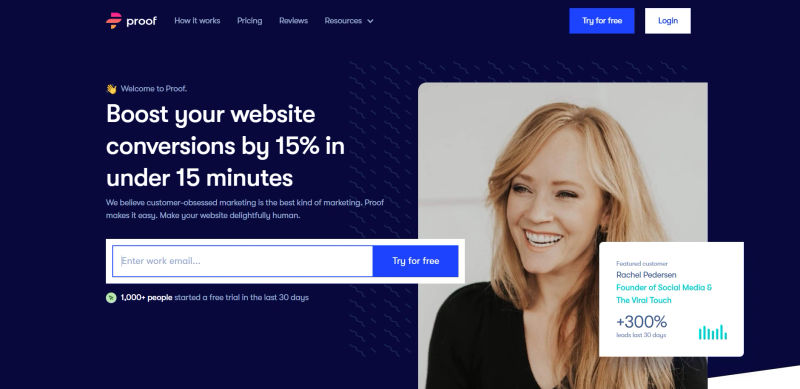
When A/B testing with Proof, you are analyzing the impact of "Herd Behavior." However, the insight comes from where and when this proof is effective. You might find that Proof notifications increase conversions on the checkout page (reassuring the user at the point of purchase) but decrease conversions on the home page (distracting the user from the primary value prop). By integrating Proof with your analytics, you can segment users who interacted with the notification versus those who ignored it. Did the users who saw the social proof have a higher Average Order Value (AOV)? If so, the insight is that social validation increases trust, allowing users to spend more.
The Learning Repository: Socializing Insights
One of the biggest failures in CRO programs is the lack of institutional memory. A test is run, it loses, and it is forgotten. Six months later, a new team member runs the exact same test. To build a true culture of experimentation, you must maintain a "Learning Repository."
Document every test with a standardized Executive Summary:
Hypothesis: What did we think would happen?
Result: What actually happened (with statistical confidence intervals)?
Insight: Why do we think this happened?
Next Steps: How does this inform the roadmap?
When presenting "neutral" or "losing" results to stakeholders, frame them as "Cost Savings." By proving that a proposed redesign didn't work, you saved the company the engineering resources of building it. This reframing is essential for maintaining executive buy-in.
Comparison of Testing Methodologies
To choose the right approach for your specific campaign, refer to the comparison below. Understanding the trade-offs between different testing types is vital for resource allocation.
Feature | A/B Testing | Multivariate Testing | Split Testing |
Primary Use Case | Testing distinct changes (e.g., Headline A vs. Headline B). | Testing combinations of elements to find the best mix. | Testing radically different designs or platforms. |
Traffic Requirement | Low to Medium. Can reach significance with moderate traffic. | High. Traffic needs increase exponentially with variables. | Medium. Similar to A/B but often for larger changes. |
Complexity | Low. Easy to set up in VWO, Instapage, etc. | High. Requires complex experimental design. | Medium/High. Requires distinct URLs/hosting. |
Insight Depth | Good for isolating single variables. | Excellent for interaction effects between variables. | Good for measuring total overhaul impact. |
Risk of Errors | Low, provided sample size is met. | High risk of "false positives" without massive data. | Low, but watch for SEO impact of redirects. |
Ideal Tool Example | Hello Bar, Proof | VWO (MVT features) | Instapage (Page variants) |
Choosing between these methodologies often comes down to your Minimum Detectable Effect (MDE). If you are looking for small, incremental gains (1-2% lift), you need massive traffic or MVT. If you are looking for large, transformative shifts (20%+ lift), Split URL testing with radical redesigns is often the only way to achieve that magnitude of change with a reasonable sample size.
Try AuthenCIO
Move to faster, smarter software evaluation with AI
Conclusion: Building a Culture of Continuous Experimentation
In 2026, the companies that win are not the ones with the best initial ideas, but the ones with the fastest feedback loops. A/B testing is the engine of that feedback loop. By moving beyond vanity metrics and focusing on strategic takeaways, you transform your marketing from a series of guesses into a predictive science.
Remember that top A/B testing tools like VWO, Instapage, POWR, Hello Bar, Proof, and Outgrow are merely instruments. The efficacy of your testing program depends on the quality of your hypotheses and the rigor of your analysis. Do not fear inconclusive results; fear the lack of curiosity. Every test, whether a win, loss, or draw, contributes a data point to your understanding of the customer. Document these learnings, socialize them across your organization, and use them to build a customer experience that is continuously optimizing itself.