
Introduction
As a company scales, the spreadsheets, manual paperwork, and disparate systems that once managed people operations quickly become liabilities. For HR managers and People Ops leaders at growing companies, this inflection point is critical. The search for a centralized, scalable Human Resource Information System (HRIS) becomes paramount, but choosing the right strategic partner is more important than simply adopting new technology. The administrative burden of tracking PTO, managing performance reviews, and onboarding new hires manually not only consumes valuable time but also introduces compliance risks and hinders strategic initiatives. This is where BambooHR enters the conversation as a leading solution designed specifically for small to medium-sized businesses.
Streamline your software evaluation process
This comprehensive 2026 guide provides a deep dive into BambooHR's software. We will dissect its core features, analyze its pricing structure, weigh its pros and cons, and compare it against key alternatives. Our goal is to equip you with the detailed insights needed to determine if BambooHR is the right strategic partner for your company's growth journey.
Key Takeaways:
Core HR is the main strength: BambooHR centralizes employee data and simplifies essential processes such as onboarding, PTO, performance, and HR reporting.
Designed around usability: Its intuitive interface and employee self-service tools can encourage faster adoption across the organization.
Flexible but integration-driven: Businesses can connect payroll, ATS, accounting, and benefits tools rather than relying on BambooHR for every function.
Useful for growing teams: It provides a structured HR foundation for companies moving away from spreadsheets and manual processes.
Plan for total cost: The base price can increase as companies add modules, implementation services, and integrations.
Global payroll needs require attention: Companies expanding internationally should evaluate payroll coverage and third-party integration requirements before committing.
BambooHR — Key Strengths & Limitations
Strengths
Easy to use: Clean, intuitive interface makes HR tasks simple for both administrators and employees.
Strong core HR: Excellent for employee records, onboarding, PTO, reporting, and HR administration.
Employee self-service: Employees can manage personal details, time off, documents, and other HR tasks independently.
Good reporting & analytics: Provides useful workforce insights around headcount, turnover, compensation, and other HR metrics.
Strong integrations: Connects with payroll, ATS, accounting, and benefits platforms to build a broader HR tech stack.
Limitations
Limited native payroll: Global and complex payroll requirements may require third-party integrations.
Modular pricing: Additional modules can significantly increase the overall cost.
Less enterprise customization: Larger organizations may find its customization and reporting less flexible than enterprise HR systems.
Not fully all-in-one: It focuses on HR rather than combining HR with IT and finance management.
Verdict: A user-friendly HRIS with strong core HR capabilities, making it particularly suitable for growing businesses that value simplicity and employee experience.
Best For: Growing SMBs with around 50–500 employees that need an easy-to-use platform for core HR, employee management, and HR automation.

Software Covered in this Article
To help you understand BambooHR in the right context, this article refers to a carefully curated set of key players:









What is BambooHR? An Overview for HR Managers
BambooHR is a comprehensive cloud-based Bamboo HR software solution designed to manage the entire employee lifecycle. Operating as a full-featured BambooHR HRIS (Human Resources Information System), it serves as a central system of record for all employee data. By automating a wide array of HR functions—from hiring and onboarding to compensation and offboarding—this Bamboo HR system eliminates manual administrative work. Founded in 2008, the BambooHR HR platform focuses on user-friendly core HR functionalities. Its reputation for high usability stems from a clean, intuitive design that minimizes the learning curve for administrators and employees adopting the Bamboo HR HRIS.
Today, BambooHR is a major player in the human capital management (HCM) space, trusted by HR professionals at over 33,000 companies across 190 countries. As a dedicated Bamboo HRIS system, it is particularly popular with growing companies that have graduated beyond basic spreadsheets. Organizations seeking a sophisticated yet intuitive Bamboo HRIS rely on it to streamline operations, enhance the employee experience, and derive actionable insights from their workforce data.
Key Benefits of Using BambooHR for Growing Companies
For a scaling organization, the right HRIS offers more than just administrative efficiency; it provides a strategic foundation. A distinct BambooHR advantage is its ability to deliver enterprise-grade tools tailored specifically for the agility of small to medium-sized businesses, providing several key benefits:
Centralized Employee Data: It consolidates all employee information into a single, secure database, eliminating data silos and ensuring accuracy. This is crucial for everything from payroll integration with tools like QuickBooks to strategic workforce planning.
Streamlined HR Workflows & Cost Savings: By automating routine tasks like onboarding checklists, time-off requests, and performance review cycles, BambooHR frees up HR teams to focus on higher-value activities. This automation directly translates to cost savings by reducing the hours spent on manual administrative work.
Enhanced Employee Experience: The platform’s employee self-service (ESS) portal empowers team members to manage their own information, request time off, and access company documents, fostering a culture of autonomy and transparency.
Data-Driven Decision Making: With robust reporting and analytics, HR managers can track key metrics like turnover, headcount, and compensation trends, providing the C-suite with the data needed to make informed business decisions. This is especially relevant in today's shifting labor market; while global hiring was down 14% and turnover down 21% year-over-year in late 2025, current late-2026 data shows hiring rebounding by 9% and turnover stabilizing, making real-time retention tracking essential.
BambooHR Core Features: A Deep Dive
BambooHR's primary strength is its comprehensive suite of core HR features. When evaluating BambooHR features, businesses prioritize modularity and usability. The most critical Bamboo HR features include employee data management, onboarding workflows, and time tracking. Let's explore these essential BambooHR core HR features in detail.
1. Employee Database & HR Records Management
At its core, BambooHR is a powerful system of record. The employee database provides a single source of truth for all people-related data. Each employee profile can store everything from personal details and emergency contacts to job history, compensation details, training records, and benefits information. Custom fields and access levels ensure that sensitive information is both comprehensive and secure, allowing HR managers to grant specific viewing or editing permissions to managers and employees.
2. Onboarding & Offboarding Workflows
First impressions matter, and BambooHR’s onboarding module helps create a structured and welcoming experience for new hires. HR managers can create custom onboarding checklists, assign tasks to different stakeholders (IT, hiring managers, etc.), and send out new-hire packets for electronic signature. This automation ensures consistency and completeness, reducing the manual chaos of getting a new employee set up. The same workflow-driven approach applies to offboarding, ensuring a smooth and compliant exit process.
3. Performance Management & Goal Setting
For growing companies focused on talent development, the Performance Management add-on is invaluable. It facilitates a continuous performance culture through features like goal setting, peer feedback, and formal assessments. In a competitive market, this data-driven approach is critical for talent retention; it helps identify top performers, create targeted development plans, and demonstrate clear paths for career progression, moving beyond the traditional, often ineffective, annual review.
4. Time Tracking & PTO Management
Managing time off can be a significant administrative drain. BambooHR simplifies this with an intuitive PTO management system. Employees can view their balances and request time off through the web portal or mobile app. Managers receive notifications and can approve or deny requests with a single click. The system automatically updates accruals based on company policy. Data from early 2026 shows that while 42% of employees requested PTO globally, only 51% of those requests were approved, highlighting the need for systems that provide clear visibility into leave management. For hourly employees, the Time Tracking add-on offers digital time clocks and timesheet management, which can be seamlessly integrated with payroll systems like Gusto or Paylocity.
5. Benefits Administration & Open Enrollment
In our review of BambooHR benefits administration features, the platform proves highly capable for mid-market companies. The Benefits Administration module simplifies managing employee benefits by allowing HR administrators to track various benefit plans, manage open enrollment periods, and provide employees with a clear self-service portal to select their options. For growing mid-market organizations, this centralization is key for compliance, ensuring accurate record-keeping, connecting directly to payroll deductions, and simplifying reporting requirements under regulations like the ACA.
6. HR Reporting & Analytics
One of the most strategic functions of an HRIS is its ability to turn raw data into actionable insights. BambooHR offers visual dashboards and a suite of standard reports covering headcount, turnover, and more. Its analytics tools allow HR leaders to create custom reports to answer specific business questions and track key performance indicators (KPIs) like compensation equity or DEI metrics. In a 2026 market where job openings have stabilized and hiring has rebounded by 12%—shifting significantly from when job openings rose 21% in mid-2025 while hiring dropped 20%—the ability to analyze internal talent and retention data becomes a powerful competitive advantage, helping you identify and develop talent from within.
Find Perfect Software For Your Business
7. Employee Self-Service & Mobile App
Empowering employees is a key tenet of modern HR. The employee self-service (ESS) portal allows team members to access and update their personal information, view pay stubs, request time off, and access the company directory without needing to contact HR. The highly-rated mobile app extends this functionality, giving employees and managers on-the-go access to essential HR tools, which is critical for companies with remote or field-based workforces.
8. Integrations & Ecosystem (e.g., Payroll, ATS)
BambooHR focuses on being the best at core HR, offering an open API and pre-built integrations with leading ATS, accounting software, and benefits carriers.
For payroll, you can integrate third-party providers (like ADP or Gusto) or use the native BambooHR Payroll add-on. When evaluating BambooHR payroll features, pricing, pros, and cons:
Features: Includes automated tax filing, direct deposit, and seamless time-tracking sync.
Pricing: Requires a custom quote and is billed as an add-on to the base subscription.
Pros: Eliminates duplicate data entry by unifying HR and payroll records.
Cons: Lacks the advanced capabilities of dedicated enterprise payroll, limiting companies with complex multi-state needs.
This modular approach differs from all-in-one platforms like Rippling, which manage HR, IT, and Finance natively.

BambooHR Pricing Plans Breakdown
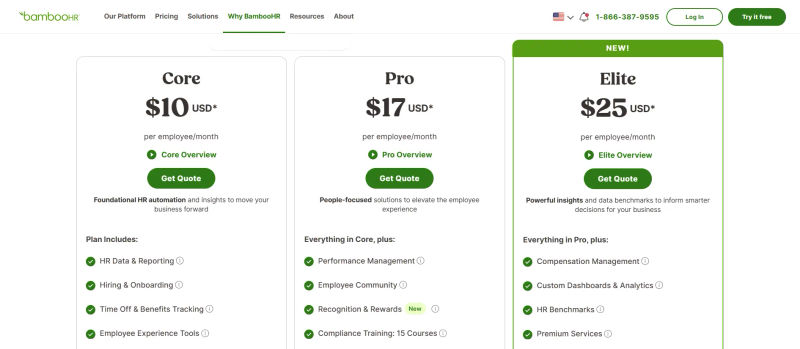
When evaluating BambooHR pricing, buyers often note a lack of upfront BambooHR pricing model transparency. The company utilizes a quote-based model, meaning they do not publish their full, exact cost tiers publicly on their website. Instead, Bamboo HR pricing is determined by your total employee headcount and the specific add-on modules you select. While this allows for a customized software package, it requires engaging with their sales team to get a clear picture of your total investment.
The cost is billed on a per-employee, per-month (PEPM) basis. BambooHR publishes a starting price of $10 per employee per month for its basic tier. From there, the platform is divided into three main plans: Core, Pro, and Elite. While the $10/month baseline is public, exact per-plan dollar figures for Pro and Elite—as well as costs for add-ons like payroll or performance management—are only available at $17 per employee per month and $25 per employee per month
Plan | Price | Best For | Features |
Core | $10 USD /employee /month | Small and mid-sized businesses that need foundational HR automation and a single HR system of record. | - HR data and reporting |
Pro | $17 USD/employee /month | Organizations that want to elevate employee experience with performance, community, and richer training. | - Everything in Core |
Elite | $25 USD/employee /month | Companies that need advanced analytics, benchmarks, and structured compensation planning. | - Everything in Pro |
*All plans are billed per employee per month with volume and non-profit discounts; exact Pro and Elite prices are provided via quote.
Understanding Implementation Costs & Hidden Fees
Beyond the monthly subscription fee, new customers must budget for a one-time implementation fee, which can range from a few hundred to several thousand dollars. It's also crucial to ask about:
Negotiation Potential: Pricing can often be negotiated, especially for growing companies committing to multi-year contracts or bundling multiple add-on modules.
How to Get an Effective Quote: Be prepared with your exact employee count, a clear list of must-have features, and your projected growth over the next 1-2 years to receive the most accurate pricing.
BambooHR Alternatives & Competitors Comparison
Evaluating BambooHR in a vacuum is a mistake. The HR tech landscape is crowded, and several strong competitors cater to the needs of growing companies.
1. BambooHR vs. HiBob:
HiBob places a strong emphasis on employee experience and company culture with a social-media-style interface and engagement tools. Choose HiBob if your primary goal is to build a vibrant culture and you need advanced compensation management tools. Choose BambooHR if you prioritize straightforward usability and best-in-class core HR administration.
2. BambooHR vs. Rippling:
Rippling is an "Employee Management Platform" that unifies HR, IT, and Finance, managing everything from payroll to app provisioning. Opt for Rippling if you need a single system to automate employee IT and HR workflows from the start. Stick with BambooHR if you prefer a dedicated, best-in-class HR system and plan to integrate it with other specialized tools.
3. BambooHR vs. Zoho People:
Zoho People is often a more budget-friendly option with a highly customizable and extensive feature set. Consider Zoho People if you are already in the Zoho ecosystem or need maximum features for the lowest cost and are willing to handle a steeper learning curve. Prefer BambooHR if out-of-the-box ease of use and a polished user experience are your top priorities.
Other Notable Alternatives
ADP & Paylocity: Payroll-first giants ideal for companies with complex payroll and compliance needs.
Gusto: An excellent, user-friendly choice for smaller companies where payroll and basic HR are tightly linked.
QuickBooks: An accounting software with a basic payroll add-on, not a comprehensive HRIS.
Employment Hero: A strong competitor, particularly in the APAC region, offering a broad suite of HR and payroll features.
Is BambooHR the Right HRIS for Your Growing Company in 2026?
Making the final decision requires looking inward at your company's specific needs, size, and growth trajectory.
A. Ideal Use Cases & Company Sizes
BambooHR shines for companies between 50 and 500 employees. These are organizations that have outgrown manual methods and need a centralized system to manage their people data and processes effectively. The ideal customer values user experience, wants to automate core HR tasks, and is focused on building a strong foundation for performance management and employee engagement.
B. The BambooHR Implementation Process: What to Expect
A smooth BambooHR implementation is crucial for success. For a company of 100-200 employees, the process typically takes 6 to 10 weeks. Key stages include:
Kickoff & Data Gathering: You'll be assigned an implementation specialist. Your primary task is to gather and clean all employee data for migration.
System Configuration: Your specialist will help configure settings for PTO, benefits, user permissions, and custom fields based on your company's policies.
Training & Rollout: BambooHR provides training for HR admins and managers. A common pitfall is not dedicating enough internal resources to this phase.
Go-Live: The system is launched for all employees.
C. Change Management: Driving User Adoption
To ensure high adoption, communicate the benefits of the new system early and often. Highlight how the employee self-service portal and mobile app will empower them. Leverage BambooHR's intuitive design by providing short, simple training guides for common tasks like requesting time off. Gaining buy-in from managers is critical, as they will be the front-line users for approvals and performance reviews.
D. Factors to Consider Before Implementation
Before signing a contract, create a decision-making framework. Consider the following:
Core Needs vs. Nice-to-Haves: What are your non-negotiable requirements?
Total Cost of Ownership: Factor in subscription fees, implementation costs, and any potential integration fees.
Integration Strategy: Do you prefer a best-in-class approach or an all-in-one platform?
Scalability & Global Growth: Consider your five-year plan. While BambooHR supports multiple languages and currencies, its native payroll is limited. If rapid international expansion is imminent, clarify its capabilities for managing multiple entities and global compliance.
Request a Demo: Never purchase an HRIS without seeing a live, personalized demo that addresses your specific use cases.
Try AuthenCIO
Move to faster, smarter software evaluation with AI
Conclusion: Making an Informed Decision on Your HR Software
For growing companies in 2026, BambooHR remains a top-tier HRIS contender. Its unwavering focus on user experience, combined with a powerful suite of core HR features, provides a robust platform to automate administrative tasks and build a strategic people operations function. It empowers HR managers to move from reactive problem-solving to proactive, data-driven decision-making.
However, it is not a one-size-fits-all solution. Its modular pricing and reliance on integrations for functions like global payroll mean a thorough evaluation is essential. By carefully weighing its strengths in usability and core HR against the comprehensive nature of alternatives like Rippling or the culture-centric tools of HiBob, you can make an informed choice. The right HRIS is a critical investment that impacts efficiency, compliance, and culture. By aligning your company's unique needs and future goals with the capabilities of a platform like BambooHR, you can lay the foundation for scalable and sustainable growth.