
Introduction
Employment classification determines how workers are paid, taxed, and protected under the law. For HR leaders, getting this right is a strategic imperative. Misclassifying an employee as an independent contractor or misapplying exempt status can trigger Department of Labor (DOL) audits, IRS penalties, and costly class-action lawsuits.
Streamline your software evaluation process
This guide provides a comprehensive framework for employment classification compliance. You will learn how to accurately categorize workers, navigate the nuances of the Fair Labor Standards Act (FLSA), and implement a 10-step best practices workflow to audit and correct your current workforce data. While primarily focused on United States federal law, this resource also highlights critical state-level variations and edge cases for modern, distributed teams.
Executive Summary: Key Takeaways
For the busy HR professional, here are the top HR tips for employee classification to serve as your quick-reference guide:
Apply Multi-Factor Tests, Not Titles: Classification is determined by legal tests (like the IRS Common Law, DOL's Economic Reality, and state-specific ABC tests), not by job titles or agreements. The degree of control and economic dependence are paramount.
Default to the Stricter State Law: Always apply the stricter standard. States like California, Washington, and New York have higher salary thresholds for exempt employees and more stringent tests for independent contractors.
Document Your Defense: A systematic, documented process for every classification decision is your best defense in an audit. Create a classification memo for each role, outlining the tests applied and the rationale.
Run Proactive Audits: Regular audits of your workforce are essential to identify and mitigate risk before regulators do. Prioritize high-risk roles like long-term contractors and borderline exempt positions.
Leverage Compliance Technology: Modern HR software is indispensable for enforcing compliance, from geo-aware timekeeping for non-exempt staff to generating compliant contracts for global contractors. For example, platforms like Rippling can manage multi-state payroll rules, while EORs like Deel handle international compliance.
Software Covered in this Article
To help you understand HR Software in the right context, this article refers to a carefully curated set of key players:


The Foundation: Understanding Employment Classification
Effective HR compliance employment law begins with a firm grasp of the fundamental categories that govern the employer-worker relationship. These classifications dictate everything from tax withholding and overtime eligibility to benefits access and statutory protections.
1. Defining Employee vs. Independent Contractor
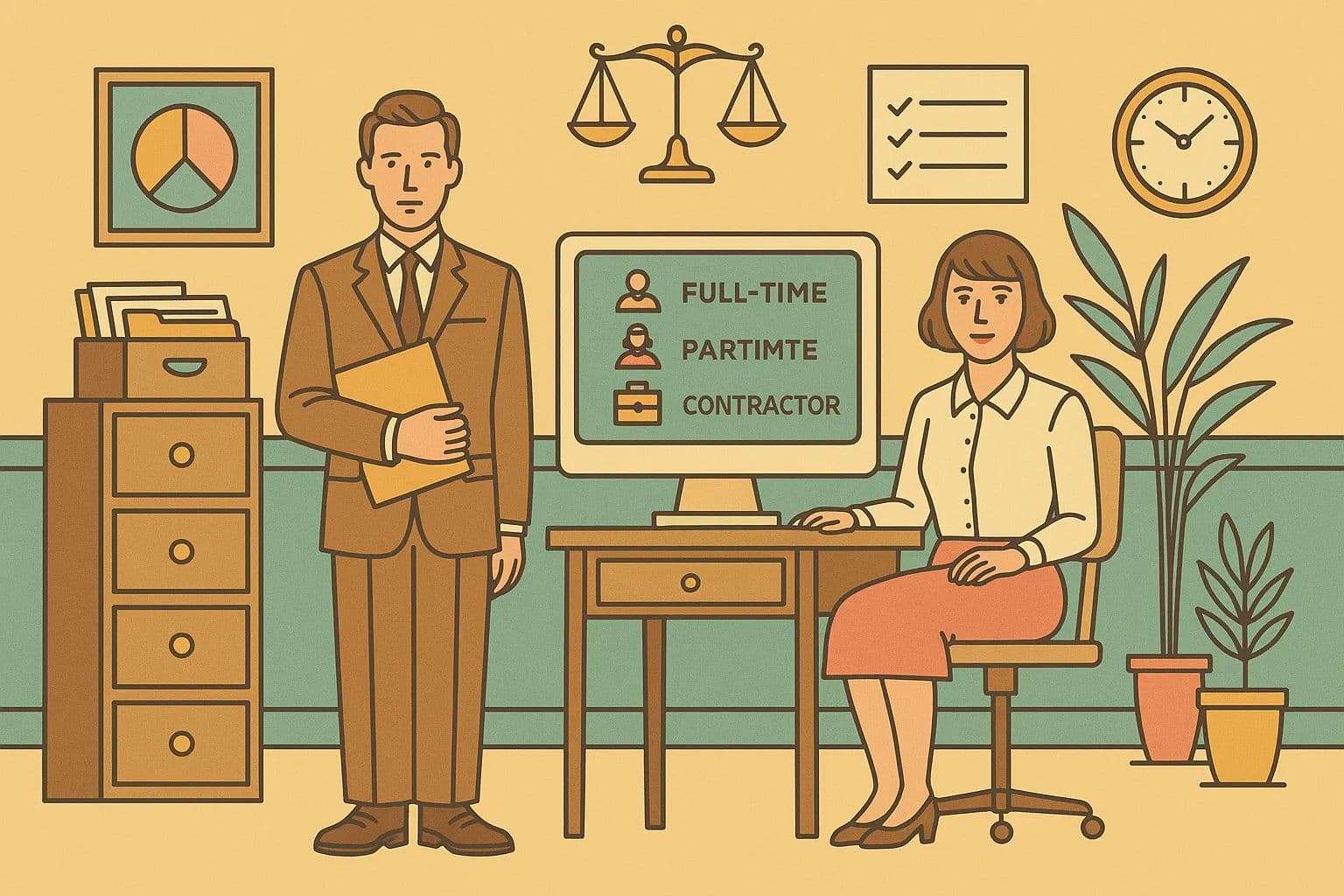
The primary fork in the classification road is determining whether a worker is an employee (W-2) or an independent contractor (1099). This distinction hinges on the substantive reality of the working relationship.
The IRS Common Law Test: This traditional federal standard, detailed in IRS Publication 15-A, examines the degree of control an employer has the right to exercise over a worker across three categories: Behavioral Control, Financial Control, and the Relationship of the Parties.
The DOL's "Economic Reality" Test: Reinstated by the DOL's 2024 final rule, this test focuses on whether a worker is economically dependent on the employer. It uses a totality-of-the-circumstances analysis of six factors, including the opportunity for profit or loss and the investment by the worker and the employer.
State-Level ABC Test: Many states (including California, Massachusetts, and New Jersey) use a much stricter ABC Test. To classify a worker as a contractor, a business must prove all three of the following: - (A) The worker is free from the control and direction of the hiring entity.
(B) The worker performs work that is outside the usual course of the hiring entity’s business.
(C) The worker is customarily engaged in an independently established trade, occupation, or business.
Test Aspect | IRS Common Law Test | DOL Economic Reality Test | ABC Test (Strictest) | Scenario: A freelance graphic designer for a tech company |
Primary Focus | Right to control | Economic dependence | All three prongs (A, B, C) must be met | Passes IRS/DOL if they use their own tools and have other clients. Fails ABC Test's 'B' prong if design is core to the tech company's app business. |
2. Exempt vs. Non-Exempt: The FLSA Framework
Once a worker is classified as an employee, you must determine their status under the Fair Labor Standards Act (FLSA), which governs overtime eligibility. If you are wondering, "how do I know if I'm an exempt employee?", the answer relies on a strict three-part evaluation.
Non-Exempt Employees: Are entitled to overtime pay (1.5x their regular rate) for hours worked beyond 40 in a workweek.
FLSA Exempt Employees: Are not eligible for overtime. To qualify, an employee must meet all three of these tests:
Salary Basis Test: Paid a predetermined, fixed salary that isn't subject to reduction based on work quantity or quality.
Salary Level Test: What is the minimum salary for exempt employees? As of January 1, 2025, the federal minimum salary threshold is $1,128/week ($58,656 annually). Always check the current DOL threshold, as it is subject to regular updates.
Duties Test: The employee’s primary job duties must fall under specific “white-collar” exemption categories (Executive, Administrative, Professional, Computer, Outside Sales). Job titles alone do not dictate status; actual daily tasks must align with DOL definitions.
3. Other Classification Types: Gig Workers, Interns, and Volunteers
Gig Workers/Contingent Workforce: This segment faces the highest scrutiny. The same IRS, DOL, and state-level control tests apply. The temporary nature of their work does not automatically make them contractors.
Interns (For-Profit): Must satisfy the DOL's seven-factor "primary beneficiary test" to be unpaid. The core question: is the intern or the employer the primary beneficiary? A compliant unpaid internship provides training similar to an educational environment and complements, rather than displaces, the work of paid employees.
Federal vs. State Differences: A Comparative Matrix
Compliance requires navigating a patchwork of state laws that are often stricter than federal rules. The rule of thumb is to always adhere to the standard that provides the greatest protection to the worker.
Jurisdiction | Salary Threshold | Contractor Test | Overtime Rule | Meal/Rest Breaks | Key Documentation |
Federal (FLSA) | $684/week | IRS/DOL | >40 hrs/week | None | Payroll, contracts |
California | $1,280/week | ABC | >8 hrs/day | 30-min meal/rest | Pay stubs, logs |
New York | $1,125/week | IRS/common law | >40 hrs/week | Mandated breaks | Timekeeping, forms |
💡 Compare multi-state HR platforms side-by-side—Explore AuthenCIO’s AI-powered comparison tool!
The Stakes: Why HR Compliance Employment Law Matters
Misclassification isn't a minor payroll error; it's a strategic risk with severe consequences.
1. Legal and Financial Risks of Misclassification
Penalties can be staggering, including:
Back Wages and Overtime: For up to three years.
Liquidated Damages: An additional penalty often equal to the amount of unpaid wages.
Payroll Tax Liability: The employer's share of FICA and FUTA taxes, plus penalties.
Benefits Restitution: The cost of benefits like health insurance or 401(k) contributions.
Legal Fees: Defending against individual or class-action lawsuits.
Scenario: A company misclassifies 15 software developers as contractors for two years. A DOL audit finds they should have been non-exempt employees. The potential liability could easily exceed $500,000 in back overtime, taxes, and penalties before legal fees.
2. Joint-Employment and Vendor Risks
When using staffing agencies or managed service providers, you can inadvertently create a joint-employer relationship. If your company exerts significant control over the agency's workers (e.g., direct supervision, setting pay, hiring/firing), you could share liability for wage and hour violations under NLRB and DOL rules.
Find Perfect Software For Your Business
Your 10-Step Employee Classification Best Practices Workflow
Adopt a systematic process to ensure every worker classification is defensible and compliant.
Intake: Gather the job description, proposed pay, and manager's expectations for any new or changing role.
Job Analysis: Go beyond the job description. Interview the hiring manager to understand the role's actual day-to-day duties, autonomy, and strategic impact.
Duty Mapping: Map the analyzed duties directly to the criteria of federal and state exemption tests.
Test Selection: Determine which tests apply. Start with the strictest applicable standard (e.g., a state's ABC test for contractors, or a state's higher salary threshold for exempt status).
Decision & Documentation: Make a preliminary classification. Document the rationale in a Classification Memo, detailing which tests were used and how the role's duties met (or failed to meet) each criterion.
Peer/Legal Review: Have a qualified second party (another HR leader or legal counsel) review the memo and decision for accuracy and consistency.
System Configuration: Once finalized, configure the role in your HRIS and payroll systems. This is where tools like BambooHR or Keka ensure the correct pay group, overtime rules, and tax settings are applied from day one.
Communication: Clearly communicate the classification (and its implications for timekeeping and overtime) in the offer letter.
Manager Training: Train the manager on how to manage the role compliantly (e.g., ensuring non-exempt employees track all hours, not treating contractors like employees).
Ongoing Monitoring: Schedule periodic reviews (annually, or when duties change significantly) to ensure the classification remains accurate.
The Misclassification Remediation Playbook
If an audit reveals a misclassification, a swift and orderly response is crucial.
Consult Legal Counsel: Immediately engage employment counsel to guide you through the process under attorney-client privilege.
Define Scope & Calculate Exposure: Determine the lookback period (typically 2-3 years) and calculate the potential liability for back wages, overtime, and taxes.
Corrective Action: Reclassify the worker(s) in your HRIS and payroll systems going forward. For example, in Gusto, you would transition a 1099 profile to a W-2 profile.
Back Pay & Payroll Corrections: Work with counsel on the strategy for paying back wages. Run an off-cycle payroll for corrections and amend prior payroll tax filings (e.g., Forms 941-X).
Benefits Enrollment: Enroll newly classified employees in all applicable benefits plans, addressing retroactive contributions as needed.
Communication: Develop a clear, empathetic communication plan to explain the change to affected employees, focusing on the positive aspects (e.g., benefits eligibility, overtime pay).
Navigating Modern Edge Cases
Multi-State Remote Workers: The employee's work location dictates which state laws apply. When evaluating what platforms handle remote employee classification compliance, prioritize systems with automated tax registration and labor law mapping. The best HR service companies specializing in multistate compliance, I-9 verification, and worker classification for remote teams include Rippling, Gusto, and Justworks. A robust HRIS like UKG or HROne remains essential for applying geo-based rules for pay, leave, and overtime.
Cross-Border Contractors & EORs: When hiring internationally, navigating foreign labor laws is complex. Using an Employer of Record (EOR) platform like Multiplier or Deel is often the safest and fastest route. They act as the legal employer in-country, ensuring compliance with local classification, payroll, and benefits laws, mitigating risks like the UK's IR35 or Germany's rules on bogus self-employment (Scheinselbstständigkeit).
Staffing Agencies & Joint Employment: To mitigate risk, ensure your contracts with staffing vendors clearly define the employer-employee relationship. Avoid directly supervising, disciplining, or controlling the day-to-day work of agency staff.
Leveraging HR Software for Classification and Compliance
Manual compliance is no longer viable. The right HR software for employment classification** embeds rules, automates processes, and creates an auditable record for payroll and workforce classification.
Exactly where to find classification guidance built into payroll platforms? Access employee classification tools in payroll software directly within onboarding workflows, worker profile settings, and compliance dashboards. Utilizing this classification guidance built into payroll platforms automatically flags FLSA and independent contractor risks during initial setup.
Buyer Criteria & Implementation
When evaluating technology, prioritize these key capabilities:
Geo-Based Rules: Can the system automatically apply different overtime, meal break, and minimum wage rules based on employee work location?
Audit Trails & Pay Groups: Does the system log all status changes and easily separate exempt, non-exempt, and contractor policies?
Compliant Timekeeping: For non-exempt staff, time tracking tools like Atto or Hubstaff must provide accurate, contemporaneous records and meal break enforcement.
Integrated Onboarding: Platforms like Zoho People should automatically present the correct documents (W-4 vs. W-9) based on initial classification.
Platform Comparison When comparing Gusto vs Deel vs Rippling vs BambooHR contractor management misclassification safeguards, consider their distinct strengths:
Deel: Best for global compliance. Deel payroll HR software overtime exempt non-exempt guidance automatically flags local labor laws and offers misclassification warranties for international contractors.
Rippling: Dynamically adjusts compliance workflows, policies, and IT access based on a worker's specific state and classification status.
Gusto: Streamlines domestic SMB contractor payments and W-2/1099 generation, though employers must determine the initial classification.
BambooHR: Excellent for core HR record-keeping, but robust international contractor management typically requires integrations.
Metrics and Your 30-60-90 Day Action Plan
Translate compliance into a measurable strategy.
KPIs to Track
Audit Coverage %: Percentage of workforce with a documented classification review in the last 12-18 months.
Audit Pass Rate: Percentage of audited roles where the classification was upheld.
Time-to-Remediate: Time from identification of a misclassification to full correction and communication.
30-60-90 Day Implementation Plan
Days 1-30 (Inventory & Triage): Create a master list of all workers. Use a risk-scoring rubric to prioritize high-risk roles (e.g., long-term contractors, roles in ABC-test states) for immediate review.
Days 31-60 (Pilot Audits & System Fixes): Conduct pilot audits on your highest-risk groups. Use the findings to refine your 10-step workflow and configure your HRIS/payroll systems with the correct compliance rules.
Days 61-90 (Rollout & Training): Roll out the audit process company-wide. Conduct mandatory training for all managers on classification principles and timekeeping policies.
Templates and Checklists for Your Toolkit
Exemption Determination Checklist: A form that walks through the salary basis, salary level, and duties tests for a specific exemption, with a final sign-off.
Contractor Evaluation Questionnaire: A questionnaire for hiring managers based on the IRS/DOL control factors to assess a potential contractor relationship before engagement.
Classification Memo Template: A standardized document with sections for Role Summary, Test(s) Applied, Factor-by-Factor Analysis, Final Decision, and Reviewer Approvals.
Try AuthenCIO
Move to faster, smarter software evaluation with AI
Conclusion: Building a Future-Proof Compliance Strategy
Employment classification is a cornerstone of strategic HR. By building a deep understanding of the core principles, implementing a systematic framework of best practices, and leveraging technology, HR leaders can transform compliance from a reactive burden into a proactive, automated process. Regular audits, meticulous documentation, and ongoing manager training are your essential defensive tools. The right HR software provides the guardrails and system of record needed to build a resilient and legally sound organization.
Disclaimer: This article provides general information for educational purposes and is not a substitute for legal advice. You should consult with a qualified employment law attorney for advice on your specific situation.