
Introduction
In the rapidly evolving landscape of human resources, People Leaders at mid-market and global companies face a distinct set of challenges. You're navigating the complexities of scaling operations, managing a distributed workforce, and fostering a cohesive culture across multiple jurisdictions. Legacy, one-size-fits-all Human Capital Management (HCM) systems often prove too rigid, while lightweight solutions lack the strategic depth required for growth.
Streamline your software evaluation process
This is the precise niche HiBob, often known simply as Bob, aims to fill. The demand is clear: industry reports project the global HR technology market will reach $81.84 billion by 2032, driven by post-pandemic shifts in work and an intense war for talent that necessitates greater organizational agility.
HiBob positions itself not just as an HRIS (Human Resources Information System) but as a people management platform designed for the modern workplace. It's built on the philosophy that HR should be less about administrative overhead and more about creating exceptional employee experiences that drive business outcomes. For a 500-person tech company expanding into Europe or a 1,500-employee professional services firm shifting to a hybrid model, HiBob offers a compelling value proposition: a centralized, culture-centric hub that engages employees and empowers leaders with actionable data. This comprehensive mid-market HR platform review will dissect that proposition.
Key Takeaways
People-focused HR platform: HiBob goes beyond basic HR administration by combining core HR, employee engagement, performance, and workforce management in one platform.
Strong employee experience: Its modern interface, feedback tools, surveys, recognition, and self-service features help create a more engaging employee experience.
Designed for global teams: HiBob supports organizations with distributed and multi-country workforces through flexible HR processes and localized capabilities.
Useful HR insights: Analytics and customizable reporting help HR teams understand workforce trends and make more informed decisions.
Automation reduces HR workload: Automated onboarding, offboarding, and employee workflows can reduce repetitive administrative tasks.
Payroll requires consideration: Since native global payroll coverage is limited, businesses may need integrations with external payroll providers.
Best suited to growing organizations: Its broader capabilities are particularly valuable for mid-sized and international companies rather than very small teams with basic HR requirements.
HiBob (Bob) — What Works & What Doesn’t
What Works
Modern, user-friendly interface: Makes HR tasks and employee self-service easy to navigate.
Strong employee engagement: Offers recognition, feedback, surveys, and culture-building tools.
Powerful HR analytics: Provides workforce insights, performance tracking, and customizable dashboards.
Flexible global HR management: Supports multi-country operations, localized policies, and distributed teams.
Automated HR workflows: Streamlines onboarding, offboarding, and employee data management.
What Doesn’t
No native global payroll: Relies on integrations with external payroll providers in many countries.
Complex implementation: Requires planning, data migration, and dedicated internal resources.
Expensive for smaller businesses: May be too costly for smaller teams with basic HR needs.
Learning curve for administrators: Advanced configuration and reporting can take time to master.
Verdict: A modern, people-focused HR platform that combines employee engagement, workforce analytics, and global HR management, but requires careful implementation and payroll planning.
Best For: Mid-sized and global companies with around 200–2,000+ employees that prioritize employee experience, performance management, and multi-country HR operations.

Software Covered in this Article
To help you understand HiBob in the right context, this article refers to a carefully curated set of key players:







Why Choose a Modern HR Platform?
Choosing a modern HR platform is the foundational step for any business undergoing digital transformation. To evaluate the HR software (human resources technology) company HiBob on HR transformation and digitalization, organizations must look at how it shifts HR from administrative record-keeping to strategic workforce management. A modern platform like HiBob drives this digital shift by:
Digitalizing the Employee Experience: Replacing paper-based and fragmented processes with a consumer-grade, unified digital interface for seamless onboarding and intuitive self-service.
Driving HR Transformation: Automating complex, routine workflows across the employee lifecycle so HR teams can pivot from manual data entry to strategic initiatives like organizational design.
Fostering Digital Culture & Engagement: Providing built-in tools for connection, recognition, and continuous feedback that keep distributed, hybrid, and remote teams aligned.
Enabling Data-Driven Decisions: Transforming static headcount reports into dynamic, real-time people analytics that help leaders predict turnover, analyze talent trends, and execute strategic workforce planning.
Who is HiBob (Bob) For?
When you evaluate the HR software (human resources technology) company HiBob on midmarket capabilities, it stands out as a purpose-built solution for organizations with 200 to 2,000+ employees. Midmarket organizations in a high-growth phase often outgrow simpler systems like BambooHR but find enterprise-grade solutions like UKG or ADP unnecessarily complex. The ideal HiBob customer is a people-centric organization that views HR as a strategic partner and prioritizes culture as a key driver of success. They require one of the top-tier global HR software options that can handle multi-country operations, diverse compliance needs, and complex organizational structures without the rigidity of legacy enterprise systems.
Key Features of HiBob HR Software
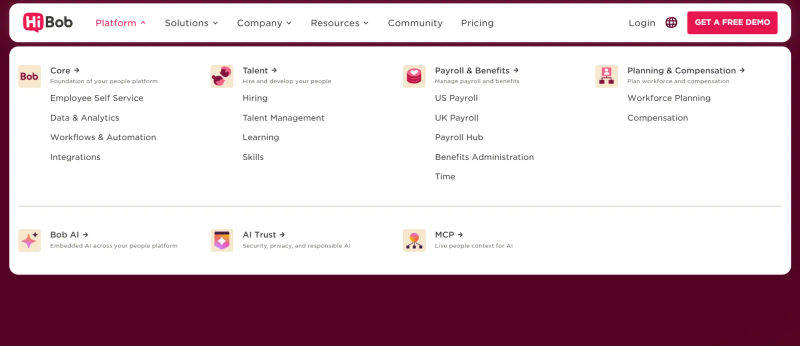
When evaluating HiBob features, organizations need tools that go beyond basic record-keeping. As a core HR software platform, HiBob delivers capabilities across four main pillars: core HR and people management, culture and employee engagement, advanced analytics, and automated workflows. These features centralize employee data, streamline onboarding, manage performance, and integrate with other enterprise systems. Let's explore these key capabilities in detail.
A. Core HR & People Management Capabilities
When you evaluate the HR software (human resources technology) company HiBob on core HR & operational excellence, the platform stands out for transforming foundational administrative tasks into streamlined, automated processes.
1. Onboarding & Offboarding Automation
HiBob drives operational excellence during critical employee transitions. Its workflow builder allows HR teams to deploy customized, automated onboarding and offboarding sequences at scale. For global organizations, administrators can design a core corporate onboarding flow and layer on location-specific tasks—such as IT setup in London, benefits enrollment in New York, and compliance training in Singapore. Automated checklists and reminders for new hires, managers, and IT departments eliminate manual bottlenecks, reducing administrative burden and ensuring a consistent, compliant experience.
2. Employee Data & Directory Management
Centralized, accurate data is the backbone of HR operational excellence. HiBob provides a dynamic, visually engaging employee directory that captures standard demographic data alongside customizable fields for skills, interests, and preferred pronouns. The platform’s “Club View” organizes employees into social groups based on shared interests, which helps break down silos and integrate teams during rapid growth or acquisitions. For People Leaders, the platform generates a living, easily filterable org chart that provides immediate visibility into reporting structures, headcount, and team compositions, enabling faster, data-driven workforce planning.
B. Culture & Engagement Tools
This is where HiBob truly differentiates itself from more traditional HR systems. It has built-in features designed to actively cultivate a positive workplace culture.
1. Performance Management & Feedback Cycles
HiBob moves beyond the dreaded annual review. It supports a continuous performance management model with flexible goal-setting (supporting both OKRs and KPIs), 360-degree feedback, 1-on-1 meeting templates, and performance check-ins. Crucially for scaling companies, it includes tools to facilitate talent calibration meetings, allowing leaders to discuss performance and potential across teams in a structured, data-backed way. The platform’s ability to link individual goals to company-wide objectives provides a clear line of sight for employees, enhancing motivation and alignment. This contrasts with platforms like Rippling, which are exceptionally strong on the payroll and benefits side but have historically placed less emphasis on the nuanced aspects of performance and culture.
2. Employee Recognition & Well-being
The platform's “Shoutouts” feature allows for peer-to-peer recognition that can be linked to company values, making appreciation visible and reinforcing desired behaviors. This data can be analyzed to identify culture champions. Furthermore, HiBob includes tools for pulse surveys and eNPS (Employee Net Promoter Score) tracking. These short, frequent surveys provide a real-time gauge of employee sentiment, allowing HR leaders to proactively address issues before they impact retention. This focus on engagement is a key differentiator from payroll-centric systems like Paylocity.
C. Analytics & Reporting for Strategic HR
When you evaluate the HR software (human resources technology) company HiBob on people analytics & data privacy, its platform stands out for transforming raw HR data into secure, strategic business intelligence. Research shows that 46% of businesses report measurable value from HR SaaS, including real-time analytics for workforce planning.
1. Workforce Insights & Dashboards
HiBob offers a comprehensive set of pre-built dashboards that track key HR metrics like headcount growth, turnover rates (regrettable vs. non-regrettable), diversity metrics, and compensation trends. These dashboards are highly visual and can be filtered by department, location, and other demographics. For example, a VP of People can quickly analyze turnover trends among high-performing engineers in their first two years, identify potential issues, and develop a targeted retention strategy. This level of granular, out-of-the-box reporting is a significant step up from systems that require extensive custom report building.
2. HR Compliance & Data Security
For global companies, compliance is a minefield. HiBob helps manage this by allowing you to store and track essential compliance documents, manage different holiday calendars and leave policies by country, and maintain a secure, centralized record of all employee data. When evaluating data privacy, the platform is strictly compliant with major regulations like GDPR, CCPA, and ISO 27001 standards, ensuring sensitive workforce data remains protected.
3. Global Compliance Capabilities
Beyond broad strokes, the platform allows for nuanced local management. For instance, you can configure specific leave policies unique to France, manage data fields required for Germany's works councils, and address data residency requirements by ensuring EU employee data is stored within the EU. While a specialized global compliance platform like Deel offers deeper EOR (Employer of Record) functionalities, HiBob provides robust core HR compliance for companies with their own legal entities in multiple countries.
Find Perfect Software For Your Business
D. Modern HR Workflows & Integrations
No HR platform exists in a vacuum. A modern system must integrate seamlessly with the broader tech stack to create efficient, automated processes.
1. Payroll & Compensation Management
When evaluating the HR software (human resources technology) company HiBob on payroll & compensation, its strategy centers on an integration-first “payroll hub” model. HiBob does not process global payroll natively. Instead, it integrates with dozens of leading regional and global payroll providers (e.g., ADP, Paylocity, Deel).
For compensation, HiBob offers a dedicated module that centralizes salary reviews, bonus allocations, and equity grants. HR teams can configure compensation cycles, define budgets, and establish multi-level approval workflows. Once a compensation change (like a salary increase or bonus) is approved in HiBob, it automatically syncs to the relevant connected payroll system. This approach provides flexibility, allowing a company to use the best-in-class payroll provider for each region while utilizing HiBob as the single source of truth for all global compensation and employee data.
2. Time & Attendance Management
HiBob includes native modules for time and attendance, allowing employees to clock in/out and request time off directly within the platform. The system can be configured to handle complex leave policies across different countries, automating accruals and approvals. For most mid-market companies, HiBob's native capabilities are more than sufficient to feed accurate hours and PTO data directly into the payroll hub.
HiBob Pricing: Plans & Costs (2026)
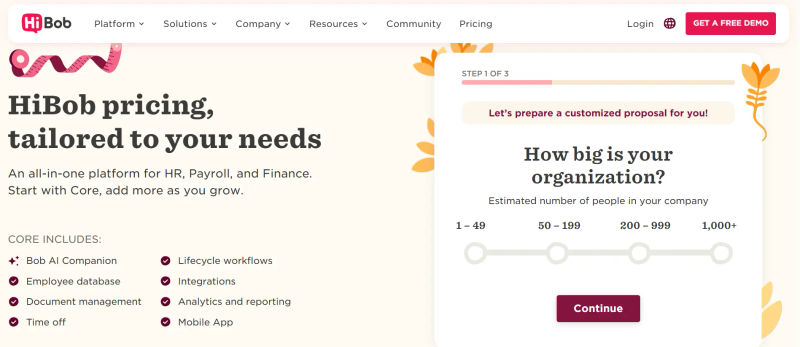
If you are wondering how much does HiBob cost, the vendor does not publish standard rates. Instead, HiBob pricing (or hi bob pricing) is entirely quote-based. Your total HiBob cost depends on your organization's headcount, chosen add-on modules, and contract length. You must contact their sales team directly for a custom quote.
Understanding HiBob's Pricing Model
HiBob's pricing is primarily calculated on a Per Employee Per Month (PEPM) basis. The final quote is influenced by:
Module Selection: The price will vary depending on which modules you choose (e.g., Core HR, Performance, Compensation).
Employee Headcount: There are typically volume discounts; the PEPM rate decreases as your employee count increases.
Contract Length: Longer-term commitments (typically 1-3 years) usually result in a lower monthly rate.
Implementation & Support: There is often a one-time implementation fee, and premium support packages may come at an additional cost.
Generally, HiBob is positioned as a premium solution. It is typically more expensive than entry-level options like Zoho People or BambooHR but may be more cost-effective than sprawling enterprise systems when considering the total cost of ownership and the value derived from its engagement and analytics features. Be sure to inquire about potential additional costs for advanced integrations or specialized training during the sales process.
Detailed Pricing Table: Plans, Features & Best For
Disclaimer: HiBob does not publish any fixed plan names or dollar prices on its pricing page; it only offers “custom pricing” via a request-a-demo form and positions Bob as a configurable HCM platform rather than tiered bundles.
Plan | Price | Best For | Features |
Core HR | $8 - $12 | Mid-market companies needing a central HRIS and strong onboarding. | Core HR database, employee directory, org charts, automated onboarding/offboarding, document management, e-signature, reporting basics. |
Growth | $13 - $18 | Companies focused on performance, engagement, and culture. | All Core HR features plus performance management (reviews, goals, 1-on-1s), engagement surveys, Shoutouts & recognition, compensation management. |
Enterprise | $19 - $25+ | Global organizations with complex needs for analytics and workforce planning. | All Growth features plus advanced HR analytics & dashboards, custom reporting, talent management modules, dedicated customer success manager. |
Add-on Modules | Varies | Companies needing specific functionality. | Time & Attendance, Payroll Hub integrations, advanced compensation planning tools. |
*Estimated price PEPM. The above prices are industry estimates for illustrative purposes. Actual quotes from HiBob will vary based on your specific needs, company size, and negotiation.
HiBob Alternatives & Competitors
When evaluating a HiBob alternative, you must understand the broader market. How does HiBob compare to other HR systems? It excels in global culture and engagement but faces strong HiBob competitors in native payroll processing. How does HiBob stack up against other HR platforms? It generally provides deeper mid-market capabilities than entry-level tools but is less complex than enterprise ERPs. For organizations focused on performance management asking, what are the top 14 HiBob talent module competitors and alternatives in 2026? The leading HiBob alternatives include BambooHR, Rippling, Lattice, Culture Amp, Leapsome, 15Five, Workday, UKG, ADP, Paylocity, ClearCompany, PerformYard, Factorial, and Deel.
1. HiBob vs. BambooHR: A Head-to-Head Comparison
When evaluating HiBob vs. BambooHR (or BambooHR vs. HiBob), the decision typically hinges on company size and global footprint.
HiBob: Stronger on culture, engagement, and advanced analytics. In a direct HiBob vs. Bamboo comparison, HiBob is built for dynamic, global mid-market companies managing complex structures and prioritizing employee experience.
BambooHR: Known for user-friendliness and simplicity. When comparing Bamboo vs. HiBob, BambooHR is ideal for small to mid-sized businesses centralizing core HR data. It is generally less expensive but lacks HiBob's deep reporting and multi-national capabilities.
2. HiBob vs. Rippling: Comprehensive HR & Payroll
HiBob: A pure-play HR platform focused on people and culture. Its strength lies in performance management and HR analytics. It integrates with other systems for payroll (via its hub) and IT (via its robust API, connecting to common ATS like Greenhouse and ERPs).
Rippling: An all-in-one “employee management platform” that combines HR, IT, and Finance. Its native global payroll is a major strength. The choice often comes down to whether you prefer a best-of-breed HR solution (HiBob) or a fully integrated, all-in-one platform (Rippling).
Other Notable Alternatives for Mid-Market HR
Breathe HR: When comparing HiBob to Breathe HR, the main difference is scale and feature depth. Breathe HR is a straightforward, budget-friendly solution tailored for small businesses needing basic core HR, leave management, and document storage. In contrast, HiBob is built for scaling mid-market companies, offering advanced analytics, global workforce management, and sophisticated culture-building tools that Breathe HR lacks.
Zoho People: Part of the broader Zoho ecosystem, Zoho People is a highly customizable and affordable option. It's a strong contender for cost-conscious organizations but may lack the polished user experience and dedicated culture tools of HiBob.
Employment Hero: A powerful platform with a strong focus on global workforce management, particularly in the APAC region. It offers robust HR, payroll, and benefits features, making it a solid alternative for companies with a significant international footprint.
UKG & Paylocity: These are more traditional, enterprise-focused HCM providers. They offer incredibly deep functionality, but for a mid-market company, they can feel less agile due to heavier implementation burdens, a less intuitive UI, and feature sets that may be overly complex for non-enterprise needs.
Deel: While primarily known for global payroll and EOR, Deel has been rapidly expanding its HRIS capabilities. For a “global-first” company that hires talent anywhere in the world, Deel is a formidable competitor, especially if managing a mix of full-time employees and international contractors is a top priority.
Is HiBob the Right HR Software for Your Organization?
Making a significant investment in an HR platform requires careful consideration. The decision hinges less on which platform has the most features and more on which platform best aligns with your company's strategic priorities, culture, and growth trajectory.
Factors to Consider Before Choosing
Organizational Culture: Is your company culture-driven? Do you prioritize employee engagement and feedback? If so, HiBob’s strengths align perfectly with these values.
Global Complexity: Are you currently operating in or planning to expand to multiple countries? HiBob’s ability to manage different policies and compliance needs is a key advantage.
Strategic HR Function: Is your leadership team expecting data-driven insights on talent and workforce trends? HiBob’s analytics suite will be a critical enabler.
Integration Ecosystem: How well must the platform connect with your existing tech stack (ATS, ERP, etc.)? Assess HiBob’s API capabilities and pre-built integrations against your specific needs.
Total Cost of Ownership (TCO): Look beyond the license fee. Factor in implementation costs, integration fees, and the internal resources required to manage the system. The ROI from improved retention and efficiency can often justify a higher initial investment.
Making an Informed Decision for Your HR Strategy
Choosing the right HR platform is a strategic decision that will impact your organization for years to come. HiBob presents a powerful, modern, and culture-centric solution for mid-market and global companies. Its strengths in employee engagement, performance management, and people analytics make it a top contender for any People Leader looking to build a thriving workplace.
However, it's crucial to conduct a thorough evaluation. The best next steps are to request a personalized demo focused on your most pressing challenges (like global compliance or manager analytics) and to speak with current HiBob customers in a similar industry and size to gather unfiltered, real-world insights.
Try AuthenCIO
Move to faster, smarter software evaluation with AI
Conclusion
HiBob has firmly established itself as a leader in the modern HCM market, particularly for people-centric, mid-sized companies navigating the complexities of scale and a distributed workforce. Its platform brilliantly combines robust Core HR functionality with best-in-class tools for fostering culture, driving engagement, and delivering the strategic people analytics that today's leaders demand. While not the cheapest option and requiring a thoughtful implementation, its focus on the employee experience can deliver a significant return on investment through improved retention, productivity, and organizational health.
For People Leaders at a crossroads, struggling with fragmented systems and a lack of actionable data, HiBob offers a compelling path forward. By centralizing people operations and providing the tools to build a connected, high-performing culture, it empowers HR to move beyond administration and become a true architect of the organization's success. The key is to weigh its powerful capabilities against your specific organizational needs and budget, comparing it objectively to the strong alternatives in the market. Making a smarter HR software decision starts with unbiased, side-by-side comparisons.