
Introduction
In this Keka HRMS review 2026, we evaluate one of the leading core HR platforms tailored specifically for Indian Small and Medium-sized Businesses (SMBs). Managing the intricate, ever-evolving web of statutory compliance while fostering a productive workforce requires a robust technological backbone. For HR Managers, selecting the right HRMS is a critical strategic decision to streamline operations and support growth.
Streamline your software evaluation process
Keka HR has cemented its position as an employee-centric platform designed to handle everything from payroll to performance management. But is it the right choice for your organization today?
This in-depth guide provides a comprehensive analysis of Keka HR software, designed specifically for the discerning Indian HR professional. We will dissect its features, scrutinize its pricing structure, weigh its pros and cons, and benchmark it against key alternatives like Zoho People, BambooHR, and HiBob.
Our goal is to equip you with the objective insights needed to determine if Keka aligns with your company's strategic HR objectives, compliance needs, and budgetary constraints. The digital transformation of HR is accelerating, with the global HR payroll software market projected to grow by USD 7.84 billion from 2025 to 2029, and making the right software choice has never been more crucial.
Key Takeaways: Keka HRMS Review 2026
If you are short on time, here is the bottom line on Keka HR for Indian small and medium-sized businesses (SMBs) in 2026:
Built for Indian Compliance: Keka's standout feature remains its deeply localized payroll engine, which automatically handles TDS, PF, PT, and ESI calculations, eliminating manual statutory compliance headaches.
Ideal for Growing SMBs: It hits the sweet spot for companies with 50 to 500+ employees looking to transition from fragmented spreadsheets to an automated, all-in-one HR ecosystem.
Standout Features: Beyond payroll, users highly rate its intuitive Employee Self-Service (ESS) portal, robust attendance and leave tracking, and customizable performance appraisal modules.
Main Limitations: While the desktop platform is highly praised, some users report occasional lag in the mobile app, and the pricing tiers may be slightly premium for micro-enterprises compared to entry-level alternatives.
Top Alternatives: If Keka doesn't fit your budget or global needs, Zoho People offers a more cost-effective local alternative, while BambooHR or Rippling are better suited for companies managing a large international workforce.
Keka HR — Key Strengths & Considerations
Strengths
India-focused payroll: Strong automation for PF, ESI, PT, TDS, and other statutory requirements.
All-in-one HR platform: Covers payroll, attendance, recruitment, performance, and employee management.
Modern and intuitive: User-friendly interface and strong employee self-service features.
Strong attendance tools: Supports shifts, multiple locations, biometrics, and geofencing.
Good customer support: Particularly useful for SMBs with limited internal HR/IT resources.
Considerations
Complex pricing: Module-based pricing can make the total cost harder to estimate.
Global scalability: Businesses expanding significantly outside India may need a more global HR platform.
Integration challenges: Legacy or niche systems may require additional integration work.
Performance module: Advanced performance-management features can have a steeper learning curve.
May be costly for very small businesses: Smaller companies may find simpler HR tools more economical.
Verdict: A comprehensive, India-focused HRMS that combines payroll, compliance, and employee management, particularly suited to growing SMBs.
Best For: Indian SMBs with around 50–500 employees that prioritize payroll compliance, attendance management, and a modern employee experience.
Software Covered in this Article
To help you evaluate Keka in the right context, this article compares it against a carefully curated set of competitors:







What is Keka HR Software?
If you are wondering what is Keka software, it is a modern, cloud-based human resources and payroll platform designed to automate the entire employee lifecycle. Functioning as a comprehensive Keka HRMS software solution, it manages everyday operations from hire to retire.
By implementing a Keka HR system, companies can centralize attendance, performance, and payroll data. Launched in 2015, Keka HR is now trusted by over 8,500 Indian businesses. When it comes to streamlining HR, Keka stands out by building its architecture specifically around Indian compliance and business practices, rather than treating regional needs as an afterthought.
Key Modules & Core Functionalities
Keka is a suite of integrated modules covering the full spectrum of human capital management. When evaluating the human capital management software company, Keka's approach to HR and payroll integrations stands out. Its architecture enables seamless data flow between internal modules and third-party systems, eliminating manual data entry. Its primary functionalities include:
HRIS & Core HR: A centralized database for all employee information, documents, and records, acting as the single source of truth.
Payroll & Expense Management: An automated system for salary processing, statutory deductions, expense claims, and generating compliance reports.
HR & Payroll Integrations: Keka natively connects with major accounting software (like Tally and QuickBooks), banking portals, and biometric hardware. This ensures attendance data flows directly into payroll, and payroll outputs sync automatically with corporate accounting systems.
Talent Acquisition: A complete applicant tracking system (ATS) to manage recruitment pipelines, from job posting to offer letter generation.
Performance & Culture: Tools for setting goals (OKRs), conducting performance reviews, facilitating 360-degree feedback, and running employee engagement surveys.
Time & Attendance: A comprehensive module for tracking work hours, managing shifts, integrating with biometric devices, and handling leave requests.
Why Keka is Relevant for Indian SMBs
Keka's relevance for Indian SMBs stems from its deep understanding of the local operational environment. It directly addresses the pain points that keep HR managers awake at night: the fear of non-compliance with ever-changing labor laws and the administrative burden of manual processes. The platform automates calculations for Provident Fund (PF), Employee State Insurance (ESI), Professional Tax (PT), and Tax Deducted at Source (TDS), ensuring accuracy and timeliness. This focus on localization sets it apart from some global competitors who may require extensive, and often costly, customization to meet Indian statutory requirements.
Keka HR Software Features Deep Dive
To evaluate the human capital management software company Keka on HRMS software capabilities, you must examine its core modules. When asking what HR and payroll management features Keka offers for Indian businesses and global teams, the platform addresses both. Key Keka features include deep localization for India—automating statutory compliance like PF, ESI, and TDS—alongside multi-currency payroll and customizable international holiday calendars to support a global workforce.
1. Payroll & Compliance Management (India-Specific)
At its core, Keka HR payroll software is built specifically to handle the nuances of Indian compensation structures. When HR and finance teams evaluate the human capital management software company Keka on payroll compliance software, the platform stands out as a highly localized solution that automates complex statutory laws. Furthermore, as administrators evaluate the human capital management software company Keka on payroll cost management, the system provides strong financial oversight to prevent budget leakage and track expenses accurately.
Statutory Compliance Automation: Keka automatically configures and calculates deductions for PF, ESI, PT, and Labour Welfare Fund (LWF) based on the latest government regulations. It generates ready-to-file challans and reports (e.g., ECR files), significantly reducing the risk of penalties.
Payroll Cost Management & Tracking: Keka gives finance teams granular visibility into payroll expenses. It tracks department-wise salary costs, overtime payouts, and statutory contributions against budgets, preventing overpayments through automated, error-free calculations.
Flexible Salary Structures: It allows for the creation of multiple salary structures with fixed pay, variable pay, and common Indian allowances (HRA, LTA, Conveyance), alongside automated statutory bonuses.
TDS & Investment Declarations: The system simplifies income tax management by allowing employees to submit investment declarations through the self-service portal. Keka projects tax liability and optimizes TDS deductions.
Full & Final Settlement (F&F): Keka streamlines offboarding by automating the calculation of final pay, gratuity, and leave encashment, ensuring a compliant exit experience.
2. Attendance & Leave Management
Keka provides a highly configurable system to manage the diverse attendance needs of Indian businesses.
Multi-Location & Shift Management: Whether you have employees in different states, working in multiple shifts, or on a hybrid model, Keka's system can handle complex scheduling and attendance policies.
Biometric & Geofencing Integration: It integrates seamlessly with common biometric devices and offers a robust mobile app with geofencing and GPS tagging, perfect for field staff or remote teams.
Leave Policy Customization: HR managers can create intricate leave policies that comply with the Shops and Establishment Act and other state-specific regulations, including rules for leave accrual, carry-forward, and encashment.
3. Performance Management & Appraisal
Moving beyond basic administration, Keka offers tools to foster a high-performance culture.
Goal Setting (OKRs & Goals): The platform supports both Objectives and Key Results (OKRs) and traditional goal-setting frameworks, enabling alignment between individual, team, and company objectives.
Continuous Feedback & 360-Degree Reviews: Keka facilitates ongoing feedback loops, peer recognition, and comprehensive multi-rater reviews, providing a holistic view of employee performance. For instance, unlike the more traditional review process in a legacy system like ADP, Keka’s interface encourages real-time feedback, similar to platforms like HiBob.
Competency Mapping & Skill Matrix: Organizations can define and track core competencies, identify skill gaps, and make data-driven decisions for training and development initiatives.
4. Recruitment & Onboarding
Keka's talent acquisition module aims to streamline the entire hiring process.
Applicant Tracking System** (ATS):** Manage job requisitions, parse resumes, schedule interviews, and collaborate with hiring managers from a single dashboard. Keka also offers integrations with popular Indian job portals like Naukri.com and LinkedIn.
Candidate Experience: The system provides a branded career page and ensures timely communication with candidates, enhancing the employer's brand reputation.
Digital Onboarding: New hires can complete all pre-joining formalities online, from document submission to policy acknowledgment, ensuring they are productive from day one.
Find Perfect Software For Your Business
5. Employee Self-Service Portal (ESS)
Empowering employees is a core principle of Keka's design. The ESS portal reduces the administrative load on HR by allowing employees to:
View and download payslips and tax statements.
Apply for leaves and regularize attendance.
Access the employee directory and company policies.
Declare investments and manage personal information.
6. HR Analytics & Reporting
Keka provides actionable insights through its analytics module. HR managers can access pre-built dashboards and generate custom reports on key metrics like attrition by department, cost of hire, compensation trends, and compliance audit reports. This data-driven approach allows HR to transition from an administrative function to a strategic business partner, a feature that is increasingly important as noted in the high demand for advanced analytics and customizable dashboards in modern HR software.

Keka HR Pricing Plans & Cost Analysis for India
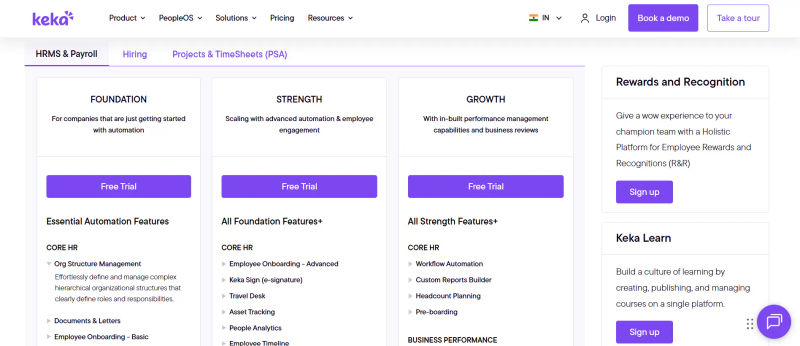
Understanding Keka pricing is straightforward. The structure combines a base platform fee with a per-employee-per-month (PEPM) rate, meaning your total Keka HR cost depends heavily on the specific modules your business needs.
At its baseline, the Keka software price covers essential HR and payroll functionalities. As you scale and add advanced features like performance management or an applicant tracking system, your overall Keka HRMS pricing will increase. When evaluating Keka HR pricing, keep in mind that opting for annual billing typically secures discounts. This modular approach to pricing Keka ensures the platform remains scalable and transparent for growing Indian SMBs.
Understanding Keka's Pricing Tiers
Below is a summary of Keka's standard plans. Prices are in Indian Rupees (INR) and reflect typical costs, which can vary based on negotiation, number of employees, and selected modules.
Factors Influencing Keka's Total Cost of Ownership (TCO)
When evaluating Keka, it's crucial to look beyond the sticker price. The Total Cost of Ownership** (TCO)** includes several factors:
Implementation Fees: Keka may charge a one-time setup and data migration fee.
Module Selection: The final PEPM cost is heavily dependent on which modules (e.g., Performance, Recruitment) you add to your base plan.
Number of Employees: The platform fee often covers a certain number of employees (e.g., up to 100), after which the PEPM cost applies to all users. This structure needs to be clarified during sales discussions.
Support Costs: While standard support is included, premium or dedicated support might come at an additional cost.
Value for Money for Indian SMBs
For an Indian SMB, Keka's value proposition lies in its ability to de-risk compliance and automate time-consuming tasks. The cost of a single compliance penalty or the man-hours saved from manual payroll processing can often justify the investment. Compared to a global platform like BambooHR, which might have a simpler pricing model, Keka's granular, India-specific compliance features provide a tangible ROI that is hard to ignore for businesses operating solely within India.
Keka HR Alternatives: A Comparative Review for India
Choosing an HRMS requires evaluating top Keka HR competitors. When seeking a reliable Keka alternative, a common question arises: Keka vs Qandle for HR management and payroll automation for Indian SMBs, which is better? The answer depends on your priorities. Keka is generally better for strict, automated payroll compliance in India, whereas Qandle excels in highly customizable HR workflows. To determine if other Keka competitors are truly better than Keka for your specific needs, you must weigh local payroll depth against broader management flexibility.
1. Keka vs. Zoho People: An Indian Perspective
This is the most direct comparison. Both are India-born products with strong localization. Zoho People often wins on price, offering a very competitive and often more affordable solution, especially for smaller businesses. Its key strength lies in its integration within the broader Zoho ecosystem (CRM, Books, etc.). Keka, on the other hand, is often perceived as having a more polished user interface and a deeper, more specialized focus on HR and payroll automation. The choice often comes down to whether you need a good HR tool (Keka) or a good HR tool that fits into a pre-existing business suite (Zoho).
2. Keka vs. BambooHR: Global Standard vs. Local Focus
BambooHR is a global leader in HR software for SMBs, renowned for its user-friendliness and strong core HR features. However, its payroll module is primarily focused on the US market. For Indian operations, BambooHR would require integration with a third-party payroll provider, adding complexity and cost. Keka is the clear winner for any Indian SMB where integrated, compliant payroll is a primary requirement.
3. & 4. Keka vs. HiBob & Rippling: Enterprise-Grade Options
HiBob and Rippling are modern, powerful platforms that are gaining popularity. HiBob excels in employee engagement, culture, and performance management. Rippling stands out with its ability to manage HR, IT, and Finance in one platform. Both are generally more expensive than Keka and might be overkill for an SMB whose primary concern is streamlining Indian payroll and compliance. They are better suited for fast-growing, global companies.
5. & 6. Keka vs. Employment Hero & ADP: Broader HR Solutions
Employment Hero offers a broad suite of HR tools with a strong focus on employee benefits and global teams. ADP is a global payroll giant with deep expertise in compliance. While ADP has a strong presence in India, its solutions are often geared towards larger enterprises and can feel less agile than a modern platform like Keka. For an Indian SMB, Keka often provides a more intuitive and cost-effective solution.

7. & 8. Keka vs. Paylocity & QuickBooks: Payroll-Centric Alternatives
Paylocity and QuickBooks are primarily known for their payroll capabilities. QuickBooks Payroll is an excellent tool for basic payroll within its accounting ecosystem but lacks the comprehensive HR features of Keka. Paylocity is heavily focused on the US market. For an integrated HR and payroll system designed for India, Keka is a more holistic choice.

How Keka HR Addresses Common HR Pain Points in India
The true test of an HRMS is its ability to solve real-world problems. Here’s how Keka tackles the challenges faced daily by Indian HR managers.
1. Streamlining Payroll & Tax Compliance
Pain Point: The manual, error-prone process of calculating salaries with complex deductions (PF, ESI, TDS, PT) and the constant fear of non-compliance penalties.
Keka's Solution: Keka's automated payroll engine eliminates manual calculations. It stays updated with the latest tax laws, transforming payroll from a multi-day ordeal into a streamlined, audited process.
2. Inefficient Recruitment and Onboarding
Pain Point: Managing a high volume of applications from multiple sources, leading to a disorganized hiring process and a poor candidate experience.
Keka's Solution: The ATS centralizes all applications, automates communication, and provides a collaborative platform for hiring managers. This structures the recruitment lifecycle, reducing time-to-hire and improving the employer brand.
3. Enhancing Employee Engagement & Productivity
Pain Point: Lack of a structured system for performance reviews, leading to biased appraisals and disengaged employees.
Keka's Solution: By implementing frameworks like OKRs and facilitating continuous feedback, Keka helps create a transparent performance culture. The platform’s engagement tools and self-service options give employees a sense of ownership, allowing HR to focus on strategic initiatives.
4. Simplifying HR Operations & Administration
Pain Point: Disorganized employee data stored in multiple spreadsheets, leading to inefficiency and a lack of actionable insights.
Keka's Solution: Keka provides a centralized HRIS that serves as a single source of truth. This, combined with the ESS portal, drastically cuts down on administrative tasks, freeing up the HR team for more value-added activities.
Explore Authencio.com — evaluate HR tools built for India-specific needs, minus sales influence.
Is Keka HR Software Right for Your Indian SMB?
Yes, Keka is highly suitable for small and mid-sized businesses. It directly addresses local Indian payroll, tax compliance, and core HR needs, making it an ideal fit for growing organizations seeking a scalable, all-in-one platform without enterprise-level complexity.
Ideal Use Cases & Business Sizes
Keka is an ideal solution for:
Indian SMBs (50-500 employees): This is Keka's sweet spot, designed to handle complexity without the cost of enterprise systems.
Companies Prioritizing Compliance: If your primary goal is to automate and de-risk your Indian payroll and statutory compliance, Keka is one of the best options.
Organizations Focused on User Experience: For companies that want a modern, intuitive HR system that their employees will enjoy using, Keka's design is a major selling point.
Businesses with Complex Attendance Needs: Companies with multiple locations, shifts, or field staff will benefit from Keka's robust time and attendance module.
Key Considerations Before Implementation
Before signing the contract, ensure you have a clear understanding of:
Your Module Requirements: Conduct a thorough needs analysis. Do you need just payroll, or is performance management a priority? Choose your modules wisely to control costs.
Data Migration** Plan:** How will you move your existing employee data? Discuss the support Keka's team will provide for this crucial step.
Total Cost of Ownership: Request a detailed quote that includes all one-time setup fees, platform fees, and PEPM costs. Project the cost over 2-3 years.
Integration Needs: Does Keka integrate with your existing accounting software (e.g., Tally Prime, Zoho Books) or other business tools? Check for native integrations or API capabilities.
Vendor Support & Training: Clarify the level of support and training provided during and after implementation. This is crucial for smooth adoption and long-term success.
Try AuthenCIO
Move to faster, smarter software evaluation with AI
Conclusion: Making an Informed Decision on Keka HR
In the dynamic Indian business environment, choosing the right HR software is a strategic decision. Keka HR stands out as a powerful, well-designed, and highly localized platform that effectively solves the core challenges of payroll, compliance, and HR administration for Indian SMBs. Its employee-centric approach empowers HR teams to move beyond administrative tasks and become true strategic partners to the business.
However, it is not a one-size-fits-all solution. Its module-based pricing requires careful consideration, and for businesses with global ambitions or those deeply embedded in the Zoho ecosystem, alternatives warrant a close look. The key takeaway is that the 'best' HRMS is the one that aligns with your specific needs, budget, and growth trajectory. Keka is undoubtedly a top-tier contender for any India-focused SMB, but a thorough evaluation against its competitors is essential. By leveraging this guide and objective comparison tools, you can make a confident, data-driven decision that will benefit your entire organization.