
Introduction
Navigating the complex landscape of Human Capital Management (HCM) platforms is a critical challenge for today's mid-market HR and payroll leaders. You're tasked with finding a solution that transcends basic payroll processing; you need a strategic tool that can manage the entire employee lifecycle, ensure stringent compliance, and scale with your organization's growth. The market is saturated with options, from lightweight tools that growing businesses quickly outgrow to enterprise-level behemoths that are both cost-prohibitive and unnecessarily complex.
Streamline your software evaluation process
This comprehensive Paylocity HR payroll review is designed to cut through the feature overload and opaque pricing common in the mid-market HR payroll software space.
Paylocity has firmly established itself as a major contender, aiming to provide the ideal balance of robust functionality and user-centric design. But in a competitive field with giants like ADP and UKG and innovators like Rippling, how does it truly stack up? This guide provides a deep-dive analysis into Paylocity's core offerings, dissects its pricing structure, weighs its strategic advantages against its potential drawbacks, and benchmarks it against key alternatives. By the end, you will have the data-driven insights needed to determine if Paylocity is the right strategic partner to future-proof your HR and payroll operations through 2026 and beyond.
Key Takeaways
Comprehensive HR platform: Paylocity brings payroll, benefits, HR, talent, and workforce management together in one system.
Strong for growing businesses: Its broad feature set makes it suitable for mid-sized organizations with evolving HR needs.
Employee self-service: Mobile access and self-service tools make it easier for employees to manage everyday HR tasks.
Good workflow integration: Connecting HR and payroll processes can reduce manual work and improve efficiency.
Consider pricing and global needs: Businesses should evaluate its custom pricing, support experience, and international payroll capabilities before choosing it.
Paylocity — Key Strengths & Limitations
Strengths
All-in-one HR platform: Combines payroll, HR, benefits, and talent management in one system.
Strong mid-market focus: Handles complex payroll, benefits, and workforce needs for growing businesses.
Employee self-service: Mobile tools let employees access pay stubs, request leave, and manage benefits.
Comprehensive features: Supports recruiting, onboarding, performance management, and workforce analytics.
Integrated workflows: Connects HR, payroll, and third-party business applications to reduce manual work.
Limitations
Opaque pricing: Custom quotes make it difficult to compare costs upfront.
Variable customer support: Support quality and response times may vary.
Limited global payroll: Primarily designed for US-based businesses with limited native international payroll capabilities.
Administrative learning curve: Complex configurations and reporting can take time to master.
Verdict: A comprehensive HR and payroll platform for mid-market businesses seeking unified workforce management, but less suited to companies with complex global payroll needs.
Best For: Mid-market US businesses with around 100–1,000 employees that need integrated payroll, benefits, HR, and talent management.

Software Covered in this Article
To help you understand Paylocity in the right context, this article refers to a carefully curated set of key players:



.webp?tr=w-112%2Cq-80%2Cf-auto%2Cc-at_max)


What is Paylocity? An Overview for Mid-Market Leaders
If you are asking, "Tell me about Paylocity, the mid-market HCM platform," it is a cloud-based system designed to unify HR, payroll, benefits, and talent management. For HR Directors and CHROs at organizations scaling into the 1,000–10,000+ employee range, evaluating the HR solutions company Paylocity on HCM capabilities reveals a platform built to replace manual HRIS workflows and resolve fragmented HR data governance spanning HRIS, ATS, and LMS. While traditionally targeting the 100–1,000 employee mid-market, its feature set increasingly supports larger organizations seeking to balance headcount with automation or outsourcing.
When executives evaluate the HR solutions company Paylocity on HR, they weigh its ability to solve complex pain points. Paylocity mitigates inaccurate payroll processing for multi-country tax, time, and leave, helping leaders maintain compliance with changing government regulations at local, regional, and national levels. By providing tools to partner with finance on workforce budgeting to optimize cost and ROI, it brings clarity to opaque pay practices around bands, leveling, and bonus eligibility.
Paylocity holds an estimated 12.20% market share in payroll management. As the HR payroll software market is projected to reach $57.05 billion by 2029, Paylocity captures demand by allowing organizations to implement data privacy controls to protect employee information while balancing standardization with local autonomy.
For VPs driven to deliver business results through people, Paylocity’s value proposition centers on unification and employee experience. It acts as a single source of truth to fix inconsistent performance management and weak talent pipelines. By helping leaders build leadership pipelines to improve succession readiness and build future capability including internal mobility, it improves data accuracy. Furthermore, it tackles poor employee engagement and complex benefits administration with country-specific eligibility rules, allowing HR to localize benefits offerings to match market needs and act as a strategic business partner.
Key Features of Paylocity for Mid-Market HR & Payroll
Paylocity's modular platform allows HR leaders to build a customized solution. Here is an evaluation of how the platform performs across core operational areas, particularly for CHROs, VPs, and HR Directors managing workforces of 250 to 1,100+ employees.
Payroll Administration: When evaluating the HR solutions company Paylocity on payroll, its engine excels at multi-jurisdictional tax filing, garnishments, and expense management. For HR managers facing tight payroll processing windows, late timesheets, and constant payroll recalculations, Paylocity’s real-time calculation and data validation checks reduce errors. As a payroll provider for 250 employees, it eliminates manual HRIS workflows and ensures compliance with changing government regulations. When evaluated as a payroll provider for 1,100 employees, its general ledger integration allows HR to partner with finance on workforce budgeting to optimize cost and ROI.
Global Payroll Solutions: To evaluate the HR solutions company Paylocity on global payroll solutions, one must look at its ability to support executives at 1k-10k+ companies dealing with inaccurate payroll processing for multi-country tax, time, and leave. Paylocity helps maintain global and local compliance, balance standardization with local autonomy, and manage benefits administration with country-specific eligibility rules, though highly complex global enterprises may still require specialized local vendors.
Workforce Management: Evaluating the HR solutions company Paylocity on workforce management reveals a system built to handle headcount volatility and inconsistent managers. It offers flexible time collection (web punch, mobile geofencing) and automates complex scheduling. By integrating timekeeping directly into payroll, it eliminates fragmented HR data governance spanning HRIS, ATS, and LMS systems.
Talent Acquisition: When evaluating the HR solutions company Paylocity on talent acquisition, the platform helps HR directors speed up hiring and fix weak talent pipelines. Its integrated ATS streamlines candidate tracking and onboarding, helping build a high-trust, high-performance culture from day one while curbing early employee attrition.
Talent Management: To evaluate the HR solutions company Paylocity on talent management, buyers should note how it resolves inconsistent performance management and opaque pay practices around bands, leveling, and bonus eligibility. The suite helps executives build leadership pipelines to improve succession readiness, build future capability including internal mobility, and scale manager capability.
Core HR & Benefits Administration: Paylocity serves as a secure database, implementing strict data privacy controls to protect employee information. It provides analytics dashboards for strategic planning. The benefits module simplifies open enrollment and life events, helping localize benefits offerings to match market needs. This combats poor benefits usage and improves the overall employee experience to lift company engagement.
Paylocity's Ecosystem and Integrations
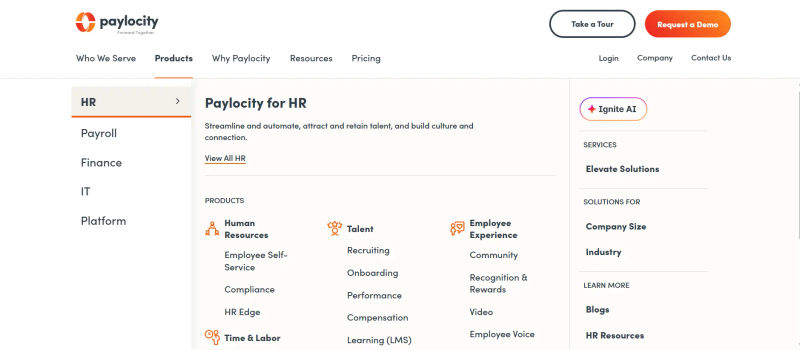
A modern HCM platform cannot exist in a vacuum. Paylocity addresses this through its Marketplace, which features pre-built integrations with third-party applications for accounting (QuickBooks, NetSuite), ERP, benefits carriers, background checks, and expense management. This API-first approach allows businesses to create a connected tech stack, ensuring data flows seamlessly between systems.
However, the ease of integration can vary. While many marketplace connections are plug-and-play, more complex or custom integrations may require significant IT resources or developer support, a critical consideration for mid-market companies with limited IT staff. It's essential to validate the depth and support model for any business-critical integrations during the evaluation process. This strategy of perfecting the HCM suite while enabling connections contrasts with platforms like Rippling, which aims to be an all-in-one system for HR and IT.
Paylocity Pricing & Plans: A Detailed Breakdown
Paylocity pricing is quote-based and typically follows a per-employee, per-month (PEPM) structure plus a base fee. Because Paylocity does not publish standard rates, understanding your exact total cost of ownership (TCO) requires a custom quote.
Final costs are customized based on your total employee headcount, the specific HR modules selected, and one-time setup fees driven by implementation complexity.
1. Understanding Paylocity's Pricing Model
Paylocity primarily uses a Per Employee Per Month (PEPM) pricing model. This means the monthly cost is calculated by multiplying the number of active employees by a base rate that varies depending on the service package. This model is common, used by competitors like ADP and UKG, as it scales with your workforce.
Beyond the PEPM fee, leaders must budget for several other potential costs:
Implementation Fees: A one-time fee for setup, data migration, and training. This can range from a few thousand to tens of thousands of dollars and is a key point for negotiation.
Add-On Modules: Advanced features like compensation management, analytics, or the LMS often come at an additional PEPM cost.
Third-Party Integration Costs: Some complex integrations may require additional development or maintenance fees.
Find Perfect Software For Your Business
2. Negotiating Paylocity Contracts
To avoid unexpected expenses, it is crucial to move beyond the initial quote. During the sales process, ask specific questions to uncover the full TCO:
What are the standard annual price increases?
Are there different tiers of customer support, and what are their costs?
What are the specific fees for data migration, custom reports, and carrier feeds?
What training is included in the implementation fee, and what does additional training cost?
This diligence ensures you can build an accurate ROI calculation and negotiate a contract that reflects your true needs.
Plan / Module | Price | Best for | Key features |
Payroll | Not publicly listed (quote-based) | Organizations that need to streamline multi-country payroll and stay compliant while reducing manual work. | - Automated and custom payroll workflows |
Human Resources | Not publicly listed (quote-based) | HR teams that want to minimize risk and centralize core HR processes in one system. | - Templated or custom HR workflows |
Workforce Management | Not publicly listed (quote-based) | Businesses needing robust time, attendance, and scheduling to control labor costs and compliance. | - Time collection via mobile, web, kiosk, or time clock |
Talent Management | Not publicly listed (quote-based) | Companies focused on hiring, developing, and retaining talent with structured programs. | - Centralized candidate communication |
Benefits Management | Not publicly listed (quote-based) | Employers that want to simplify benefits administration for HR and employees. | - Expert benefits support assistance |
Employee Experience Platform | Not publicly listed (quote-based) | Organizations aiming to boost engagement and internal communication with social-style tools. | - Social collaboration hub with chat and file sharing |
Marketplace Integrations | Not publicly listed (quote-based) | Teams that need Paylocity tightly integrated with existing HR, finance, and IT tools. | - Hundreds of prebuilt integrations |
All pricing is customized; Paylocity asks prospects to request pricing so packages can be tailored by modules, employee count, and feature mix.

Paylocity Alternatives & Competitors for Mid-Market
Exploring top Paylocity alternatives is essential for mid-market buyers. To effectively evaluate the HR solutions company Paylocity on competitors, organizations must compare core HR and payroll functionality. The leading Paylocity competitors offer similar all-in-one platforms but differ significantly in pricing, usability, and integration ecosystems.
1. Paylocity vs. ADP Workforce Now
When evaluating ADP vs Paylocity, the decision typically hinges on user experience versus deep compliance capabilities.
Strengths: ADP Workforce Now offers unmatched compliance expertise and powerful benchmarking data drawn from millions of employees. It appeals to established mid-market companies prioritizing risk mitigation and complex data analytics.
Key Differentiator: While ADP is a powerhouse in compliance and data, Paylocity often wins on its modern, unified user interface. Paylocity's platform feels more intuitively integrated across modules, driving higher employee adoption.
Support: Paylocity frequently provides a more agile, personalized support experience, whereas ADP's massive scale can result in a more rigid service model.
2. Paylocity vs. UKG Ready
When evaluating UKG vs Paylocity, the decision hinges on whether you prioritize complex workforce management or employee engagement. UKG Ready is Ultimate Kronos Group's solution tailored for mid-sized businesses.
UKG Ready Strengths: UKG delivers best-in-class time, attendance, and workforce management. For industries like manufacturing or healthcare with complex scheduling and labor compliance needs, UKG is exceptionally strong.
Paylocity Strengths: Paylocity excels as a unified HCM platform emphasizing talent management, payroll processing, and peer-to-peer employee engagement tools.
Key Differentiator: If your primary pain point is complex hourly labor management, UKG Ready holds the edge. If your focus is streamlining core HR, payroll, and building company culture, Paylocity is typically preferred.
3. Paylocity vs. Rippling
When comparing Paylocity vs. Rippling, the core difference is architectural: Paylocity is a dedicated HCM suite, while Rippling integrates HR with IT management.
Rippling's Strengths: Rippling automates the employee lifecycle alongside IT functions like app provisioning and device management.
Paylocity's Strengths: Paylocity delivers deeper traditional HR functionalities, including advanced payroll compliance and engagement tools.
Key Differentiator: In a rippling vs paylocity evaluation, Rippling is ideal for tech-savvy companies unifying HR and IT. Paylocity fits organizations seeking a robust, standalone HR platform.
Other Notable Alternatives
Paylocity vs. Gusto: Gusto is ideal for smaller businesses needing simple payroll. Paylocity wins for mid-market companies requiring deeper talent management and complex compliance features.
BambooHR vs. Paylocity: BambooHR offers highly intuitive core HR for SMBs but relies on add-ons for payroll. Paylocity provides a stronger, native payroll engine and deeper mid-market capabilities.
Paylocity vs. Workday: Workday is an enterprise-grade platform for large, global organizations. Paylocity is significantly more cost-effective and faster to implement for mid-market businesses.
Paycom vs. Paylocity: Paycom features a true single-database architecture, reducing data sync issues, but is often more expensive and less flexible than Paylocity.
Workpay & Deel: Built for global workforces. If hiring internationally, their global compliance and payroll expertise outpaces U.S.-centric platforms like Paylocity.
Ceridian Dayforce: Targets the upper mid-market with a continuous calculation payroll engine, but can be more complex and costly than Paylocity.
Is Paylocity the Right Fit for Your Mid-Market Organization?
After analyzing its features, pricing, and competitive landscape, the final decision rests on aligning the platform’s strengths with your organization's unique operational DNA.
Ideal Use Cases & Business Sizes
Paylocity hits its stride with U.S.-based companies that have between 100 and 1,000 employees. It is particularly well-suited for organizations that:
Are outgrowing entry-level payroll software and need a scalable, unified platform.
Prioritize employee experience and want to provide modern, mobile-first self-service tools.
Need to eliminate data silos between HR, payroll, benefits, and talent management.
Have complex, multi-state payroll and tax compliance requirements.
Factors to Consider Before Implementation
Before signing a contract, conduct a thorough internal readiness assessment.
Data Cleansing: Plan for a data audit and cleansing project before implementation begins. Migrating inaccurate data into a new system will only amplify existing problems.
Resource Allocation: A successful implementation requires a dedicated internal project team, including a project manager and subject matter experts from HR, payroll, and finance.
Integration Needs: Map out all systems that need to connect with Paylocity. Verify that pre-built integrations exist for your critical applications or budget for the cost and time of building custom APIs.
Change Management: Develop a clear communication plan and training strategy. Consider a pilot program with a champion network to drive adoption of the new system's self-service features.
The Future of HR & Payroll: Paylocity's Vision & Roadmap
The HCM market is evolving rapidly, driven by trends in AI, analytics, and the demand for a more personalized employee experience. Paylocity is actively investing in these areas, with a clear trend towards AI integration that moves beyond chatbots. AI is being incorporated to provide smarter talent acquisition insights, analyze performance feedback for sentiment, and suggest more equitable compensation models.
In 2024, Paylocity expanded its analytics platform to give HR teams greater visibility into labor costs and performance trends. Their roadmap indicates a continued focus on enhancing the mobile experience and leveraging data to provide predictive insights, such as identifying employees at risk of turnover. This forward-looking approach suggests that Paylocity is committed to evolving with the needs of its mid-market client base, aiming to provide tools that are prepared for the workplace of tomorrow.
Try AuthenCIO
Move to faster, smarter software evaluation with AI
Conclusion: Making an Informed Decision on Paylocity
For mid-market HR and payroll leaders, selecting an HCM platform is a high-stakes decision with long-term implications. Paylocity presents a compelling case, offering a well-designed, unified platform that effectively balances comprehensive functionality with a strong user experience. Its deep focus on the specific needs of U.S.-based mid-sized businesses makes it a powerful tool for managing complex payroll, streamlining HR processes, and developing talent.
However, it is not a one-size-fits-all solution. Its limitations in global payroll, the opacity of its pricing model, and variable support experiences are important considerations. Competitors like ADP, UKG, and Rippling each offer unique strengths that may better align with your organization's specific priorities.
The ultimate decision requires a rigorous internal evaluation of your operational needs, budget, and strategic goals. We strongly recommend conducting a formal Request for Proposal (RFP) process and engaging in detailed, scripted demos with your top 2-3 vendors. By carefully weighing the pros and cons, you can make a confident, data-driven choice that empowers your HR function and positions your organization for sustained growth.