
Introduction
If your current CRM requires reps to spend more time on data entry than selling, you are actively bleeding revenue. For growing sales teams in 2026, the best CRM systems are no longer passive systems of record—they are revenue intelligence engines.
To help you find the right fit, we evaluated the market to identify the top CRM solutions for scaling operations: Pipedrive, Close, HubSpot, Zoho CRM, Nutshell, and Salesforce.
Streamline your software evaluation process
The era of expensive "shelfware" is over. Today's high-growth teams demand platforms that reduce friction, automate administrative drudgery, and provide predictive insights into pipeline health. Whether you manage a Product-Led Growth (PLG) motion, a traditional field sales team, or a hybrid model, your CRM is the central nervous system of your Revenue Operations (RevOps) strategy.
Finding the best sales management software 2026 has to offer requires looking beyond basic feature lists. This guide dissects these top contenders, analyzing how they handle the complex demands of modern sales cycles, integrate with AI-driven workflows, and ultimately dictate your revenue velocity.
Key Takeaways
Top CRM Contenders for 2026: The best platforms for scaling sales teams include Pipedrive (visual pipeline management), Close (high-volume outreach), HubSpot (unified inbound growth), Zoho CRM (global AI insights), Nutshell (collaborative selling), and Salesforce (complex enterprise architecture).
Core Evaluation Criteria: When upgrading your sales stack, prioritize API extensibility, AI maturity (predictive vs. generative), total cost of ownership (TCO) versus time to value, and seamless user adoption.
Future-Proofing Your Stack: Successful scaling requires treating your CRM as an "invisible" tool that reduces administrative burden through automation, while maintaining strict data governance and ethical AI practices.
🔝 Top Software Picks
Here is the best sales CRM 2026 has to offer for growing teams:
Salesforce — best for enterprise‑level scalability and integrations
HubSpot — best for inbound marketing and sales automation
Zoho CRM — best for cost‑efficient small business management
Pipedrive — best for visual pipeline tracking and deal flow
Close — best for remote sales teams with built‑in calling tools
Nutshell — best for all‑in‑one CRM with reporting and automation
Software covered in this article
To help you understand CRM in the right context, this article refers to a carefully curated set of key players:






Why CRM Scalability is the Priority for Sales Managers
For a Head of Sales, the nightmare scenario is a "rip and replace" project eighteen months after implementation. Scalability in 2026 isn't just about adding seats; it's about handling increasing data complexity without degrading performance.
As teams grow, the volume of data points—calls, emails, product usage signals—explodes. Finding the best CRM for 50-person sales team structures means transitioning from a tool for individual contributor efficiency to a platform for management visibility. At this size, the system must support complex territory mapping, multi-currency pipelines, and sophisticated role-based permissions.
The requirements are even steeper for an AI native company scaling sales team 2026 operations. These organizations process massive volumes of unstructured data and rely on real-time API calls to feed proprietary models. If a CRM throttles API limits or lacks robust webhook infrastructure, the revenue engine stalls.
Furthermore, the "mid-market gap" is real. Many tools that are perfect for startups crumble under compliance requirements and API load limits once a company hits $10M ARR. The goal is selecting a platform offering startup agility with enterprise governance.
Key Evaluation Criteria for High-Growth Sales Stacks
To determine the best criteria for evaluating sales CRM software in 2026, sales leaders must establish a scalable framework for evaluation. A CRM that supports a five-person team will often break under the workflow complexity of fifty reps. For high-growth revenue teams reviewing top software picks, the following evaluation criteria are non-negotiable:
1. API Extensibility and Integration Velocity
Your CRM does not exist in a vacuum. It must communicate seamlessly with marketing automation platforms, customer success tools, and enrichment data sources. In 2026, a "growth-ready" CRM is defined by its API flexibility. When identifying the best connected customer platform for sales teams 2025 2026, integration velocity is the primary differentiator. Can it handle the bi-directional sync of thousands of records without timing out? Does it integrate natively with 2026-standard communication tools like Slack AI agents or Microsoft Teams co-pilots?
Tools like HubSpot and Salesforce have built entire ecosystems around this, ensuring that if a tool exists, it connects. Because of this unparalleled extensibility, HubSpot frequently ranks as the best connected customer platform for sales teams 2026. Meanwhile, smaller players like Close are catching up with robust, developer-friendly APIs that allow for custom "headless" CRM implementations, which are increasingly popular for tech-forward sales teams.
2. AI Maturity: Predictive vs. Generative
AI is no longer a buzzword; it is a baseline requirement. We must distinguish between generative AI (drafting emails), predictive AI (forecasting revenue), and autonomous workflows. Finding the best ai crm for b2b sales teams 2026 requires platforms that utilize AI to analyze call sentiment, score leads, and predict deal closure probability.
This shift toward independent task execution defines the best autonomous crm for sales teams 2025 2026. For example, Zoho’s Zia and Salesforce’s Einstein 1 have moved beyond simple automation to become active participants, flagging pipeline risks before they become lost revenue. Ultimately, the best autonomous crm for sales teams 2026 offers "augmented selling," where AI acts as a real-time coach and independently executes routine follow-ups.
3. Time to Value vs. Total Cost of Ownership (TCO)
Enterprise-grade power often comes with enterprise-grade headaches. Salesforce might offer infinite customization, but if it requires a six-month implementation and a dedicated administrator, the Time to Value (TTV) is slow. Conversely, Pipedrive offers immediate utility but could require expensive add-ons to match the reporting depth of larger tools as you scale.
Sales leaders must calculate the TCO, which includes implementation fees, training downtime, and the "invisible cost" of rep friction. In 2026, usage-based pricing models are also challenging the traditional seat-based model, so understanding your interaction volume is key.
4. User Adoption and "Invisible CRM"
The number one reason CRM implementations fail is low user adoption. In 2026, the best CRMs are "invisible"—they capture data automatically from emails, calendars, and calls without manual intervention. If a rep has to manually log a call, the system is already obsolete. Close and Nutshell have excelled in this area by prioritizing the rep's workflow over the manager's reporting needs, paradoxically leading to better data for the manager because the system is actually used.
5. Data Governance, Sovereignty, and AI Ethics
With the rise of AI scraping and automated enrichment, data privacy has become a board-level concern. By 2026, regulations around data sovereignty (where your data physically resides) and AI ethics (how your data is used to train models) are stricter than ever.
Scaling teams operating in Europe or California need CRMs that offer granular control over data retention and AI opt-outs. Salesforce and HubSpot lead here with enterprise-grade compliance centers, whereas smaller tools may struggle to provide the necessary audit trails for SOC2 or ISO compliance.
6. Migration Velocity
How hard is it to leave your current system? This is often overlooked. Migration velocity refers to the ease of mapping old data to new fields without losing historical context. Tools that offer native "one-click" migration services or dedicated concierge onboarding significantly reduce the technical debt associated with switching platforms.
When evaluating options, checking verified CRM software reviews on G2 can help sales leaders gauge real-world user satisfaction and feature trade-offs
Top 6 CRM Solutions for Scaling Sales Teams
We have selected the best cloud CRM platforms for growing businesses in 2025 and 2026. These six solutions represent the top of the market, each serving a specific growth trajectory and sales philosophy.
1. Pipedrive: Mastering Visual Pipeline Management
Best For: Deal-driven teams and SMBs focused on sales velocity and actionable reporting.
Pipedrive remains the gold standard for visual pipeline management. Built by salespeople for salespeople, its philosophy is rooted in "Activity-Based Selling." The logic is simple: you cannot control the result (the sale), but you can control the actions (calls, demos, emails) that lead to it.
In 2026, Pipedrive has addressed its historical weakness—reporting—by introducing advanced analytics suites suitable for mid-market teams. This upgrade solidifies its position as one of the best crm analytics tools for sales teams 2025 2026. For managers specifically evaluating the best crm analytics tools for sales teams 2026, Pipedrive now offers customizable dashboards, revenue forecasting, and granular win-rate insights. Its "Workflow Automation" feature allows managers to set up complex triggers—for instance, automatically creating a task for a rep when a prospect opens an email three times. This ensures that pipeline hygiene is maintained without manual nagging.
For growing teams, Pipedrive’s interface is incredibly intuitive, leading to high adoption rates. However, for teams with complex multi-product hierarchies, it may still feel lighter than Salesforce, but for pure-play sales teams, it is unmatched.

2. Close: Accelerating High-Volume Sales Outreach
Best For: High-velocity inside sales teams and remote-first organizations.
If your sales strategy relies on high-volume outreach—cold calling, SMS, and rapid-fire emailing—Close is the superior choice. Unlike other CRMs that treat calling as an add-on integration, Close builds telephony into its core.
For teams seeking the best CRM automation workflow tools for scaling sales operations in 2025 and 2026, Close delivers unmatched efficiency. Its powerful Workflows feature allows scaling sales teams to automate multi-channel sequences across email, SMS, and calls. This ensures leads never slip through the cracks while freeing reps from manual data entry.
In 2026, Close’s "Power Dialer" and predictive dialing features are essential for teams maximizing rep productivity. It minimizes context switching; a rep can review a lead, make a call, drop a pre-recorded voicemail, and send a follow-up email from a single screen.
Close has also embraced the "async" nature of modern sales. Its integration with meeting tools and these advanced automation capabilities allows small teams to punch above their weight. The trade-off is that Close is laser-focused on the sales interaction. It does not try to be a marketing suite. For heads of sales who want a dedicated machine for their SDRs and AEs, this focus is a feature, not a bug.

3. HubSpot: Unified Growth for Scaling Organizations
Best For: Scaling companies needing alignment between Marketing, Sales, and Service.
HubSpot has evolved from a marketing tool into a comprehensive CRM platform that rivals Salesforce in capability while maintaining a consumer-grade user experience. For growing teams in 2026, the value of HubSpot lies in the "Flywheel" concept—removing friction between departments.
HubSpot stands out as the best CMS for sales teams 2025 2026. Integrating its Content Hub directly with the CRM allows reps to leverage personalized content delivery and track document engagement. Additionally, HubSpot's native data tools and app ecosystem make it one of the best CRM enrichment platforms for sales 2025 2026, automatically populating records with firmographic data to reduce manual entry.
However, buyers should be wary of the "All-in-One Trap." While HubSpot's Sales Hub is excellent, scaling teams sometimes find the Service or Operations Hubs less feature-rich than best-of-breed competitors. That said, the "Smart CRM" features allow for incredible context. When a sales rep opens a contact record, they see every marketing email opened and blog post read.

HubSpot’s ecosystem is vast, fitting into almost any 2026 tech stack. The pricing model can get steep as you scale, with significant "per seat" costs for the Enterprise tier, but for teams needing deep marketing alignment, the ROI is justifiable.
Find Perfect Software For Your Business
4. Zoho CRM: AI-Driven Insights for Global Sales Teams
Best For: Small sales teams seeking advanced AI capabilities and extensive customization on a budget.
When evaluating the best ai crm for small sales teams 2026, Zoho CRM stands out as the top choice. Continuing its momentum as the best ai crm for small sales teams 2025 2026, it offers a level of customization and artificial intelligence usually reserved for much more expensive enterprise platforms. Part of the massive Zoho "Operating System for Business," it provides exceptional value.
Zoho’s AI assistant, Zia, has matured significantly to empower smaller teams. It can now predict the best time to contact a lead, detect anomalies in sales trends, and even analyze sales calls for sentiment in real-time, giving small teams an enterprise-grade analytical edge. For global teams, Zoho’s support for multiple currencies and languages is robust out of the box.
The platform’s "Canvas" builder allows sales ops leaders to completely redesign the CRM interface to match their specific industry workflow, ensuring that reps only see what they need to see. While the UI can sometimes feel less polished than Pipedrive or HubSpot, the sheer breadth of features—from inventory management to gamification—makes it a powerhouse for operations-heavy and growing sales teams.

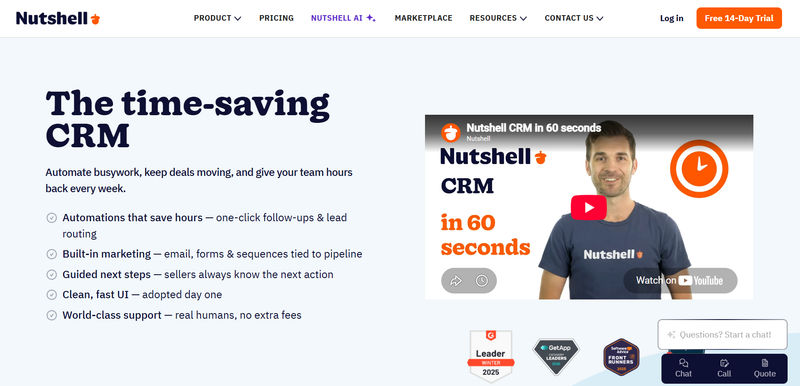
5. Nutshell: Collaborative Selling for Growing Teams
Best For: Small to mid-sized businesses and agencies that need an all-in-one CRM and Email Marketing solution.
Nutshell punches above its weight by focusing on collaboration and simplicity. In an era where B2B buying committees are large, Nutshell helps sales teams map out the complex web of relationships within a prospect account. It is highly adaptable for agency internal crm team hybrid models, where account managers, creatives, and sales reps must collaborate seamlessly on shared client records.
Its standout feature for 2026 is the seamless integration of email marketing (Nutshell Campaigns) directly into the CRM. This allows sales managers to run nurture sequences without needing a separate marketing automation tool. For a growing team where the Head of Sales might also be wearing the Marketing hat, this consolidation is invaluable.
Nutshell also offers "limitless" storage and contacts, avoiding the pricing cliffs that often plague growing teams on other platforms. While it may lack the deep enterprise API capabilities of Salesforce, its focus on ease of use and intuitive pipeline views make it one of the best crm alternatives to spreadsheets for sales teams 2026. It is the ideal stepping stone for teams transitioning off spreadsheets, offering immediate visual organization without a steep learning curve.
6. Salesforce: The Gold Standard for Enterprise Growth
Best For: Complex enterprise sales cycles, advanced CPQ (Configure, Price, Quote) requirements, and organizations planning for massive scale.
Salesforce remains the 800-pound gorilla of the industry. In 2026, its dominance is fueled by the "Einstein 1 Platform," which integrates Data Cloud and generative AI deep into the workflow. For a VP of Sales at a rapidly scaling company, Salesforce is widely regarded as the best B2B CRM for complex sales pipelines and enterprise quotes 2025 2026.
The platform’s ability to manage intricate territory models, multi-layered commission structures, and multi-product quote-to-cash cycles is unrivaled. If you are evaluating the best B2B CRM for complex sales pipelines and CPQ 2025 2026, Salesforce Revenue Cloud offers industry-leading capabilities. It handles advanced pricing rules, discounting approvals, and contract management seamlessly, cementing its position as the best B2B CRM for complex sales pipelines and CPQ 2026.
For teams scaling from 50 to 500 reps, Salesforce provides the necessary governance and security controls. The AppExchange ecosystem means that if you have a niche need, there is likely a plugin for it. Whether you need the best B2B CRM for complex sales pipelines and quotes 2025 2026 or a robust engine for Revenue Operations, Salesforce delivers—provided you have the budget and the technical talent to architect and manage it.
Comparative Analysis: Matching the Tool to the Workflow
Choosing a CRM is not about finding the "best" tool in a vacuum; it is about finding the best match for your specific sales motion. A field sales team has different needs than an inside sales team.
Scenario A: The High-Velocity Outbound Team
If your team makes 100 calls a day, Close is your winner. The click reduction alone will save hours per rep per week. Pipedrive is a close second if your process is more visual than phone-heavy. In this scenario, you want to avoid complex platforms like Salesforce that require too many clicks to log a simple disposition.
Scenario B: The Inbound/Content-Led Team
If you rely on whitepapers, webinars, and SEO, HubSpot is the logical choice. The flow of data from marketing to sales is seamless, preventing the "black hole" of lead handoffs. The ability to trigger sales tasks based on website visits is critical here.
Scenario C: The Complex B2B Enterprise Team
If you are selling six-figure deals to Fortune 500 companies involving procurement and legal reviews, you need Salesforce or a highly customized Zoho instance. This is also true if you are evaluating the best CRM for architecture firms sales teams in 2025 and 2026. Complex B2B organizations and architecture firms must map multiple stakeholders, track long-term project engagement, and manage complex contracts. Simple tools like Nutshell may not offer the depth required for CPQ (Configure, Price, Quote) integrations.
Scenario D: The Hybrid / Product-Led Growth (PLG) Team
This is the most common scenario in 2026. You have a free trial (PLG) but also a sales team chasing enterprise licenses. Here, integration is key. You need a CRM that can ingest product usage data (e.g., "User X invited 5 teammates"). HubSpot and Salesforce handle this well via integrations with data warehouses, but Close is also popular here for its API ability to trigger outreach sequences based on product events.
Strategies for Seamless CRM Migration and Adoption
Selecting the software is only 20% of the battle. The other 80% is implementation. A failed migration creates "ghost data" and can set a sales team back by two quarters. To ensure success, follow this 90-day checklist approach tailored for scaling teams.
Phase 1: The Audit and Cleanse (Days 1-30)
Before you move a single byte of data, audit your current processes. Do not simply replicate your old broken workflow in a new expensive tool.
Data Hygiene: Use tools to deduplicate contacts and verify emails.
Field Mapping: Identify which data points actually matter. If a field hasn't been used in 12 months, do not migrate it.
Stakeholder Interviews: Talk to the SDRs, not just the managers. What is the one thing they hate about the current system? Solve that, and you win their loyalty.
Phase 2: The Pilot Program (Days 31-60)
Never do a "Big Bang" launch. Select a "Tiger Team" of 3-5 high-performing reps to test the new system.
Configuration: Set up the pipelines and automations for this small group.
Feedback Loops: Run weekly syncs to adjust the interface. If Pipedrive is your choice, tweak the stages. If it's Salesforce, adjust the page layouts.
Proof of Concept: Measure the time saved. If the Tiger Team is closing deals faster, use that data to sell the tool to the rest of the company.
Phase 3: The Rollout and Enablement (Days 61-90)
Training: Move away from generic classroom training. focus on role-based workshops (e.g., "How to prospect in Close" vs. "How to forecast in Close").
Gamification: Use the CRM’s native features (like Zoho’s Gamescope) to reward early adopters.
The "Burn the Ships" Moment: Set a hard date where the old system becomes read-only.
2026 CRM Comparison Matrix
Platform | Best For | AI Maturity | Scalability | Price Model |
Salesforce | Enterprise / Complex Sales | High (Einstein GPT) | Infinite | Seat + Add-ons |
HubSpot | Scaling Inbound Teams | High (HubSpot AI) | High | Seat + Contact Tier |
Pipedrive | Visual Deal Management | Medium (Sales Assistant) | Medium-High | Per Seat |
Close | High-Volume Outreach | Medium (Call Analysis) | Medium | Per Seat |
Zoho | Customization on Budget | High (Zia) | High | Per Seat / Bundle |
Nutshell | All-in-One / SMB Growth | Medium | Medium | Per Seat |
Future-Proofing: AI and Automation Trends in 2026
As we look toward the latter half of the decade, the CRM landscape is being reshaped by Generative AI and automation. The research indicates that 51% of businesses identify generative AI as a top CRM trend, and for good reason.
1. Filtering the AI Noise
One of the biggest challenges in 2026 is the flood of AI-generated outbound spam. A modern CRM must help managers distinguish between high-quality human outreach and mass-produced noise. Tools are evolving to score incoming communications, ensuring your reps spend time on real buyers, not bots talking to bots.
2. Generative AI for Coaching
For teams seeking the best CRM built-in sales coaching in 2026, HubSpot and Salesforce lead the market. These platforms use generative AI to analyze call recordings and deliver real-time coaching tips to reps during live conversations. This "augmented selling" capability significantly reduces ramp time for new hires. When a rep faces a complex objection, the CRM instantly surfaces the most effective response based on thousands of successful historical calls.
3. Predictive Lead Scoring
In 2026, static lead scoring is dead. Modern CRMs use behavioral data to predict exactly when a prospect is ready to buy, allowing reps to prioritize their day based on win probability rather than gut feeling. This shift improves forecast accuracy—a critical metric for any Head of Sales reporting to the board.
Try AuthenCIO
Move to faster, smarter software evaluation with AI
Conclusion: Future-Proofing Your Sales Process
Selecting the best CRM for a growing sales team in 2026 is a strategic decision that impacts your revenue trajectory for years to come. It requires balancing the immediate needs of your reps (usability, speed) with the long-term needs of the business (data integrity, scalability).
Do not fall into the trap of over-buying complexity or under-buying capability. Start with your sales process. Map out your customer journey. Then, select the tool that reduces friction at every stage of that journey. Whether you choose the visual simplicity of Pipedrive, the communication power of Close, or the ecosystem of Salesforce, ensure that your implementation plan prioritizes user adoption above all else.
A CRM is only as good as the data within it. Choose a system your team will actually use, and you will build a foundation for scalable, predictable revenue growth.