
Introduction
By 2026, the debate over adopting AI in Customer Success (CS) has ended. The focus is now on how CS Ops teams deploy agentic AI to predict churn and maintain high-touch relationships. If you are seeking alternatives to legacy systems, evaluating the best ai tools for customer success teams 2025 2026 is critical. Today's standard is an ai-powered platform built for cs ops teams that actively drives revenue retention. Whether you need a dedicated ai success platform or the best customer success software for ops to unify data, the right ai tools for customer success will transform your workflows.
Streamline your software evaluation process
Legacy tools are being replaced by deep, native AI integrations. Finding the best ai customer success software means choosing an ai-powered customer success platform that autonomously drafts mitigation playbooks and updates revenue forecasts in real-time. Whether you need an ai-driven customer success platform us-based or global, this shift to proactive "outcome engineering" defines the 2026 CS landscape.
Selecting the right ai customer success tools from a crowded market of alternatives is the new challenge. While a modern ai customer success platform handles mundane tasks, it still requires technical proficiency to architect. The solutions below represent the top ai customer success software on the market, serving as the ultimate customer success ai tools for teams capable of bridging data engineering and customer empathy.
Key Takeaways for CS Ops Leaders
Before diving into the technical reviews, here are the critical shifts and top software picks defining the market:
Best Automation for Scaling: When evaluating customer success tools with best automation for scaling cs teams?, prioritize platforms like respond.io, Intercom, and Ada. They leverage dynamic health scoring, trigger-based workflows, and generative AI to manage long-tail accounts efficiently.
AI Playbook Recommendations: If you need cs platforms with ai-driven recommendations for playbooks, Catalyst and Custify lead the pack. Top customer success platforms ai playbook recommendations emphasize prescriptive actions, automatically drafting personalized outreach and suggesting next-best steps based on real-time telemetry.
Agentic AI is the New Standard: We have moved beyond simple chatbots to agents that execute complex tasks, with tools like Landbot offering accessible no-code AI automation.
Data Hygiene is Non-Negotiable: The effectiveness of customer success operations automation depends entirely on your data layer's cleanliness.
Revenue Accountability & Explainable AI: The best tools link CS directly to Net Revenue Retention (NRR) and provide transparency into why AI models flag accounts.
🏆 Top Software Picks
Ada — Best for large enterprises needing advanced AI orchestration, autonomous resolutions, security, and complex multi-step workflows.
Catalyst — Best for revenue-focused Customer Success teams using predictive AI for churn prevention, renewals, and expansion opportunities.
Intercom — Best for SaaS teams wanting AI-first customer support combined with proactive customer success and engagement.
Custify — Best for B2B SaaS teams needing AI-driven customer health scoring, product-usage analytics, and early churn detection.
respond.io — Best for high-volume CS teams needing AI-powered omnichannel customer communication and automated routing.
Landbot — Best for teams wanting quick, no-code AI automation for onboarding, conversational workflows, and tech-touch customer success.
Software covered in this article
For learning and reference, this listicle presents a selective overview 6 best AI customer success software:






Why AI-Driven CS Ops is the Standard in 2026
The role of CS Ops has fundamentally expanded. It is no longer sufficient to simply manage the CRM and generate weekly reports. In 2026, CS Ops is the architectural backbone of the "Silent CSM"—the automated infrastructure that handles 60% of customer touchpoints without human intervention.
1. From Predictive to Prescriptive: The Era of LAMs
Early iterations of AI in CS focused on predictive analytics: telling you who might churn based on historical patterns. The standard in 2026 is prescriptive and agentic, driven by Large Action Models (LAMs). unlike Large Language Models (LLMs) which are designed to predict the next word in a sequence, LAMs are trained to predict and execute the next action in a workflow.
For a CS Ops team, this distinction is critical. An LLM might draft an email apologizing for a bug. A LAM will detect the bug via API, cross-reference the customer's SLA, issue a credit to their billing account, and then draft the email detailing the action taken. This capability transforms the software from a passive advisor into an active team member, capable of executing complex logic chains that previously required human clicks.
2. The Data Unification Mandate
AI is only as intelligent as the data it consumes. The platforms highlighted in this list excel not just in algorithms but in data hygiene and unification. They seamlessly ingest telemetry from product usage, sentiment from support tickets, and financial data from ERPs to create a dynamic, 360-degree view of the customer. This allows for "generative health scoring," where the weighting of health metrics adjusts automatically based on the customer's lifecycle stage and historical behavior patterns.
Take the guesswork out of finding tech-forward CS tools using AuthenCIO.
Key AI Features Every Tech-Forward CS Team Needs
When evaluating software in the current market, tech-forward teams must look for specific capabilities that drive efficiency and Net Revenue Retention (NRR).
1. Generative Auto-Replies and Sentiment Analysis
Standard chatbots are obsolete. The expectation now is context-aware, generative communication. Tools must be able to parse complex customer queries, access the company's knowledge base and customer history, and generate responses that sound indistinguishable from a senior CSM. Furthermore, sentiment analysis runs in the background of every interaction—email, call, or chat—to detect micro-frustrations before they escalate into NPS detractors.
2. Predictive Churn Modeling
Yes, there are tools that automatically spot at-risk customers without needing dedicated CS Ops staff. Platforms like Catalyst and Custify use predictive churn modeling to continuously monitor account activity in the background. Instead of requiring analysts to build reports, these AI engines analyze usage drops and support sentiment to automatically flag churning accounts.
These tools distinguish between unavoidable churn (like bankruptcy) and preventable churn (like poor adoption). The AI provides a probability score, highlights the top risk factors, and triggers automated interventions or alerts CSMs instantly, completely bypassing the need for manual data crunching.
3. Dynamic Health Score Weighting
Static health scores often fail to reflect reality. AI-driven tools in 2026 utilize dynamic weighting. If a customer is in the onboarding phase, the AI prioritizes "time to value" metrics. If they are approaching renewal, the AI shifts weight to "executive engagement" and "contract utilization." This fluidity ensures that the health score is always a relevant indicator of the current relationship status.
4. Explainable AI (XAI)
As AI models become more complex, the "black box" problem grows. Tech-forward CS Ops teams in 2026 are prioritizing Explainable AI (XAI). It is not enough for a system to downgrade a customer's health score from Green to Yellow; the system must provide attribution. XAI features break down the decision logic—for example, explicitly stating, "Health score lowered by 12 points because 'Executive Sponsor' has not logged in for 45 days, despite overall team usage remaining high." This transparency allows human CSMs to trust the machine's judgment and validates the automated playbooks being triggered.
Compare AI-powered CS tools without sales pressure at AuthenCIO.
Best AI Customer Success Platforms: Top 6 Reviews
The following platforms have been selected based on their ability to integrate advanced AI into practical CS workflows. They range from communication-heavy tools to deep analytical engines, covering the spectrum of needs for modern CS Ops teams.
1. respond.io: Best for Omnichannel AI Communication
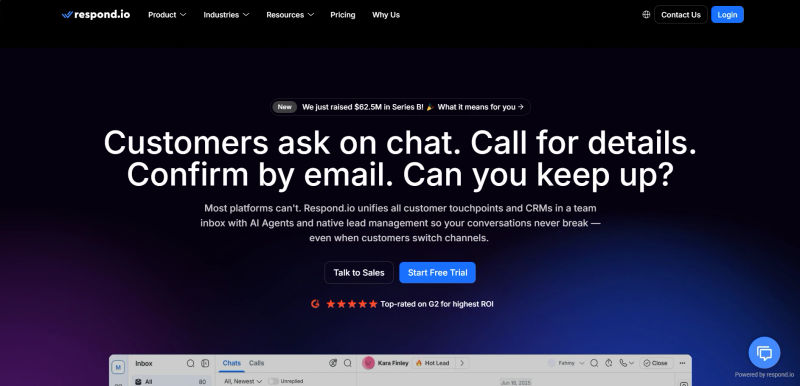
respond.io has evolved into a powerhouse for high-volume, tech-touch customer success teams. While it began as a messaging aggregation platform, its 2026 iteration is a sophisticated AI communication hub designed to handle customer engagement across WhatsApp, email, social media, and web chat simultaneously.
AI Capabilities & Ops Utility
For CS Ops, respond.io offers the "AI Agent," a highly customizable bot that handles Tier 1 and Tier 2 inquiries autonomously. Unlike rigid decision trees of the past, this agent uses a flexible knowledge base to answer questions about pricing, features, and troubleshooting. It can recognize when a high-value account is messaging and instantly route the conversation to a dedicated human agent while providing a summary of the client's recent health metrics.
RevOps Connectivity
respond.io bridges the gap between support and sales by syncing conversation data directly into CRMs like Salesforce and HubSpot. It ensures that every informal chat on WhatsApp is logged as an activity against the contact record, preventing the "dark data" problem where valuable customer context is lost in unmonitored channels.
Multi-threading Capabilities
The platform excels at identity resolution. It can merge duplicate contacts from different channels (e.g., a user messaging via Facebook and emailing via Outlook) into a single profile. This allows CS teams to see the full thread of communication across the entire buying committee, ensuring that a champion's request on one channel isn't missed because the CSM was looking at another.
2. Landbot: Best for No-Code AI Automation
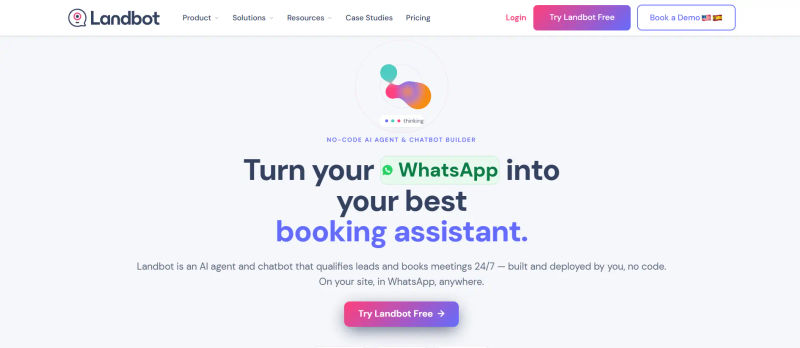
When evaluating the most affordable customer success automation platforms with AI insights, Landbot stands out for startups and small CS teams. It eliminates the need for expensive engineering resources, making it the top choice for scaling "Tech-Touch" segments—smaller accounts that need automated guidance rather than a dedicated CSM.
AI Capabilities & Ops Utility
Landbot ranks highly among the best customer success platforms with AI-driven insights for startups because of its intuitive, prompt-based builder. CS Ops teams can generate complex conversational flows simply by typing prompts like, "Build a renewal qualification bot." The AI instantly maps out the logic, questions, and CRM integration points, streamlining automated onboarding and structured data gathering.
RevOps Connectivity & Customer Intelligence
For those seeking customer intelligence tools with best automation for small CS teams, Landbot serves as a highly effective data collection layer. It captures unstructured intent data through conversational forms, structures it, and pushes it directly to your CRM. By tagging users based on their responses (e.g., "Budget Approved" vs. "Researching"), it triggers targeted marketing or CS sequences in platforms like HubSpot.
Multi-threading Capabilities
Landbot also excels at role-based routing. The bot can identify user roles (e.g., "Admin" vs. "End User") and route conversations accordingly. Technical stakeholders are directed to documentation, while decision-makers are routed to account management, automatically threading the account relationship without human intervention.
3. Catalyst: Best for Predictive Revenue Intelligence
Catalyst defines the category of "Customer Growth Platforms" and stands out as the best customer success platform with built-in AI workflows for revenue teams. Designed for organizations that treat Customer Success as a core revenue engine, Catalyst’s 2026 AI features focus heavily on revenue acceleration, expansion identification, and churn prevention through deep data synthesis.
AI Capabilities & Ops Utility
Catalyst’s "Co-Pilot" features are embedded directly into the CSM's daily routine. The platform analyzes email correspondence, meeting transcripts, and product usage to generate a "Revenue Health" signal. Unlike a generic health score, this signal utilizes predictive churn analytics AI to forecast the likelihood of renewal and upsell. Crucially, it delivers customer success AI next best action renewals guidance, suggesting the exact steps a CSM should take to secure a contract extension. It also identifies "ghosting" stakeholders—detecting when a champion has stopped engaging—and prompts the CSM with a re-engagement email drafted by generative AI.
RevOps Connectivity
Catalyst sits at the center of the RevOps stack. Its bi-directional sync with Salesforce allows CSMs to update opportunity stages, forecast renewals, and log notes without leaving the Catalyst interface. This ensures the revenue forecast in the CRM is always a mirror reflection of the ground truth in CS.
Multi-threading Capabilities
Catalyst visualizes the organizational chart of every customer account. Its AI monitors engagement levels across the entire hierarchy, flagging risks if an Executive Sponsor's engagement drops while a Power User's remains high. This prompts CSMs to "multi-thread" their relationship strategy, ensuring they aren't single-threaded with a low-influence user.
4. Custify: Best for Automated Customer Health Scoring
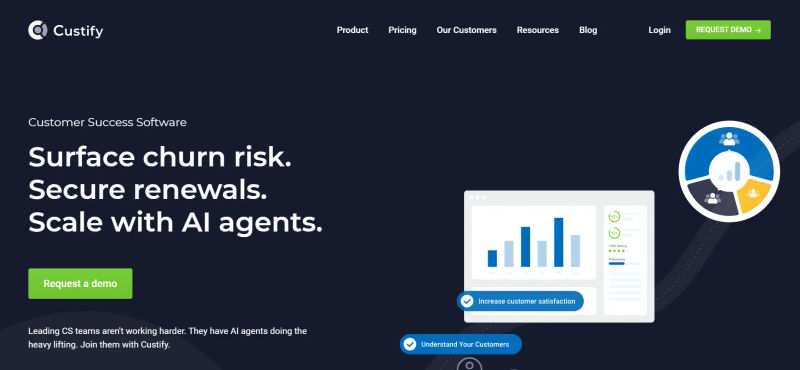
When evaluating the best ai-powered customer success platforms for mid-market tech companies, Custify stands out for its granular view of product adoption. For teams asking, "is there a tool that tracks feature adoption and champion engagement across all customer touchpoints automatically?" Custify is the definitive answer. It is engineered for B2B SaaS businesses to digest complex usage data from support tickets, CRM logs, and in-app behavior, translating it into actionable health scores using AI-driven logic.
AI Capabilities & Ops Utility
Custify’s "KPI Pulse" uses AI to monitor deviations in customer behavior. In 2026, this goes beyond simple thresholds. The AI learns the "normal" usage pattern for each specific customer segment. If a power user suddenly drops their login frequency by 15%, Custify flags this anomaly immediately, even if the total usage is still above the global average. This context-aware monitoring is critical for preventing silent churn.
RevOps Connectivity
Custify feeds product usage data back into the CRM, empowering Sales and Marketing teams. A Sales Rep looking to upsell an account can see exactly which features are being underutilized, allowing for a data-driven pitch. This connectivity ensures that marketing campaigns are triggered based on actual product adoption milestones, not just time-based sequences.
Multi-threading Capabilities
The platform automatically tracks feature adoption and champion engagement across all customer touchpoints at the individual user level, aggregating insights at the account level. By seamlessly syncing this data, CS Ops can build dynamic "Champion Tracking" dashboards. If a high-usage individual leaves the company (indicated by a deactivated email or zero usage), Custify alerts the CSM to identify and train a new champion immediately, securing the mid-market account against turnover risk.
5. Intercom: Best for AI-First Customer Support & Success
Intercom’s pivot to an AI-first architecture cements its position as the best ai knowledge base software for customer success and support 2025 2026. By deploying its "Fin" AI agent, Intercom effectively bridges the gap between customer support and customer success. It transforms reactive troubleshooting into proactive relationship building by instantly retrieving and synthesizing answers directly from your existing documentation.

AI Capabilities & Ops Utility
Fin stands out as a premier AI agent in 2026. By turning static help articles into a dynamic, conversational AI knowledge base, it resolves up to 50% of support queries instantly without human intervention. For CS Ops, the real value lies in the telemetry Fin collects. It automatically categorizes conversation topics and sentiment, feeding this data directly into customer health profiles. If a user repeatedly queries a specific bug, Intercom dynamically adjusts their health score and alerts the assigned technical account manager.
RevOps Connectivity
Intercom functions as a critical "voice of the customer" engine for RevOps. By auto-tagging conversations with feature requests or churn risks, it routes structured qualitative data to product and sales teams. Deep integrations with CRMs like Salesforce ensure every support interaction is visible to Account Executives, preventing tone-deaf upsell attempts to frustrated users.
Multi-threading Capabilities
Intercom's "Series" feature enables sophisticated role-based messaging. CS teams can configure automated campaigns that deliver strategic business reviews to Admins via email, while simultaneously pushing contextual feature tips to end-users via in-app messages. This ensures the right message reaches the right stakeholder, driving broad engagement across the entire account.
6. Ada: Best for Enterprise-Grade AI Orchestration
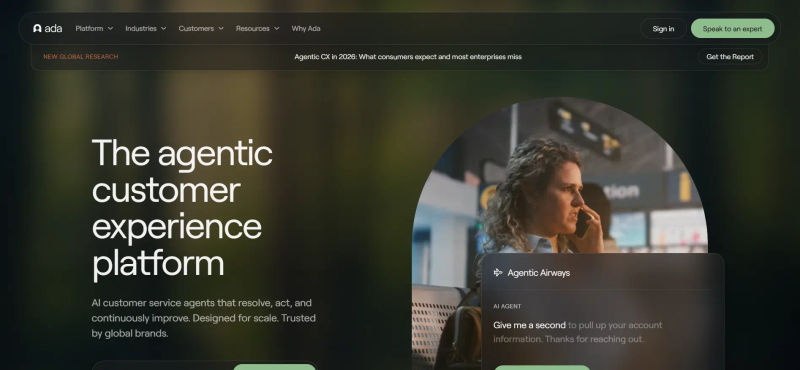
Ada is widely recognized as the best AI orchestration software for enterprise customer success teams requiring robust, secure, and highly scalable automation. It positions itself as an advanced AI Agent that works alongside human teams, capable of orchestrating complex, multi-step resolutions across disparate systems.
AI Capabilities & Ops Utility
Ada’s reasoning engine allows it to troubleshoot complex issues that previously required a human engineer. It can access backend systems to process refunds, upgrade plans, or reset configurations autonomously. For CS Ops, this means a massive reduction in low-value administrative tickets. Ada’s "Guidance" feature also assists human agents by suggesting the next best action based on the customer’s entire history and current context.
RevOps Connectivity
Ada integrates deeply with enterprise tech stacks, including Oracle, SAP, and Salesforce. It can trigger revenue workflows, such as creating a renewal opportunity in the CRM when a customer asks about contract terms. This automation ensures that commercial signals detected by the AI are immediately operationalized by the revenue team.
Multi-threading Capabilities
Ada’s cross-channel persistence allows it to recognize a user whether they are on mobile, web, or social. For enterprise accounts with hundreds of users, Ada maintains context for each individual while aggregating insights for the account level. It helps CS teams understand the collective sentiment of an enterprise client, rather than just the mood of the loudest complainer.
Methodology: How We Evaluated 2026’s Top AI CS Tools
To ensure this guide provides actionable value for tech-forward Ops teams, we established a rigorous evaluation framework. We did not simply look at feature lists; we analyzed the architectural readiness of these platforms for the 2026 AI standard. Our ranking is based on three primary technical criteria:
1. Agentic Autonomy vs. Passive Advice
We prioritized tools that can execute actions, not just suggest them. In our evaluation, a tool scored higher if it could autonomously update a CRM field, trigger a webhook, or modify a user's subscription state without human intervention. The ability to function as a "Large Action Model" (LAM) was a key differentiator.
2. API Flexibility and Data Ingestion
CS Ops is an integration game. We evaluated the API documentation of every vendor. We looked for robust rate limits, comprehensive webhook events, and the ability to handle custom objects. Tools that forced a rigid data structure were penalized, while those offering flexible, schema-less data ingestion scored higher.
3. Enterprise Security and Governance
With the proliferation of LLMs, data sovereignty is paramount. We evaluated each platform's approach to data privacy. Specifically, we looked for "Zero Retention" policies for AI processing, SOC 2 Type II compliance, and the ability for customers to bring their own encryption keys (BYOK). We also assessed whether the vendors use customer data to train their public base models—a practice we view as a security risk for enterprise clients.
Find Perfect Software For Your Business
Comparison Table: Pricing, Best For, and Top AI Features
Below is a comparison of the key plans suitable for tech-forward CS Ops teams. Prices reflect the 2026 market rates for mid-market to enterprise tiers where AI features are fully unlocked.
Plan | Price | Best For | Features |
respond.io Growth | $199/mo | Omnichannel Engagement | • AI Assist response rewriting |
Landbot Business | Custom Pricing | No-Code Automation | • GPT-4o powered builder |
Catalyst Growth | Custom Pricing | Revenue Intelligence | • Predictive churn modeling |
Custify Enterprise | Custom Pricing | Usage Analytics | • Dynamic health scoring |
Intercom Expert | $132/seat/mo | Support & Success Loop | • Fin AI Agent (usage billed separately) |
Ada Generative | Custom Pricing | Enterprise Orchestration | • Reasoning engine |
*Note: All prices shown reflect typical monthly billing. Vendors often offer lower pricing for annual commitments, but those discounts are excluded here for easier comparison. Actual costs may vary depending on your requirements, usage volumes, and negotiated terms.
Evaluate the leading AI customer success platforms on AuthenCIOs vendor-neutral platform.
How to Evaluate AI Capabilities in Your CS Tech Stack
Migrating to an AI-enabled CS platform is a significant undertaking. To ensure your organization is ready and to avoid "AI-washing" (where vendors overstate their AI capabilities), follow this evaluation framework.
1. The Readiness Checklist
Before signing a contract, audit your internal operations. AI requires structure.
Data Centralization: Is your customer data currently siloed in five different tools? You must have a unified data layer or a data warehouse (like Snowflake) ready to feed the AI.
Process Documentation: You cannot automate what you haven't defined. Do you have clear, written SOPs for renewals, onboarding, and risk mitigation? AI accelerates bad processes just as fast as good ones.
Volume Assessment: Do you have enough interaction volume to train the models or justify the cost? AI ROI is highest where volume is high and complexity is moderate.
2. Auditing Data Hygiene
AI models are sensitive to "garbage in, garbage out." Tech-forward CS Ops teams must perform a data hygiene audit. This involves standardizing naming conventions in the CRM, ensuring contact records are up to date, and verifying that product telemetry is mapping correctly to customer accounts. If your churn reasons are not standardized in dropdown menus, an AI model cannot accurately predict future churn risks.
3. API Flexibility and Integration
The true power of AI in 2026 lies in orchestration—one tool triggering actions in another. Evaluate the API documentation of any potential vendor. Does it support webhooks? Can it read and write data back to your CRM? A closed system is a dead end. You need a platform that can push a health score update to Slack, trigger a marketing sequence in HubSpot, and alert a CSM in Salesforce simultaneously.
4. Human-in-the-Loop Protocols
Determine how the software handles the hand-off between AI and humans. Look for "Human-in-the-Loop" (HITL) features. Can a human review an AI-drafted email before it sends? Can the AI flag a conversation for human review if sentiment drops below a certain threshold? The best tools treat AI as a co-pilot, not an autopilot, giving you controls to intervene when necessary.
5. Security, Compliance, and Data Sovereignty
In an era where AI models are hungry for training data, CS Ops leaders must be vigilant about security. When evaluating a vendor, ask specifically about their LLM architecture. Do they use a multi-tenant model where your data might influence predictions for other customers? Or do they offer single-tenant isolation? Ensure the platform supports PII (Personally Identifiable Information) redaction before data is sent to the AI model. For teams in regulated industries like FinTech or HealthTech, look for vendors that allow you to host the model within your own private cloud environment or those that guarantee zero data retention after processing.
Try AuthenCIO
Move to faster, smarter software evaluation with AI
Conclusion: Scaling Customer Success with AI
In 2026, the competitive advantage belongs to Customer Success teams that can scale intimacy. The goal of adopting AI software is not to replace the CSM but to liberate them from the administrative burden that prevents strategic thinking. By leveraging tools like Catalyst for revenue intelligence, respond.io for communication, or Ada for enterprise orchestration, CS Ops teams can build a machine that monitors the mundane, allowing humans to focus on the meaningful.
The tools reviewed here represent the pinnacle of current technology, but the right choice depends on your specific maturity, data infrastructure, and customer engagement model. Whether you are running a high-volume PLG motion or a white-glove enterprise service, there is an AI capability ready to amplify your impact.