
.webp&w=64&q=75)
Introduction
Welcome to our comprehensive Respond.io review for 2026. If you are searching for the best omnichannel CRM for businesses managing sales over WhatsApp, Instagram, and email, this guide breaks down exactly how Respond.io performs in a high-velocity sales environment. Today, "speed to lead" has evolved from a best practice into a survival metric. For a Head of Sales at a growing business, the challenge is plugging the massive attribution gaps and lead leakage that occur when conversations fragment across disparate platforms.
Streamline your software evaluation process
The modern buyer journey is non-linear and mobile-first, yet many sales teams are still operating with legacy infrastructure that treats messaging as a secondary support channel rather than a primary revenue driver.
To compete effectively, sales leaders need the best omnichannel CRM for sales to consolidate these channels into a single command center. Recent data underscores the criticality of immediate engagement: 78% of customers buy from the company that responds first to their inquiry. Furthermore, responding within the first minute can lead to a staggering 391% increase in conversion rates. Conversely, only 37% of businesses respond to leads within one hour, leaving a massive opportunity for agile competitors to capture market share.
The disconnect often lies in the tools. Sales representatives, driven by the need for speed, often resort to using personal WhatsApp accounts to communicate with prospects. This creates a "dark social" problem where critical customer data, negotiation history, and sentiment analysis are locked away in personal devices, inaccessible to the CRM and invisible to management.
This lack of oversight creates compliance risks and makes accurate sales forecasting impossible. Furthermore, with the rise of "AI-first" buyer expectations, customers in 2026 demand instant, intelligent responses 24/7, something human-only teams cannot sustain without burnout.
To combat this, forward-thinking organizations are adopting Unified Conversation Management platforms. These are not simple chat widgets; they are robust infrastructure layers that centralize omni-channel communication, automate routing based on agent capacity or lead value, and sync seamlessly with systems of record like Salesforce or HubSpot.
In this authoritative Respond.io review, we will dissect its capabilities, scrutinize its 2026 pricing, and compare it rigorously against competitors like Freshchat, Tidio, and Landbot to help you determine if it is the right engine to power your sales and customer support operations.
Key Takeaways for Sales Leaders
If you are evaluating Respond.io for your sales organization in 2026, here is the bottom line:
Omni-Channel Centralization: It remains the top choice for consolidating WhatsApp, Messenger, and Telegram into a single inbox, preventing lead leakage across disparate messaging apps.
AI-Driven Lead Qualification: The 2026 AI Agent upgrades allow teams to automate initial discovery and routing, significantly reducing time-to-response for inbound inquiries.
CRM Dependency: Respond.io is a communication layer, not a system of record. Maximum ROI requires deep integration with your existing CRM (like HubSpot or Salesforce) to trigger automated workflows.
Cost Management: Pricing is heavily tied to Monthly Active Contacts (MAC). Sales leaders must implement strict data hygiene and archive dead leads promptly to prevent budget overruns.
Respond.io: Pros and Cons Analysis
No software is perfect. For a Head of Sales, understanding the limitations is just as important as knowing the benefits. Here is an unbiased look at where Respond.io shines and where it may introduce friction.
Pros
Stability and Uptime: As a mature platform with Series A backing and a large user base, Respond.io offers reliable uptime, which is non-negotiable for a revenue-generating channel.
Deep WhatsApp Integration: Few competitors match the depth of their WhatsApp integration. The ability to manage templates, broadcasts, and the 24-hour window natively is best-in-class.
Flexible Automation: The workflow builder is extremely powerful. The ability to execute custom code or HTTP requests means that if you have a technical resource, you can build virtually any logic flow required by your sales cycle.
Unified Contact Profile: The merging of contacts across channels is superior to many helpdesk tools that keep a user's Facebook and Email identities separate. This unified view prevents disjointed customer experiences.
Cons
Learning Curve: With power comes complexity. The workflow builder, while visual, requires a logical mindset to configure correctly. A non-technical sales manager might struggle to build complex routing without assistance from IT or Ops.
Mobile App Experience: While functional, the mobile app has historically lagged behind the desktop experience in terms of feature parity. For field sales reps who live on their phones, this can be a minor friction point.
Reporting Granularity: While the reporting suite covers the basics, it can lack the deep, cross-object BI (Business Intelligence) capabilities found in enterprise tools. For example, correlating "Chat Sentiment" directly with "Closed Won Revenue" might require exporting data to an external BI tool like Tableau or PowerBI.
Cost at Scale: While the base license fees are reasonable, the costs can stack up when you add the Meta conversation fees and potential overages for high volumes of AI interactions.
Best For:
Mid‑sized and growing support teams that need scalable automation, multilingual ticketing, and unified omnichannel workflows without enterprise‑level overhead.
Verdict:
Freshdesk 2026 delivers strong value for teams balancing cost and capability — a reliable, automation‑ready platform that scales smoothly with customer growth.
Respond.io** & Leading Customer Support Alternatives**
While this guide focuses on Respond.io, it’s helpful to compare it against the most recognized Customer Support solutions:




What is Respond.io?
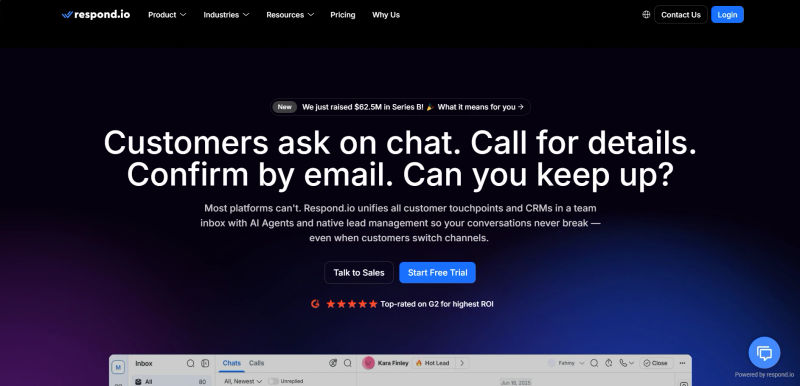
Respond.io has positioned itself as a leading respond.io omnichannel messaging platform, particularly for companies operating in regions where WhatsApp is the dominant communication protocol. Unlike traditional helpdesk software that treats messaging tickets like emails, Respond.io is architected around the "Conversation" as the core unit of value.
This distinction is vital for sales teams where the goal is a continuous, relationship-building dialogue rather than a transactional "ticket closure."
Founded with a vision to decouple messaging from individual devices, the company has seen significant traction. With estimated annual revenue reaching $23.4M and a workforce that grew by 67% in the past year, Respond.io has graduated from a startup solution to a robust mid-market enterprise tool.
The platform currently serves a diverse portfolio, with 40% of its customer base being medium-sized enterprises, validating its fit for growing businesses that have outgrown basic tools but aren't ready for seven-figure custom implementations.
At its core, the software functions as a comprehensive respond.io omnichannel messaging CRM and Customer Conversation Management Software (CCMS). It streamlines respond.io omnichannel messaging by aggregating conversations from virtually any channel—WhatsApp Business API, Facebook Messenger, Telegram, WeChat, Line, Email, and web chat—into a single, unified inbox.
However, its value proposition for a Head of Sales extends beyond aggregation. It focuses heavily on Contact Merging, a feature that uses unique identifiers (like phone numbers or email addresses) to recognize that the prospect chatting on Instagram is the same person who emailed yesterday. This 360-degree view is essential for context-aware selling, preventing the embarrassment of asking a qualified lead basic discovery questions multiple times.
Technically, the platform is built to handle high throughput. It supports complex API endpoints and webhooks, allowing for bidirectional data flow between the chat interface and your CRM. This means that when a deal stage changes in HubSpot, the relevant automated message can be triggered in WhatsApp without manual intervention, ensuring your CRM is updated automatically without manual rep entry.
For sales leaders, this translates to less time on administrative data entry and more time on high-value selling activities.
Respond.io Supported Channels & Omnichannel Inbox
The respond.io omnichannel inbox centralizes customer conversations from various messaging apps into a single, high-visibility interface. For sales teams, this respond.io omnichannel dashboard eliminates the need to switch tabs, ensuring rapid response times and preventing lost leads. Key respond.io unified inbox features include automatic contact merging to prevent duplicate profiles across different apps, internal team tagging for seamless handoffs, and real-time typing indicators.
Regarding the respond.io supported channels 2026 lineup, the platform connects natively with nearly every major global messaging app. Crucially for traditional outreach, respond.io sms channel support is fully integrated via providers like Twilio, Vonage, and MessageBird, allowing teams to blend modern chat with classic text messaging. The full list of respond.io supported channels includes:
WhatsApp Business API
Facebook Messenger & Instagram Direct
Telegram, WeChat, LINE, and Viber
Google Business Messages
SMS (via third-party integrations)
Web Chat and Custom Channels via API
Leveraging these respond.io omnichannel features within the respond.io inbox omnichannel environment allows sales leaders to route leads intelligently based on the channel's origin. This ensures high-value prospects are immediately connected to the right sales rep, regardless of how they initiated the conversation.
Respond.io Updates 2026
In 2026, Respond.io rolled out several major updates focused on advanced AI capabilities, deeper CRM integrations, and enhanced omnichannel routing for enterprise sales teams. These respond.io updates 2026 are specifically designed to reduce response times and automate complex sales workflows.
AI-Powered Intent Recognition (Q1 2026): The platform upgraded its AI agents to automatically detect buying intent from incoming messages across WhatsApp, Instagram, and web chat, instantly routing high-value leads to available sales reps.
CRM Sync 2.0 (Q2 2026): A rebuilt, bidirectional integration for Salesforce and HubSpot now allows sales teams to update deal stages and trigger CRM workflows directly from the Respond.io chat interface.
Advanced Attribution Dashboard (Q3 2026): Sales managers gained access to granular reporting, tracking which messaging channels and specific automated workflows are driving the highest closed-won conversion rates.
These platform improvements solidify Respond.io's evolution from a basic shared inbox into a comprehensive, revenue-driving messaging hub for modern sales leaders.
Key Features Deep Dive
To justify an investment in a unified messaging platform, the feature set must go beyond basic chat functionality. It must offer enterprise-grade control, automation, and analytics. Here is an analysis of Respond.io’s core capabilities relevant to a sales use case.
1. WhatsApp Business Integration for Sales
For many growing businesses, WhatsApp is the new email. However, the standard WhatsApp Business App is insufficient for teams larger than two or three people due to device limitations. Respond.io provides a respond.io WhatsApp official integration as a Meta Business Solution Provider (BSP). This direct respond.io WhatsApp API integration unlocks features critical for scaling sales and customer support operations securely.
Broadcasts & Template Messaging: One of the most powerful features is the ability to send bulk broadcasts to segmented lists of contacts. Unlike standard blasts, these utilize pre-approved Message Templates to ensure compliance with Meta’s commerce policies. Be aware of WhatsApp Business API template approval time 2026 bottlenecks: due to Meta's stricter automated compliance checks this year, approval times for promotional templates can occasionally stretch from minutes to up to 48 hours. Respond.io helps mitigate this by providing pre-vetted template categories and real-time status tracking to prevent campaign delays.
24-Hour Session Management: Meta imposes a 24-hour customer service window. Respond.io visualizes this window clearly for agents, preventing them from attempting to send free-form messages when the window has closed. It automatically prompts the user to utilize a paid template message to reopen the conversation, ensuring compliance and reducing the risk of number blocking.
Multi-Agent Access: The platform resolves the "one phone, one user" bottleneck. Dozens of sales agents can log in simultaneously to manage conversations from a single WhatsApp number. This centralization is the only way to effectively monitor quality assurance and enforce standardized sales scripts across the team.
2. Workflows & Automation
Automation in 2026 is about more than just "away messages." It is about intelligent routing and lead qualification. Respond.io features a visual Workflow Builder that rivals dedicated automation tools.
Conditional Logic Routing: You can build sophisticated decision trees. For example, if a lead comes in via WhatsApp and their country code is "+1", route to the North American Sales Team. If the lead source is "VIP Pricing Page," bypass the bot and assign immediately to a Senior Account Executive. This granular control reduces Time to First Response significantly.
HTTP Requests & Webhooks: For technical sales teams, the ability to trigger external actions is a game-changer. You can configure a workflow step that sends an HTTP POST request to your external scoring engine or CRM to fetch the lead's current credit score or deal value, and then serve that data to the agent in the sidebar as a "Snippet" or internal note.
Analytics Integration: Every automated action feeds directly into respond.io official omnichannel workflow automation reporting. Customer support and sales leaders can track workflow completion rates, bot-to-human handover times, and drop-offs to continuously optimize routing efficiency.
3. AI Agents and Brand Control
With 88% of teams claiming AI adoption, Respond.io has integrated AI agents that can handle initial lead qualification. Crucially for sales leaders concerned about brand reputation, the platform offers controls over the AI's Tone of Voice.
You can configure the agent to be "Professional," "Friendly," or "Empathetic," ensuring it aligns with your brand guidelines. These agents can ask open-ended questions, parse the intent, and update contact fields automatically before a human ever touches the chat. This ensures your expensive sales talent is only speaking to MQLs (Marketing Qualified Leads) or SQLs (Sales Qualified Leads).
4. Reporting & Analytics
Data-driven sales management requires visibility into the "black box" of chat. Respond.io provides a comprehensive reporting suite that breaks down performance by agent, channel, and team. Crucially, respond.io official omnichannel inbox workflow automation reporting connects automated routing directly to your analytics dashboard.
Workflow Automation Reporting: Track workflow success rates directly within the omnichannel inbox. Measure how many conversations are resolved by bots versus routed to human agents to identify automation bottlenecks.
Conversation Metrics: Track Incoming Messages, Replies, and Resolution Time. For a Head of Sales, the "First Response Time" report is the most critical KPI to monitor daily.
Agent Performance: Audit individual agent productivity. How many conversations did Agent A close compared to Agent B? What is their average handling time? This data allows for targeted coaching interventions.
Attribution Reporting: By utilizing reference parameters in your "Click-to-Chat" links (e.g., from Facebook Ads), Respond.io can help track which campaigns are driving the highest volume of WhatsApp conversations.

Security, Compliance, and Data Governance
For a Head of Sales, getting IT and the CTO to sign off on a new communication platform is often the biggest hurdle. Respond.io addresses these enterprise concerns with robust security measures designed for data governance.
GDPR & Compliance: The platform is built to support GDPR compliance, offering features that allow you to export or delete customer data upon request, a mandatory requirement for selling into the EU. This protects your organization from hefty regulatory fines.
Role-Based Access Control (RBAC): You can define granular permissions for your team. Junior sales reps can be restricted to viewing only their assigned conversations, while Sales Managers can have a "Manager View" to oversee all ongoing chats without intervening. This prevents data theft and ensures that sensitive high-value client negotiations are only visible to authorized personnel.
Audit Logs: For troubleshooting and security audits, the Enterprise plan offers detailed logs of who accessed what data and when. This level of visibility is often a prerequisite for SOC 2 audits within your own organization.
Find Perfect Software For Your Business
Industry-Specific Applications
While Respond.io is industry-agnostic, its feature set aligns perfectly with high-touch, high-volume sales verticals.
Real Estate: Agents can use the mobile app to respond to property inquiries while on-site. Automated workflows can qualify buyers by asking about budget and location preferences before routing them to the appropriate agent, ensuring high-value property leads aren't lost in a generic inbox.
SaaS & Technology: For B2B tech sales, the ability to sync conversation data with HubSpot or Salesforce is paramount. Respond.io allows SDRs to nurture leads via WhatsApp, with every interaction automatically logged in the CRM for the Account Executive to review before a demo.
Logistics & Supply Chain: In industries where "Where is my order?" is a common sales blocker, Respond.io can integrate with backend ERP systems via API to provide automated status updates, freeing up sales reps to focus on new business rather than support tickets.
Respond.io Pricing Breakdown (2026)
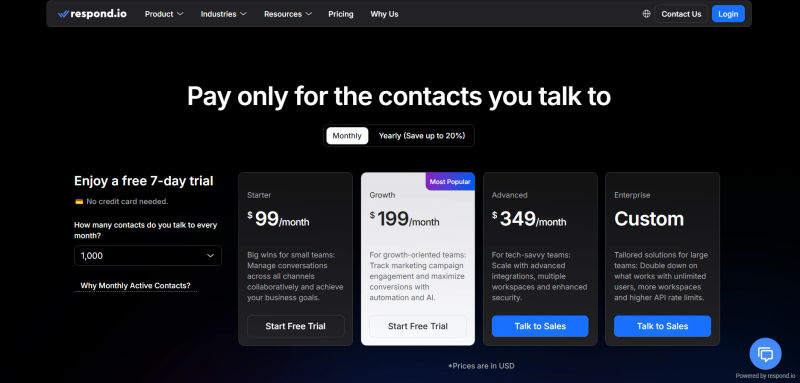
When evaluating respond.io pricing, transparency is essential for budget approval. Respond.io operates on a tiered SaaS model based on Monthly Active Contacts (MACs) and user seats. In 2026, the pricing structure reflects the commoditization of basic features and the premium placed on AI and advanced automation.
A critical factor for sales leaders is respond.io pricing whatsapp integration. While the platform provides the inbox and automation tools, respond.io pricing 2026 whatsapp api costs are dictated by Meta's conversation-based pricing model. These WhatsApp API fees (divided into user-initiated and business-initiated conversations) are billed separately or passed through the platform. Therefore, your "Total Cost of Ownership" (TCO) will be higher than the base software fee alone.
Important Note on Users: The base pricing tiers include a set number of "Seats" or named users. As your sales team scales, you will need to account for the cost of adding additional seats, which can impact the budget for larger teams. Ensure you calculate the total cost based on your projected headcount and messaging volume, not just the base plan fee.
Plan | Price | Best For | Features |
Free Trial | 7‑day free trial (no card) | Teams evaluating the platform | • Full Growth plan access during trial |
Starter | $99/mo | Small teams needing unified inbox | • 5 Users (additional at $12/mo) |
Growth | $199/mo | Growing teams that need automation | • 10 Users (additional at $20/mo) |
Advanced | $349/mo | Tech‑savvy teams & enterprise | • 10 Users (additional at $24/mo) |
Enterprise | Custom | Large & custom teams | • Unlimited users |
*Note: All prices shown reflect typical monthly billing. Vendors often offer lower pricing for annual commitments, but those discounts are excluded here for easier comparison. Actual costs may vary depending on your requirements, usage volumes, and negotiated terms.
Competitor Landscape: How It Stacks Up
Evaluating Respond.io in a vacuum is insufficient. To make an informed decision, you must consider the alternatives. Here is how it compares to three key competitors: Freshchat, Tidio, and Landbot.
1. Respond.io vs. Freshchat
Freshchat (part of the Freshworks suite) is a formidable competitor, particularly for organizations already invested in the Freshworks ecosystem (Freshsales, Freshdesk).
The Verdict: Freshchat offers a more "out-of-the-box" experience for enterprise support teams and has tighter native integration with Freshsales CRM. However, Respond.io generally offers more flexibility in custom API workflows and often provides a better standalone experience for WhatsApp-heavy markets. If you use Salesforce or HubSpot, Respond.io's neutrality is an asset.
Migration Complexity: Moving from Freshchat to Respond.io is moderately complex due to the proprietary nature of Freshworks' data structure, but Respond.io offers CSV import tools to ease the transition of contact data.
2. Respond.io vs. Tidio
Tidio is a dominant player in the SMB and e-commerce space, known for its ease of use and quick setup.
The Verdict: Tidio is excellent for smaller teams that need to get a chat widget up and running on a Shopify or WordPress site in minutes. It is user-friendly and affordable. However, for a "Head of Sales" managing a team of 20+ reps with complex routing needs and high-volume WhatsApp traffic, Tidio's automation capabilities may feel limiting compared to Respond.io's robust workflow engine.
Migration Complexity: Migration is relatively simple as Tidio's data structure is straightforward. You can export contacts easily, though chat history migration may require API assistance.
3. Respond.io vs. Landbot
Landbot is specialized in building conversational experiences. It is primarily a "chatbot builder" rather than a unified inbox.
The Verdict: Landbot excels at creating visually stunning, highly interactive automated flows (the "conversational web"). It is fantastic for lead capture and qualification on a landing page. However, it is not designed to be the primary workspace for human sales agents to manage ongoing conversations. Respond.io is the "Inbox" where the conversation happens; Landbot is the "Form" that starts it.
Migration Complexity: Since Landbot is often used as a front-end tool, you might not "migrate" from it but rather integrate it. However, replacing Landbot's logic with Respond.io's workflow builder will require rebuilding your decision trees from scratch.
Implementation Strategy: Integrating Respond.io into Your Tech Stack
Adopting a platform like Respond.io is a change management project. To ensure a successful rollout that drives ROI, a Head of Sales should follow a structured implementation path. The goal is to minimize disruption while maximizing the "Time to Value."
Phase 1: The Audit & Connection (Week 1)
Before creating a single account, audit your current entry points. Where are leads currently leaking? Identify all personal WhatsApp numbers used by reps, all Facebook Pages, and all website forms. The first technical step is porting your primary business phone number to the WhatsApp Business API via Respond.io.
Warning: This is an irreversible step for that specific number; it cannot easily revert to a standard WhatsApp consumer account, so ensure you are committed. Connect your CRM (Salesforce/HubSpot) immediately to ensure data flows from day one.
Phase 2: The Routing Logic (Week 2-3)
Do not launch with a blank slate. Map out your routing logic on a whiteboard first.
Scenario A: Inbound lead during business hours -> Round Robin assignment to Sales Team A.
Scenario B: Inbound lead after hours -> AI Agent qualification -> Schedule a meeting link -> Assign to morning shift.
Configure these workflows in the builder and test them rigorously. A broken workflow that sends a lead into a black hole is worse than no automation at all.
Phase 3: Team Training & Enablement (Week 4)
Sales reps will resist new tools if they perceive them as administrative burdens. Position Respond.io as a tool that "protects their commission." Show them how the Snippets (canned responses) save them typing time and how the mobile app allows them to respond to hot leads from anywhere without exposing their personal number. Establish a strict SLA (Service Level Agreement), such as "All WhatsApp inquiries must be replied to within 15 minutes," and use the reporting dashboard to gamify this metric.
Try AuthenCIO
Move to faster, smarter software evaluation with AI
Final Verdict: Is Respond.io the Right Investment for 2026?
For the Head of Sales at a growing business, Respond.io represents a strategic investment in infrastructure. It is not the cheapest tool on the market, nor is it the simplest. However, its strength lies in its scalability and reliability for high-volume, omni-channel communication.
If your primary goal is to professionalize your WhatsApp operations, eliminate lead leakage from personal devices, and implement complex routing logic that syncs with your CRM, Respond.io is a Tier-1 contender. It bridges the gap between a chaotic startup using personal phones and a sluggish enterprise using legacy ticketing systems.
However, if you are a very small team (under 3 users) primarily focused on web chat for support rather than sales, tools like Tidio might offer a faster ROI. Similarly, if you are deep in the Freshworks ecosystem, Freshchat remains a strong alternative. But for a standalone, best-of-breed messaging powerhouse that puts sales velocity first, Respond.io is highly recommended for 2026.
Head of Sales Action Checklist
Ready to move forward? Use this checklist to validate if your organization is ready for Respond.io:
Audit Lead Leakage: Survey your sales team to find out how many are using personal WhatsApp numbers for client comms. If it's >30%, you need this platform.
Verify CRM Access: Ensure you have administrative access to your HubSpot or Salesforce instance to authorize the API integration.
Define the Number: Decide which phone number will be your "Official" business WhatsApp number. Remember, once ported to the API, it cannot be used on a personal phone app again.
Map the Journey: Draw your ideal "After Hours" flow. Do you want a bot to take a message, or an AI agent to qualify the lead?
Secure Budget: Factor in the platform cost + estimated Meta conversation fees (approx. $0.03-$0.05 per conversation depending on region) to present a full TCO to your finance team.