
Introduction
In 2026, minimizing Time-to-Value (TTV) is the top priority for Customer Onboarding Specialists. To achieve this, teams are abandoning fragmented spreadsheets in favor of specialized customer success software for onboarding. The top platforms leading the market—and serving as powerful alternatives to legacy project management tools—are Callvu, Ruby, ChurnZero, SmartKarrot, Userflow, and Appcues. These solutions automate the Sales-to-CS handoff, enforce process compliance, and accelerate the customer's journey to their first "aha" moment.
The broader customer success landscape has shifted definitively from retention-focused defense to value-driven offense. Modern SaaS buyers expect immediate utility. If a customer does not perceive ROI within the first 30 to 90 days, the likelihood of early churn skyrockets.
Streamline your software evaluation process
However, specialists on the ground still face significant operational burdens. Onboarding teams are frequently trapped in the "Black Hole" problem—a lack of visibility where stakeholders cannot see the real-time status of a customer's implementation. You are often the face of a messy handoff, tasked with explaining to a new client why the promises made during the sales cycle require complex technical configuration.
Specialists struggle with manual data entry fatigue, updating CRMs and project management tools simultaneously. This fragmentation leads to inconsistent experiences dependent on individual CSMs rather than a standardized playbook. To solve this, high-performing teams rely on the six platforms compared in this article to handle the technical and human nuances of modern onboarding, ensuring transparent, scalable, and rapid customer activation.
Key Takeaways
Top Enterprise Solutions: ChurnZero and SmartKarrot lead the 2026 market for complex onboarding workflows, offering predictive insights and data-driven scaling for large customer bases.
Best for Product-Led Growth: Userflow and Appcues provide the most robust no-code product tours and personalized in-app experiences to accelerate user time-to-value.
Top Communication Tools: Callvu and Ruby excel at streamlining multi-stakeholder communication and digital engagement during the critical sales-to-CS handoff.
Strategic Priority: The most successful onboarding implementations this year prioritize strict data hygiene and internal change management to ensure rapid return on investment.
Leading Customer Success Software Solutions to Know
While this guide explores key industry insights, seeing these principles in action requires the right platform. Here is a snapshot of the most recognized Customer Success Software solutions currently shaping the market.






The Data Hygiene Hurdle in Handoffs
One of the most overlooked aspects of the Sales-to-CS handoff is data hygiene. No amount of automation can fix a workflow if the input data is flawed. In 2026, the best onboarding software serves as a gatekeeper. Instead of a CSM chasing a Sales Rep for context via Slack or email, platforms like ChurnZero and SmartKarrot now enforce "Exit Criteria" for sales opportunities.
Before a contract can be marked "Closed-Won" in the CRM, the software validates that critical onboarding fields—such as technical POC, desired launch date, and specific success criteria—are populated. This automated validation relieves the Onboarding Specialist from the awkward task of policing the sales team. It ensures that when the onboarding project is created, the "Migration Readiness" data is already present, allowing the specialist to focus on strategy rather than data cleanup. This shift from manual information gathering to automated validation is a primary driver in reducing initial drag during the first week of the customer relationship.
Evaluate the leading onboarding customer success platforms on AuthenCIOs vendor-neutral platform.
Key Criteria for Selecting Onboarding Workflow Tools
Before diving into specific tools, it is critical to understand what constitutes a high-functioning onboarding workflow in the current market. The most successful strategies in 2026 utilize a hybrid "tech-touch" model. This approach leverages automation for low-value tasks—such as data collection, scheduling, and basic training—while reserving human capital for high-stakes relationship building and strategic consulting.
A robust onboarding workflow must seamlessly bridge the gap between the sales promise and the post-sale reality. This requires distinguishing between internal project management views and client-facing task lists. While the internal team needs detailed Gantt charts and dependency tracking (often synced with Jira or Asana) to ensure technical compliance, the client needs a simplified, gamified view of their progress. Tools that provide a transparent progress bar or a "Launchpad" view significantly reduce client anxiety and improve adoption rates by hiding the sausage-making complexity while showing linear progress.
Finally, the core metric for these workflows is TTV. This is no longer a vague feeling of satisfaction but a quantifiable metric: the number of days from contract signature to the customer utilizing a key feature that drives revenue or efficiency. The software selected must not only track this metric but actively work to compress it through automated triggers—such as sending a welcome email with login credentials immediately upon CRM update—and proactive bottleneck alerts.
Top 6 Customer Success Platforms for Onboarding Specialists
1. Callvu: Enhancing Digital Engagement Workflows
Callvu approaches onboarding from a visual engagement perspective, making it a unique player in the 2026 market. It is particularly effective for organizations with complex, document-heavy onboarding processes—such as FinTech or InsurTech—where friction often leads to drop-offs. Callvu’s platform transforms standard communication channels into rich, interactive digital experiences.

Minimizing Time-to-Value (TTV): Callvu accelerates TTV by removing friction from administrative tasks. Instead of emailing PDFs back and forth, onboarding specialists can trigger secure, visual workflows directly to a customer’s smartphone during a live call or via SMS. This capability is crucial for streamlining "KYC" (Know Your Customer) processes and complex account setups. By guiding customers through smart visual forms, automated document collection, and real-time co-browsing sessions, Callvu reduces the "ping-pong" of support tickets that typically delays activation. Recent 2026 data shows these visual flows can reduce onboarding abandonment rates by up to 40%.
Ecosystem Integration & Implementation: A common question is how Callvu fits into existing tech stacks. It is designed to sit on top of legacy infrastructure, making it highly valuable for enterprises unable to rip and replace backend systems. It integrates seamlessly via API with major CRMs (Salesforce, Microsoft Dynamics) and contact center solutions (Genesys, Avaya, Cisco). Data collected during visual sessions populates directly into the system of record, eliminating manual entry errors. Thanks to new low-code deployment tools introduced in early 2026, implementation time has dropped from 4-6 weeks to just 2-3 weeks, allowing teams to map visual flows to backend API endpoints faster and drastically reduce handle time during onboarding calls.
2. Ruby: Streamlining Communication for Faster Activation
While most onboarding discussions focus on software automation, human availability remains a critical bottleneck. Ruby provides a distinctive solution by offering "Receptionist-as-a-Service" and live chat capabilities tailored for high-touch onboarding models. In 2026, as AI handles routine tasks, the premium value of human connection has increased, making Ruby a strategic asset for concierge onboarding and immediate client activation.
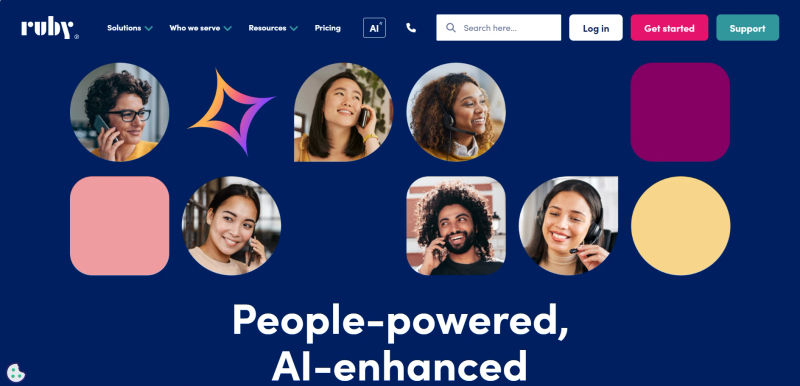
How does Ruby accelerate the onboarding timeline? For many businesses, onboarding delays stem from missed calls or slow responses to simple setup queries. Ruby ensures every customer interaction is captured instantly. By integrating Ruby’s live chat specialists into your onboarding portal, customers receive immediate answers to basic configuration questions 24/7. This continuous availability removes roadblocks that would otherwise wait for a Customer Success Manager's (CSM) working hours, significantly compressing the time-to-value timeline.
What are Ruby's core integrations for onboarding workflows? Ruby functions as a communication layer rather than a data repository, featuring robust integration capabilities to streamline handoffs. It syncs with calendar tools like Calendly to book kickoff meetings directly during a client's first interaction. Crucially, it integrates natively with platforms like Salesforce, HubSpot, Clio, and Rocket Matter to log every interaction. If a new client calls with a setup issue, the receptionist logs the ticket directly into your support workflow. Implementation is highly agile—often fully deployed in under 48 hours—providing immediate bandwidth support for scaling onboarding teams.
3. ChurnZero: Data-Driven Onboarding at Scale
ChurnZero is a leading Customer Success platform designed for enterprise teams requiring deep data integration and rigorous workflow governance. It excels at mapping complex customer journeys and enforcing standardized, data-backed playbooks to reduce time-to-value.

Automated Data Transfer & Triggers: ChurnZero automates the critical "Sales-to-CS" handoff through robust, bi-directional syncs with CRMs like Salesforce and HubSpot. In 2026, its advanced automation engine handles sophisticated triggers: when a contract is marked "Closed-Won," ChurnZero instantly assigns a CSM based on capacity or territory, generates a tailored onboarding project plan based on the purchased product tier, and initiates a personalized welcome sequence. This eliminates manual data entry and accelerates the activation phase.
Ecosystem Integration & Implementation: For Onboarding Specialists, ChurnZero acts as the central command center by integrating deeply with project management tools like Jira and Asana. This enables cross-functional collaboration: technical teams can work in Jira, and when an engineer marks a migration task as "Done," ChurnZero’s onboarding checklist updates automatically via bi-directional sync. This instantly triggers the next client communication playbook. While implementation is a heavier lift—typically taking 8 to 12 weeks to fully map data schemas, custom health scores, and predictive models—it delivers a highly comprehensive, automated view of the customer lifecycle.
4. SmartKarrot: Predictive Insights for Onboarding Success
SmartKarrot focuses on "Augmented Intelligence," leveraging machine learning to predict onboarding outcomes and automate next-best actions. For onboarding teams, this shifts the focus from reactive project management to proactive risk mitigation.
Predicting TTV Risks: How does SmartKarrot prevent onboarding delays? Its engine analyzes historical data to establish dynamic benchmarks across different customer segments. As new customers progress, the system compares their product telemetry and engagement against successful cohorts. If a user logs in but fails to complete critical setup milestones, the "Early Warning System" flags a potential delay in Time-to-Value (TTV). This triggers automated playbooks, allowing Onboarding Specialists to intervene with targeted resources before the customer stalls.
Ecosystem Integration & Implementation: SmartKarrot relies on deep data ingestion to power its predictive models. It natively connects with data warehouses (Snowflake, Redshift) and product analytics tools (Mixpanel, Pendo). It also integrates directly into daily workflows via Slack and Microsoft Teams. If a high-value enterprise account stalls during the configuration phase, SmartKarrot pushes an alert to a dedicated CS Slack channel to prompt immediate swarm support. Implementation typically takes 6 to 8 weeks, heavily focused on training the AI models on your historical data to ensure accurate health scoring from day one.
Find Perfect Software For Your Business
5. Userflow: Building Seamless No-Code Product Tours
Userflow remains a top choice for product-led onboarding, enabling Onboarding Specialists to build sophisticated, no-code in-app guides. In 2026, its standout feature is the AI-powered assistant, which allows teams to generate dynamic product tours and tooltips based on simple text prompts, significantly reducing creation time without engineering support.
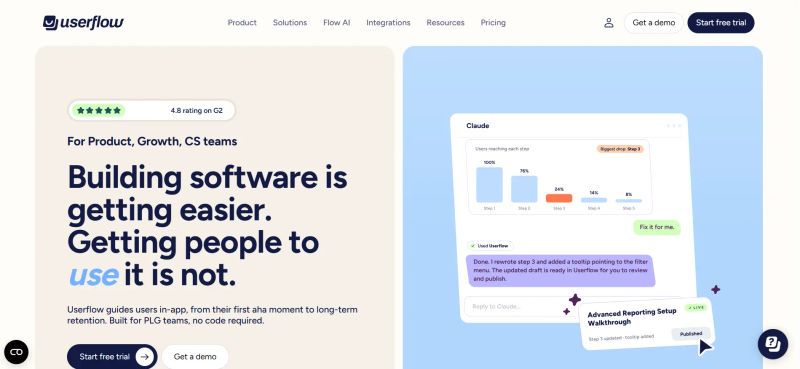
In-App Guidance for TTV: Userflow accelerates Time-to-Value (TTV) by replacing static manuals with interactive, context-aware flows. For example, a flow can highlight an "Import Data" button, wait for the user action, and adapt the next step based on their specific user role. Recent updates include native A/B testing for onboarding flows, allowing specialists to measure which tour variations yield the highest activation rates.
Ecosystem Integration & Implementation: Userflow integrates deeply with the modern data stack, including Amplitude, Mixpanel, Segment, and Snowflake. Every interaction with an onboarding checklist is tracked as an event to pinpoint drop-off rates. Bidirectional syncs with HubSpot and Salesforce ensure "Tour Completed" milestones instantly update health scores in the CRM. Implementation requires a simple JavaScript snippet installation, taking only minutes, though optimizing the flows is an ongoing, data-driven process.
6. Appcues: Personalized User Experiences That Drive Value
Appcues continues to lead in delivering personalized, behavioral-based onboarding flows. In 2026, its expanded capabilities in cross-platform segmentation (web and mobile) make it a versatile tool for SaaS companies looking to automate initial user education and deflect early support tickets.
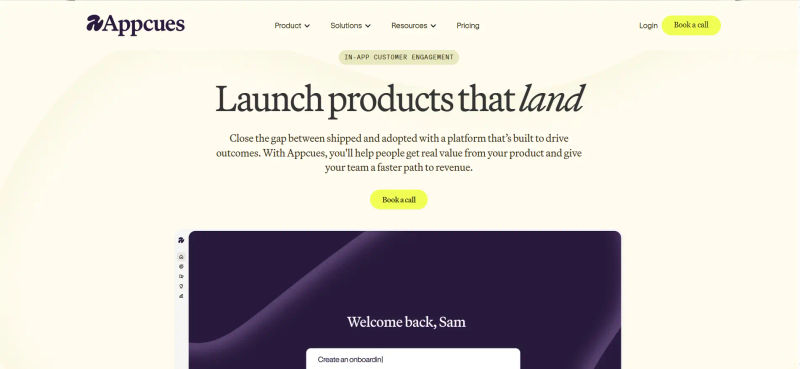
Behavioral Triggers & Support Deflection: Appcues allows for highly granular targeting based on user properties and real-time events. Onboarding workflows trigger based on what users have (or haven't) done. For example, if a user accesses a complex feature but fails to complete the setup within 10 minutes, Appcues can trigger a contextual tooltip or a brief video modal. This proactive guidance nudges users toward value-generating actions and significantly reduces "how-to" support inquiries during the critical first week.
Ecosystem Integration & Implementation: Appcues offers a robust integration library, connecting seamlessly with modern data stacks like Amplitude, Mixpanel, Salesforce, and HubSpot. A standout capability for 2026 is its native support for reverse-ETL tools (like Hightouch or Census), allowing teams to pull complex warehouse data to hyper-personalize the onboarding experience (e.g., "Welcome back, Sarah. We saw your team uploaded 500 records yesterday..."). While technical implementation requires only a lightweight SDK or JS snippet, successful deployment requires a strategic content audit to ensure in-app messages align with broader onboarding emails and support documentation.
Comparison Table: Pricing, Plans, and Key Features
The following table outlines the pricing and feature sets for the six selected platforms. Prices reflect Q3 2026 market rates for mid-market to enterprise plans suitable for established onboarding teams.
Plan | Price | Best For | Features |
Callvu Digital Engagement | Custom Pricing | Enterprise Visual Workflows | Visual IVR builder, Co-browsing capabilities, Digital forms automation, API integrations with legacy systems, Real-time analytics dashboard, Omnichannel deployment, Secure document sharing |
Ruby Essential Reception | ~$355 / month | Human-Assisted Concierge | 24/7 Live virtual receptionists, Integrated live chat services, Mobile app for status updates, Call handling & screening, Lead capture integration, Bilingual support capabilities, Voicemail transcription |
ChurnZero Professional | Custom Pricing | Data-Driven CS Teams | Real-time health scoring, Journey mapping automation, In-app announcements, NPS & CSAT surveying, Bi-directional CRM sync, Segmentation engine, Customer portal access |
SmartKarrot Growth | ~$899 / month | Predictive Onboarding | Augmented intelligence alerts, Onboarding playbooks, Touchpoint tracking, Early warning system, Product adoption analytics, Task management automation, Success outcomes modeling |
Userflow Adoption Studio | $500 / month (1k active users) | No-Code In-App Guidance | Drag-and-drop flow builder, User segmentation, NPS surveys, Resource center widget, A/B testing for flows, Event tracking without code, Multi-language support |
Appcues Growth | Custom Pricing | Personalized Adoption | Advanced targeting & segmentation, Native Salesforce integration, Click-to-track analytics, Flow analytics & reporting, NPS & surveys, Mobile app support, unlimited user flows |
*Note: All prices shown reflect typical monthly billing. Vendors often offer lower pricing for annual commitments, but those discounts are excluded here for easier comparison. Actual costs may vary depending on your requirements, usage volumes, and negotiated terms.
Compare top onboarding tools without sales pressure at AuthenCIO.
Navigating Multi-Stakeholder Complexity
A common pitfall in selecting onboarding software is failing to distinguish between "User Onboarding" and "Account Onboarding." This distinction is vital when navigating multi-stakeholder complexity in B2B environments.
User Onboarding (handled best by Userflow and Appcues) focuses on the individual's experience inside the product—teaching them where to click and how to function. Account Onboarding (handled best by ChurnZero and SmartKarrot) focuses on the holistic relationship—contract fulfillment, executive business reviews, and technical integrations that involve IT, Legal, and Procurement departments.
In 2026, the most mature organizations often run these in parallel. For example, a specialist might use ChurnZero to manage the project timeline with the client's VP of Operations (the buyer), ensuring that milestones are met and governance is maintained. Simultaneously, the product team uses Appcues to train the 50 end-users who will actually log in daily.
The data from Appcues (e.g., "only 20% of users have logged in") feeds into ChurnZero, alerting the CSM to a risk in the account's overall health. Recognizing this duality is essential; trying to force a project management tool to do in-app guidance, or vice versa, usually leads to a disjointed customer experience.
Implementation Strategies to Accelerate Onboarding ROI
Once a tool is selected, the implementation strategy determines the success of the investment. A common failure mode is attempting to migrate a broken manual process directly into a software tool. To avoid this, teams should follow a strict "Migration Readiness" protocol.
1. The Migration Readiness Checklist
Before you import a single customer into your new platform, ensure you have the following five elements defined:
The Happy Path vs. Exception Logic: Document the ideal onboarding flow (Happy Path) and the specific triggers that define an exception (e.g., "Legacy Data Import Required"). Automate the former; flag the latter.
Data Dictionary & Clean-up: Ensure your CRM data fields map 1:1 to the new platform. If your CRM has three different fields for "Start Date," standardize this before integration.
Content Repository: Gather all email templates, PDFs, and help articles. Rewrite them for the new medium (e.g., converting a long email into a checklist item).
Stakeholder Matrix: Define who receives alerts. Does the Sales Rep need to know when onboarding is complete? Does the Product Manager need to know when a user fails a tour?
Success Metrics: Define exactly how TTV is calculated in the new system. Is it "Login," "Feature Usage," or "Integration Complete"?
2. Internal Change Management
The best software will fail if your team refuses to use it. Onboarding Specialists often resist new tools because they fear losing the "personal touch" or simply dread the learning curve. To combat this, frame the software implementation not as a monitoring tool, but as an "Admin Eliminator."
Show the team specifically how the tool will remove 5 hours of data entry from their week. Create "Internal Champions"—power users within the team who can troubleshoot for their peers. Finally, ensure that the executive team uses the software's dashboards for their reporting, which forces adoption down the chain of command.
Try AuthenCIO
Move to faster, smarter software evaluation with AI
Conclusion: Choosing the Right Tool for Your 2026 Strategy
In 2026, the Onboarding Specialist is the architect of the customer's first impression. The software you choose acts as the blueprint for that experience. Whether you prioritize the deep data orchestration of ChurnZero, the predictive intelligence of SmartKarrot, the in-app agility of Userflow and Appcues, or the engagement layers of Callvu and Ruby, the ultimate goal remains constant: reducing the time it takes for a customer to realize they made the right purchase decision.
By focusing on ecosystem integration, visibility, and automation, you can transform onboarding from a cost center into a competitive advantage. The right tool will not only organize your team but will fundamentally change how your customers experience your product, turning the precarious first 90 days into the foundation of a long-term partnership. Start by auditing your current "Black Holes" and selecting the platform that illuminates them most effectively.