
Introduction
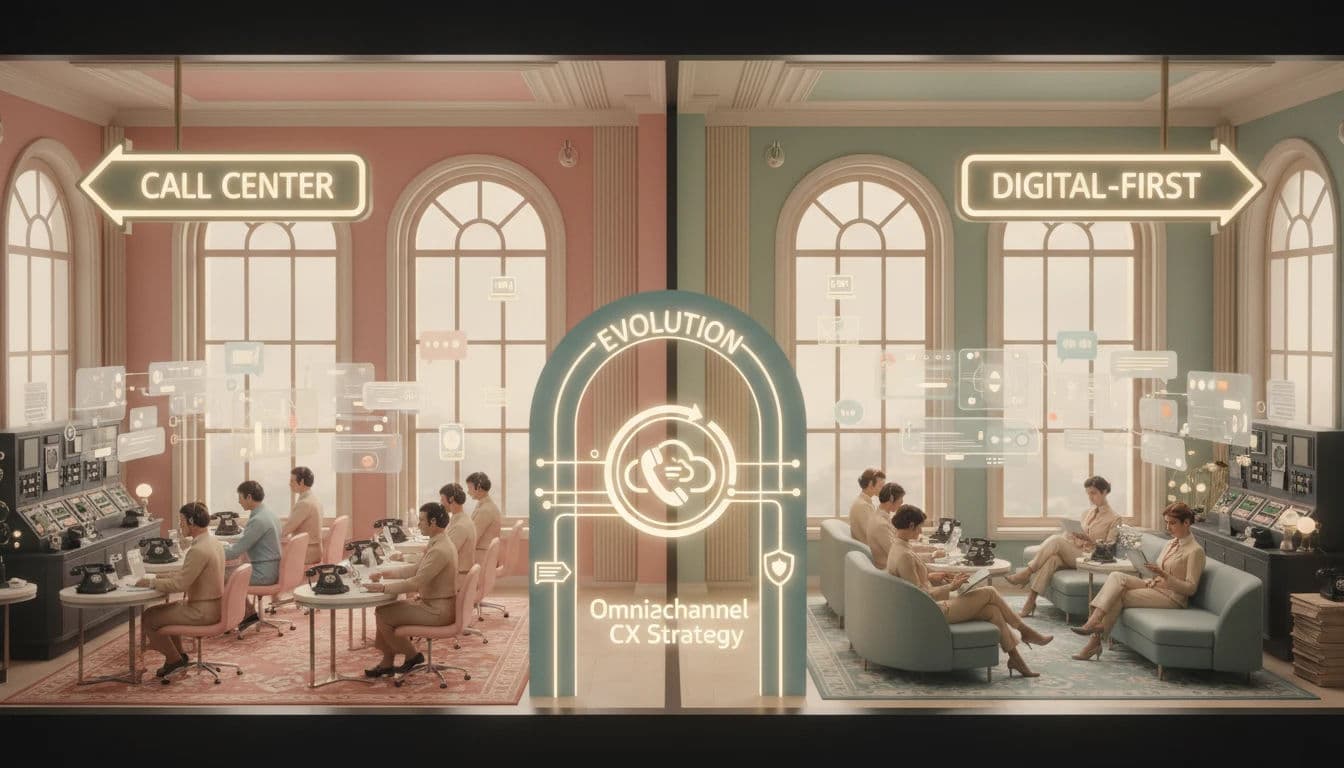
In the rapidly evolving landscape of Customer Experience (CX), a pervasive narrative suggests a zero-sum game between Artificial Intelligence and human employment. However, the most forward-thinking Support Directors and VPs of Operations recognize this as a false dichotomy. The future of high-performance customer service is not about replacement; it is about augmentation. We are witnessing the rise of the "Symbiotic Support Stack," where AI for support agents serves as a force multiplier, handling computational heavy lifting while human agents focus on empathy, complex negotiation, and high-value relationship building.
Streamline your software evaluation process
Despite the clear operational benefits, a "silicon ceiling" often exists—a barrier formed by frontline skepticism and fear of job displacement. It is crucial to acknowledge these concerns upfront. The goal is not to render the human obsolete but to elevate their role. Recent industry data supports this shift toward collaboration over substitution. According to the Stanford AI Index Report 2025, nearly 60% of enterprise AI interactions are now designed to be augmentative—enhancing human capabilities rather than automating them away. Furthermore, organizations deploying "Agent Assist" technologies have reported productivity gains of up to 30%, proving that the most efficient support teams are those that leverage AI to remove friction from their human agents' workflows.
For leaders managing distributed support teams, the challenge is no longer if they should adopt AI, but how to implement it strategically to solve specific pain points like high burnout, inconsistent tone of voice, and unmanageable ticket volumes. This article explores best practices for integrating AI into your support operations to empower your staff, utilizing advanced tools like Freshchat, Tidio, Landbot, and Callvu to bridge the gap between automation and the human touch.
Leading Customer Support Solutions to Know
While this guide explores key industry insights, seeing these principles in action requires the right platform. Here is a snapshot of the most recognized Customer Support solutions currently shaping the market.




The Paradigm Shift: From Replacement to Augmentation
The traditional view of automation focused on "deflection"—keeping customers away from expensive human resources. While reducing cost-per-contact remains a valid metric, the modern paradigm prioritizes First Contact Resolution (FCR) and Customer Satisfaction (CSAT) through intelligent augmentation. In this model, AI is not a gatekeeper; it is a co-pilot.
This shift addresses a critical vulnerability in legacy support models: the "Empathy Gap." When agents are bogged down by repetitive, Tier 0 inquiries—such as password resets or order status checks—their cognitive load increases, leading to decision fatigue. By the time a complex, emotionally charged Tier 3 issue reaches them, their capacity for empathy is depleted. The financial implications are severe; replacing a burnt-out, high-performing agent can cost up to 200% of their annual salary in recruitment and ramp-up time.
Augmentation reverses this dynamic. By automating the administrative and retrieval tasks, AI preserves the agent's mental energy for interactions that require genuine human connection. This approach aligns with findings from the KPMG AI Pulse survey, which notes that leaders tracking human-AI collaboration see significantly improved employee satisfaction alongside profitability. The goal is to elevate the support agent from a "ticket closer" to a "customer success consultant," supported by a sophisticated digital infrastructure.
Intelligent Triage: Using NLP for Contextual Routing
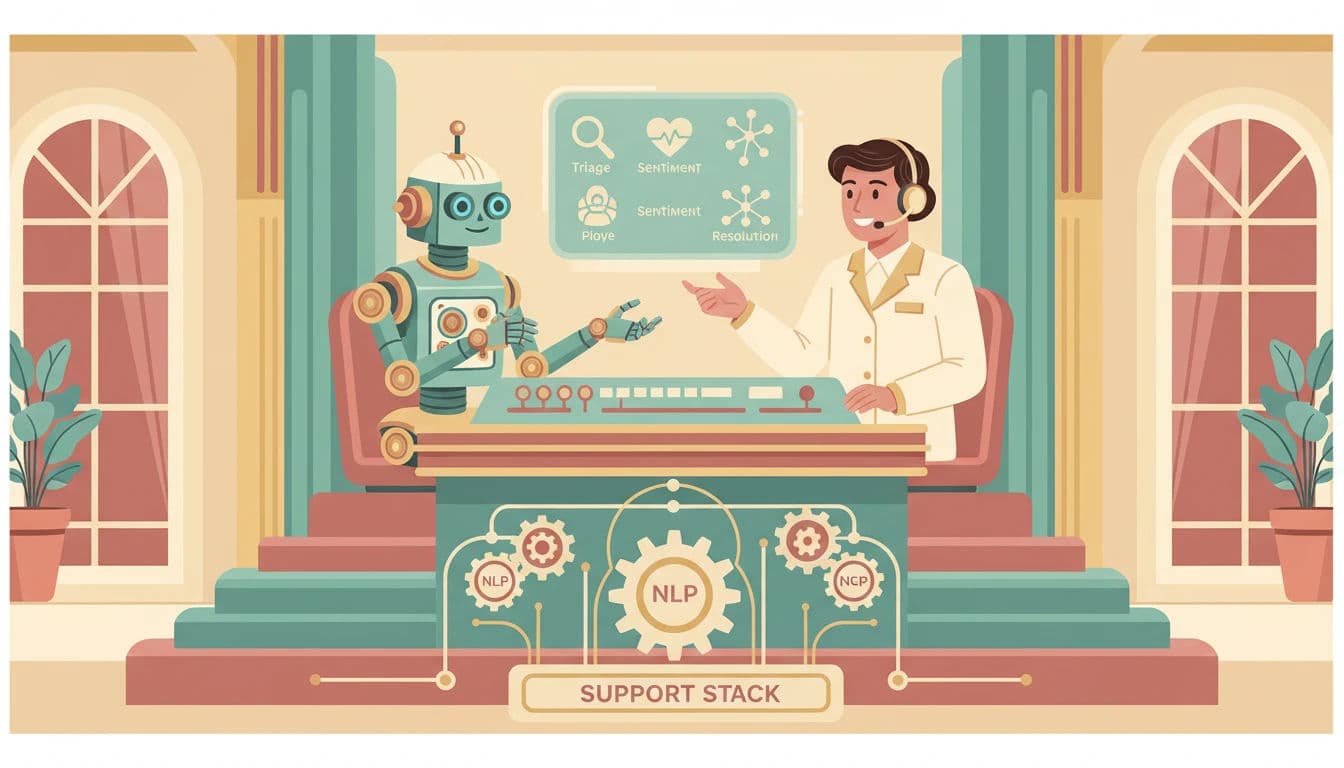
One of the most immediate ways to enhance agent performance is to ensure they are only working on tickets that match their specific expertise. Manual triage is inefficient and prone to error, often resulting in multiple transfers that frustrate customers and waste agent time. Best-in-class support stacks now utilize Natural Language Processing (NLP) to analyze incoming queries in real-time, categorizing them by intent, sentiment, and complexity before a human ever sees them.
Freshchat exemplifies this capability through its advanced routing features. Rather than simple keyword matching, Freshchat’s AI algorithms analyze the semantic context of a user's message. For instance, if a customer writes, "I'm frustrated that my refund hasn't processed and I'm considering cancelling," the system detects both the intent (billing/refund) and the sentiment (negative/churn risk).

Instead of routing this to a general queue, the AI can prioritize the ticket and route it directly to a retention specialist or a senior agent equipped to handle financial disputes. This is Intelligent Triage in action. It empowers agents by providing them with context before the conversation begins. When the agent picks up the ticket, they aren't asking, "How can I help you?"; they are saying, "I see you're waiting on a refund, let me expedite that for you." This proactive stance, enabled by AI, significantly reduces Average Handle Time (AHT) and boosts the agent's perceived competence.
The Risk of "Garbage In, Garbage Out" (GIGO)
However, implementing intelligent triage requires rigorous data hygiene. AI models are probabilistic; they learn from historical data. If your existing ticket tags are messy, inconsistent, or overlapping, the NLP will learn these bad habits—a phenomenon known as "Garbage In, Garbage Out." Before deploying a tool like Freshchat, it is imperative to audit your taxonomy. Ensure that your "intent" categories are mutually exclusive and collectively exhaustive (MECE) so the AI has a clean dataset to reference. Without this foundation, even the most advanced algorithms will misroute tickets, leading to agent confusion rather than augmentation.
The AI Co-Pilot: Real-Time Agent Assistance and Sentiment Analysis
Once a conversation is underway, the role of AI shifts from router to assistant. In a high-pressure environment, agents often struggle to retrieve the correct information from knowledge bases or maintain a consistent brand tone. This is where Agent Assist technology becomes vital. It acts as a whisperer in the agent's ear, suggesting responses, retrieving documentation, and monitoring the emotional temperature of the chat.
Tidio, particularly with its Lyro AI infrastructure, is a prime example of this co-pilot model. Unlike a standard chatbot that deflects, Tidio’s tools can be configured to assist human agents by drafting responses based on the company's entire support history and knowledge base. When an agent receives a complex technical query, Lyro can instantly surface the relevant troubleshooting steps, allowing the agent to verify the solution and personalize the delivery rather than spending ten minutes searching through PDFs.
Mitigating AI Hallucinations
A critical aspect of using a co-pilot is training agents to manage "AI Hallucinations"—instances where the AI confidently suggests incorrect or non-existent information. While tools like Tidio are designed to minimize this by grounding responses in your specific support content, no model is infallible. Agents must be trained to treat AI suggestions as drafts, not final edicts. They must verify specific data points (like refund policies or technical specs) before hitting send. This verification step is where the human agent adds value, acting as the quality control filter that ensures accuracy while benefiting from the AI's speed.

Moreover, real-time sentiment analysis is a game-changer for quality assurance. If a customer's language becomes increasingly aggressive, Tidio’s AI can flag the conversation to a supervisor for immediate intervention. This protects agents from abuse and ensures that escalating situations are managed with the appropriate level of seniority, creating a safety net for the team.
Find Perfect Software For Your Business
Mastering the Human-in-the-Loop (HITL) Handoff
The most critical moment in any hybrid support interaction is the handoff. A clumsy transition from bot to human can destroy customer trust instantly. The "Human-in-the-Loop" (HITL) methodology dictates that AI should handle the conversation only as long as it adds value, and must relinquish control seamlessly when complexity exceeds its confidence threshold.
Landbot excels in orchestrating these conversational workflows. It allows teams to build structured, rule-based interactions that feel conversational but are rigorously designed to gather necessary data before involving a human. For example, in a technical support scenario, Landbot can walk a customer through standard diagnostic steps (e.g., "Have you restarted the device?", "What is the serial number?").
Setting the Confidence Threshold
To optimize this handoff, best practices suggest configuring a strict "confidence threshold." For instance, if the AI analyzes a user's query and the confidence score for intent matching drops below 85%, the system should automatically trigger a handover protocol rather than guessing. Landbot allows you to program these logic jumps explicitly. By the time the conversation reaches a human agent, all preliminary data gathering is complete, and the agent enters the chat with a full transcript. They don't have to ask repetitive questions; they can simply say, "Thanks for those details. Based on the serial number you provided, I see your warranty is active. Let's get this replaced."
Visual Engagement: Enhancing Complex Resolution
Text-based support has limitations, particularly for complex troubleshooting involving hardware, billing statements, or physical documents. Trying to explain a complex procedure over chat or voice can lead to miscommunication and extended resolution times. Here, AI-driven visual engagement tools can drastically augment an agent's ability to resolve issues remotely.
Callvu offers a compelling solution through its Visual IVR and digital engagement platform. When a customer calls with a complex issue, instead of navigating a frustrating voice menu or trying to describe a physical problem, the agent (or the IVR system) can push a visual interface to the customer's smartphone.
AI plays a crucial role here through predictive modeling. Based on the real-time context of the conversation—such as keywords related to "installation failure" or "router error light"—Callvu's engine can predict the specific visual assets or schematics the agent will need. It auto-loads these resources onto the agent's dashboard, reducing the cognitive load of searching for manuals. The agent can then co-browse with the customer, highlighting exactly where to click or what cable to plug in. This visual layer bridges the gap between being onsite and being remote, significantly improving First Contact Resolution rates for technical support teams.

Comparative Analysis: AI Capabilities vs. Human Empathy
To successfully implement a hybrid model, leaders must clearly delineate which tasks belong to AI and which belong to humans. The following table breaks down the comparative strengths, guiding where to deploy tools like Tidio, Freshchat, Landbot, and Callvu versus where to deploy your human talent.
Feature/Capacity | AI Agents (The Co-Pilot) | Human Agents (The Pilot) |
Primary Strength | Speed, Data Processing, Scalability | Empathy, Critical Thinking, Negotiation |
Ideal Task Volume | High Volume, Low Complexity (Tier 0/1) | Low Volume, High Complexity (Tier 2/3) |
Availability | 24/7/365 Instant Response | Shift-based, subject to fatigue |
Context Window | Immediate access to full history & database | Nuanced understanding of tone & subtext |
Decision Making | Logic-based, rule-following | Judgment-based, exception-handling |
Customer Sentiment | Detects sentiment triggers (Keywords) | De-escalates emotional volatility |
Learning Curve | Instant updates via knowledge base ingestion | Requires training, coaching, and experience |
Accountability | None (Tool-based execution) | Final authority on brand reputation & ethics |
Stop guessing. Use AuthenCIO to find the right AI-powered software for your team.
Best Practices for Implementing AI Augmentation
Implementing these technologies requires more than just a software purchase; it requires a cultural shift within the support organization. The fear of replacement is real, and ignoring it can lead to sabotage or disengagement. Here are actionable best practices for rolling out an AI-augmented support strategy.
1. Reframe the Narrative to "Promotion," Not "Replacement"
When introducing tools like Freshchat or Tidio, explicitly position them as tools to eliminate "grunt work." Communicate to your team that their value lies in their brainpower, not their typing speed. Frame the AI as a junior assistant that handles the paperwork so the agents can focus on the client. Use internal communications to highlight new career paths, such as "AI Content Curator" or "Conversation Designer," where experienced agents help train the bots.
2. Ensuring Secure AI-Powered Customer Service: Data Privacy and PII
Security is a paramount concern when integrating AI. Agents and customers alike need assurance that their data is safe. When deploying these tools, you must establish strict protocols for Personally Identifiable Information (PII). Ensure that your AI vendors (like the ones mentioned in this article) are SOC 2 compliant and offer data masking features. You must configure your AI to redact sensitive data—such as credit card numbers or social security numbers—before it is processed or stored in the training model. This not only ensures compliance with regulations like GDPR and CCPA but also builds trust with your agents, who are the custodians of customer data.
3. Navigating Integration Complexity
An AI tool operating in a silo offers limited value. To truly augment your agents, your AI stack must integrate seamlessly with your existing CRM (e.g., Salesforce, Zendesk, HubSpot). This often involves configuring APIs and Webhooks to ensure bidirectional data flow. For example, when Landbot collects lead qualification data, it should instantly populate the relevant fields in your CRM so the human agent doesn't have to copy-paste information. Plan for a technical integration phase where you map out data fields and test synchronization to prevent fragmented customer profiles.
4. Audit and Optimize Your Knowledge Base
AI tools are only as good as the data they are fed. Before deploying Lyro AI or Landbot flows, conduct a comprehensive audit of your internal documentation (LMS, FAQs, Wikis). If your knowledge base is outdated, your AI will confidently provide wrong answers. Involve your senior agents in this process—they know the content best. This also gives them ownership over the AI's success.
5. Establish Clear Escalation Protocols
Define the exact triggers for a human handoff. Is it when a customer uses a specific keyword like "cancel" or "lawsuit"? Is it after the bot fails to resolve the intent twice? These rules must be hard-coded into your workflows. Use Callvu’s visual interfaces to smooth these transitions, ensuring the customer feels upgraded to a human specialist, not dumped into a queue.
6. Measure New KPIs
Traditional metrics like "Ticket Volume" may decrease for humans, which is good. Shift your KPIs to measure the quality of the human interaction. Focus on Customer Effort Score (CES), Total Resolution Time, and Agent Satisfaction (ESAT). If your AI implementation is successful, your agents should report feeling less burnt out, even if they are handling more complex issues, because the monotony has been removed.
7. The "Human-in-the-Loop" Feedback Cycle
Create a mechanism where agents can flag incorrect AI suggestions. If Freshchat routes a ticket wrongly, or Tidio suggests an outdated policy, the agent should be able to tag that interaction for review. This feedback loop is essential for fine-tuning the NLP models and ensures that the AI gets smarter over time, directly learning from the human experts it is meant to assist.
Try AuthenCIO
Move to faster, smarter software evaluation with AI
Conclusion: The Future is Hybrid
The era of choosing between efficient automation and effective human support is over. The winning strategy for 2025 and beyond is the seamless integration of both. By leveraging Freshchat for intelligent triage, Tidio for real-time assistance, Landbot for structured data gathering, and Callvu for visual resolution, organizations can build a support ecosystem that is scalable, efficient, and deeply empathetic.
Ultimately, the goal of AI in customer support is to make the human interaction more meaningful. When an agent is freed from the shackles of repetitive data entry and basic troubleshooting, they are liberated to do what humans do best: listen, understand, and solve problems with creativity and care. This is not the end of the human agent; it is their evolution.
To get started, conduct a "Stack Audit" of your current operations. Identify the top three repetitive tasks that drain your agents' energy and map them to the tools discussed above. The path to a symbiotic support stack begins with a single step toward augmentation.