

Introduction
For Chief Information Officers (CIOs) evaluating infrastructure in 2027, finding the right unified communications provider is critical. In this comprehensive cloud communications software review, we conclude that Nextiva is a top-tier enterprise VoIP solution for US-centric organizations prioritizing 99.999% uptime and AI-driven analytics. However, multinational enterprises requiring extensive global PSTN coverage may find it lacking compared to competitors.
Streamline your software evaluation process
As enterprise infrastructure moves toward 6G-readiness and edge-cloud convergence, telephony must operate as a fully integrated ecosystem connecting voice, video, messaging, and artificial intelligence. The global cloud communications market is projected to exceed $45 billion by 2030, with an estimated 75% of enterprises in 2027 now relying exclusively on UCaaS for their telephony systems. The strategic stakes for migrating from on-premise Private Branch Exchange (PBX) infrastructure to the cloud have never been higher.
Nextiva has positioned itself as a major player in this space, emphasizing its robust US-based data centers and the AI-driven NextOS platform. However, enterprise decision-makers know that vendor-reported feature counts do not always translate to operational success. A successful deployment requires assessing the "Day 2" operational burden—the ongoing administrative overhead, integration maintenance, network remediation, and user management required long after the initial rollout is complete.
This review evaluates Nextiva strictly through the lens of enterprise requirements. We analyze its core strengths, expose its limitations for distributed global workforces, break down its pricing models, and compare it directly against leading alternatives to help you make an informed, data-driven infrastructure decision.
Tool | Best For | Pricing ($) | Key Features | Primary Security Certifications | Use Cases |
Nextiva | US-centric enterprises | Custom Enterprise | NextOS AI, 99.999% uptime | SOC2 Type II, HIPAA | High-volume US call centers, hybrid unification |
RingCentral | Massive scalability | Custom Enterprise | Deep MS Teams/Google APIs | SOC2, HIPAA, FedRAMP | Global enterprise deployments, legacy migrations |
Dialpad | AI-driven analytics | Custom Enterprise | Real-time sentiment analysis | SOC2 Type II, GDPR | Sales-heavy operations, automated contact centers |
Zoom Phone | Cost-effective video | Custom Enterprise | Video-first architecture | SOC2, FedRAMP | Remote-first enterprises, budget-conscious scaling |
8x8 | Global reach | Custom Enterprise | Cross-border PSTN | SOC2, HIPAA, FISMA | Multinational corporations, global supply chains |
Vonage | API extensibility | Custom Enterprise | CPaaS integration | SOC2 Type II, PCI-DSS | Highly customized workflows, proprietary apps |
Quo | Niche workflows | Custom Enterprise | Agile deployment, modules | SOC2 Type II | Mid-to-large enterprises seeking disruptive tech |
Ooma | Legacy PBX bridging | Custom Enterprise | SIP trunking, analog support | SOC2, HIPAA | Phased on-premise migrations, manufacturing |
*Note: All prices shown reflect typical monthly billing. Vendors often offer lower pricing for annual commitments, but those discounts are excluded here for easier comparison. Actual costs may vary depending on your requirements, usage volumes, and negotiated terms.
Key Takeaways
Nextiva remains a top-tier VoIP solution for US-centric enterprises in 2027, offering unmatched network reliability and deep NextOS AI analytics. However, it struggles with global scalability compared to competitors like 8x8.
The Pros:
Enterprise-Grade Reliability: Delivers consistent 99.999% uptime with robust security and AI data governance.
Advanced NextOS Analytics: Real-time transcription and AI-driven insights seamlessly integrate with major CRMs.
Administrative Depth: Offers granular control over user permissions, security policies, and compliance standards.
The Cons:
Limited Global Reach: Infrastructure heavily favors North America, creating friction for multinational operations.
Migration Complexity: Bridging legacy on-premise systems requires significant IT resources and time.
Cost Transparency: Enterprise Total Cost of Ownership (TCO) can inflate due to hidden fees and strict vendor lock-in clauses.
Ideal Use Case: Nextiva is the optimal choice for North American CIOs managing 1,000+ employees who prioritize security, compliance, and AI-driven customer insights over international expansion.

Software Covered in this Article
The following articles break down the key aspects of Cloud Communications Software, featuring a carefully curated set of key players:






Key Enterprise Features: Where Nextiva Excels
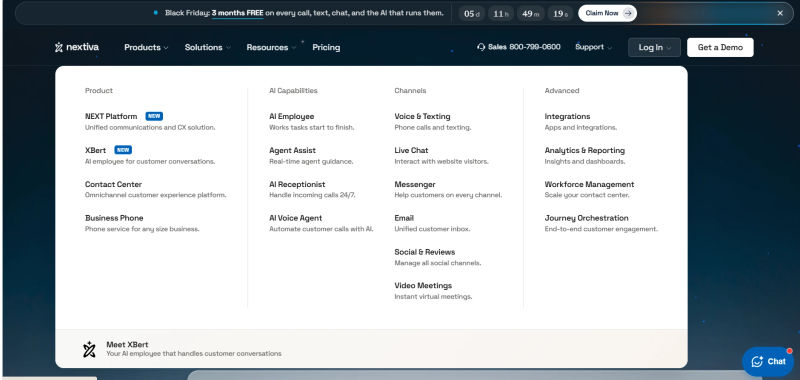
When evaluating Nextiva for large business deployments, CIOs must look beyond standard VoIP functionalities like call forwarding or visual voicemail. The platform's true enterprise value lies in its infrastructure resilience, security governance, and unified communication capabilities designed to solve complex operational bottlenecks at scale.
1. Enterprise-Grade Uptime and Network Reliability
For high-stakes executive communications and high-volume concurrent calls, latency and jitter are unacceptable. Nextiva operates a highly redundant network of US-based data centers, offering a financially backed 99.999% uptime Service Level Agreement (SLA). For US-centric operations, this translates to less than five minutes of unplanned downtime per year.
The platform utilizes advanced failover protocols, edge-cloud convergence techniques, and carrier-grade routing to ensure that if one node experiences an outage, traffic is instantaneously rerouted without dropping active sessions. Third-party latency benchmarks across major US Internet Service Providers (ISPs) consistently place Nextiva in the top tier for voice clarity and packet delivery, provided the enterprise LAN and Wi-Fi architecture are properly configured for Quality of Service (QoS).
2. NextOS AI Analytics and Real-Time Transcription
In 2027, AI is a standard utility, not a novelty. Nextiva's NextOS platform delivers auditable, actionable intelligence through automated sentiment analysis, which evaluates the tone of conversations in real-time to alert supervisors of escalating customer or internal disputes.
Furthermore, its real-time transcription capabilities are highly accurate, automatically generating call summaries and action items that sync directly to enterprise CRM systems. This reduces the manual administrative burden on operations teams and ensures compliance with strict record-keeping protocols.
3. AI Data Governance and Compliance
A critical factor for 2027 enterprise deployments is how vendors handle the data feeding their AI engines. Nextiva addresses AI data governance by offering clear data residency controls, ensuring that US corporate data does not cross borders for processing.
Crucially, Nextiva provides explicit model-training opt-outs, allowing enterprises to utilize NextOS AI features without sacrificing proprietary conversational data to train public or shared machine learning models. This is a major compliance hurdle cleared for heavily regulated industries such as finance and healthcare.
4. Security and Granular Administrative Control Depth
Security and governance must be assessed alongside call quality. Nextiva provides a comprehensive suite of enterprise-grade security certifications, including SOC2 Type II and HIPAA compliance. The platform utilizes advanced TLS and SRTP encryption for data in transit and AES-256 encryption for data at rest.
To manage the Day 2 operational burden, Nextiva offers deep administrative control. For IT administrators managing 1,000+ users across multiple geographic locations, Nextiva provides granular Role-Based Access Control (RBAC), multifactor authentication (MFA), and detailed audit logs.
This ensures that permissions are strictly compartmentalized—separating billing administrators from technical engineers—and shadow IT is minimized.
5. Ecosystem Integration and API Extensibility
Integration friction between the communication platform and existing enterprise software stacks is a primary pain point for CIOs. Nextiva addresses this through proprietary APIs and native integrations with 2027-era CRM and ERP systems, including Salesforce, HubSpot, and Microsoft Dynamics.
The platform allows for seamless directory synchronization and identity provider integration (e.g., Okta, Azure AD), streamlining onboarding and offboarding processes so that access is automatically revoked when an employee departs.
6. The Mobile Executive Experience
For a distributed C-suite, communication cannot be tethered to a desk. Nextiva provides a robust mobile application optimized for 6G networks, ensuring seamless handoffs between cellular and enterprise Wi-Fi networks without dropping calls.
The mobile client maintains the same strict encryption standards as desktop endpoints, securing executive communications on corporate-issued laptops or BYOD mobile devices while on the road, and integrating with enterprise Mobile Device Management (MDM) solutions for remote wipe capabilities.
Where Nextiva Falls Short for Scaled Operations
Despite its robust capabilities, Nextiva is not a one-size-fits-all solution. Objective analysis reveals specific limitations that operations executives must consider, particularly regarding global scalability and complex deployment models.
1. Global Scalability vs. US-Centric Operations
Nextiva's infrastructure is undeniably optimized for the United States. While it functions internationally, global enterprises often face limitations compared to competitors like 8x8 or RingCentral. Nextiva's international termination fees can be higher, and it lacks the extensive native PSTN replacement capabilities in dozens of foreign countries that multinational corporations require.
If your enterprise operates heavily in Europe, Asia, or Latin America, relying on Nextiva may introduce latency issues due to data routing back to US servers, or necessitate managing multiple regional telecom carriers alongside the UCaaS platform, defeating the purpose of a unified system.
2. Migration Friction and Legacy System Bridging
Transitioning from a legacy on-premise PBX system to Nextiva's cloud infrastructure requires a meticulous 12-month migration roadmap. While Nextiva provides implementation support, enterprises operating in hybrid environments—where some locations remain on-premise due to hardware depreciation cycles, analog fax machines, or overhead paging systems—may find Nextiva's SIP trunking and analog bridging capabilities less flexible than Ooma's.
The risk of communication silos and data loss during this transition is a material concern, requiring internal IT teams to execute rigorous network readiness assessments prior to deployment.
3. Hidden Costs and Vendor Lock-In Risks
While base licensing may appear competitive, critical analysis reveals potential hidden costs as the organization scales. Advanced AI features, deep CRM integrations, and premium 24/7 dedicated enterprise support often require upgrading to the highest pricing tiers.
Furthermore, CIOs must be wary of API call volume limits and tiered data storage surcharges for long-term call recordings. Relying heavily on the proprietary NextOS ecosystem can also introduce vendor lock-in, making it technically and financially difficult to extract historical data and analytics if the enterprise decides to migrate away in the future.
Find Perfect Software for Your Business
Nextiva Pricing: Is the Enterprise Investment Worth It?
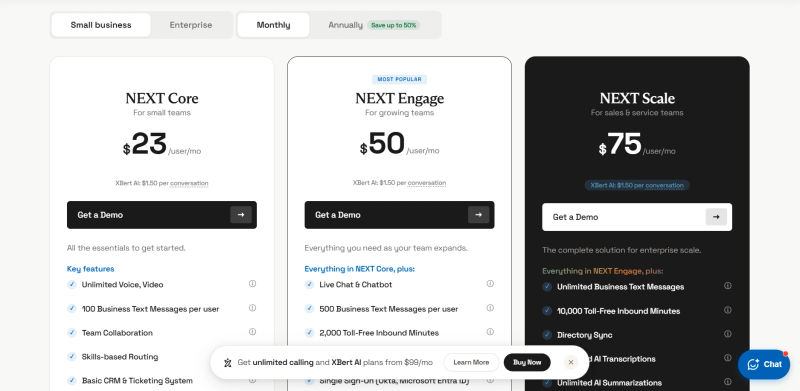
Evaluating the financial viability of Nextiva requires moving beyond basic per-user, per-month metrics and calculating the Total Cost of Ownership (TCO) over a three-to-five-year lifecycle.
1. Understanding the Enterprise TCO and Indirect Costs
For 2027 deployments exceeding 500 seats, Nextiva operates on custom enterprise pricing tied directly to its NextOS AI tiers. A comprehensive Total Cost of Ownership (TCO) model must account for core software licensing, international calling consumption, hardware endpoints, and implementation fees. Crucially, CIOs must also factor in API call volumes and AI transcription storage limits, which can trigger overages under the latest licensing structure.
Indirect costs require careful forecasting. Beyond network remediation for cloud voice traffic, enterprises must budget for internal AI workflow training and data governance audits. When negotiating, clarify if Nextiva offers evergreen pricing or if steep rate hikes apply at contract renewal for premium features.
Compared to competitors like Zoom Phone, Nextiva's initial licensing is often higher. However, this is frequently offset by bundled NextOS AI analytics and native CRM integrations that other vendors treat as costly add-ons.
2. Evaluating SLAs and Penalty Clauses
A critical component of the financial evaluation is the Service Level Agreement. Nextiva offers a 99.999% uptime guarantee, but operations executives must scrutinize the penalty clauses for downtime.
Ensure the contract explicitly defines how downtime is measured, the Mean Time to Resolve (MTTR) incidents, and the financial credits applied if the SLA is breached. In enterprise negotiations, these clauses are paramount for mitigating the financial risk of operational paralysis during an outage.
You must verify whether credits are applied automatically or require manual audits and claims by your IT department.
3. Implementation Timelines and Time-to-Value
Peer-based benchmarks indicate that enterprise deployments of Nextiva typically span 90 to 180 days from contract signature to full global rollout. The time-to-value is heavily dependent on the enterprise's internal change management processes and user adoption rates.
The high proportion of organizations retaining their current UCaaS provider (estimated at 41.4%) indicates that switching friction is material. Therefore, the cost of internal training, network upgrades, and potential productivity dips during the transition must be factored into the overall investment analysis.
Join 10,000+ businesses that trust AuthenCIO for choosing enterprise cloud communications.
Top Nextiva Alternatives for Enterprise VoIP in 2027
Because 31.6% of businesses use different vendors for unified communications and contact-center services, verifying ecosystem fit is crucial. If Nextiva does not perfectly align with your operational requirements, several enterprise-grade alternatives warrant consideration.
1. RingCentral: Scalability & Microsoft Integration
RingCentral remains a dominant force, particularly for enterprises deeply entrenched in the Microsoft 365 or Google Workspace ecosystems. RingCentral holds a significant market share due to its massive global scalability and deep, native API integrations.
If your organization requires complex, multinational PSTN replacement and seamless coexistence with Microsoft Teams, RingCentral often edges out Nextiva in sheer global infrastructure footprint.
2. Dialpad: AI-First Capabilities
For operations executives focused heavily on sales and customer support, Dialpad offers an AI-first architecture that is difficult to match. While Nextiva has strong AI features, Dialpad's real-time voice coaching, automated QA scoring, and instantaneous sentiment analysis are built natively into its core engine rather than bolted on.
It is the superior choice for organizations where live agent assistance and automated transcription are the primary drivers of ROI.
3. Zoom Phone: Cost vs. Performance
Zoom Phone has rapidly expanded its enterprise footprint by leveraging its ubiquitous video conferencing platform. For enterprises looking for a highly cost-effective, video-first communication ecosystem, Zoom Phone offers aggressive pricing and simplified administration.
While it may lack the deep, native CRM contact center routing of Nextiva, its ease of deployment and lower TCO make it highly attractive for remote-first, budget-conscious enterprises.
4. 8x8: Unmatched Global Reach
If your enterprise operates across multiple continents with complex international supply chains, 8x8 is a formidable alternative. 8x8 owns its global infrastructure and offers unmatched international calling zones and local number porting in dozens of countries.
It also excels in UCaaS and CCaaS convergence, providing a single, unified platform for both internal communications and global customer contact centers, mitigating the US-centric limitations of Nextiva.
5. Vonage: API Extensibility
Vonage stands out for organizations that require highly customized workflows. Operating as both a UCaaS and Communications Platform as a Service (CPaaS) provider, Vonage offers developer-friendly APIs that allow IT teams to embed voice, video, and messaging directly into proprietary enterprise applications.
If out-of-the-box integrations do not meet your needs, Vonage provides the architectural flexibility that Nextiva's more rigid NextOS might restrict.
6. Quo: Niche Enterprise Workflows
As an emerging player in the 2027 landscape, Quo targets mid-to-large enterprises seeking agile, disruptive technology. Quo focuses on highly specialized industry modules, offering bespoke workflows for sectors like telehealth or specialized logistics.
While it lacks the decades of market presence of Nextiva, it is a viable alternative for organizations prioritizing rapid innovation over traditional telecom frameworks.
7. Ooma: Hybrid Migration Support
For enterprises burdened by extensive legacy on-premise hardware, Ooma excels in hybrid migrations. Ooma provides robust SIP trunking and analog endpoint support, allowing organizations to bridge legacy PBX systems with cloud communications during a phased, multi-year migration.
If a hard cutover to Nextiva is too risky, Ooma offers a safer, more gradual path to the cloud.
The CIO’s 2027 VoIP RFP Checklist
Before finalizing any vendor selection, enterprise decision-makers must conduct a rigorous Request for Proposal (RFP) process. When evaluating Nextiva or its competitors, use this checklist to ensure all critical operational risks are addressed during vendor negotiations:
Disaster Recovery Architecture: How exactly does the platform handle failover during a regional ISP outage, and what is the documented Mean Time to Recovery (MTTR) for enterprise clients?
Technical Account Management (TAM): Does the enterprise tier include a dedicated TAM, or is support routed through a general 24/7 helpdesk that lacks context on our specific network topology?
AI Data Residency and Governance: Can we definitively opt out of having our corporate communication data used to train the vendor’s broader machine learning models, and is data guaranteed to remain within our required geographic borders?
API Rate Limiting: What are the specific volume limits on API calls between the VoIP platform and our CRM, and what are the exact overage fees if we exceed them during peak seasons?
Data Extraction and Portability: If we terminate the contract in three years, what is the exact technical process and cost for exporting our historical call recordings, transcription logs, and analytics data?
SLA Financial Penalties: Are the financial credits for breaching the 99.999% uptime guarantee automatically applied to our invoice, or do they require manual claims and internal audits to enforce?
Endpoint Security: Does the mobile client support deep integration with our existing Mobile Device Management (MDM) solution for remote wipe capabilities on BYOD devices?
Try AuthenCIO
Move to faster, smarter software evaluation with AI
Final Verdict: Should You Buy Nextiva for Your Enterprise?
Concluding this cloud communications software review, Nextiva stands out as a highly reliable platform for US-centric enterprises that demand 99.999% uptime, robust security compliance, and deep integrations with standard CRM systems.
Its NextOS platform effectively bridges the gap between internal communications and customer experience, providing actionable AI insights that drive productivity without compromising data governance.
However, Nextiva is not the default choice for every organization. If your enterprise requires extensive global PSTN replacement, RingCentral or 8x8 are better suited. If AI-driven real-time sales coaching is your primary objective, Dialpad leads the market. If you are executing a complex, phased migration from legacy hardware, Ooma provides superior hybrid bridging.
Ultimately, the decision should be based on measurable outcomes: service availability, administrative effort, and a rigorous five-year TCO analysis. Do not rely solely on vendor-reported feature lists.
Evaluate your network readiness, map your required integrations, and demand transparent SLA penalty clauses before signing a contract to ensure you select the best UCaaS for CIOs 2027 has to offer.