

Introduction
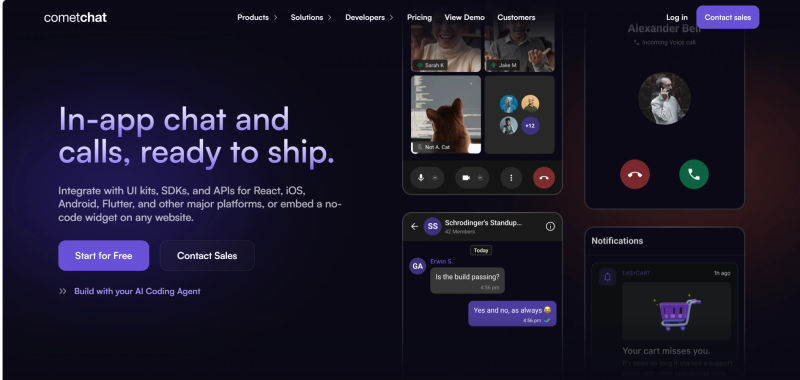
If you are conducting a cloud communications software review for your product in 2027, CometChat stands out as a top-tier Communications Platform as a Service (CPaaS) optimized for rapid in-app chat deployment. Product managers and lead developers no longer just look for a basic way to send text messages; they require scalable, low-latency cloud infrastructure that supports agentic AI orchestration, high-definition video, and strict data compliance. Choosing the best in-app chat SDK is a critical architectural decision that directly impacts your product's time-to-market, long-term maintainability, and user retention.
Streamline your software evaluation process
In this comprehensive CometChat review 2027, we evaluate whether this popular cloud communications API still holds its ground against enterprise heavyweights and nimble alternatives. We bypass the marketing jargon to examine its core SDK capabilities, developer experience, pricing model, and how it directly compares to competitors like Sendbird, Stream, and Twilio.
Before diving into the technical architecture, here is a high-level overview of how CometChat compares to the broader 2027 cloud communications software market landscape.
Tool | Best For | Pricing (USD $) | Key Features | Use Cases |
CometChat | Rapid deployment via UI Kits | Starts at $109/mo (MAU-based) | Pre-built UI components, Voice/Video, AI moderation | Marketplaces, Telemedicine, EdTech |
Sendbird | Enterprise-grade scale | Starts at $399/mo (MAU-based) | Advanced moderation, Salesforce integration, Offline sync | Large-scale social, Enterprise apps |
Stream (GetStream) | High-performance feeds & chat | Starts at $399/mo (MAU-based) | Edge network latency, Custom UI kits, Activity feeds | Social networks, Live streaming |
Twilio | Omnichannel orchestration | Pay-as-you-go (Usage-based) | SMS/Voice fallback, Workflow routing, Programmable chat | Customer support, CRM integrations |
PubNub | Real-time IoT & data streaming | Starts at $49/mo (Transaction-based) | Pub/sub messaging, Edge compute, Device presence | IoT control, Live location tracking |
Firebase | Rapid MVP development | Free tier / Pay-as-you-go | Real-time database, Authentication, Cloud functions | Early-stage startups, Basic data sync |
Ably | Massive concurrent broadcasting | Starts at $29/mo (Message-based) | Guaranteed message delivery, WebSockets, Kafka integration | Live sports updates, Financial tickers |
*Note: All prices shown reflect typical monthly billing. Vendors often offer lower pricing for annual commitments, but those discounts are excluded here for easier comparison. Actual costs may vary depending on your requirements, usage volumes, and negotiated terms.
Key Takeaways
The Verdict for 2027: CometChat is one of the most balanced in-app messaging SDKs on the market, offering a sweet spot between rapid deployment (using pre-built UI Kits) and deep architectural control (via Core SDKs).
Ideal Use Cases: It is highly recommended for marketplaces, telehealth (fully HIPAA compliant), and EdTech platforms. The native integration of voice, video, and AI-driven moderation eliminates the need to stitch together multiple third-party APIs.
Pricing and Scalability: CometChat is exceptionally cost-effective for startups and mid-market teams. However, enterprise products scaling beyond 100,000 Monthly Active Users (MAUs) should carefully forecast their usage, as high-volume pricing can become competitive with rivals like Sendbird and Stream.
Build vs. Buy: With the maturity of CometChat's API and WebRTC infrastructure, building a custom chat solution from scratch using Firebase or raw WebSockets is rarely financially viable. Most product teams can deploy a fully functional Proof of Concept (POC) in under 48 hours.
Before building with CometChat, see how it compares to other chat SDKs on AuthenCIO.
Pros and Cons of CometChat:
Pros
Comprehensive competitor comparison with Sendbird, Stream, Twilio, Firebase, PubNub, and Ably.
Covers pricing, features, scalability, security, and compliance in detail.
Well-structured with tables, FAQs, use cases, and clear section hierarchy.
Strong commercial intent that helps buyers evaluate CometChat effectively.
Includes enterprise-focused considerations such as HIPAA, GDPR, SOC 2, and ISO 27001.
Cons
Article is lengthy and may feel overwhelming for readers seeking quick insights.
Some performance and scalability claims lack supporting citations.
Repetitive use of target keywords in multiple sections.
Software Covered in this Article
The following articles break down the key aspects of Cloud Communications Software, featuring a carefully curated set of key players:







Core Features and SDK Capabilities of CometChat
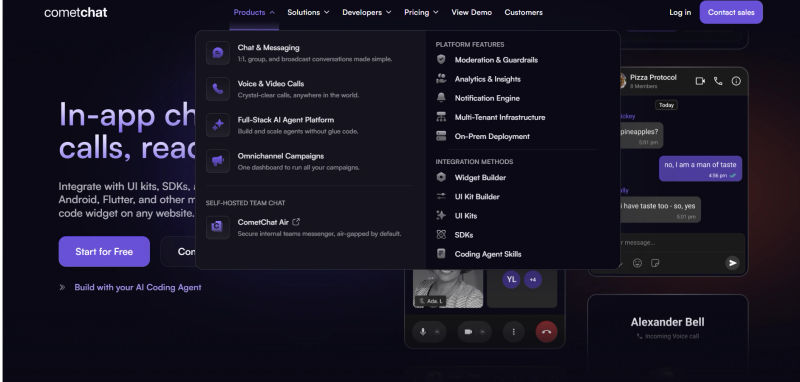
When evaluating an in-app messaging infrastructure for product teams, the primary concern is the balance between speed-to-market and long-term customizability. CometChat attempts to bridge this gap by offering a two-tiered approach to integration: UI Kits and Core SDKs, functioning effectively as a highly adaptable white-label chat SDK.
1. UI Kits vs. Core SDK Architecture
CometChat’s UI Kits are pre-built, open-source components available for React, React Native, iOS (Swift), and Android (Kotlin). In 2027, these kits have matured significantly, offering a highly modular architecture. Developers can drop a fully functioning chat widget into an application in a matter of hours. This includes "table-stakes" features like typing indicators, read receipts, message threading, and media sharing.
However, product teams must be aware of the trade-offs. While UI Kits accelerate the initial launch, heavily customizing the DOM structure or overriding core behaviors can lead to technical debt. For teams requiring a pixel-perfect, highly bespoke user experience, CometChat’s Core SDK is the better route. The Core SDK provides headless access to the messaging infrastructure, allowing developers to build their own UI while relying on CometChat for state management, WebSocket connections, and data persistence.
2. Developer Experience (DX) and API Maturity
The developer experience in 2027 is largely defined by type safety, API consistency, and observability. CometChat provides robust TypeScript definitions, which drastically reduces runtime errors during implementation. The platform's webhooks are reliable, allowing backend systems to listen for events like message.delivered or user.status.changed to trigger server-side logic, such as pushing data to a CRM or triggering a custom push notification pipeline.
3. Voice, Video, and WebRTC Integration
Unlike some competitors that strictly focus on text, CometChat includes native voice and video calling capabilities. Built on modern WebRTC standards, the infrastructure handles signaling, NAT traversal (STUN/TURN servers), and media routing. This prevents teams from having to stitch together a chat SDK with a separate video provider like Agora or Twilio Video, unifying the communications stack under a single billing and authentication umbrella.
4. AI Orchestration and Moderation
In 2027, AI is an expectation, not a luxury. A critical question for lead developers is whether an SDK forces a closed "black-box" AI or allows custom integrations. CometChat strikes a balance. It provides built-in models for automated content moderation (masking profanity, detecting PII, flagging inappropriate media) and real-time translation.
More importantly for advanced teams, CometChat supports custom LLM middleware. Through its webhook architecture, developers can intercept messages pre-delivery, route them to custom models hosted on OpenAI or Anthropic for specialized agentic AI responses or sentiment analysis, and then return the formatted payload to the chat stream. This flexibility prevents vendor lock-in regarding artificial intelligence capabilities.
Evaluating CometChat for Specific Use Cases
An SDK is only as good as its ability to solve specific industry pain points. CometChat's architecture lends itself well to several distinct verticals, though it must be evaluated strictly against your product's operational requirements.
1. Marketplaces and On-Demand Services
For platforms like ride-sharing, freelance networks, or peer-to-peer marketplaces, communication must be seamless but secure. CometChat excels here through its data masking and temporary channel capabilities. Buyers and sellers can communicate without revealing personal phone numbers. The SDK's offline persistence ensures that if a user loses cellular connection while in transit, messages are queued locally and delivered once the connection is re-established.
2. Healthcare and Telemedicine
Telemedicine requires strict adherence to data privacy laws, and in 2027, compliance is heavily scrutinized. CometChat provides a robust HIPAA compliant messaging SDK, ensuring that ePHI (Electronic Protected Health Information) is encrypted both in transit (via TLS 1.3) and at rest (using AES-256 encryption).
Beyond HIPAA, enterprise PMs will be pleased to note that CometChat maintains SOC2 Type II and ISO 27001 certifications. Furthermore, they offer strict Data Residency options, allowing European clients to mandate that all user data and message history remain exclusively on EU-based servers to ensure full GDPR compliance.
3. EdTech and Virtual Events
Virtual classrooms and massive online events require infrastructure that can handle sudden spikes in concurrent connections. While CometChat handles standard group chats effortlessly, teams building massive broadcast events might find the platform's throttling limits restrictive compared to specialized pub/sub networks. However, for standard cohort-based learning, the ability to share files, utilize whiteboards, and moderate student discussions out-of-the-box is a significant advantage.
4. Internal B2B SaaS & Enterprise Collaboration
Many product managers seek an SDK to build Slack-like functionality directly into their proprietary B2B SaaS platforms. CometChat is highly effective for this use case. Its Core SDK supports complex nested threading, granular user presence (online, away, custom statuses), and rich media attachments. The ability to integrate role-based access control (RBAC) ensures that organizational hierarchies and channel permissions are strictly enforced within the chat interface.
Join thousands of product teams using AuthenCIO to choose the right communications stack.
Pricing Breakdown: Is CometChat Cost-Effective at Scale?
Predicting the Total Cost of Ownership (TCO) over a 3-year period is a primary concern for product managers. A common pitfall when evaluating chat SDKs is looking only at the entry-level price without modeling how costs scale alongside user growth.
1. The 2027 Pricing Model
CometChat’s pricing is primarily driven by Monthly Active Users (MAU) and Concurrent Connections.
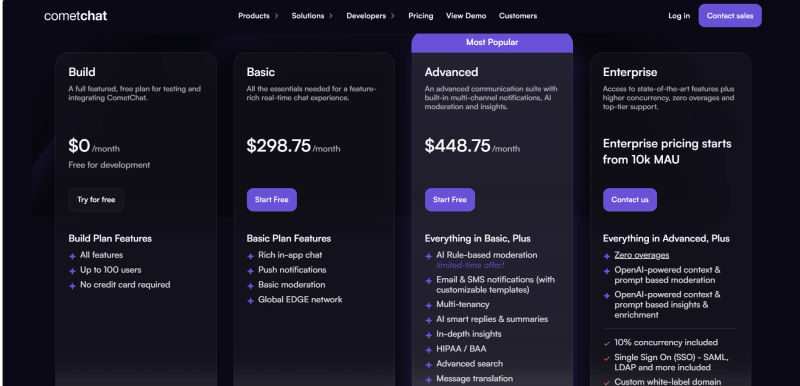
Basic/MVPs: The entry tier (starting at $298.75/month) supports up to 10,000 MAUs. It provides core chat features, UI kits, and basic push notifications for early-stage apps.
Advanced/Scale: Ranging from $399 to $799/month, these tiers increase MAU limits (up to 100,000) and unlock advanced capabilities like role-based access control (RBAC), AI moderation, and larger group chat limits.
Enterprise: Custom pricing applies for deployments exceeding 100,000 MAUs. This requires negotiated contracts for dedicated infrastructure, 99.99% uptime SLAs, HIPAA compliance, and premium support.
2. Build vs. Buy Financial Framework
When deciding whether to build a chat system in-house using WebSockets and a database like PostgreSQL, teams must calculate the hidden costs. Building in-house requires at least two senior engineers (iOS/Android) and one backend engineer. In 2027, the infrastructure costs for hosting scalable WebSocket servers, managing Redis clusters for pub/sub state, and paying for TURN servers for video can easily exceed $3,000 a month at scale.
CometChat is highly cost-effective in the "Build vs. Buy" equation for teams up to 250,000 MAU. However, teams must closely monitor their concurrent connection ratios. If your app has highly concentrated usage spikes (e.g., a live trivia game where all users connect simultaneously), you may incur overage fees that make the platform more expensive than anticipated.
3. Data Portability and Exit Costs
A critical factor in TCO is vendor lock-in. If you decide to migrate away from CometChat in two years, how difficult is the exit? CometChat provides comprehensive data portability options. Enterprise tiers allow for automated syncing of message histories and user metadata to your own AWS S3 buckets. Additionally, their REST APIs allow developers to export complete conversation JSON payloads, significantly reducing the technical friction and cost of migrating to another provider.
Find Perfect Software for Your Business
CometChat vs. Top Competitors: Sendbird, Stream, and Twilio
To make an informed decision, a product team cannot evaluate CometChat in a vacuum. The 2027 market is highly competitive, with several vendors offering overlapping capabilities.
1. CometChat vs Sendbird 2027
Sendbird is widely considered the enterprise giant in the in-app chat space, powering massive applications like Reddit and DoorDash.
Where Sendbird Wins: Sendbird offers a proven capability to handle 1M+ concurrent connections per application without degradation. They provide deep integrations with Salesforce Service Cloud and highly granular moderation tools. Their offline caching mechanism is arguably the most robust in the industry.
Where CometChat Wins: CometChat generally offers a lower barrier to entry regarding price and ease of initial setup. For teams that want integrated voice and video calling without negotiating a separate enterprise contract, CometChat provides a more unified, accessible package.
The Verdict: Choose Sendbird for massive, global, enterprise-scale social applications. Choose CometChat for rapid deployment in marketplaces, EdTech, or healthcare where integrated video is a priority.
2. CometChat vs Stream (GetStream)
Stream originally made its mark with activity feeds before pivoting heavily into chat and video infrastructure.
Where Stream Wins: Stream's global edge network provides incredibly low latency, making it ideal for high-speed, high-volume environments. In 2027 benchmark tests, Stream's edge network averages around 30ms latency in APAC and LATAM regions. CometChat typically hovers around 50-60ms in those specific regions unless dedicated enterprise nodes are provisioned. Stream's UI kits are also highly praised for being deeply customizable.
Where CometChat Wins: CometChat’s out-of-the-box feature set for specific verticals (like telemedicine) requires slightly less configuration. CometChat also has a longer history of supporting legacy frameworks, which can be beneficial for migrating older enterprise applications.
The Verdict: Stream is the superior choice for social networks, live streaming, and applications where chat speed and UI fluidity are the core product differentiators. CometChat is better suited for utility chat (B2B, healthcare, on-demand).
3. CometChat vs Twilio Conversations
Twilio is the undisputed leader in programmable SMS and voice, but their in-app chat offering (Twilio Conversations) serves a different architectural purpose.
Where Twilio Wins: Twilio excels at omnichannel workflow orchestration. If your product requires a conversation to start as an SMS, move to an in-app chat, and escalate to a voice call—all while routing through a contact center—Twilio is unmatched.
Where CometChat Wins: Twilio does not provide comprehensive, drop-in UI kits for chat. Building a modern chat interface on top of Twilio Conversations requires significant frontend engineering. CometChat provides the UI and the backend out of the box.
The Verdict: Use Twilio if chat is just one part of a massive, omnichannel customer support strategy. Use CometChat if you need a dedicated, rich in-app messaging experience built quickly.
Other Notable Alternatives: PubNub, Firebase, and Ably
If your product requirements deviate from standard user-to-user chat, you may need to look beyond traditional chat SDKs and consider raw infrastructure providers.
4. Firebase vs CometChat for Chat
Firebase Realtime Database or Firestore is often the first tool startups use to build an MVP chat feature. It effortlessly syncs JSON data across clients. However, Firebase is a specialized real-time database that requires significant custom overhead for chat-specific features. To achieve feature parity with CometChat (unread counts, typing indicators, push notification routing, user presence), your team will have to write and maintain thousands of lines of complex Cloud Functions. Firebase is great for basic data syncing, but CometChat is built for production-grade messaging.
5. PubNub vs CometChat
PubNub is a real-time edge messaging network. It is incredibly fast and highly reliable. However, PubNub operates on a publish/subscribe (pub/sub) model. It is designed for IoT device control, live location tracking on maps, and financial ticker updates. While you can build a chat app on PubNub, you are responsible for building the chat logic, database storage, and UI. CometChat is a specialized layer built on top of similar infrastructure, saving you the architectural headache.
6. Ably vs CometChat Comparison
Similar to PubNub, Ably provides enterprise-grade pub/sub messaging with guaranteed message delivery and seamless Kafka integrations. Ably is the tool of choice for broadcasting data to millions of concurrent connections (e.g., live sports scores). If you are building a massive live event platform, Ably's infrastructure is superior for data transport, but like PubNub, it lacks the pre-built chat UI and specialized messaging features of CometChat.
Try AuthenCIO
Move to faster, smarter software evaluation with AI
Final Verdict: A Scalable Messaging Infrastructure Choice?
Concluding this cloud communications software review, choosing the right stack requires aligning your product's specific needs with the vendor's core strengths.
Evaluated specifically as a cloud communications software, CometChat remains a highly competitive, robust scalable messaging infrastructure choice in 2027 for product teams that need to deploy rich in-app messaging, voice, and video quickly. Its UI Kits drastically reduce time-to-market, and its HIPAA-compliant, SOC2-certified infrastructure makes it a safe bet for healthcare, marketplaces, and enterprise B2B platforms.
However, it is not a silver bullet. If your application requires massive, Twitch-style live chat scalability with ultra-low APAC latency, Stream is likely a better fit. If you need deep enterprise CRM integrations and complex offline synchronization for millions of users, Sendbird warrants a closer look. And if you are orchestrating omnichannel SMS-to-chat workflows, Twilio remains the industry standard.
Ultimately, CometChat strikes an excellent balance between developer experience, feature depth, and cost-effectiveness for the vast majority of mid-market and enterprise applications seeking reliable cloud communications software.
Next Steps: 48-Hour POC Checklist
For lead developers ready to evaluate CometChat in a sandbox environment, follow this rapid Proof of Concept (POC) checklist to validate the SDK against your architecture:
Provision Sandbox: Create a CometChat developer account and generate your unique App ID and Region Code.
Initialize SDK: Install the Core SDK via NPM or Gradle and initialize it globally within your app's root lifecycle.
Authentication: Generate a secure Auth Token using your backend server and pass it to the client to log in a test user.
Mount UI Kit: Drop the
CometChatUIcomponent into a test view to instantly render the conversation list and message panel.Test Webhooks: Configure a local endpoint (using ngrok) to listen for the
message.deliveredwebhook to validate server-side observability.