

Introduction
Evaluating enterprise cloud communications in 2027 requires moving beyond per-user sticker prices. For CIOs and Operations Executives, migrating to a Unified Communications as a Service (UCaaS) platform hinges on Total Cost of Ownership (TCO), reliability, and security.
Streamline your software evaluation process
With the global enterprise communication market projected to grow at a 16.7% CAGR, scrutinizing Nextiva hosted PBX pricing is critical. This guide provides a transparent, decision-focused breakdown of Nextiva’s 2027 pricing structure, comparing it against top alternatives to determine the best financial and technical fit for your operations.
Key Takeaways for CIOs
TCO is Paramount: The true cost of Nextiva in 2027 includes professional services, compliance add-ons (HIPAA, PCI), network upgrades, and administrative overhead, often exceeding the base license fee.
AI is a Cost Variable: Advanced AI features like sentiment analysis and automated transcription are typically premium add-ons in Nextiva's enterprise plans, whereas competitors like Dialpad bundle them natively.
Competitors Serve Niche Needs: While Nextiva offers a balanced UCaaS platform, RingCentral excels in complex integrations, Zoom Phone in video-centric cost consolidation, and 8x8 in predictable global calling plans.
Security and Compliance are Differentiators: Evaluating providers requires a deep dive into SOC2 Type II compliance, data residency policies, encryption standards, and the financial penalties outlined in their 99.999% uptime SLAs.
Plan | Best For | Pricing (USD $) | Limitations |
Nextiva Enterprise | Balanced UCaaS with native CRM integration | Negotiated (Est. $23-$75/user) | Advanced AI transcription and sentiment analysis require premium add-ons. |
RingCentral Premium | Complex multinational enterprises needing deep ERP integrations | Negotiated (Est. $35-$45/user) | Higher baseline cost; can be overly complex for standard routing needs. |
Dialpad Enterprise | Sales and support teams requiring real-time AI voice analytics | Negotiated (Est. $30-$40/user) | Steeper learning curve for AI workflows; data sovereignty policies need review. |
Zoom Phone Global | Organizations heavily invested in the Zoom video ecosystem | Negotiated (Est. $20-$30/user) | Lacks deep native CRM capabilities compared to dedicated UCaaS platforms. |
8x8 X Series | Global enterprises needing unlimited international calling | Negotiated (Est. $25-$45/user) | Administrative interface and reporting tools can feel less modern. |
Vonage API | Development-heavy teams needing deep CPaaS/API customization | Consumption-based | Requires significant internal developer resources to build and maintain. |
Quo Enterprise | Lean enterprises prioritizing basic, reliable routing without bloat | Negotiated (Est. $15-$25/user) | Missing advanced omnichannel contact center and deep integration features. |
Ooma Office Pro | Distributed enterprises needing simple, plug-and-play hardware | Negotiated (Est. $20-$30/user) | Limited third-party enterprise integrations and advanced automation. |
*Note: All prices shown reflect typical monthly billing. Vendors often offer lower pricing for annual commitments, but those discounts are excluded here for easier comparison. Actual costs may vary depending on your requirements, usage volumes, and negotiated terms.
Software Covered in this Article
The following articles break down the key aspects of Cloud Communications Software, featuring a carefully curated set of key players:






Breaking Down Nextiva’s Enterprise Tiers: What You’re Really Paying For
Nextiva’s 2027 enterprise pricing strategy centers on a unified platform blending traditional PBX replacement with customer experience (CX) tools.
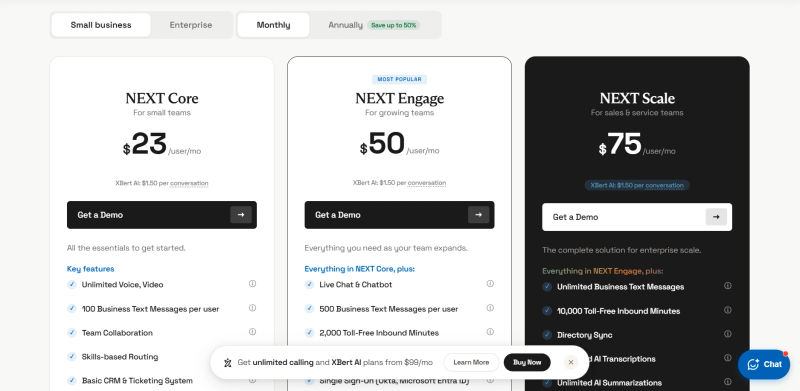
For large organizations (500+ seats), pricing is customized through Nextiva volume discount tiers, but baseline expectations for its Enterprise and Ultimate Nextiva business communication plans generally fall between $23 and $75 per user, per month, contingent on contract length and feature bundles.
Nextiva's value lies in its reliability and included features. Enterprise tiers offer advanced Interactive Voice Response (IVR), multi-level auto-attendants, and omnichannel support that competitors often gate behind separate contact center licenses.
Crucially, Nextiva backs its agreements with a 99.999% uptime Service Level Agreement (SLA)—a key factor for executives calculating the financial impact of downtime. The platform also holds critical compliance certifications, including SOC2 Type II, and offers HIPAA and PCI-DSS compliant environments, though these may require specific plan tiers or add-ons.
However, plan limitations must be scrutinized. While basic call recording is included, advanced AI-driven features—such as automated transcriptions, real-time sentiment analysis, and virtual agents—are typically premium add-ons.
If your strategy relies on AI for sales coaching or quality assurance, the TCO can escalate. Furthermore, while Nextiva offers robust native integrations with major CRMs, connecting to legacy ERP systems often requires their professional services team. These fees can be a flat project rate or a percentage of the annual contract value (ACV), adding a significant one-time expenditure to your rollout.
Find Perfect Software for Your Business
Nextiva vs. The Market: How It Compares to Top Competitors
1. Nextiva vs. RingCentral: Scalability vs. Cost
RingCentral is best for complex, multinational enterprises needing deep CRM, ERP, and identity management integrations. Its extensive marketplace of native integrations makes it a default choice for organizations with fragmented technology stacks.
In 2027, RingCentral’s premium tiers generally run 15-20% higher than Nextiva’s. The premium is justified if your enterprise requires seamless, out-of-the-box integration with niche software, potentially saving on custom development costs.
However, for organizations needing reliable voice, standard video, and basic CRM connectivity, RingCentral's feature-rich platform can lead to paying for unused tools. Nextiva often provides better value for a streamlined, highly reliable UCaaS experience without the premium associated with RingCentral’s exhaustive app ecosystem.
2. Nextiva vs. Zoom Phone: The Video-First Alternative
Zoom Phone is ideal for organizations already invested in the Zoom video ecosystem. Adding Zoom Phone to existing Zoom One licenses is often the most cost-effective telephony solution, sometimes falling below $20 per user. The primary advantage is vendor consolidation.
The limitation, however, is its depth as a standalone UCaaS platform. It lacks the native CRM and advanced customer experience tools Nextiva provides.
For security-conscious CIOs, Zoom has invested heavily in its security posture, now offering end-to-end encryption and robust administrative controls, addressing earlier reputational concerns. It's a budget-friendly choice for internal communications but may fall short for complex external customer routing.
3. Nextiva vs. Dialpad: AI-Driven Communication Value
Dialpad's primary use case is for sales and support teams requiring real-time AI voice analytics and coaching. Unlike Nextiva, where AI is often an add-on, Dialpad built its platform around AI. Automated transcriptions, sentiment analysis, and live agent coaching are native.
For a data-driven contact center, Dialpad offers immense value at a competitive price point. The limitation is a steeper learning curve for administrators managing AI workflows.
From a data privacy perspective, CIOs must verify data residency and processing policies, as AI features require voice data to be processed and stored, raising potential compliance concerns depending on your industry and geography.
4. Nextiva vs. 8x8 and Vonage: Global Reach vs. Reliability
For organizations with significant international operations or custom development needs, 8x8 and Vonage present strong alternatives.
8x8 is best for global enterprises needing unlimited international calling. Its X Series plans include unmetered calling to dozens of countries, drastically lowering TCO for multinational corporations by eliminating the variable toll charges that cause unpredictable billing with other providers. The trade-off is that 8x8’s administrative interface is often cited as less intuitive than Nextiva’s.
Vonage excels for development-heavy teams needing deep CPaaS (Communications Platform as a Service) and API customization. It allows enterprises to build custom voice, SMS, and video integrations into their own applications.
Its consumption-based pricing can be cost-effective for irregular usage but increases forecasting complexity. The true cost of Vonage must also include the internal developer resources required to build and maintain these custom integrations.
5. Nextiva vs. Quo and Ooma: High-End Enterprise vs. SMB Value
For CIOs focused on aggressive cost-cutting, Quo and Ooma provide budget-friendly alternatives.
Quo is for lean enterprises prioritizing basic, reliable routing without paying for unused UCaaS features. By focusing on high-quality voice and essential messaging, Quo offers enterprise-grade reliability between $15 and $25 per user. The limitation is scalability; it cannot support future needs for advanced AI or deep CRM integration.
Ooma is best for distributed enterprises needing simple, plug-and-play hardware, like retail chains or clinics with limited on-site IT.
Its pricing is transparent, avoiding the complex, multi-year contracts common with Nextiva. However, Ooma’s enterprise integrations and centralized administrative controls are limited, making it less suitable for a large corporate headquarters.
Join 10,000+ businesses that trust AuthenCIO for choosing enterprise cloud communications on budget.
Hidden Costs and Implementation Fees to Watch Out For in 2027
To accurately evaluate Nextiva’s 2027 pricing, executives must build a comprehensive TCO model that extends beyond the base subscription. The true cost of enterprise VoIP migration is often buried in implementation, compliance, infrastructure, and administrative overhead.
Technical Debt and Network Readiness: Migrating from a legacy on-premise PBX requires a robust network. Hidden costs include upgrading network switches, optimizing bandwidth, and purchasing new SIP trunking hardware.
Integrating legacy hardware like warehouse paging systems or analog fax machines often requires specialized analog-to-digital converters, adding unexpected hardware costs.
Implementation and Professional Services: Large-scale deployments (1,000+ users) almost always require dedicated project management, number-porting coordination, and user provisioning. These professional services are rarely included.
During procurement, CIOs should negotiate for implementation fees to be waived or heavily discounted in exchange for a multi-year commitment.
Security and Compliance Add-Ons: While Nextiva provides excellent baseline security, specific certifications for healthcare or finance (such as advanced HIPAA compliance packages, PCI-compliant call recording, or extended audit logs) may require upgrading to the highest tier or purchasing standalone security modules.
Administrative Overhead and Training: Managing a 5,000-seat UCaaS platform is not a zero-sum resource swap. Budget for at least 1-2 Full-Time Equivalents (FTEs) for administration, user support, and MACDs (moves, adds, changes, deletes).
Furthermore, large-scale user adoption requires a change management budget for training, which can be a significant hidden cost.
E911 and Disaster Recovery: While all providers are E911 compliant, managing user locations for remote and hybrid workers creates an administrative burden. Beyond the 99.999% uptime SLA, CIOs must review the disaster recovery protocol, including failover processes and the specific financial penalties for non-compliance.
Try AuthenCIO
Move to faster, smarter software evaluation with AI
Decision Matrix: Which VoIP Provider Fits Your Operations?
Choosing the right enterprise VoIP provider in 2027 requires aligning a platform’s strengths with your organization's specific operational needs.
Nextiva remains a compelling choice for CIOs seeking a balanced, reliable UCaaS platform with strong native CRM integrations and excellent uptime. Its pricing is competitive, provided you manage the scope of AI add-ons and professional services.
However, a final decision should be guided by a clear action plan:
Audit Current Infrastructure and Usage: Analyze your existing seat licenses, call volume, international usage, and integration dependencies to establish a precise TCO baseline.
Request a Proof of Concept (POC): For features critical to your ROI, such as AI analytics or a specific CRM integration, conduct a POC with your top two vendors to validate performance.
Conduct a Security and Data Residency Review: Involve your CISO to ensure the provider’s encryption standards, data storage locations, and compliance certifications (SOC2, HIPAA) meet your corporate and regulatory requirements.
If your enterprise requires deep ERP integrations, RingCentral justifies its premium. If real-time voice analytics are paramount, Dialpad offers superior native capabilities. For organizations vested in video, Zoom Phone provides unmatched cost consolidation.
Multinational firms should look to 8x8 for predictable international billing, while development teams will find Vonage’s APIs more flexible. And for lean operations focused purely on cost, Quo and Ooma offer the best defense against software bloat.
By utilizing this decision matrix and accounting for all hidden TCO factors, you can secure a cloud communications infrastructure that drives true operational ROI.