

Introduction
Key Takeaways for CIOs in 2027:
Switching Platforms is Easier with the Right Alternative: When evaluating cloud communications software alternatives, prioritize platforms offering seamless legacy-to-cloud migration paths that minimize downtime and integrate natively with your existing CRM and ERP systems.
AI Governance is Mandatory: Following the 2026 Global AI Governance Act, your chosen cloud communications software must feature robust model training opt-outs and internal LLM interoperability.
Hardware Evolves: Spatial computing via WebXR and 6G edge node latency benchmarks have replaced basic uptime metrics as primary evaluation criteria for modern enterprise communications.
TCO Requires Transparency: Procurement heads must rigorously evaluate vendor lock-in risks, API integration fees, and the engineering burden of custom workflows before committing to a new solution.
Streamline your software evaluation process
For Chief Information Officers (CIOs) and enterprise procurement heads operating in 2027, selecting the right cloud communications software is a high-stakes architectural decision. As organizations outgrow legacy systems, the search for robust cloud communications software alternatives demands a rigorous evaluation of security, interoperability, and Total Cost of Ownership (TCO). The complexities of managing "Shadow IT," ensuring Zero Trust Network Access (ZTNA), and maintaining compliance across a globally distributed workforce require platforms that go far beyond basic telephony.
The modern communication landscape has shifted dramatically. Basic voice and video capabilities are now baseline prerequisites. Today’s procurement decisions hinge on advanced interoperability with existing enterprise ecosystems, real-time AI governance, and readiness for emerging technologies like spatial computing and 6G-enabled high-fidelity voice codecs. Furthermore, decision-makers must weigh "Platform-led" strategies against "Best-of-breed" deployments to avoid vendor lock-in while maintaining a seamless, secure environment across diverse hardware.
This guide bypasses generic definitions to provide a data-driven comparison of the 12 best UCaaS and cloud communications software alternatives for growing teams. Whether you are migrating from an on-premise Private Branch Exchange (PBX) or consolidating fragmented communication tools, this analysis will help you identify the precise platform that aligns with your enterprise’s security, scalability, and operational requirements.
Ready to migrate to integrated unified communications? Compare the best UCaaS software on AuthenCIO.
Top Software Picks
Nextiva — best for customer experience-focused business communications.
Quo — best for AI-powered business phone systems and call management.
Weave — best for healthcare and patient communication workflows.
Calilio — best for startups needing affordable cloud telephony.
KrispCall — best for global virtual numbers and remote teams.
RingCentral — best for enterprise-grade unified communications and scalability.
Zoom Phone — best for organizations already using Zoom Workplace.
Dialpad — best for AI-powered calling, meetings, and coaching.
8x8 — best for global communications with integrated contact centers.
Vonage — best for customizable communications and developer-friendly APIs.
GoTo Connect — best for all-in-one VoIP and remote collaboration.
Mitel — best for hybrid cloud communications and deployment flexibility.
Software Covered in this Article
The following articles break down the key aspects of Cloud Communications Software, featuring a carefully curated set of key players:









Quick Comparison: Top UCaaS Platforms at a Glance
Before diving into the granular technical specifications, review this high-level comparison of the top Cloud Communications Software available in 2027. This table outlines primary use cases, estimated starting prices for enterprise deployments, integration ecosystems, and core differentiators optimized for late 2026 and 2027 IT budgets.
Tool | Best For | Pricing (1,000+ seats, USD $) | Primary Integration Ecosystem | Key Features |
RingCentral | Global Enterprise Scalability | $35 - $65 / user | Native Microsoft Teams & Salesforce | 6G edge node routing, ZTNA architecture, AI-driven global data residency |
Zoom Phone | Video-First Organizations | $18 - $40 / user | Google Workspace & WebXR | Spatial computing integration, AR/VR collaboration, AI companion agents |
Dialpad | AI-Driven Communication Insights | $25 - $50 / user | Agentic AI & Custom LLMs | Real-time translation, automated QA scoring, strict AI governance protocols |
Nextiva | Unified Customer Experience | $30 - $50 / user | HubSpot & Salesforce (Platform-led) | Native CCaaS blending, predictive customer journey mapping, omnichannel threading |
Weave | Service-Based Local Enterprises | $35 - $55 / user | Specialized Vertical CRMs (Healthcare) | Automated appointment scheduling, patient management, HIPAA/HITRUST compliance |
Vonage | Customizable API Integrations | $25 - $50 / user | Custom ERPs & Proprietary Apps | CPaaS capabilities, low-code SDKs, extensive developer experience (DX) |
Quo | High-Growth Tech Infrastructure | $18 - $35 / user | Jira, Linear & Agile Stacks | API-first deployment, modern tech stack, shadow IT prevention |
Calilio | Privacy-Conscious Global Business | $25 - $45 / user | Sovereign Cloud & Air-gapped Systems | EU Data Act 2027 compliance, strict data residency, post-quantum encryption |
KrispCall | Modern Sales and Support Teams | $20 - $40 / user | Pipedrive & Zendesk | Lightweight scaling, advanced CRM integrations, automated sentiment analysis |
8x8 | Integrated Contact Center Capabilities | $30 - $60 / user | Microsoft Teams (PSTN Replacement) | 60-day time-to-value deployment, E911 compliance, global carrier routing |
GoTo Connect | Small to Mid-Market Versatility | $28 - $45 / user | Microsoft 365 & Google Workspace | Simplified administration, consistent cross-device UX, 99.999% uptime SLA |
Mitel | Hybrid Cloud Deployments | $30 - $55 / user | Legacy On-Premise PBX & Room Kits | Phased cloud migration strategies, robust hardware support, CAPEX to OPEX ROI |
*Note: All prices shown reflect typical monthly billing. Vendors often offer lower pricing for annual commitments, but those discounts are excluded here for easier comparison. Actual costs may vary depending on your requirements, usage volumes, and negotiated terms.
Why Consider Alternatives to Legacy Cloud Communications Software?
Organizations actively seek Cloud Communications Software Alternatives when their current legacy systems fail to support hybrid work models, lack advanced AI integrations, or become prohibitively expensive to maintain. As we approach 2027, sticking with outdated infrastructure often means sacrificing agility and compromising data security.
Several critical triggers prompt IT leaders to migrate away from legacy tools:
Vendor Lock-in: Rigid contracts and proprietary hardware make it difficult to scale operations or integrate with modern CRM and helpdesk tools.
Poor AI Capabilities: Legacy platforms often lack native conversational AI, real-time sentiment analysis, and automated meeting summaries, which are now standard in modern UCaaS.
Escalating Maintenance Costs: Maintaining on-premises servers or outdated early-cloud architecture drains IT budgets and resources.
Compliance and Security Gaps: Older systems struggle to meet evolving data sovereignty laws and zero-trust security frameworks required for enterprise operations.
Upgrading to a modern UCaaS solution eliminates these bottlenecks. By evaluating new alternatives, CIOs can consolidate their tech stacks, reduce total cost of ownership (TCO), and deploy a unified system that scales seamlessly with their global workforce.
Best UCaaS Software for Enterprise Scalability
When evaluating platforms for a 1,000+ user environment, scalability must be matched with stringent security protocols and global infrastructure. The following platforms excel in supporting massive, distributed workforces without compromising on latency or administrative control.
1. RingCentral
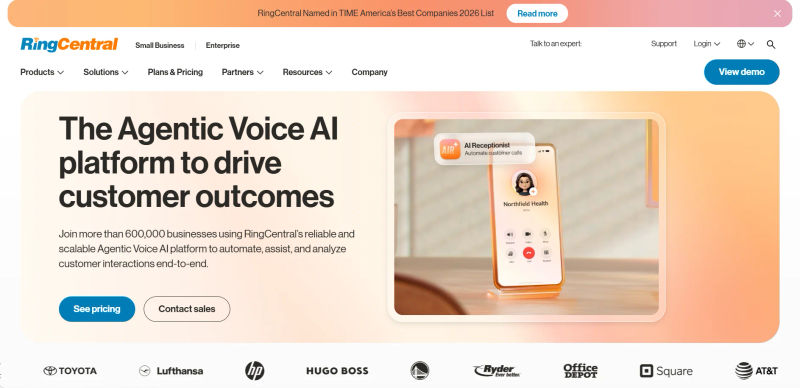
Who is this best for? RingCentral is best for global enterprises requiring extensive data residency options, 6G edge node latency benchmarks, and rigorous security architectures for thousands of distributed employees.
Core Architecture & 2027 Capabilities RingCentral remains a titan in the UCaaS space by prioritizing enterprise-grade infrastructure. In 2027, its architecture boasts native Zero Trust Network Access (ZTNA) and SOC2 Type II compliance, ensuring that internal communications are fortified against sophisticated phishing and ransomware threats. The platform’s global infrastructure offers localized data residency options, minimizing latency for international offices and ensuring compliance with regional data sovereignty laws.
Integration & Procurement Insights For procurement departments, RingCentral offers a predictable TCO framework, though a stark procurement warning regarding vendor lock-in is necessary. Egressing data from RingCentral’s proprietary ZTNA architecture can be highly complex and costly. Conducting a Proof of Concept (PoC) is highly structured, allowing IT teams to test interoperability with specialized ERP systems. Its robust administrator portal significantly reduces the technical debt associated with managing thousands of user profiles, making it a top-tier choice for massive scale.
2. Zoom Phone
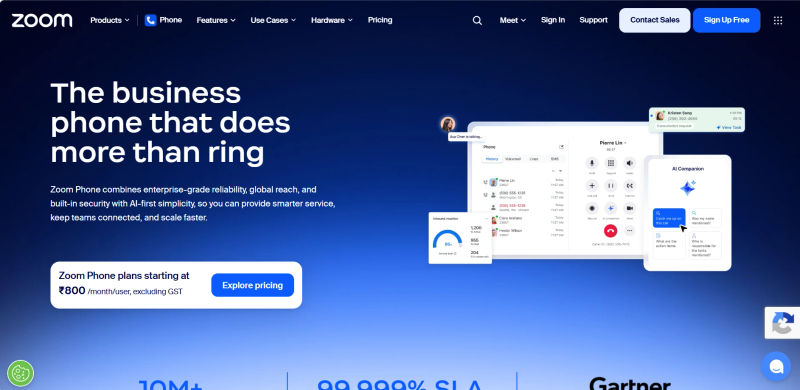
Who is this best for? Zoom Phone is best for video-first organizations that heavily rely on visual collaboration and are actively integrating spatial computing into their daily workflows.
Core Architecture & 2027 Capabilities Moving far beyond its origins as a simple video conferencing tool, Zoom Phone has evolved into a comprehensive UCaaS powerhouse by natively supporting spatial computing via WebXR. For enterprises deploying the Apple Vision Pro 3 or Meta Quest 5, Zoom’s standout differentiator is its seamless integration of AR/VR environments for remote collaboration. Furthermore, Zoom has mastered the balance between synchronous and asynchronous work, allowing teams to seamlessly transition from live spatial meetings to threaded, searchable video messaging.
Integration & Procurement Insights Zoom Phone’s interoperability with Microsoft 365 and Google Workspace is virtually flawless, drastically reducing the friction of user adoption. From a TCO perspective, Zoom offers highly competitive seat-based pricing, though enterprises must carefully monitor feature creep as users request add-ons like advanced AI meeting assistants. For CIOs looking to future-proof their stack, Zoom’s roadmap commitments to spatial hardware optimization make it a forward-looking investment for highly mobile, visually driven workforces.
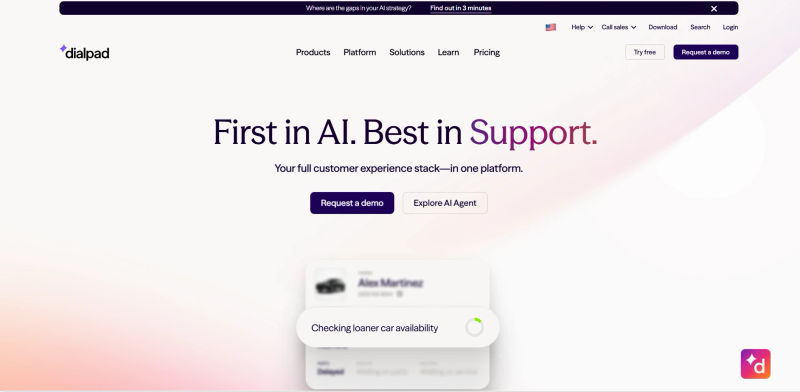
3. Dialpad
Who is this best for? Dialpad is best for data-driven enterprises that require deeply integrated, AI-native communication insights and strict AI governance across all user interactions.
Core Architecture & 2027 Capabilities Dialpad was built from the ground up with artificial intelligence at its core. For growing teams in 2027, Dialpad offers unmatched AI governance, a critical requirement following the 2026 Global AI Governance Act. It allows deep interoperability with internal LLMs and Agentic AI workflows. Its proprietary engine delivers real-time language translation with near-zero latency, automated meeting summaries that instantly sync to project management tools, and live sentiment analysis for customer-facing teams.
Integration & Procurement Insights Dialpad provides administrators with granular controls over how employee communications are used for model improvement, addressing modern compliance headaches with strict opt-out protocols. The TCO is transparent, with most advanced AI features included in the core enterprise licenses rather than gated behind premium add-ons. During the RFP process, procurement heads will find Dialpad’s API documentation quality to be exceptional, allowing internal developer teams to build custom workflows that bridge the gap between internal chat and external customer support seamlessly.
Top Unified Communications for Customer Experience
For many enterprises, internal communication and external customer experience (CX) are no longer siloed. The following platforms excel at blending UCaaS with Contact Center as a Service (CCaaS) capabilities to provide a unified front.
Find Perfect Software for Your Business
4. Nextiva
Who is this best for? Nextiva is best for organizations seeking a unified customer experience by seamlessly blending internal team collaboration with powerful, integrated contact center capabilities.
Core Architecture & 2027 Capabilities Nextiva has positioned itself as the premier "Platform-led" solution for bridging the gap between employees and customers. In 2027, Nextiva’s platform shines through its threaded communication history, which allows any internal team member to instantly view the entire lifecycle of a customer’s interaction—from a support chat to a video call. This eliminates the siloed data that typically plagues enterprise customer service, providing a true single pane of glass for all interactions.
Integration & Procurement Insights Nextiva offers deep, native interoperability with major CRM platforms like Salesforce and HubSpot, ensuring that customer records are updated synchronously. When evaluating TCO, CIOs should note that Nextiva’s value proposition relies on consolidating multiple vendor contracts into one. By replacing standalone VoIP, team chat, and CCaaS providers with Nextiva, enterprises can significantly reduce their software footprint. Their migration checklist is highly refined, offering dedicated implementation engineers to assist with moving from legacy hybrid setups to a pure cloud environment.

5. Weave
Who is this best for? Weave is best for mid-market distributed clinics and service-based local enterprises that require specialized tools for patient management and strict HIPAA compliance.
Core Architecture & 2027 Capabilities While many UCaaS platforms target traditional office environments, Weave is purpose-built for service-oriented businesses that manage high volumes of client appointments across distributed locations. In 2027, Weave’s platform integrates robust VoIP capabilities with automated SMS scheduling, payment processing, and digital forms. For healthcare and regulated service providers, Weave offers ironclad compliance frameworks, ensuring that call recording, archiving, and e-discovery meet stringent industry standards.
Integration & Procurement Insights Weave’s interoperability focuses heavily on specialized industry software—such as dental, optometry, and veterinary practice management systems—rather than generic enterprise CRMs. It is important for CIOs to clarify that Weave is highly effective for mid-market distributed clinics rather than massive, centralized corporate enterprises. Procurement teams will find Weave’s pricing model highly inclusive, minimizing the risk of hidden API integration fees that often plague generic UCaaS deployments when forced into specialized healthcare environments.

6. Vonage
Who is this best for? Vonage is best for developer-heavy organizations that require customizable API integrations and the ability to build highly specific, programmable communication workflows.
Core Architecture & 2027 Capabilities Vonage stands out by offering a potent combination of standard UCaaS applications and a robust Communications Platform as a Service (CPaaS) architecture. For enterprises in 2027, this means IT teams are not restricted to out-of-the-box features. Vonage allows developers to embed voice, video, and messaging directly into proprietary business applications. This flexibility is critical for organizations looking to mitigate "Shadow IT" by providing employees with custom-built, authorized communication tools that fit their exact operational needs.
Integration & Procurement Insights Evaluating Vonage requires a developer-focused lens. Their Developer Experience (DX) is industry-leading, offering robust SDKs that allow for rapid PoC development. From a TCO perspective, procurement heads must carefully model their expected API usage, as programmable communication costs can scale dynamically based on volume. CIOs must also calculate the internal engineering burden required to maintain these custom workflows. However, for organizations that need to integrate modern cloud communications with highly bespoke, legacy ERP systems, Vonage provides unmatched architectural freedom.

Operational Efficiency and Optimized ROI Platforms
Not every growing team requires a bloated, feature-heavy enterprise suite. The following platforms offer operational efficiency, modern architectures, and aggressive pricing models for teams that need agility and specific compliance standards without sacrificing ROI.
7. Quo
Who is this best for? Quo is best for high-growth tech startups and agile infrastructure teams that demand a modern, API-first communication stack with rapid deployment capabilities.
Core Architecture & 2027 Capabilities Quo is a rising star in the 2027 UCaaS market, built entirely on modern, cloud-native microservices. It strips away the legacy bloat found in older platforms, offering a lightning-fast, intuitive interface that appeals to younger, tech-savvy workforces. Quo excels in handling asynchronous collaboration, offering advanced threaded messaging and AI-driven task prioritization that integrates seamlessly with agile project management tools like Jira and Linear, effectively eliminating the desire for employees to use unauthorized messaging apps.
Integration & Procurement Insights Quo’s primary advantage is its incredibly low barrier to entry and rapid deployment speed. IT administrators can provision hundreds of users globally in minutes. The TCO is highly competitive, making it an attractive option for procurement teams looking to optimize software spend without sacrificing core functionality. Furthermore, Quo’s strict adherence to modern security protocols ensures that fast scaling does not introduce vulnerabilities, maintaining exceptionally high Net Promoter Scores (NPS) among IT administrators who value simplicity and speed.

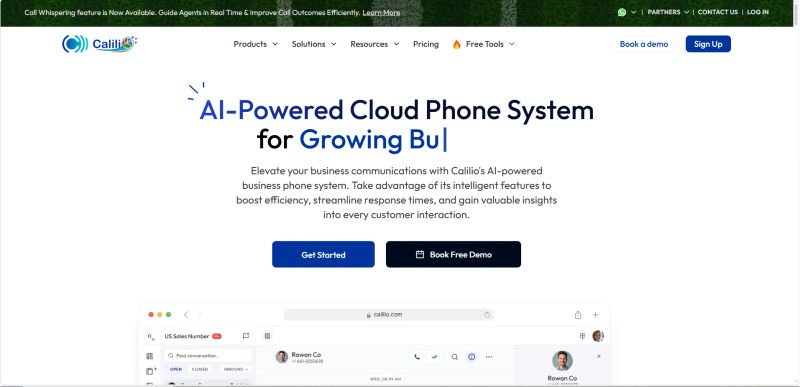
8. Calilio
Who is this best for? Calilio is best for privacy-conscious global businesses operating in highly regulated regions that require sovereign cloud capabilities and absolute data control.
Core Architecture & 2027 Capabilities As global data privacy regulations become increasingly stringent in 2027, Calilio has carved out a critical niche by focusing on sovereign cloud architecture. Calilio guarantees full compliance with the EU Data Act of 2025, ensuring that communication data and cross-border metadata never cross unauthorized regional borders. This makes it the premier choice for enterprises operating in the EU, China, or the public sector. The platform enforces strict end-to-end encryption standards and provides administrators with total control over cryptographic keys.
Integration & Procurement Insights Because of its intense focus on security, Calilio’s interoperability is carefully curated to maintain compliance. Integrations undergo rigorous security audits before being approved for the platform. While the TCO may be slightly higher due to the premium placed on sovereign cloud infrastructure, the cost is easily justified for procurement heads mitigating the financial risks of data breaches or compliance violations. Calilio’s vulnerability disclosure history is impeccably transparent, offering peace of mind to risk-averse CIOs.
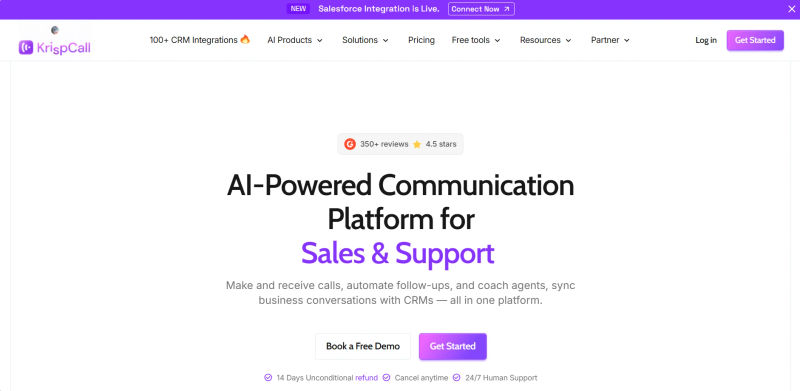
9. KrispCall
Who is this best for? KrispCall is best for modern sales and support teams that need a lightweight, easily scalable virtual phone system with deep, out-of-the-box CRM integrations.
Core Architecture & 2027 Capabilities KrispCall focuses on perfecting the core elements of voice and SMS communication for revenue-generating teams. In 2027, it leverages AI to provide real-time call coaching, automated bottleneck detection, and instant transcription. Unlike heavier UCaaS suites that try to be everything to everyone, KrispCall remains intentionally streamlined, ensuring a consistent and bug-free user experience across mobile devices and desktop environments that sales teams rely on daily.
Integration & Procurement Insights KrispCall’s integration strategy is highly targeted, offering deep, native connections to platforms like Pipedrive, HubSpot, and Zendesk. For procurement departments, KrispCall offers a highly predictable, seat-based pricing model that actively avoids "feature creep." The TCO analysis is straightforward, with no hidden costs for basic API access or onboarding. It boasts a remarkably low support-ticket-to-user ratio, making it an ideal solution for organizations that have already standardized on a separate video conferencing tool but desperately need a modern telephony solution.
Best Legacy-to-Cloud Transition Solutions
Moving away from on-premise PBX systems can be a logistical nightmare. The following platforms specialize in easing this transition, offering robust hardware support, hybrid deployment options, and rapid time-to-value to prevent operational downtime.
10. 8x8
Who is this best for? 8x8 is best for large enterprises seeking to replace global legacy PSTN lines while natively integrating advanced contact center capabilities into Microsoft Teams.
Core Architecture & 2027 Capabilities 8x8 remains a dominant force for enterprises undergoing complex digital transformations. Its 2027 architecture is uniquely capable of providing full PSTN replacement in over 50 countries, making it a critical asset for multinational corporations. Furthermore, 8x8 offers one of the most robust, native integrations with Microsoft Teams, allowing organizations to use Teams as the primary interface while 8x8 handles the complex, enterprise-grade telephony, CCaaS routing, and E911 compliance in the background.
Evaluate top-rated unified communications platforms side-by-side on AuthenCIO.
Integration & Procurement Insights When evaluating TCO, CIOs must factor in the massive cost savings of retiring on-premise hardware and consolidating global carrier contracts into a single 8x8 invoice. 8x8’s migration checklist is enterprise-grade, boasting a 90-day time-to-value deployment metric for global rollouts. Their ability to seamlessly blend UCaaS and CCaaS under one licensing model makes procurement highly efficient, drastically reducing the technical debt associated with managing disparate communication silos across international borders.

11. GoTo Connect
Who is this best for? GoTo Connect is best for mid-market organizations transitioning to the cloud that require simple administration, high IT admin NPS, and intuitive user adoption.
Core Architecture & 2027 Capabilities GoTo Connect has built its reputation on extreme reliability and ease of administration. In 2027, it continues to offer a highly intuitive visual dial plan editor that allows IT generalists—rather than specialized telecom engineers—to manage complex call routing. The platform provides a highly consistent experience across diverse hardware, ensuring that employees working from home, in the office, or on the road experience the exact same interface and call quality.
Integration & Procurement Insights GoTo Connect is highly effective at mitigating the complexity of "Shadow IT" by providing a tool that employees actually adopt without friction. It maintains a high NPS among IT administrators due to its straightforward deployment. For procurement heads, the TCO framework is highly attractive, as GoTo Connect bundles premium features like unlimited international calling to specific regions and robust meeting capabilities into their standard tiers, eliminating the unpredictable billing cycles associated with metered usage.

12. Mitel
Who is this best for? Mitel is best for established enterprises that require hybrid cloud deployments and continued support for physical hardware, such as executive desk phones and conference room kits.
Core Architecture & 2027 Capabilities While the industry rushes toward pure cloud software, Mitel recognizes that many enterprises still rely heavily on physical office hubs. In 2027, Mitel offers the most sophisticated hybrid cloud architecture on the market. It allows organizations to maintain on-premise survivability for mission-critical locations while leveraging the cloud for remote workers and advanced AI features. Mitel’s support for spatial computing room kits and high-fidelity desk phones remains unmatched.

Integration & Procurement Insights For CIOs managing the high cost and technical debt of legacy systems, Mitel provides a phased migration strategy rather than a risky "rip-and-replace" mandate. Procurement departments can structure TCO frameworks that amortize existing hardware investments while gradually shifting licensing from CAPEX to OPEX. During the RFP process, vendor sales teams from Mitel excel at providing detailed roadmaps for future-proofing physical office spaces, ensuring that hardware investments made today will remain compatible with technological leaps.
Try AuthenCIO
Move to faster, smarter software evaluation with AI
How to Choose the Right UCaaS Platform for Your Growing Team in 2027
Selecting the optimal cloud communications software requires looking beyond vendor-claimed SLAs and generic feature lists. In 2027, CIOs and procurement heads evaluating top cloud communications software must utilize a weighted vendor evaluation scorecard. This ensures you choose a platform that prioritizes practical outcomes, security, and sustainability over theoretical capabilities.
1. Evaluating AI Governance and Compliance
First, assess your enterprise's stance on AI governance and data sovereignty. If your organization operates in highly regulated sectors, platforms offering Zero Trust Network Access (ZTNA) and sovereign cloud capabilities must be weighted heavier than those offering cutting-edge, but less secure, AI meeting assistants. Ask vendor sales teams specific questions during the RFP process regarding their compliance with the 2026 Global AI Governance Act, specifically focusing on how they manage AI model training opt-outs and handle cross-border metadata.
2. ESG and Sustainability Metrics
In 2027, procurement heads are increasingly required to report on the carbon footprint of their cloud vendors. Sustainability is no longer a fringe benefit; it is a mandatory procurement reporting requirement. When evaluating platforms, CIOs must request ESG (Environmental, Social, and Governance) metrics, specifically looking for green data center certifications and transparent carbon footprint reporting related to cloud storage and video processing.
3. Calculating UCaaS ROI for CIOs
Evaluating your existing technical debt and integration needs is critical for calculating true ROI. A "Platform-led" strategy simplifies administration and billing, but a "Best-of-breed" strategy may yield higher user adoption and prevent "Shadow IT." Ensure your TCO framework accounts for hidden costs, such as API integration fees, premium support tiers, and the internal labor required to conduct a large-scale Proof of Concept (PoC). Furthermore, assess cyber-insurance compatibility; platforms with robust ZTNA architectures can significantly lower enterprise cyber-insurance premiums, accelerating the ROI of moving from CAPEX (on-premise) to OPEX (cloud).
To standardize this process, procurement teams should implement a weighted evaluation scorecard. A recommended 2027 baseline includes:
Security, ZTNA, and Data Sovereignty (35%): Prioritizes compliance, AI governance, and cyber-insurance compatibility.
Interoperability and Ecosystem (25%): Evaluates native integrations, API quality, and the internal engineering burden (DX).
TCO and ROI (20%): Analyzes seat pricing, hidden fees, CAPEX to OPEX transition, and ESG metrics.
UX, Adoption, and Hardware Support (20%): Measures IT admin NPS, support-ticket-to-user ratios, and compatibility with spatial computing or legacy hardware.
Ultimately, the best UCaaS software is the one that aligns seamlessly with your specific operational realities. By focusing on these core decision factors, enterprise leaders can execute a flawless migration that scales effortlessly into the future.