
Introduction
When evaluating Cloud Communications Software Pricing in 2027, decision-makers must look beyond the headline monthly fee. Chat API vendors like CometChat typically price based on Monthly Active Users (MAUs) and concurrent connections, with entry-level tiers starting between $100 and $300 per month and scaling into custom enterprise contracts. The true cost of ownership requires navigating complex hybrid pricing models, hidden feature paywalls (such as AI moderation), and unpredictable data egress fees.
Streamline your software evaluation process
This guide breaks down CometChat’s cost structure and compares it against top alternatives to help you accurately forecast your budget. We evaluate Full-Stack SDKs (Sendbird, Stream) that offer pre-built UI and backend logic, and Infrastructure Primitives (Twilio, Ably, PubNub, Firebase) that provide core APIs but require significantly more engineering effort. Our goal is to help you choose the most cost-effective communications stack for your specific use case without sacrificing performance.
Key Takeaways
Predictable MAU-Based Pricing: CometChat’s 2027 pricing model continues to scale based on Monthly Active Users (MAUs) and concurrent connections. Base plans typically start around $149 per month for early-stage apps, making it highly predictable compared to strict pay-as-you-go models.
Strong Mid-Market Value: When compared to competitors like Sendbird and Stream, CometChat hits the sweet spot for mid-market applications. It offers robust UI kits and core chat functionalities without the steep premium feature markups seen in enterprise-heavy alternatives.
Beware of Hidden Scale Costs: While the base subscription is straightforward, scaling apps must budget for ancillary costs. AI moderation, extended media storage, and data egress fees are the most common culprits for budget overruns in 2027 chat API contracts.
Vendor Lock-in and Infrastructure: Choosing CometChat over raw infrastructure providers like Firebase or PubNub saves significant development and maintenance time, but requires careful review of data portability clauses to avoid long-term vendor lock-in.
Software Covered in this Article
The following articles break down the key aspects of Cloud Communications Software, featuring a carefully curated set of key players:







2027 Chat SDK Pricing Comparison: At a Glance
Plan | Best For | Pricing (USD $) | UI Kits Included | Limitations |
CometChat | Unified chat API and UI kits for rapid deployment | Starts at $298.75/mo (Basic) | Yes | Strict MAU limits on lower tiers; advanced moderation and compliance are paywalled. |
Sendbird | Enterprise-grade chat with advanced compliance | Starts at $399/mo (Pro) | Yes | High entry cost; steep overage fees for peak concurrent user (PCU) spikes. |
Twilio Conversations | Omnichannel messaging (SMS, WhatsApp, Chat) | Pay-as-you-go ($0.05/MAU) | No | Requires extensive custom engineering; no pre-built UI or moderation tools included. |
Stream (GetStream) | Advanced activity feeds and social chat | Starts at $399/mo (Standard) | Yes | Pricing scales heavily based on API calls and concurrent connections, creating cost volatility. |
PubNub | Real-time IoT data and event streaming | Starts at $49/mo (Starter) | No | Message-based pricing becomes unpredictable for high-volume chat apps. |
Ably | High-scale pub/sub messaging infrastructure | Starts at $29/mo (Standard) | No | Connection-based pricing; lacks out-of-the-box chat UI components. |
Firebase | Early-stage startups and rapid prototyping | Pay-as-you-go (Blaze Plan) | No | The "Success Tax": database reads/writes balloon exponentially at scale. |
*Note: All prices shown reflect typical monthly billing. Vendors often offer lower pricing for annual commitments, but those discounts are excluded here for easier comparison. Actual costs may vary depending on your requirements, usage volumes, and negotiated terms.
Find Perfect Software for Your Business
Understanding CometChat’s 2027 Pricing Model: MAUs vs. Features
CometChat positions itself as an accessible chat SDK, balancing pre-built UI components with backend scalability. In 2027, their pricing model reflects the industry shift toward hybrid billing—combining a predictable base subscription with usage-based overages. Recent 2026 and 2027 pricing datasets show hybrid pricing adoption now exceeding 65% across API providers, and CometChat’s structure is a prime example.
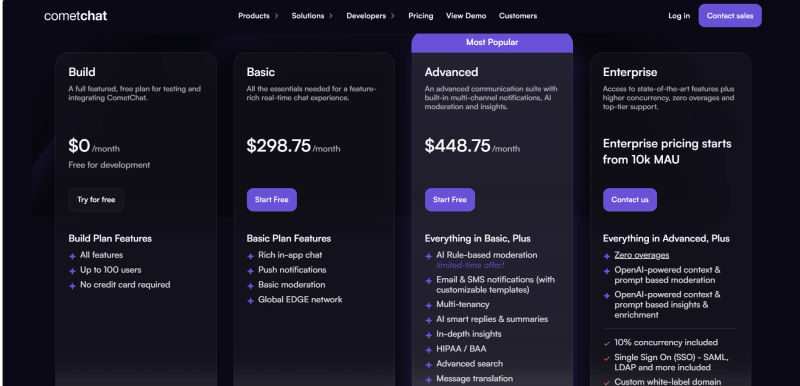
CometChat’s billing fundamentally hinges on two metrics: Monthly Active Users (MAU) and Peak Concurrent Users (PCU). MAU counts the total unique users connecting within a 30-day window, while PCU measures the maximum number of users connected simultaneously. The Basic Plan (around $298.75/month) covers up to 10,000 MAUs, providing essentials like 1-on-1 messaging and basic UI kits.
The critical limitation is the PCU cap, strictly restricted to 5% of your MAU limit. If your app hosts high-concurrency events (like live streaming or flash sales), you will hit PCU rate limits or incur steep overage fees, even if your total MAU remains well under the tier limit.
The Advanced Plan (around $448.75/month) increases the MAU limit and unlocks features like webhooks and role-based access control. This is where the "Build vs. Buy" inflection point is most apparent. For teams scaling between 10,000 and 50,000 MAUs, the engineering hours saved by not maintaining WebSockets and presence infrastructure often outweigh the monthly fee.
However, limitations emerge when evaluating enterprise needs. Advanced features are gated behind the custom-quoted Enterprise Plan. This includes critical security and compliance certifications like HIPAA, SOC2, and ISO 27001, along with GDPR-compliant data residency options.
Their "Advanced Moderation" at this tier is AI-driven, moving beyond simple keyword filters to offer sentiment analysis and image moderation, but this comes at a variable cost tied to usage. Buyers must clearly define what constitutes a "billable event" to avoid surprise invoices for media storage and data egress.
Before buying CometChat developer plans, see how they compare to other chat SDK costs on AuthenCIO.
CometChat vs. Competitors: Who Offers the Best Value in 2027?
Choosing the right SDK requires a clear-eyed assessment of your product roadmap against each vendor's core strengths and pricing model.
1. Sendbird vs. CometChat: Premium Features vs. Predictable Billing
Sendbird is best for enterprise-grade chat, heavily used by large-scale marketplaces and healthcare platforms requiring stringent compliance. Their base plans start significantly higher than CometChat—around $399/month for entry-level access. Sendbird justifies this with high uptime SLAs, feature-complete moderation tools, and advanced security certifications available on lower tiers than CometChat.
The primary drawback is Sendbird's rigid MAU and PCU ceilings, known for strict overage penalties. If your user engagement is volatile, Sendbird’s billing can become unpredictable.
Additionally, the technical overhead can be higher; managing client-side state with tools like Sendbird's SyncManager requires dedicated engineering effort. For product managers, the decision is budget versus compliance.
If you need HIPAA and SOC2 out of the box, Sendbird may be worth the premium. If you need standard chat on a tighter budget, CometChat offers better entry-level value.
2. Stream (GetStream) vs. CometChat: UI Kits and Performance Costs
Stream (GetStream) is best for applications requiring advanced activity feeds alongside social chat features. Their Chat Standard plan starts at $399/month for up to 25,000 MAUs. Stream's value is in its exceptional UI kits and performance under high-concurrency loads, which can significantly reduce front-end development time.
However, Stream’s pricing is a bottleneck due to its reliance on API call limits. Unlike CometChat’s MAU model, Stream monitors API requests. In a social chat app, a single message sent to 50 users with typing indicators and read receipts can generate hundreds of API calls.
For example, one message triggers 50 message.new events, 50 push notifications, and potentially 50 read events. This API call risk requires aggressive client-side optimization (e.g., debouncing typing indicators) to prevent spiraling costs. If your app doesn't need complex social feeds, paying Stream’s premium may yield a poor ROI.
3. Twilio and Ably: Pay-as-you-go vs. Tiered Subscription Models
When evaluating Cloud Communications Software Pricing, buyers typically choose between raw infrastructure (pay-as-you-go) and full-stack solutions (tiered subscriptions). Twilio and Ably represent the infrastructure side of this market, offering low upfront API costs but requiring significant engineering investment.
Twilio Conversations is best for omnichannel communication. If your product needs to switch between in-app chat, SMS, and WhatsApp, Twilio is the logical choice. Its 2027 pricing remains largely pay-as-you-go (around $0.05 per MAU).
The hidden cost is the engineering effort. Twilio provides raw API primitives, meaning your team must build the UI, state management, and moderation tools from scratch. The Total Cost of Ownership (TCO) for Twilio must include the salaries of engineers maintaining it.
Ably, an infrastructure provider, is best for high-scale pub/sub messaging. Its connection-based pricing (starting around $29/month) is attractive, and its infrastructure offers guaranteed message delivery.
However, like Twilio, Ably lacks specialized chat features like UI kits or pre-built moderation. The upfront API costs are lower, but the engineering TCO is substantially higher than a full-stack solution like CometChat.
4. Firebase and PubNub: The Infrastructure Maintenance Trade-off
Firebase remains the default for early-stage startups and rapid prototyping. Its pay-as-you-go Blaze Plan costs virtually nothing to start. However, Firebase is infamous for the "Success Tax."
Chat is read/write intensive, and as your MAU grows, database operations compound exponentially, leading to billing surprises. Further, its 200,000 concurrent connection limit is a hard ceiling that requires complex sharding to overcome.
The Migration Trigger: To avoid the 'Success Tax' spike, teams should begin migration planning once they hit 15,000 MAUs. By the time an app reaches 50,000 MAUs, moving to a dedicated chat SDK like CometChat becomes a financial and technical necessity.
PubNub operates on a message-based pricing model (starting at $49/month). A single message sent to a 100-user group equals 100 billable transactions.
Add presence updates and typing indicators, and costs can escalate quickly, making it better suited for IoT or live-tracking use cases where chat is a secondary feature.
4 Hidden Costs to Watch for in Chat API Contracts
Evaluating the true in-app chat infrastructure cost requires a TCO analysis beyond the sticker price. Here are four hidden costs that emerge at scale.
1. The Cost of AI Features and Moderation
In 2027, AI-powered features like automated moderation and suggested replies are common. However, they create a second variable-cost layer.
Research shows average enterprise AI spending increased from $112,000 per month in 2026 to an estimated $145,000 in 2027, despite falling token prices, because token consumption scales with message volume. Ensure AI moderation costs are either included in your base tier or strictly capped.
2. Data Egress and Media Storage
Text messages are cheap; media files are not. If your app relies on image sharing or voice notes, media storage and data egress fees can eclipse your base subscription.
Vendors often provide a baseline storage limit and charge a premium per GB thereafter. It is crucial to implement media retention policies, such as auto-deleting files after 30 days, to control these costs.
3. SLA Guarantees and Support Response Times
For a production application, downtime is expensive. Lower-tier plans often come with vague "best-effort" support and no guaranteed uptime. Enterprise tiers offer Service Level Agreements (SLAs), typically guaranteeing 99.9% or 99.99% uptime, backed by financial credits.
The hidden cost is paying for a premium plan just to get priority support. Evaluate the TCO of a potential outage versus the cost of an enterprise plan with a 1-hour support response time.
4. Data Portability and Vendor Lock-in Risks
Migrating chat history is a significant engineering challenge. Before committing to a vendor, verify their data export policies. Can you easily export all user messages and metadata in a common format like JSON?
Some vendors make this process intentionally difficult to discourage churn, creating vendor lock-in. The cost of being unable to migrate your data can be catastrophic if you need to switch providers due to price hikes or performance issues.
Try AuthenCIO
Move to faster, smarter software evaluation with AI
Decision Matrix: Which Chat SDK Should You Choose in 2027?
Navigating cloud communications software pricing in 2027 requires balancing upfront SDK costs with long-term scaling realities. Choosing the best chat API depends on how a provider's billing model aligns with your user growth and feature requirements.
CometChat remains a cost-effective solution for mid-market applications, offering a strong middle ground between pre-built UI kits and predictable MAU-based pricing. It is ideal for teams deploying quickly without the steep entry costs of Sendbird or the API-call volatility of Stream.
However, if your roadmap includes complex omnichannel routing, Twilio is the better architectural choice. If you require HIPAA-compliant, enterprise-grade infrastructure, Sendbird justifies its premium. If you are prototyping an MVP, Firebase is the logical starting point—provided you have a clear migration plan.
Use this final checklist to evaluate overall cloud communications software pricing for your stakeholder meeting:
Use Case: Is our primary need 1-on-1 chat, social feeds, or omnichannel messaging?
Time-to-Market: Do we need pre-built UI kits to launch faster and offset developer costs?
Scalability Model: Are we more sensitive to MAU, PCU, or API call volume?
Compliance: Do we need HIPAA, SOC2, or GDPR data residency, which often force higher pricing tiers?
TCO: Have we accounted for media storage, AI features, and potential migration costs?
Ultimately, the most durable differentiators are pricing predictability, SDK maturity, and the ability to control usage-based charges. Evaluate your projected MAU and model your data needs before signing a contract.