
Introduction
Healthcare IT directors face a critical challenge in 2027: balancing strict HIPAA and HITECH compliance with shrinking operational budgets.
As legacy on-premise fax servers become a severe security liability and maintenance burden, evaluating digital faxing tier costs is essential.
The cost of inaction is steep; maintaining legacy PRI/T1 lines, physical servers, and analog-to-digital gateways drains IT budgets and introduces severe compliance vulnerabilities that modern health systems cannot afford.
However, navigating complex vendor pricing models, hidden overage fees, and implementation costs can quickly derail an IT budget.
This guide breaks down WestFax pricing 2027 and compares top enterprise healthcare fax pricing models to help you make a data-driven, budget-conscious decision for your hospital or health system.
Plan | Best For | Pricing (USD $) | SSO/Active Directory Support | Limitations |
WestFax | Dedicated HIPAA API Faxing | Starts at $15/mo | Yes (via SAML 2.0) | High overage fees for high-volume spikes |
Weave | Integrated Patient Communication Workflows | $199 - $299/mo per location | Limited | Lacks deep enterprise EHR interoperability |
mFax Enterprise | High-Volume Reliability and Uptime | $250 - $1,000+/mo | Yes | Advanced API routing requires premium tiers |
eFax Corporate | Legacy Brand Trust and High Security | Custom (Starts ~$350/mo) | Yes | Rigid per-user licensing models |
Concord Fax | Large-Scale EHR Interoperability | Custom (Starts ~$800/mo) | Yes | Steep implementation and setup fees |
RingCentral Fax | Unified Communications Integration | $20 - $40/user/mo | Yes | Fax is secondary to the VoIP PBX ecosystem |
Fax.plus Enterprise | Modern User Experience and Security | $59.99 - $150+/mo | Yes (SSO on Enterprise) | Enterprise features capped by user limits |
SRFax Healthcare | Budget-Conscious HIPAA Compliance | $11.45 - $100+/mo | No | Basic interface; lacks advanced workflow automation |
*Note: All prices shown reflect typical monthly billing. Vendors often offer lower pricing for annual commitments, but those discounts are excluded here for easier comparison. Actual costs may vary depending on your requirements, usage volumes, and negotiated terms.
Software Covered in this Article
The following articles break down the key aspects of Cloud Communications Software, featuring a carefully curated set of key players:







Quick Evaluation: 2027 HIPAA-Compliant Fax Pricing Comparison
The persistence of large healthcare data breaches makes vendor resilience a primary procurement issue.
In 2025, U.S. healthcare organizations reported an average of 57 large breaches per month, with business associates accounting for 35.8% of those incidents.
This data reinforces the urgent need to evaluate a cloud-fax provider as a critical HIPAA business associate, not merely as a communications vendor.
When evaluating HIPAA compliant cloud fax costs in 2027, hospital administrators must look beyond the monthly seat price.
A true Total Cost of Ownership (TCO) calculator for enterprise healthcare faxing must account for users, fax pages, inbound numbers, outbound destinations, overage rates, document storage, optical character recognition (OCR) routing, API access, and implementation services.
Furthermore, while approximately 80% of hospitals now participate in the Trusted Exchange Framework and Common Agreement (TEFCA) and utilize FHIR APIs, faxing remains a clinical necessity for external partners lacking modern interfaces.
Cloud fax is increasingly positioned as a secure, compliant bridge between legacy workflows and interoperable exchange.
Therefore, the most durable enterprise criteria for 2027 include EHR integration, HL7 workflow support, identity management, and automated routing.
Comparing healthcare digital faxing tiers requires mapping these advanced features against your specific clinical volume to avoid unpredictable monthly billing fluctuations.
Detailed WestFax Pricing Breakdown: Tiers, Features, and Compliance
WestFax has positioned itself as a strong contender in the healthcare communications space, emphasizing security differentiation that shifts from basic transmission encryption toward full document lifecycle controls.
Who is this best for? WestFax is best for mid-to-large healthcare organizations needing dedicated HIPAA-compliant cloud faxing with straightforward REST API access and robust compliance auditing tools.
1. Pricing Differences and Value for Money
WestFax enterprise plans are typically custom-quoted based on a standard usage scenario—calculating monthly inbound and outbound pages, number of users, and required compliance features.
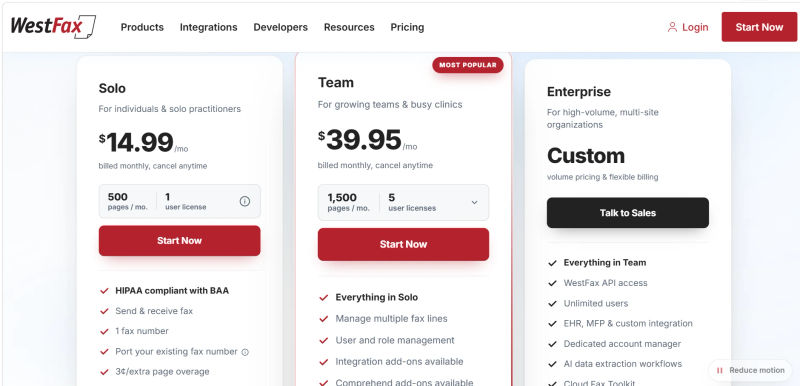
While smaller practices might utilize standardized tiers starting around $14.99 to $39.95 per month, enterprise deployments for 500+ bed hospitals generally start at approximately $499 per month and can scale past $1,500 depending on volume.
The value for money lies in their comprehensive security posture.
WestFax includes a Business Associate Agreement (BAA) standard across its healthcare tiers.
They also offer SOC2 Type II and HITRUST certifications, ensuring least-privilege access, multifactor authentication, immutable audit trails, and configurable retention policies are built into the platform.
Their support for Single Sign-On (SSO) and Active Directory integration makes user provisioning significantly easier for IT departments.
2. Inbound Volume Management
A major pain point for hospital administrators is controlling inbound volume, which is often dictated by external referring providers and cannot be easily throttled.
WestFax addresses this by offering specialized high-volume inbound routing capabilities.
However, IT directors must carefully negotiate their contracts to clarify if they are receiving an "unlimited" inbound tier or a pooled page limit.
Failing to secure predictable inbound pricing can lead to massive budget overruns during seasonal admission spikes or referral surges.
3. Hidden Costs and Plan Limitations
The primary financial risk with WestFax pricing 2027 involves predicting monthly billing fluctuations in a high-volume clinical setting.
Overage Fees: A transparent look at overage charges reveals that exceeding your pooled page limit can trigger steep per-page penalties. In a 24/7 clinical environment, an unexpected spike in admissions can easily push a hospital into overage territory.
Implementation Costs: Replacing on-premises fax servers involves number porting, workflow mapping, and user provisioning. WestFax may charge additional professional services fees for complex API integrations with legacy healthcare software.
Limitations: WestFax focuses heavily on faxing. If your hospital is looking to consolidate multiple departmental budgets into a single unified communications contract (including voice and SMS), WestFax's singular focus may require you to maintain separate vendor contracts.
Top WestFax Alternatives for Healthcare IT Directors
Evaluating alternatives requires understanding that no single platform fits every hospital's architecture.
The following breakdown highlights how top competitors stack up against WestFax in specific clinical scenarios.
1. Weave
Who is this best for? Weave is best for integrated patient communication workflows in outpatient clinics and mid-sized specialty practices that want to bundle faxing with VoIP, SMS, and scheduling.
Pricing Differences: Weave typically charges a flat rate per location (ranging from $199 to $299 per month), which includes a suite of communication tools alongside digital faxing.
Value for Money: The ROI comes from eliminating the maintenance burden of physical fax machines while simultaneously upgrading patient engagement tools.
Hidden Costs: While the flat rate is attractive, scaling across a multi-facility health system can multiply costs quickly, as pricing is location-based rather than enterprise-pooled.
Plan Limitations: Weave lacks the deep, large-scale EHR interoperability (like native Epic or Cerner API integrations) required by massive enterprise hospital networks. It also has limited SSO support compared to dedicated enterprise fax servers.
2. mFax
Who is this best for? mFax is best for high-volume reliability and uptime across multi-facility health systems that require predictable, pooled-page billing.
Pricing Differences: When comparing WestFax vs mFax pricing, mFax often provides more aggressive page-pooling options for enterprise clients, with custom tiers ranging from $250 to over $1,000 per month based on massive volume discounts.
Value for Money: mFax excels in its administrative dashboard, making it incredibly easy for IT directors to manage thousands of users, configure secure deletion, and monitor failed transmissions. Their Active Directory integration is seamless.
Hidden Costs: Advanced routing features and dedicated account management are gated behind their highest enterprise tiers.
Plan Limitations: While mFax offers a robust API, its native, out-of-the-box integrations with specialized healthcare EHRs are not as deeply developed as some legacy competitors, requiring more custom development work from your internal IT team.
3. eFax Corporate
Who is this best for? eFax Corporate is best for legacy brand trust and high security in risk-averse enterprise hospitals that prioritize established vendor reputation.
Pricing Differences: eFax Corporate vs WestFax reveals that eFax often relies on a rigid "per-user" model combined with page limits. Enterprise deployments typically start around $350 per month but scale linearly with user count.
Value for Money: The value lies in their massive infrastructure, redundant delivery, and disaster recovery objectives. They offer strict TLS encryption, comprehensive BAAs, and robust SSO capabilities.
Hidden Costs: eFax Corporate can be notorious for complex contracts, minimum user requirements, and high overage fees for international destinations or additional inbound numbers.
Plan Limitations: The user interface and administrative portal can feel dated compared to modern alternatives, increasing the indirect costs of staff time spent on manual sorting and administration. Staff usability is a major factor in support ticket volume, and legacy interfaces often drive up internal IT costs.
Find Perfect Software for Your Business
Concord Fax & RingCentral Fax: Heavyweight Enterprise Alternatives
For hospitals looking to deeply integrate faxing into their core clinical or communication infrastructure, Concord and RingCentral offer distinct pathways.
4. Concord Fax
Who is this best for? Concord Fax is best for large-scale EHR interoperability and automated clinical workflows, particularly for hospitals running Epic, Cerner, or Meditech.
Pricing Differences: Concord Fax healthcare rates are premium, reflecting their status as a specialized integration engine. Enterprise pricing is highly customized, often starting at $800+ per month for high-volume hospital deployments.
Value for Money: The ROI is realized through the reduction of indirect costs. Concord's "Zero-Click" workflow capabilities are a massive ROI driver for Health Information Management (HIM) departments. By utilizing cloud-based OCR routing and native EHR integrations, Concord automatically classifies and routes inbound faxes directly into the correct patient chart without manual intervention.
Hidden Costs: The initial technical headache of integrating cloud faxing with legacy on-premise software is mitigated by Concord's professional services, but these implementation and workflow mapping services carry significant upfront fees.
Plan Limitations: Concord is overkill for small practices or departments that simply need to send and receive basic PDFs. The platform's complexity requires dedicated IT administration and extensive staff training.
5. RingCentral Fax
Who is this best for? RingCentral Fax is best for unified communications integration where a hospital IT director wants to consolidate voice, video, messaging, and fax into a single vendor contract.
Pricing Differences: RingCentral Fax healthcare pricing is typically bundled into their broader UCaaS (Unified Communications as a Service) licenses, which run $20 to $40 per user per month. Standalone fax plans are available but less common for enterprise deployments.
Value for Money: By consolidating multiple departmental budgets into a single enterprise contract, hospitals can achieve massive economies of scale and simplify vendor management.
Hidden Costs: Ensuring full HIPAA compliance across the entire RingCentral ecosystem requires activating a specific "HIPAA-mode" toggle. While this secures fax transmissions, it can inadvertently disable other unified communication features, leading to unexpected operational limitations.
Plan Limitations: Because fax is a secondary feature to their VoIP PBX ecosystem, RingCentral lacks some of the hyper-specialized healthcare workflow automations found in dedicated fax servers like Concord or WestFax.
Fax.plus & SRFax: Balancing Strict Compliance with Budget Constraints
Not every deployment requires complex EHR integration.
Sometimes, IT directors need secure digital faxing for hospital admins or specialized departments without breaking the budget.
6. Fax.plus
Who is this best for? Fax.plus is best for modern user experience and security for health systems with strict data residency and encryption standards.
Pricing Differences: Fax.plus offers highly transparent pricing. Their Enterprise tier starts at $59.99 per month for 3,000 pages and scales predictably. Custom high-volume plans are available for larger deployments.
Value for Money: They offer a sleek, intuitive UI that requires zero staff training. Their security framework is top-tier, featuring data residency controls, Single Sign-On (SSO), and advanced malware scanning.
Hidden Costs: The hidden costs of cloud faxing with Fax.plus emerge if you have a massive user base. Enterprise features are sometimes capped by user limits, requiring custom negotiations to scale across thousands of hospital staff.
Plan Limitations: While they offer an API, they do not provide the deep, out-of-the-box HL7 integrations that legacy healthcare providers might require for automated clinical routing.
7. SRFax
Who is this best for? SRFax is best for budget-conscious HIPAA compliance in specialized departments, smaller hospital wings, or rural clinics that need basic, reliable transmission.
Pricing Differences: SRFax offers some of the lowest HIPAA fax cost per page 2027 metrics on the market. Healthcare plans start as low as $11.45 per month, with mid-tier plans around $100 per month offering substantial page volumes.
Value for Money: SRFax delivers exactly what it promises: a streamlined, highly secure, fully HIPAA-compliant faxing solution with a standard BAA. It is highly cost-effective for departments that just need to replace physical machines.
Hidden Costs: There are very few hidden costs, but the platform lacks advanced features like OCR data extraction, meaning hospitals will pay the "indirect cost" of manual administrative labor.
Plan Limitations: The interface is basic, and it lacks the enterprise-grade workflow automation, directory integration (no SSO), and advanced analytics required by large-scale, data-driven health systems.
Operational Logistics: Number Portability and Support SLAs
When transitioning away from legacy infrastructure, the software's price tag is only one part of the equation.
Hospital IT directors must heavily weigh the operational logistics of migrating to a cloud fax solution.
A poorly executed migration can result in lost referrals, delayed patient care, and immediate compliance violations.
1. Navigating Number Portability
A major headache for enterprise health systems is moving 1,000+ legacy fax numbers from traditional telecom carriers to a new cloud provider.
Vendors handle porting fees and timelines differently.
While some providers include bulk number porting for free in their enterprise tiers, others charge a per-number transition fee that can add thousands of dollars to the initial implementation cost.
A typical enterprise migration timeline spans 30 to 90 days.
This includes a discovery phase to audit existing numbers, a testing phase to ensure routing rules work correctly, the actual porting process (which depends heavily on the responsiveness of the losing carrier), and the final go-live.
IT directors must demand a clear, contractually obligated porting schedule from their chosen vendor to prevent service interruptions.
2. Uptime SLAs and Technical Support
For a 24/7 hospital, a fax failure at 3 AM in the ER is a critical incident.
When evaluating enterprise healthcare fax pricing, the Service Level Agreement (SLA) is paramount.
Hospitals require a minimum of 99.99% uptime (the "four nines"), backed by redundant delivery infrastructure and clear disaster recovery objectives.
Furthermore, IT directors must verify if the vendor offers financial credits for downtime.
If the platform goes offline, the vendor must share the financial risk.
Equally important is the quality of technical support.
Healthcare organizations should mandate 24/7, US-based technical support as part of their enterprise contract.
Relying on standard business-hours support or offshore ticketing systems is unacceptable when dealing with time-sensitive protected health information (PHI).
Try AuthenCIO
Move to faster, smarter software evaluation with AI
Final Verdict: Finding the Best HIPAA Fax Server Price for Your 2027 Digital Faxing Solution
Selecting the right cloud fax provider in 2027 requires a strategic approach to a hospital's specific clinical volume, integration needs, and security posture.
As the industry shifts toward FHIR APIs and TEFCA interoperability, your fax solution must serve as a secure, compliant bridge rather than an isolated silo.
Calculating Healthcare Fax ROI
When calculating the ROI of cloud faxing in 2027, IT directors must look beyond the initial quote.
A sample ROI presentation slide deck for hospital board members should highlight the elimination of physical telephony lines, the reduction in maintenance burdens, and the mitigation of data breach risks.
More importantly, it must quantify the indirect costs of faxing—specifically, the staff time saved by utilizing cloud-based OCR routing over manual document sorting.
The best HIPAA fax server price is the one that lowers your Total Cost of Ownership across all these vectors, not just the one with the cheapest per-page rate.
2027 Enterprise Cloud Fax Migration Checklist
Before finalizing your budget, create a step-by-step enterprise cloud fax migration checklist for transitioning thousands of existing fax numbers without service interruption.
Audit Current Infrastructure: Map all existing fax numbers, analog lines, and connected multi-function printers (MFPs).
Define Security Requirements: Ensure the vendor supports SAML 2.0 SSO, SOC2 Type II, and provides a comprehensive BAA.
Evaluate Workflow Integrations: Determine if you need basic PDF delivery or advanced "Zero-Click" EHR routing.
Demand Transparency: Clarify all overage charges, implementation fees, and inbound volume limits.
Establish SLAs: Secure a 99.99% uptime guarantee with 24/7 US-based support.
Whether you require the deep EHR interoperability of Concord Fax, the high-volume reliability of mFax, or the dedicated API capabilities of WestFax, ensuring you have the right pricing data is paramount.
Avoid vague marketing claims and overly technical jargon that ignores the business and operational impact on your clinical staff.
By systematically comparing these platforms against your organization's unique requirements, you can successfully balance strict HIPAA compliance with a shrinking IT budget.