
Introduction
For design agency owners in 2027, evaluating website builder pricing is no longer just about looking at a monthly subscription fee. It is about understanding the Total Cost of Ownership (TCO) and how platform fees impact your bottom-line profit margins.
Streamline your software evaluation process
As your agency scales from ten to hundreds of client sites, the "Scaling Tax"—where platform costs grow faster than your ability to bill clients—can quietly destroy your profitability.
Choosing the right platform requires a granular look at tiered agency plans, hidden costs like hosting and bandwidth overages, and the efficiency of white-label client billing engines.
You need a platform that not only delivers exceptional design capabilities but also supports a sustainable recurring revenue model. This guide breaks down the 2027 pricing structures of Webydo and its top competitors, focusing strictly on decision-making factors: pricing differences, value for money, hidden costs, and plan limitations to help you choose the most profitable tool for your agency.
Key Takeaways:
The "Scaling Tax" (hidden costs like hosting and bandwidth overages) is the primary threat to agency profit margins in 2027.
Webydo offers bulk agency pricing and native client billing, making it highly profitable for volume-based agencies, though migration requires upfront effort.
Webflow and Framer dominate high-end visual design, but their per-site pricing models and CMS limits can restrict margin expansion.
Wix Studio's revenue-share model provides passive income opportunities, while Duda competes closely with Webydo in the white-label space.
When calculating Total Cost of Ownership (TCO), agencies must factor in talent acquisition, platform risk, and 2027 AI credit costs.
Agency Platform Pricing at a Glance
Use this comparison to quickly see how each platform’s pricing model, white-label capability, and key limitations affect agency profitability. It highlights the trade-off between upfront cost, scalability, and control—setting up the detailed cost analysis in the sections that follow.
Tool | Best For | Pricing | Full White-Labeling Included | Limitations |
Webydo Agency | Pure white-label client handoffs | $400/mo (up to 50 sites) | Yes | Limited native third-party API integrations compared to headless setups. |
Webflow Enterprise | High-end custom interactions | Custom Pricing | No (Requires Enterprise) | Strict CMS item limits; dual-pricing model complicates client billing. |
Framer Pro | Design-first performance sites | $45/mo/site | No | Localization and advanced AI features require expensive add-ons. |
Duda Agency | Rapid scaling & client management | $69/mo | Yes | Custom widget development requires advanced coding knowledge. |
Wix Studio Elite | Integrated marketing ecosystems | $159/mo | No | Ecosystem lock-in; difficult to migrate client data off-platform. |
Elementor One | WordPress-based agency control | $19/mo | Yes (WP ecosystem) | Requires separate managed hosting, SSL, and maintenance overhead. |
Squarespace Advanced | Small business portfolio simplicity | $139/mo | No | Rigid templates; limited custom backend capabilities for complex sites. |
*Note: All prices shown reflect typical monthly billing. Vendors often offer lower pricing for annual commitments, but those discounts are excluded here for easier comparison. Actual costs may vary depending on your requirements, usage volumes, and negotiated terms.
Software Covered in this Article
To help you understand Webydo in the right context, this article refers to a carefully curated set of leading alternatives:







Webydo Pricing 2027: Is It Still Profitable for Agencies?
Webydo has long positioned itself as a platform built specifically for designers, but in 2027, its pricing structure is heavily optimized for agency profitability and client management.
Unlike consumer-focused builders that try to up-sell your clients directly, Webydo's model is built around protecting the agency-client relationship through robust white-labeling.
Who is this best for? Webydo is best for design agencies that want a pure white-label experience without touching code, allowing them to pass on a fully branded CMS to clients while maintaining control over billing.
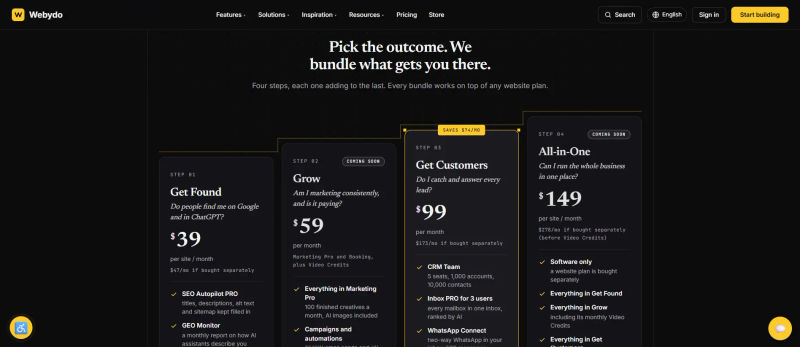
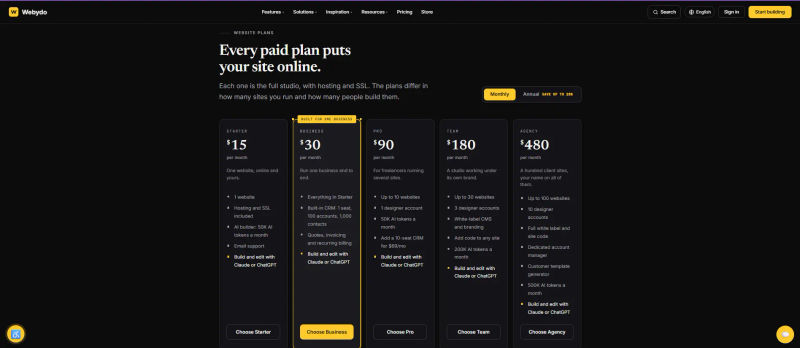
Pricing Differences and Value for Money Webydo's 2027 pricing is divided into three main tiers: Pro, Team, and Agency. While the Pro plan ($90/month) is suitable for solo freelancers, the Agency plan ($400/month) is where the true value lies for scaling businesses.
The Agency plan typically includes hosting for up to 50 sites, which brings the per-site cost down to just $8 per month. When you charge a client a standard $100/month retainer for hosting and maintenance, your profit margin per site is exceptionally high.
Furthermore, Webydo's white-label "Client Billing" engine is a massive value-add in 2027. It allows agencies to invoice clients directly from the platform under their own brand, integrating seamlessly with accounting software like QuickBooks or Xero.
This eliminates the overhead of manual billing cycles and allows agencies to effortlessly transition from project-based billing to a lucrative recurring revenue model.
Plan Limitations While Webydo excels in white-labeling, it does have limitations. The platform's native API integrations are not as extensive as advanced WordPress headless setups.
If your agency builds highly complex web applications that require deep database connections or custom backend logic, Webydo's infrastructure may present roadblocks. Additionally, while the $400/month Agency plan is cost-effective at scale, it represents a steep upfront commitment for smaller agencies with fewer than 15 active clients.
The Reality of Migration When evaluating Webydo, agencies must account for the switching costs and the reality of migration. Moving from a legacy builder or a standard Figma-to-Webflow pipeline to Webydo requires a distinct shift in operational workflows.
There is an inherent learning curve for design teams adapting to Webydo's specific interface and structural logic. Furthermore, migrating existing client sites is rarely a one-click process; it often involves manually rebuilding layouts and transferring CMS data.
This upfront time-cost can temporarily dip your effective hourly rate during the transition phase. However, agencies that successfully navigate this migration often find that the long-term margin expansion—driven by the $8 per-site bulk hosting cost—far outweighs the initial operational friction.
Webflow and Framer: The Premium Design Alternatives
For agencies that prioritize award-winning visual development and complex animations, Webflow and Framer are the dominant players in 2027. However, their pricing models are structured very differently from Webydo, often prioritizing per-site revenue over agency margins.
Webflow Workspace and Site Plans Webflow utilizes a notoriously complex dual-pricing model. Agencies must pay for a Workspace plan (starting around $25/month for basic team collaboration) and a separate Site plan for every published website (typically $39/month for a standard CMS plan).
Who is this best for? Webflow is best for agencies focused on high-end custom interactions, enterprise-grade bespoke builds, and clients who demand pixel-perfect code exports.
Value for Money and Limitations: The primary issue with Webflow's pricing is the impact on agency margins. If you are paying $29/month per site, your baseline cost is significantly higher than Webydo's bulk agency pricing.
Furthermore, Webflow enforces strict CMS item limits and bandwidth caps. If a client's site goes viral or they upload too many blog posts, you are forced into a higher tier (often $49/month or more), which immediately cuts into your retainer.
The hidden cost here is the "Scaling Tax"—the more successful your client's site becomes, the more Webflow charges you.
Framer Pro Plans Framer has aggressively captured the design-first market in 2027 by offering an interface that feels exactly like a design canvas. Framer charges on a per-site basis, with the Pro plan sitting at roughly $30/month per site.
Who is this best for? Framer is best for design-first performance sites where advanced animations and seamless canvas-to-web workflows are the top priority.
Value for Money and Limitations: Framer is incredibly efficient for rapid deployment, which saves agency staff time—a crucial metric for ROI. However, Framer's limitations become apparent with international clients.
Localization features and advanced 2027 AI-assisted design credits are often locked behind expensive add-ons or enterprise tiers. Like Webflow, the per-site pricing model means your agency margins remain static as you scale, rather than improving through bulk discounts.
Talent Market Dynamics Despite the higher licensing fees and per-site costs associated with Webflow and Framer, agency owners must also factor in the broader talent market. In 2027, the pool of specialized Webflow developers and Framer experts is vast.
It is often much easier—and faster—to recruit, hire, and onboard a designer who is already fluent in the Figma-to-Webflow pipeline than it is to find specialists for niche platforms. This abundance of talent can significantly reduce your agency's recruitment costs and training overhead, offsetting some of the margin compression caused by their higher software subscription fees.
Duda and Wix Studio: The Scalable Agency Powerhouses
If your agency's goal is volume—pumping out 10 to 20 high-quality sites a month—you need a platform built for rapid scaling and client management. Duda and Wix Studio are engineered specifically for this business model, offering distinct approaches to agency profitability.
Duda Agency Pricing Duda is perhaps Webydo's most direct competitor in the white-label space. In 2027, Duda's Agency plan costs approximately $69/month, which includes 4 hosted sites.
Who is this best for? Duda is best for volume-based agencies that require rapid scaling, robust client management portals, and dynamic page generation connected to external databases.
Value for Money and Limitations: Duda provides excellent value through its client management features. The ability to save custom sections as agency-wide templates drastically reduces development time. Duda also offers comprehensive white-labeling, similar to Webydo.
However, the $25/month additional site cost is higher than Webydo's bulk rate. Furthermore, while Duda is highly customizable, developing custom widgets requires advanced coding knowledge (JavaScript/React).
This limitation may force you to hire specialized developers, thereby increasing your payroll overhead and impacting your overall profit margins.
Find Perfect Software For Your Business
Wix Studio Partner Program Wix Studio has evolved significantly by 2027, offering a dedicated workspace for agencies. Instead of standard bulk pricing, Wix Studio heavily promotes a revenue-share model through its Partner Program. Sites typically cost between $17 and $39 per month, but agencies earn a percentage back based on their partner tier.
Who is this best for? Wix Studio is best for agencies building integrated marketing ecosystems where clients need built-in CRM, email marketing, and scheduling tools native to the platform.
Value for Money and Limitations: Wix Studio offers incredible value by consolidating tech stacks. You can replace separate form builders, email marketing software, and booking systems with Wix's native tools.
The major limitation often cited is platform lock-in, as migrating client data off Wix Studio is notoriously difficult. Additionally, you lose the pure white-label control that Webydo offers; your clients will always know they are on Wix.
However, for many modern agencies, the Wix Revenue Share model is not just a limitation—it is a highly lucrative passive income stream. By keeping clients within the Wix billing ecosystem, agencies can earn recurring commissions without the administrative burden of handling invoices directly, turning a perceived negative into a strategic financial advantage.
Elementor and Squarespace: The Budget-Friendly Ecosystems
For agencies working with budget-conscious small businesses, keeping overhead as low as possible is the only way to maintain profitability. Elementor (WordPress) and Squarespace offer two very different approaches to budget-friendly web design.
Elementor Agency Plan (WordPress) Elementor remains a titan in 2027. The Elementor Agency plan costs $288/year and allows you to install the Pro plugin on up to 1000 websites.
Who is this best for? Elementor is best for agencies that demand complete WordPress-based control, own their hosting infrastructure, and want to maximize profit margins on budget-conscious clients.
Value for Money and Limitations: On paper, $288/year for 1000 sites is unbeatable. However, this is where hidden costs run rampant. You must pay for separate managed WordPress hosting (e.g., WP Engine or Kinsta), which can cost $20-$30/month per site.
You also bear the cost of premium plugins for security, SEO, and backups. The ultimate hidden cost of Elementor is maintenance time. Automated SEO maintenance and plugin updates require constant agency oversight.
If a plugin conflict breaks a client site, your team loses billable hours fixing it. The TCO is often much higher than the initial $399 suggests.
Squarespace Circle Program Squarespace offers the Circle program for agencies, which provides a 20% discount on standard website plans.
Who is this best for? Squarespace is best for agencies focused on small business portfolio simplicity, rapid deployment, and low-maintenance client handoffs.
Value for Money and Limitations: Squarespace is incredibly stable; you never have to worry about hosting, security, or plugin updates. This drastically reduces your agency's maintenance overhead.
However, the ecosystem is highly rigid. If a client suddenly needs a complex database or a highly customized e-commerce checkout flow in 2027, Squarespace will severely limit your capabilities.
Furthermore, the 20% discount is helpful, but it does not allow for the massive markup potential of a fully white-labeled Webydo or Duda site.
Evaluating White-Label Website Builder Pricing and Hidden Costs
When calculating your Total Cost of Ownership (TCO) for scaling from 10 to 100+ client sites over a three-year period, the advertised sticker price of a website builder is only half the story.
In 2027, SaaS platforms are increasingly relying on hidden costs and usage-based pricing to drive their own revenue, often at the expense of your agency's profit margins.
1. Bandwidth Overages
Platforms like Webflow and Framer impose strict bandwidth limits on their standard plans. If an agency runs a successful marketing campaign for a client that drives a massive spike in traffic, the platform will automatically upgrade the site to a higher tier or charge overage fees.
If your agency service agreement does not explicitly state that clients cover bandwidth overages, your agency eats that cost. This unexpected inflation of monthly hosting fees can quickly erode the profitability of a fixed-price retainer.
2. CMS Item Limits
Many builders restrict the number of CMS items (blog posts, portfolio items, dynamic pages) a site can host. A client on a basic tier might be limited to 2,000 CMS items.
As their business grows and their content marketing scales, they will hit this wall, resulting in a forced upgrade. Webydo's bulk agency hosting generally provides more breathing room here, whereas per-site builders use this as a primary up-sell tactic.
Agencies must audit these limits carefully to avoid awkward conversations with clients about sudden price hikes.
3. White-Label Fees and Client Management
True white-labeling is rarely a standard feature across all platforms. While Webydo and Duda include it in their Agency tiers, other platforms charge a premium for removing their branding or do not offer it at all.
Furthermore, managing multiple client logins across disparate platforms creates administrative bloat. The cost of your project manager's time spent navigating different dashboards, resetting client passwords, and manually tracking down unpaid invoices is a hidden cost that directly reduces your effective hourly rate.
Consolidating under a single white-label client billing engine is a strategic move to reclaim those lost hours.
4. Third-Party Integrations and AI-as-a-Service
In 2027, clients expect AI integrations—whether it is AI-assisted copywriting in the CMS, automated SEO tagging, or dynamic layout adjustments. Platforms are beginning to charge "AI credits" for these features, turning what used to be standard functionality into a metered expense.
Additionally, if your builder lacks native forms or advanced e-commerce, you will be forced to purchase third-party tools (like external form builders or specialized hosting providers), fracturing your tech stack and multiplying your monthly SaaS subscriptions.
5. Platform Risk
Finally, agencies must consider the financial implications of Platform Risk. This is the cost associated with a software provider pivoting away from agency support, drastically raising prices, or going out of business entirely.
Venture-backed competitors often offer artificially low introductory rates to capture market share, only to hike prices once agencies are locked in.
Evaluating the sustainability of a platform's pricing model—and ensuring you have a clear exit strategy or migration path for client data—is a critical component of long-term agency risk management.
Try AuthenCIO
Move to faster, smarter software evaluation with AI
Final Verdict: Which Platform Should Your Agency Choose in 2027?
Choosing the best website builder for agencies 2027 comes down to aligning the software's pricing model with your agency's specific profit model and client base. There is no single "perfect" platform, only the most strategic choice for your specific operational goals and target audience.
As a strategic consultant evaluating these tools, the recommendation hinges entirely on your agency's primary value proposition.
If your agency's primary focus is high-end, award-winning visual design and custom animations, Webflow or Framer remain the best choices for high-fidelity bespoke design. However, you must carefully structure your client retainers to cover their per-site fees, strict CMS limits, and potential bandwidth overages.
If you are building complex, integrated marketing ecosystems where the website is just one part of a broader CRM and email strategy, Wix Studio offers the best all-in-one suite. Its revenue-share model can also serve as a valuable passive income stream, despite the lack of true white-labeling.
If you have a dedicated team of developers and want absolute control over your infrastructure while keeping software licensing costs low, Elementor remains the most flexible choice, provided your agency can absorb the hidden costs of ongoing maintenance, plugin updates, and managed hosting.
However, if your goal is to maximize profit margins through a scalable, recurring revenue model, Webydo and Duda stand out as the premier choices for margin-focused volume. Webydo is particularly strong for agencies that want to eliminate the "Scaling Tax" entirely.
By offering bulk site pricing and a sophisticated, fully white-labeled client billing engine, it allows you to consolidate your tech stack, protect your brand identity, and drastically increase the markup on your web design services.
Evaluate your current client volume, calculate your three-year TCO, and choose the platform that allows your agency to keep the revenue it generates.