

Introduction
For small and medium-sized business (SMB) operators in 2027, a website is no longer just a digital brochure; it is a core operational asset. With U.S. small-business website adoption reaching 82%, the question is no longer whether you need a site, but how to maximize its return on investment (ROI). Decision-makers are increasingly seeking predictable e-commerce and site builder costs, moving away from variable-cost platforms that drain margins through hidden fees and app subscriptions.
Streamline your software evaluation process
The 2027 digital landscape has fundamentally shifted. Rampant inflation within third-party app marketplaces has made platforms relying on "add-on" features financially unviable for lean teams. Consequently, fixed-cost, all-in-one builders are trending as SMBs look to consolidate their tech stacks. Evaluating website builder ROI 2027 requires looking past the advertised monthly subscription. True ROI is calculated by assessing the total cost of ownership (TCO), which includes hosting, premium integrations, transaction fees, and the internal labor required for maintenance.
Key Takeaways for Decision-Makers:
ROI is Total Cost of Ownership: The sticker price is irrelevant if a platform requires $100/month in third-party apps or expensive developer retainers.
Labor is Your Biggest Expense: Pagecloud's primary financial benefit is reducing billable maintenance hours through accessible, in-house design management.
Match the Tool to the Model: Shopify is essential for high-volume retail, but service-based SMBs overpay for its infrastructure.
Hidden Fees Destroy Margins: Transaction fees, security remediation, and accessibility compliance are the silent budget killers of 2027.
Pagecloud vs. Leading Website Builders: 2027 Pricing and Best Fit
The right website builder depends on more than the advertised monthly price. This comparison outlines each platform’s ideal use case, starting cost, and key limitations so SMB operators can assess total value—not just the base subscription.
Tool | Best For | Pricing | Limitations |
Pagecloud | Service SMBs needing fast visual building | Starts from $26/mo | Limited to 100 pages; lacks native advanced e-commerce features |
Webflow | Design-heavy brands needing custom interactions | Starts from $25/mo | Steep learning curve; strict bandwidth and visitor limits |
Squarespace | Creatives and local shops wanting all-in-one | Starts from $25/mo | 3% transaction fee on base e-commerce; rigid templates |
Wix | Businesses needing built-in scheduling and apps | Starts from $17/mo | Storage capped at 50GB; site speed can lag with heavy app usage |
Shopify Basic | Dedicated e-commerce retailers | Starts from $39/mo | Poor for non-retail sites; high reliance on paid third-party apps |
WordPress | Content-heavy sites needing total ownership | Starts from $9/mo+ | Requires ongoing technical maintenance; hidden premium plugin costs |
Weebly | Budget-conscious local brick-and-mortar | Starts from $16/mo | Outdated templates; limited scalability for 2027 digital trends |
*Note: All prices shown reflect typical monthly billing. Vendors often offer lower pricing for annual commitments, but those discounts are excluded here for easier comparison. Actual costs may vary depending on your requirements, usage volumes, and negotiated terms.
Software Covered in this Article
To help you understand Pagecloud in the right context, this article refers to a carefully curated set of leading alternatives:







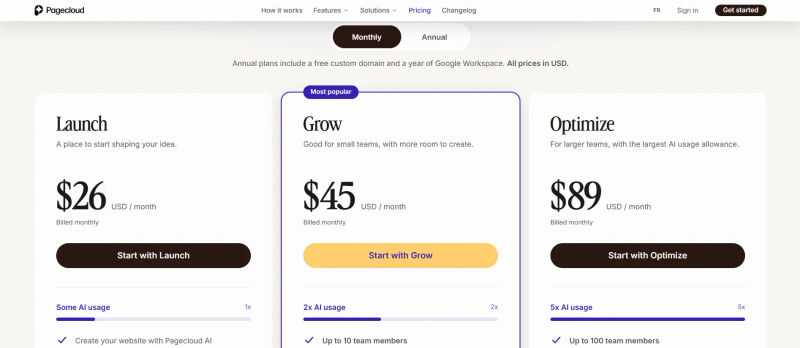
Decoding Pagecloud’s 2027 Pricing Tiers
Pagecloud has positioned itself as the premier "Design-to-Live" platform, focusing heavily on visual editing without the need for custom code. For SMB operators, time is money. Pagecloud's primary value proposition is reducing the billable hours spent on website maintenance and layout adjustments by allowing non-technical staff to manage the site.
1. The Small Business Plan: Best for Portfolio & Brand Presence
Priced at $26/month, this tier is optimized for lead generation and brand presence. Research indicates that while 82% of SMBs have a website, only 19% actually process payments directly through it. If your business relies on generating leads, booking consultations, or showcasing a portfolio, paying for heavy e-commerce features is a waste of capital.
This plan offers unlimited bandwidth, robust native SEO controls, and an accessible layout structure. Crucially, a free Google Workspace integration for the first year is included across all of Pagecloud's annual plans, not just this base tier, providing immediate operational savings for new businesses.
2. The Business Plan: Scaling Your SMB Operations
At $45/month, the Business Plan is designed for scaling operations, increasing page limits and offering priority support. The ROI here is realized through API flexibility. SMBs that need custom integrations can connect essential tools without being forced into high-end enterprise pricing. For example, a local service business can seamlessly sync a proprietary local CRM or push lead data directly into Mailchimp without paying for an expensive, top-tier Zapier subscription to bridge the gap.
3. E-commerce Pro: Predictable Costs for Online Retailers
Starting at $89/month, Pagecloud's e-commerce tiers are built to deliver predictable e-commerce costs 2027. Unlike platforms that penalize growth with escalating transaction fees, Pagecloud includes inventory management and automated tax calculations natively.
However, decision-makers must acknowledge the limitations. While Pagecloud excels in design flexibility, its e-commerce ecosystem is not as expansive as dedicated retail platforms. High-volume retailers requiring complex multi-channel fulfillment integrations may find the native tools limiting. Furthermore, the 100-page limit on the base plan means content-heavy publishers will need to upgrade quickly.
Find Perfect Software For Your Business
Pagecloud vs. The Market: 2027 Value Comparison
To truly understand the Pagecloud cost for SMBs, it must be evaluated against the broader market. Every platform has a distinct ideal user, and choosing the right one prevents overpaying for unused features.
1. Pagecloud vs. Webflow: Design Flexibility vs. Cost Predictability
When evaluating high-fidelity design platforms, the Pagecloud vs Webflow pricing conversation is inevitable. Webflow has dominated the market for custom, animation-heavy websites, but its pricing structure and total cost of ownership present unique challenges for the average SMB.
Webflow's CMS plan starts at $29/month, which appears competitive with Pagecloud's $24/month Small Business plan. However, Webflow restricts you to 250,000 monthly visitors and 200GB of bandwidth. If a marketing campaign goes viral, you face automatic overage charges.
The most significant differentiator is the cost of labor. Webflow operates on a complex visual box model requiring a deep understanding of HTML and CSS. Finding reliable Webflow freelancers is increasingly difficult, and when you do, they command premium rates of $75 to $150 per hour.
An SMB operator cannot simply hand a Webflow site to a junior marketing coordinator for structural updates. Pagecloud's unstructured, true drag-and-drop canvas allows in-house staff to make layout changes instantly, drastically reducing long-term maintenance costs and driving higher ROI for lean teams.
2. Shopify vs Pagecloud Pricing: Transaction Fees and E-commerce ROI
Shopify is the undisputed leader in e-commerce, but its pricing model relies heavily on variable costs that disrupt financial forecasting.
Shopify Basic costs $39/month. While this includes robust inventory features, the platform is notorious for its reliance on third-party apps. Market research indicates that merchants routinely spend an additional $50 to $200 per month on apps for basic functionality like advanced product filtering or cross-selling pop-ups.
Furthermore, examining Shopify vs Pagecloud pricing reveals a stark contrast in checkout customization. On Shopify, customizing the checkout experience to improve conversion rates often requires upgrading to Shopify Plus, an enterprise tier that costs thousands of dollars a month.
Additionally, Shopify penalizes users who do not use Shopify Payments by charging an additional 2% third-party transaction fee. If your business falls into the 81% of SMBs that do not process direct retail payments on their site, Shopify is an incredibly poor investment. Pagecloud’s E-commerce tiers offer a more balanced, fixed-cost approach for businesses that sell a few products but primarily focus on lead generation.
3. Pagecloud vs Squarespace Cost Comparison and Wix: The All-in-One Value Battle
Squarespace and Wix remain the titans of the all-in-one website builder market. But how does their value stack up in a direct Pagecloud vs Squarespace cost comparison?
Squarespace's Basic plan sits at $25/month, slightly cheaper than Pagecloud. However, a major hidden cost is its 3% transaction fee on e-commerce sales at this tier. If your SMB processes just $5,000 a month in online sales, that 3% fee equals $150/month—completely negating the initial subscription savings. You must upgrade to their $39/month Core plan to remove this fee.
Wix's Core plan at $29/month offers excellent built-in tools but comes with a severe 50GB storage cap. In 2027, where high-resolution video backgrounds are standard for conversion optimization, 50GB is consumed rapidly.
Beyond basic pricing, decision-makers must factor in Support and Reliability. When a site goes down, downtime equals lost revenue. Wix and Squarespace manage millions of micro-sites, often leading to massive support queues and slow ticket resolution times for standard users. Pagecloud's priority support on its higher tiers offers better ROI for businesses that cannot afford extended outages, providing a higher "Value-per-Feature" for operators prioritizing uptime and design freedom.
4. Pagecloud vs. WordPress and Weebly: Managed vs. Open Ecosystems
At opposite ends of the spectrum are WordPress (the open-source giant) and Weebly (the budget-friendly legacy builder).
WordPress software is technically free, but the total cost of ownership is often the highest on this list. To achieve a secure, fast-loading site in 2027, you need premium managed hosting ($18 to $40/month), premium themes ($60+), and a visual page builder plugin ($59/year).
More critically, decision-makers must account for Security and Insurance costs. In 2027, cyber liability insurance premiums for SMBs often depend on strict software patching protocols.
A single plugin exploit on WordPress can cost between $500 and $2,000 in emergency developer remediation. The "free" platform is a massive liability for lean teams without a dedicated IT manager.
Conversely, Weebly’s Professional plan is highly attractive at $16/month. However, the platform has seen little meaningful development. The templates are outdated, and it struggles to support modern digital trends. Choosing Weebly saves money upfront but drastically limits your business's growth ceiling.
Hidden Costs to Watch for in 2027: Plugins, Hosting, and Domains
When auditing your current site expenses, the base subscription fee is only the tip of the iceberg. In 2027, new hidden costs of website builders are catching SMB operators off guard.
1. Accessibility Remediation
Accessibility is no longer an optional add-on; it is a legal and operational baseline. The 2025 Web Almanac reported that 67% of sites explicitly removed default focus outlines, creating massive accessibility defects. Platforms that rely heavily on third-party templates often require expensive custom development to meet WCAG compliance.
Pagecloud's native infrastructure provides a better out-of-the-box search-engine-friendly structure and accessible layout, reducing the need to purchase expensive third-party accessibility overlays or hire remediation consultants. When calculating ROI, factor in the risk management and cost savings of a platform that supports keyboard navigation natively.
2. AI Integration Fees
As AI-assisted design and content workflows become standard, many platforms are introducing "AI Credits" or gating these features behind their most expensive enterprise tiers. When comparing plans, verify whether AI SEO tools, automated text generation, and image optimization are included in the base price or billed on a usage model. Pagecloud's all-in-one pricing model aims to consolidate these costs, preventing unpredictable monthly overhead.
3. App Ecosystem Inflation
The most common frustration among SMB operators is "feature gating." You purchase a $26/month plan only to realize that automated tax calculations, abandoned cart recovery, or advanced form builders require a $15/month app subscription.
Over a year, a site builder that costs $26/month with $75/month in apps is significantly more expensive than a premium $60/month all-inclusive plan. Pagecloud’s native feature set helps eliminate this app ecosystem inflation.
Migration Effort & Costs: Moving to Pagecloud in 2027
Identifying the best value website builder for small business operations is only half the battle; migrating to it is the other. Decision-makers must calculate the time and financial investment required to move content from legacy platforms to Pagecloud to ensure the switch yields a positive ROI.
Migrating a standard 30-page SMB website from WordPress or Wix to Pagecloud typically takes an internal team two to four weeks of part-time effort. If outsourced to a digital agency, this migration can cost anywhere from $2,000 to $5,000 depending on the complexity of the design and the amount of media being transferred.
However, Pagecloud's unstructured editor drastically reduces the friction of rebuilding layouts. Instead of fighting with rigid templates to match your old branding, your team can visually recreate pages in a fraction of the time.
Furthermore, the true cost of a botched migration is lost organic traffic. Pagecloud includes robust, easy-to-manage 301 redirect mapping tools in its base plans. Ensuring your SEO equity transfers smoothly prevents the catastrophic revenue dips that often accompany platform migrations, safeguarding your lead flow during the transition.
Try AuthenCIO
Move to faster, smarter software evaluation with AI
Verdict: Which Pagecloud Plan Should Your SMB Choose?
Choosing the right website builder in 2027 comes down to aligning the platform's primary strength with your specific business model. If you are a high-volume e-commerce retailer, Shopify remains the necessary standard, despite its variable app costs. If you have an in-house development team and need complex, custom-coded animations, Webflow is worth the steep learning curve.
However, for the vast majority of SMB operators—specifically service providers, local businesses, and boutique online retailers—Pagecloud delivers the highest ROI. By eliminating the need for expensive developers, offering predictable, all-in-one pricing without hidden app fees, and providing unmatched visual design freedom, Pagecloud allows you to consolidate costs and focus your capital on growth rather than website maintenance.
Next Steps: Your 2027 ROI Audit Checklist
Before making a final software choice, take 15 minutes to run this internal audit:
Audit Your Current App Stack: List every third-party plugin or app you currently pay for. Can Pagecloud replace these natively?
Check Traffic and Storage Logs: Are you dangerously close to a bandwidth or storage cap on your current Webflow or Wix plan?
Calculate Transaction Volume: Multiply your average monthly online sales by 3%. If the number is higher than the cost of upgrading your plan, you are losing money to transaction fees.
Assess Monthly Maintenance Hours: Ask your marketing team how many hours they spend fighting with your current CMS. Multiply that by their hourly rate to find your true labor cost.
Take the time to evaluate your total cost of ownership, and choose a platform that scales with your financial goals without holding your essential features hostage.