

Introduction:
In this cloud communications software review, we evaluate Unitel Voice—a virtual phone system tailored specifically for startups and entrepreneurs. While asynchronous platforms like Slack and Microsoft Teams dominate internal workflows in 2027, real-time voice communication remains the ultimate trust-builder for closing enterprise deals, supporting high-value clients, and pitching investors.
Streamline your software evaluation process
For early-stage founders, relying on a personal mobile number compromises privacy and lacks scalability. Conversely, traditional enterprise-grade VoIP (Voice over Internet Protocol) systems often come burdened with high monthly overhead costs and complex hardware requirements that drain a bootstrapped startup’s runway. Cloud-based startup phone solutions like Unitel Voice enter the equation here, positioned as a founder-friendly platform designed to bridge the gap between basic call forwarding and complex enterprise PBX systems.
But does it truly hold up against the modern demands of distributed teams? In this comprehensive 2027 review, we evaluate Unitel Voice based on total cost of ownership, mobile app reliability, scalability, and essential features. We will also compare it directly against top competitors to help you make a definitive, data-backed purchasing decision.
Tool | Best For | Pricing (USD $) | Key Features | Use Cases |
Unitel Voice | Bootstrapped remote startups | $9.99 - $29.99/mo | Auto-attendant, mobile app, toll-free numbers | 2-10 person distributed teams needing affordable professional lines |
Grasshopper | Solopreneurs & local businesses | $14.00 - $80.00/mo | Desktop/mobile apps, custom greetings, virtual fax | Founders wanting a legacy, simple add-on to existing mobile devices |
Phone.com | Rapidly scaling teams | $12.74 - $29.99/mo | Mix-and-match metered/unlimited routing, CRM integration | Startups with fluctuating call volumes across different departments |
Nextiva | Sales-heavy operations | $21.00 - $45.00/mo | Advanced pipeline CRM, pipeline analytics, workflow automation | High-volume sales teams needing deep customer data integration |
RingCentral | Enterprise-bound startups | $20.00 - $35.00/mo | AI conversational analytics, video meetings, global deployment | Funded startups planning rapid international expansion and UCaaS consolidation |
800.com | Marketing-focused campaigns | $15.00 - $50.00/mo | Premium vanity numbers, call tracking, SMS marketing | E-commerce or service startups tracking ROI on specific ad campaigns |
Quo | Modern messaging-first teams | $10.00 - $25.00/mo | Shared SMS inboxes, modern UI, lightweight calling | B2C startups prioritizing text-based customer support over voice |
Ooma | Hybrid office environments | $19.95 - $29.95/mo | Desk phone compatibility, overhead paging, virtual receptionist | Startups transitioning between a physical office and remote work |
OpenPhone | Modern remote startups | $15.00 - $23.00/mo | Shared numbers, Slack integration, international SMS | Tech-forward teams wanting a collaborative, workspace-style phone app |
*Note: All prices shown reflect typical monthly billing. Vendors often offer lower pricing for annual commitments, but those discounts are excluded here for easier comparison. Actual costs may vary depending on your requirements, usage volumes, and negotiated terms.
Key Takeaways
Unitel Voice is the premier virtual phone system for solo founders and early-stage startups in 2027, prioritizing ease of use and affordability over complex enterprise features.
Ideal Use Case: Perfect for bootstrapped entrepreneurs needing a professional business number, automated attendant, and reliable mobile app routing directly to personal devices.
Pricing Value: Highly competitive entry-level tiers provide massive value for tight budgets, though scaling teams should monitor fair-usage minute caps.
The Verdict: Unitel Voice wins on simplicity and remote onboarding. However, if your team requires advanced video conferencing or deep CRM integrations, consider heavier alternatives like Nextiva or RingCentral.
Pros and Cons: What Entrepreneurs Need to Know
Before committing, it is essential to weigh the specific advantages and limitations of Unitel Voice based on current industry standards.
The Pros:
Exceptional Affordability: The entry-level pricing is highly competitive, keeping startup burn rates low.
Ease of Use: The intuitive dashboard ensures that non-technical founders can manage routing, greetings, and extensions without IT support.
Toll-Free Focus: Unitel Voice is widely considered the best toll-free number service for startups, offering a massive inventory of vanity numbers to establish a national presence instantly.
US-Based Customer Support: Unlike many budget VoIP providers that outsource support, Unitel Voice is highly rated for its responsive, helpful customer service.
The Cons:
Limited Native Integrations: While it handles basic workflows via Zapier, it lacks the deep, out-of-the-box native integrations with complex CRMs that platforms like Nextiva offer.
Basic Analytics: The reporting features are sufficient for basic call logs but lack the advanced AI-driven sentiment analysis and detailed agent productivity metrics needed by large sales floors.
Not Built for Heavy Video: If your team requires a unified platform that seamlessly blends phone calls with enterprise-grade video conferencing, Unitel Voice will require you to run a separate tool alongside it.

Software Covered in this Article
This guide breaks down the pricing and key features of cloud communications software, covering a curated set of providers:







What is Unitel Voice? A 2027 Overview for Entrepreneurs
Unitel Voice is a cloud-based virtual phone system specifically engineered for small business owners, startup founders, and entrepreneurs. Unlike heavy UCaaS platforms that bundle video conferencing, complex team messaging, and enterprise identity management into a single expensive package, Unitel Voice focuses strictly on core telephony: providing professional business numbers, intelligent call routing, and reliable mobile access.
In 2027, the definition of a "startup phone system" has evolved. Buyers no longer want to manage SIP trunking or physical PBX hardware. They require variable capacity—the ability to spin up a toll-free number in minutes, assign extensions to a globally distributed team, and manage everything from a smartphone or web browser.
Unitel Voice targets this exact need, allowing founders to separate their business and personal communications on a single device without requiring dual physical SIM cards, fully supporting modern eSIM compatibility.
It is important to note that while the Unitel Voice app functions globally over Wi-Fi or cellular data, the platform is primarily designed for US and Canadian businesses. The phone numbers provided are North American, making it the ideal choice for startups targeting those markets, even if the founders themselves are digital nomads working from Europe or Asia.
Key Features That Drive Startup Growth
To determine if Unitel Voice is the best virtual phone system for startups 2027, we must analyze how its core features perform in real-world remote operations.
1. Seamless Remote Deployment and Onboarding
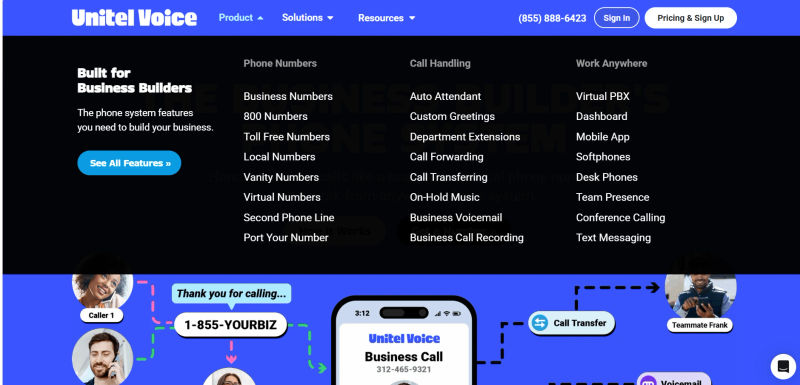
One of the most significant pain points for non-technical founders is the complexity of telecom setup. Unitel Voice effectively eliminates this friction. The platform is designed for immediate deployment, allowing a startup to go live with a professional presence in under an hour.
The 5-Minute Setup Checklist for Startups:
Select a Number: Choose a local, toll-free, or vanity number from their extensive inventory.
Create Extensions: Assign dedicated extensions (e.g., Ext 101 for the CEO, Ext 102 for Sales) to team members.
Configure Routing: Set up basic forwarding rules to route calls to the respective employees' personal mobile devices.
Record Greetings: Upload or record a professional main greeting.
Deploy the App: Have team members download the iOS or Android app to begin making outbound calls displaying the business caller ID.
2. Automated Attendant and Call Routing Efficiency
Missing a critical customer or investor call due to poor notification systems is a fatal error for early-stage companies. Unitel Voice’s auto-attendant acts as a 24/7 virtual receptionist.
For distributed teams spanning multiple time zones, the "Follow Me" call forwarding feature is indispensable. You can configure the system to ring your mobile phone first, then your desktop app, and finally forward to a co-founder in a different time zone if you remain unavailable.
Professional Auto-Attendant Script Template:"Thank you for calling [Startup Name], where we are redefining [Industry]. If you know your party's extension, please dial it at any time. For Sales, press 1. For Customer Support, press 2. For Billing, press 3. To reach our company directory, press 4. Or, stay on the line to speak with the next available representative."
3. Mobile App Reliability for Founders on the Go
Because Unitel Voice relies heavily on its mobile application (iOS and Android) to deliver its service, app reliability is a make-or-break factor. In 2027, remote operations often rely on 5G networks or Low Earth Orbit (LEO) satellite internet (like Starlink) when founders are traveling or working from rural locations.
Recent aggregated user sentiment data indicates that Unitel Voice’s mobile app maintains excellent call quality with minimal latency over stable 5G and satellite connections. The app interface is clean, allowing users to easily toggle their availability status, check visual voicemail, and separate business SMS from personal texts.
4. Number Porting and Data Sovereignty
Startups migrating from legacy systems or personal cell phones are often terrified of losing their established business numbers. Unitel Voice handles number porting efficiently, usually completing the transfer within 1 to 2 weeks. They require a standard Customer Service Record (CSR) from your previous carrier.
More importantly, Unitel Voice respects data sovereignty; if you eventually outgrow the platform, they do not hold your numbers hostage, allowing you to port them out to a larger UCaaS provider seamlessly.
5. AI-Powered Spam Filtering and Security
In 2027, spam calls are a major productivity killer. Unitel Voice has integrated modern STIR/SHAKEN protocols to provide AI-powered spam filtering, flagging suspicious inbound calls before they interrupt your workflow.
Additionally, the platform supports Two-Factor Authentication (2FA) for administrative logins and utilizes robust encryption protocols for internal call routing, satisfying basic compliance requirements for B2B startups.
Find Perfect Software for Your Business
Integrations and Modern Workflows
As businesses shift toward asynchronous models, cloud-based startup phone solutions must play nicely with other software. While Unitel Voice is not as integration-heavy as enterprise platforms, it offers essential connections that modern workflows demand.
Unitel Voice includes voicemail-to-email with automated transcription capabilities. When a client leaves a voicemail, the system emails the audio file alongside a text transcription directly to your inbox or a shared team address.
For deeper workflow automation, startups can leverage Zapier to connect Unitel Voice with tools like Slack, Notion, and HubSpot. For instance, a common 2027 startup workflow involves routing all transcribed voicemails and missed call alerts directly into a dedicated #customer-calls Slack channel. This allows the entire team to see the communication asynchronously and claim responsibility for the callback, bridging the gap between real-time voice and asynchronous text.
Unitel Voice Pricing: High Value or High Cost?
Advertised per-user rates rarely tell the full story. For a bootstrapped startup, the Total Cost of Ownership (TCO) over a 12-month period is the most critical metric. Unitel Voice pricing and features are known for being transparent and startup-friendly, but decision-makers must be aware of how costs scale.
1. The Pricing Tiers
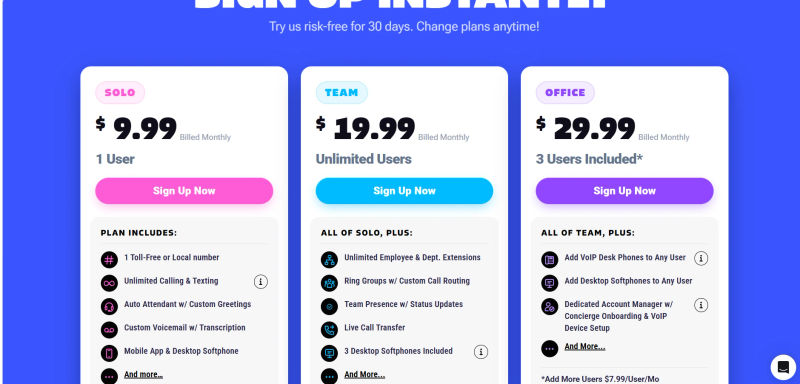
Unitel Voice structures its pricing into metered and unmetered tiers based on call volume and user count.
Start-Up Plan ($9.99/month): Includes 500 monthly minutes, one business number, and unlimited users. Ideal for solopreneurs with low call volume.
Growth Plans ($19.99 to $29.99/month): Provides larger minute buckets (1,000 to 2,500 minutes) and unlimited users for scaling startups.
Unlimited Plan ($24.99/user/month): Offers unmetered domestic calling and SMS. Unlike metered plans, this tier charges per user, making it cost-effective only for sales-heavy teams with high daily call volumes.
2. Hidden Costs and Fair-Usage Caps
Unbiased analysis requires looking at the fine print. First, startups must account for mandatory regulatory fees and local telecom taxes, which can often add 20% to 30% to the advertised sticker price of any VoIP provider.
Second, while "unlimited" plans are standard, they almost always include fair-usage policies to prevent abuse by massive call centers. High-volume startup sales teams using auto-dialers may hit these caps, resulting in account throttling.
Additionally, adding team members mid-month will result in prorated charges, and international calling rates outside of the US and Canada are billed per minute, which can inflate overhead for globally focused sales teams.
3. Decision Matrix by Funding Stage
Bootstrapped (0-3 Employees): Unitel Voice’s entry-level metered plan is highly cost-effective. It provides the professional image required to close early deals without draining cash reserves.
Seed-Funded (4-15 Employees): The unlimited tier offers predictable billing. However, this is the stage where founders must evaluate if they need deep native integrations with CRMs.
Series A (15+ Employees): At this stage of rapid scaling, the lack of advanced AI conversational analytics or deep workflow automation might necessitate a migration to a heavier platform.
Unitel Voice vs. The Competition: A Head-to-Head
A complete cloud communications software review requires evaluating Unitel Voice against its top competitors. The virtual phone market is crowded, and alternative platforms often serve distinctly different operational models, scaling requirements, and budget constraints for startups.
1. Unitel Voice vs Grasshopper: The Battle for Simplicity
Grasshopper is the legacy giant in the solopreneur space, focusing on adding a business line to an existing mobile device.
Key Advantage: Grasshopper offers a flat fee for the account with multiple extensions, rather than strictly per-user pricing.
Ideal For: Solopreneurs who want a legacy, simple add-on without needing advanced routing.
The Verdict: In 2027, Grasshopper’s feature set has remained relatively stagnant. Unitel Voice generally offers a more modern mobile app experience and better overall value for bootstrapped startups.
2. Unitel Voice vs. Phone.com: Which Offers Better Scalability?
Phone.com is a formidable alternative due to its unique pricing model.
Key Advantage: Phone.com allows a mix-and-match pricing model. You can have some users on cheap, metered plans and others on unlimited plans.
Ideal For: Startups with highly variable call volumes across different departments (e.g., developers vs. sales reps).
The Verdict: Phone.com offers superior cost scalability for diverse teams, but Unitel Voice often wins on pure ease of use and customer support responsiveness for early-stage founders.
3. Unitel Voice vs. Nextiva & RingCentral: When to Level Up
Nextiva and RingCentral are heavyweights in the UCaaS space. They are comprehensive communication ecosystems.
Key Advantage (Nextiva): Exceptional native CRM integration and sales pipeline analytics.
Key Advantage (RingCentral): Enterprise scale, automated meeting summaries, and global deployment capabilities.
Ideal For: Funded startups (Series A and beyond) with 15+ employees, dedicated sales floors, and international offices.
The Verdict: If your startup is a two-person team, RingCentral and Nextiva are overkill and will introduce unnecessary complexity. However, if you are scaling rapidly, you will eventually outgrow Unitel Voice and should look to these platforms.
Top Alternatives for Specific Use Cases
If your operational model is highly specific, consider these affordable business phone systems for entrepreneurs:
OpenPhone: - Key Advantage: Shared numbers, highly collaborative workspace UI, and strong Slack integrations.
Ideal For: Modern, tech-forward remote startups that want their phone system to feel like a collaborative messaging app.
800.com: - Key Advantage: Premium vanity numbers and advanced call tracking to measure marketing ROI.
Ideal For: Startups whose primary growth engine is offline marketing, billboards, or radio ads.
Quo: - Key Advantage: Superior shared SMS inboxes and a messaging-first interface.
Ideal For: Gen-Z focused B2C startups where customer support happens primarily via text message.
Ooma: - Key Advantage: Bridges the gap between physical hardware and cloud software, supporting desk phones and overhead paging.
Ideal For: Startups operating a hybrid model with a physical office or warehouse alongside remote workers.
Try AuthenCIO
Move to faster, smarter software evaluation with AI
Final Verdict: Is Unitel Voice Your Best Bet?
Choosing the right virtual phone system is less about finding the tool with the longest feature list and more about finding the exact fit for your current growth stage and operational model.
Unitel Voice remains one of the premier choices in 2027 for a specific demographic: bootstrapped, remote-first startups and solopreneurs who need to project a professional, national image without inflating their monthly software budget. It delivers on its core promises of reliability, ease of use, and excellent customer support.
Choose Unitel Voice if:
You are a founder using a personal cell phone for business and need an immediate, affordable professional upgrade.
Your team is fully remote and relies entirely on mobile apps or desktop browsers for communication.
You want transparent pricing, robust toll-free options, and fast, US-based customer service.
Look elsewhere if:
You manage a high-volume outbound sales center that requires deep CRM integrations (look to Nextiva).
You are rapidly expanding internationally and need enterprise-grade UCaaS with built-in video conferencing (look to RingCentral).
You want a highly collaborative, shared-inbox experience for internal team messaging (look to OpenPhone).
Ultimately, Unitel Voice provides the essential building blocks for startup communication. It allows founders to stop worrying about missed calls and start focusing on scaling their business. If you are ready to upgrade your communications, taking advantage of a free trial is the best next step to test the mobile app's performance in your specific remote environment.