

Introduction
Why E-commerce Leaders are Prioritizing WhatsApp API in 2027
Evaluating and selecting the best WhatsApp Business API platforms for e-commerce is the most critical infrastructure decision marketing ops leaders will make in 2027. The post-cookie landscape and sweeping global privacy shifts have severely handicapped traditional ad tracking, driving customer acquisition costs (CAC) to unsustainable highs. Simultaneously, standard email marketing campaigns are increasingly being buried in algorithmic "Promotions" tabs, leading to historically low open rates and fragmented customer communication.
Streamline your software evaluation process
To combat these systemic challenges, high-growth e-commerce brands are pivoting entirely toward conversational commerce. In 2027, WhatsApp is no longer just a reactive customer support channel; it operates as a native checkout space, a dynamic marketing engine, and an autonomous AI shopping assistant all rolled into one centralized platform. However, scaling these operations requires far more than the standard, free WhatsApp Business App.
E-commerce store owners managing thousands of monthly orders require robust enterprise WhatsApp API providers to automate complex sales funnels, synchronize data bidirectionally with central CRMs, and deploy hyper-personalized messaging at scale. A mismatch between your technical stack and your API provider can lead to data silos, inefficient manual support, and lost revenue. This guide bypasses generic buzzwords to provide a deep, actionable comparison of the top platforms, helping you choose the exact tool that fits your operational scale, compliance needs, and strategic goals.
2027 E-commerce WhatsApp API Comparison Matrix
Tool | Best For | Pricing (USD $) | Key Features | Implementation Time | Security Compliance |
Treble.ai | Automated Customer Journeys | Starts at $99/mo | Agentic AI workflows, deep CRM sync | 1-2 Weeks | SOC2, GDPR |
Wati.io | Mid-Market Shopify Growth | Starts at $49/mo | Native Shopify sync, no-code chatbot | 24-48 Hours | GDPR |
CallHippo | Unified Sales & Support Teams | Starts at $50/mo | Voice + WhatsApp sync, call tracking | 1 Week | SOC2, HIPAA |
ManyChat | Marketing Automation & Lead Gen | Starts at $15/mo | Visual flow builder, Meta ad handoff | 24 Hours | GDPR |
Twilio | Custom Developer-Led Scalability | Pay-as-you-go | Raw API access, limitless customization | 3-6 Weeks | SOC2, ISO 27001 |
Bird | High-Volume Omnichannel Messaging | Custom Enterprise | Marketing cloud orchestration, massive scale | 4-8 Weeks | SOC2, GDPR |
SleekFlow | Social Commerce & CRM Integration | Starts at $79/mo | O2O tracking, native payment links | 1-2 Weeks | GDPR, PDPA |
MessageBird | Automated Customer Engagement | Starts at $50/mo | Visual automation builder, enterprise comms | 2-3 Weeks | SOC2, GDPR |
Respond.io | Multi-Agent Conversational Sales | Starts at $79/mo | Complex routing, VIP segmentation | 1-2 Weeks | ISO 27001, GDPR |
Sinch | Enterprise Reliability & Global Reach | Custom Enterprise | Tier-1 direct connections, low latency | 4-8 Weeks | SOC2, ISO 27001 |
Gupshup | AI-Driven Conversational Commerce | Pay-as-you-go | Native checkout, Agentic AI assistants | 2-4 Weeks | SOC2, GDPR |
Vonage | Integrated Communication Workflows | Pay-as-you-go | Programmable messaging, Jumper.ai | 3-6 Weeks | SOC2, GDPR |
*Note: All prices shown reflect typical monthly billing. Vendors often offer lower pricing for annual commitments, but those discounts are excluded here for easier comparison. Actual costs may vary depending on your requirements, usage volumes, and negotiated terms.
Top Software Picks
Treble.ai — best for AI-powered WhatsApp customer engagement and conversational commerce.
Wati.io — best for WhatsApp-first SMBs that need support, broadcasts, and automation without coding.
CallHippo — best for cloud telephony, sales calling teams, and virtual call centers.
ManyChat — best for creators, e-commerce brands, and Instagram/WhatsApp marketing automation.
Twilio — best for developers building custom messaging, voice, SMS, and WhatsApp solutions.
Bird (MessageBird) — best for enterprise omnichannel communications across SMS, WhatsApp, email, voice, and RCS.
SleekFlow — best for omnichannel commerce and customer conversations across social messaging apps.
Respond.io — best for multi-channel customer support, lead management, and AI-powered conversation workflows.
Sinch — best for telecom-scale SMS, voice, verification, and customer communications.
Gupshup — best for enterprise WhatsApp chatbots and conversational messaging in high-volume markets.
Vonage — best for unified communications, voice APIs, contact centers, and business messaging.
Software Covered in this Article
The following articles break down the key aspects of Cloud Communications Software, featuring a carefully curated set of key players:











Deep Dive: The 11 Best WhatsApp Business API Platforms for 2027
1. Treble.ai
Who is this best for? E-commerce brands needing advanced, AI-driven customer journeys and seamless CRM synchronization.
As e-commerce moves away from static email blasts, Treble.ai has positioned itself as a powerhouse for automated conversational commerce. Instead of just sending one-way notifications, Treble.ai allows marketing ops leaders to build hyper-personalized, multi-step customer journeys entirely within WhatsApp. The platform excels at bidirectional syncing of conversational data back to central CRMs like HubSpot and Salesforce. For a marketing ops lead, this means custom fields in HubSpot are updated in real-time based on WhatsApp chat sentiment. If you are evaluating Wati vs Treble.ai for e-commerce, Treble.ai often wins for complex, data-driven automation powered by GPT-6 level reasoning.
Planning WhatsApp automation with Treble.ai? Compare it with other Business APIs on AuthenCIO.
Key E-commerce Use Cases:
Agentic AI Cart Recovery: Automatically trigger dynamic WhatsApp messages when a user abandons their cart, with the AI negotiating personalized discounts based on the user's past purchase history.
Post-Purchase Upsell Flows: Deploy autonomous AI shopping assistants that recommend complementary products immediately after a successful delivery, driving a 15% lift in repeat purchase rate.
Pros:
Deep, native integrations with major enterprise CRMs prevent data silos.
Agentic AI capabilities handle complex customer queries and autonomous negotiations without human intervention.
Cons:
The highly advanced feature set presents a steeper learning curve for smaller, non-technical teams.
Pricing Context: Treble.ai operates on a tiered subscription model starting around $99/month, plus Meta's standard conversation-based fees. Custom enterprise plans are available for high-volume senders.
2. Wati.io
Who is this best for? Mid-market e-commerce stores heavily reliant on Shopify looking for rapid deployment and immediate ROI.
Wati.io remains one of the most popular WhatsApp CRM for online stores, specifically those built on Shopify. Built entirely around the WhatsApp Business API, Wati.io offers a streamlined, user-friendly interface that requires zero coding knowledge. Its shared team inbox is highly effective for customer support teams transitioning away from manual phone or email support, often resulting in a 30% reduction in support overhead. In 2027, Wati.io's native Shopify integration tools allow for instant catalog syncing and automated order updates directly within the chat interface.
Key E-commerce Use Cases:
Automated Order Tracking: Send proactive shipping updates, delivery confirmations, and delay alerts without manual input.
Collaborative Customer Support: Utilize the shared inbox to assign specific customer tickets to specialized support agents based on workload.
Pros:
Incredibly fast setup time (24-48 hours), especially for Shopify merchants.
Intuitive drag-and-drop chatbot builder for quick, effective automation recipes.
Cons:
Lacks native support for other messaging channels; it is strictly WhatsApp focused.
Routing capabilities are somewhat basic compared to enterprise alternatives like Respond.io.
Pricing Context: Wati.io offers transparent pricing starting at $49/month, making it highly accessible for growing SMBs, though Meta's API charges still apply per conversation.

3. CallHippo
Who is this best for? High-ticket e-commerce brands that require a unified blend of voice calling and WhatsApp messaging to close complex sales.
While primarily known as a cloud telephony provider, CallHippo has evolved into a robust omnichannel platform by deeply integrating WhatsApp Business API capabilities. For e-commerce brands selling high-value items (like luxury goods, bespoke furniture, or custom electronics), a simple text message often isn't enough to close a sale. CallHippo allows sales representatives to seamlessly transition a customer from a WhatsApp chat into a live voice call, maintaining the entire interaction history in one unified, secure dashboard.
Key E-commerce Use Cases:
High-Friction Sales Support: Instantly escalate a complex WhatsApp product inquiry into a live phone call with a specialized product expert.
Unified Agent Analytics: Track agent performance across both voice calls and WhatsApp messaging to optimize high-ticket sales conversions.
Pros:
Excellent for bridging the gap between text-based conversational commerce and traditional voice sales.
Strong call tracking, recording, and quality assurance features built-in.
Cons:
The WhatsApp interface is less feature-rich than dedicated messaging-first marketing platforms.
Not ideal for brands looking purely for automated marketing blasts or low-ticket volume sales.
Pricing Context: Plans integrating WhatsApp start around $50/month per user. It is a premium investment tailored specifically for sales-heavy operations.
4. ManyChat
Who is this best for? Marketing teams focused on lead generation and converting social media ad traffic directly into automated WhatsApp sales funnels.
ManyChat is a dominant force in marketing automation, particularly for brands leveraging Meta's ecosystem. If your primary customer acquisition strategy involves Click-to-WhatsApp ads on Instagram or Facebook, ManyChat provides an unparalleled visual flow builder to capture and nurture those leads. By 2027, ManyChat has perfected the handoff from a social media ad click to an automated WhatsApp sales funnel, significantly lowering CAC for e-commerce merchants. For those seeking Manychat alternatives for whatsapp, it is hard to beat their native Meta integration.
Key E-commerce Use Cases:
Ad-to-Chat Funnels: Automatically trigger a personalized welcome flow the exact moment a user clicks a WhatsApp ad on Instagram.
Interactive Quizzes: Run product recommendation quizzes directly in WhatsApp to capture zero-party data and drive targeted sales.
Pros:
Industry-leading visual flow builder that is highly intuitive for marketing ops leaders.
Seamless, native integration with the broader Meta advertising ecosystem.
Cons:
Can become disorganized if managing extremely high volumes of complex, multi-agent support tickets.
Advanced enterprise CRM integrations often require third-party connectors like Zapier.
Pricing Context: ManyChat is highly affordable for early-stage growth, starting at $15/month, scaling up based on the number of active contacts.

5. Twilio
Who is this best for? Enterprise technical teams that require raw API access to build custom, highly scalable messaging infrastructure.
Twilio is not an out-of-the-box software application; it is a foundational developer platform. For enterprise-scale e-commerce operations with millions of monthly active users, off-the-shelf software often presents limitations. Twilio provides the raw WhatsApp Business API infrastructure, allowing your engineering team to build exactly what you need. Whether integrating with a proprietary, custom-built e-commerce backend or orchestrating complex omnichannel logic, Twilio offers ultimate flexibility and SOC2 compliance.
Key E-commerce Use Cases:
Headless Commerce Integration: Connect WhatsApp messaging directly into a custom-built headless e-commerce architecture.
High-Volume Transactional Alerts: Send millions of time-sensitive delivery notifications with guaranteed low latency during peak seasons.
Pros:
Limitless customization and scalability for massive global operations.
Highly reliable infrastructure with excellent uptime during high-traffic events like Black Friday.
Cons:
Requires significant engineering resources and weeks of implementation time to build, deploy, and maintain.
No native user interface for marketing or support teams without building one or buying an add-on.
Pricing Context: Twilio operates on a strict pay-as-you-go model. You pay a micro-fraction of a cent per message sent, plus Meta's standard fees, making it cost-effective at scale but unpredictable for fixed budgets.
6. Bird
Who is this best for? Large-scale e-commerce brands needing a comprehensive omnichannel marketing cloud to orchestrate WhatsApp alongside SMS and Email.
Bird (formerly recognized alongside its distinct MessageBird product line) has evolved into a massive omnichannel marketing cloud. In 2027, e-commerce brands cannot rely on a single channel. Bird allows marketing ops leaders to build complex orchestration rules: for example, sending a WhatsApp message first, and if unread after 12 hours, automatically falling back to an SMS or Email. This ensures maximum deliverability for critical e-commerce communications across diverse global markets.
Key E-commerce Use Cases:
Omnichannel Fallback Logic: Guarantee message delivery by cascading communications across WhatsApp, SMS, and Email based on user engagement and preference.
Mass Promotional Broadcasts: Execute large-scale holiday marketing campaigns across multiple regions simultaneously without hitting rate limits.
Pros:
Powerful marketing cloud capabilities that rival traditional enterprise ESPs (Email Service Providers).
Global carrier connectivity ensures high deliverability rates across borders.
Cons:
The platform can be overwhelmingly complex for standard, mid-market e-commerce setups.
Pricing and contract terms are typically geared toward six-figure enterprise budgets.
Pricing Context: Bird primarily operates on custom enterprise contracts, tailored to the specific volume, region, and channel mix of the brand.

7. SleekFlow
Who is this best for? E-commerce brands heavily invested in social commerce and online-to-offline (O2O) retail strategies.
SleekFlow has carved out a strong niche as one of the premier conversational commerce platforms. It excels at merging conversations from WhatsApp, Instagram, WeChat, and Line into a single CRM. For e-commerce brands that also operate physical retail stores, SleekFlow offers unique O2O tracking, allowing sales associates to message clients on WhatsApp and attribute in-store purchases to digital conversations. Furthermore, its native payment link integrations make checking out within the chat incredibly frictionless.
Skip the sales pressure and compare Treble.ai side-by-side with top competitors on AuthenCIO.
Key E-commerce Use Cases:
In-Chat Payments: Generate and send secure payment links directly within the WhatsApp conversation to close sales instantly.
O2O Attribution: Track how automated WhatsApp marketing campaigns drive foot traffic and direct sales in physical retail locations.
Pros:
Exceptional multi-channel social inbox for brands operating across various global messaging apps.
Strong focus on direct revenue generation, compliance (PDPA/GDPR), and payment integrations.
Cons:
Analytics reporting can sometimes lack the deep granularity required by advanced marketing ops leaders.
The automation builder is effective but less visual than platforms like ManyChat.
Pricing Context: SleekFlow offers a tiered model starting around $79/month, scaling with the number of users and advanced social commerce features required.
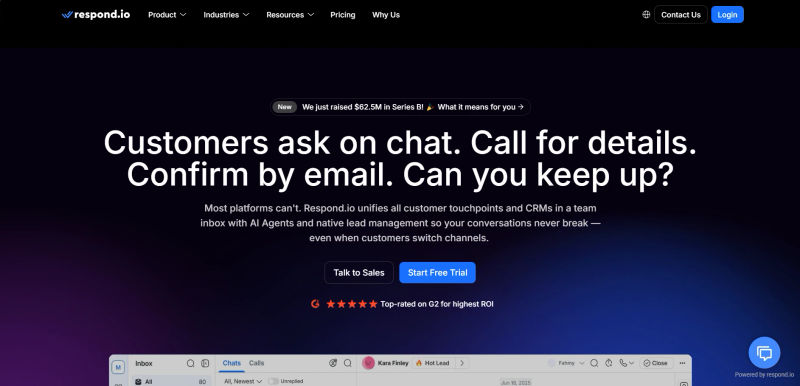
8. Respond.io
Who is this best for? E-commerce companies with large, multi-agent sales and support teams requiring complex conversation routing.
Respond.io is built from the ground up to handle high volumes of inbound conversations across multiple agents. When an e-commerce brand scales to the point where they have dozens of support reps and sales closers, managing WhatsApp becomes a logistical challenge. Respond.io solves this with enterprise-grade routing algorithms, ensuring that VIP customers are instantly routed to dedicated account managers, while general inquiries are distributed evenly among support staff to maintain low response times.
Key E-commerce Use Cases:
VIP Customer Routing: Automatically identify high-lifetime-value (LTV) customers and route their WhatsApp messages to senior sales representatives.
Shift-Based Assignment: Distribute incoming WhatsApp queries based on agent online status, working hours, and language proficiency.
Pros:
Best-in-class multi-agent inbox with advanced collaboration tools (internal notes, tagging, snoozing).
Highly customizable routing logic that prevents bottlenecks during peak shopping seasons.
Cons:
The focus is heavily on the inbox and routing; marketing automation features are secondary.
Can be expensive for teams with a high headcount due to per-seat pricing models.
Pricing Context: Pricing begins at $79/month, but costs scale quickly as you add more user seats and require advanced routing features.
9. Sinch
Who is this best for? Global enterprise e-commerce brands prioritizing carrier-grade reliability, low latency, and maximum API uptime.
Sinch is a global telecommunications giant that provides tier-1 direct connections to carrier networks worldwide. For enterprise WhatsApp API providers, reliability is paramount. During high-traffic events like Black Friday or Cyber Monday, API latency can cost millions in lost sales. Sinch guarantees some of the highest delivery success rates and lowest latencies in the industry, making it the backbone for many of the world's largest e-commerce conglomerates.
Key E-commerce Use Cases:
Mission-Critical Alerts: Deliver time-sensitive fraud alerts or high-value purchase confirmations with guaranteed global delivery.
Global Expansion: Scale WhatsApp commerce into emerging markets with confidence in local network compliance and deliverability.
Pros:
Unmatched infrastructure reliability, ISO 27001 compliance, and global reach.
Direct partnerships with Meta and global carriers minimize points of failure.
Cons:
Strictly an API platform; requires a third-party interface or custom development for non-technical teams to use.
Overkill for SMBs or mid-market brands with localized customer bases.
Pricing Context: Custom enterprise pricing based on committed message volumes. Requires negotiation and typically involves minimum spend thresholds.

10. Gupshup
Who is this best for? Brands looking to implement end-to-end native checkout and advanced AI shopping assistants within WhatsApp.
Gupshup has aggressively positioned itself at the forefront of AI-driven conversational commerce in 2027. The platform excels at creating seamless, end-to-end buying experiences without the user ever leaving the WhatsApp interface. By deeply integrating native product catalogs, localized payment gateways, and GPT-6 level reasoning, Gupshup transforms WhatsApp from a marketing channel into a standalone digital storefront driven by Agentic AI.
Key E-commerce Use Cases:
Native WhatsApp Checkout: Allow customers to browse catalogs, add to cart, and complete payment natively within the WhatsApp chat.
Agentic AI Assistants: Deploy advanced NLP bots that can understand complex product requests (e.g., "Show me red running shoes under $100 in size 10 that can be delivered by tomorrow").
Pros:
Pioneering features for native commerce, in-chat transactions, and autonomous AI.
Strong presence and localized expertise in high-growth WhatsApp markets like India and Latin America.
Cons:
The backend interface can feel dated compared to newer, design-focused startups.
Setting up complex, highly accurate NLP models requires dedicated time and optimization.
Pricing Context: Operates on a pay-as-you-go model per message, with additional costs for advanced AI features and payment gateway integrations.

11. Vonage
Who is this best for? Brands needing programmable messaging deeply integrated with video, voice, and specialized conversational commerce tools like Jumper.ai.
Vonage (now part of Ericsson) offers a highly programmable communication API suite. For e-commerce, their acquisition and integration of Jumper.ai make them a formidable player. Vonage allows brands to create integrated communication workflows where a WhatsApp interaction can seamlessly trigger a live video consultation or a personalized voice note. This is particularly effective for consultative e-commerce, such as custom jewelry or high-end cosmetics, where visual confirmation is required.
Key E-commerce Use Cases:
Consultative Video Commerce: Transition a customer from a WhatsApp text chat into a live video product demonstration instantly.
Social Listening to Chat: Use Jumper.ai capabilities to automatically initiate a WhatsApp conversation when a user comments on a specific social media post.
Pros:
Comprehensive suite of APIs covering video, voice, and messaging.
Strong social commerce features inherited from the Jumper.ai integration.
Cons:
Can be complex to navigate the vast array of APIs and technical documentation.
Requires development resources to fully unlock the cross-channel capabilities.
Pricing Context: Pay-as-you-go API pricing, with separate licensing fees for the Jumper.ai conversational commerce interface.

WhatsApp Business API Trends in 2027
To maximize the ROI of these platforms, e-commerce leaders must align their software choices with the technological realities of 2027. The era of simple, text-based broadcast messages is over. Today, the most successful brands are leveraging hyper-personalized video messaging directly within WhatsApp. By integrating customer data platforms (CDPs) with tools like Treble.ai or SleekFlow, brands can automatically generate and send unique video clips to customers, showcasing products based on their specific browsing history.
Furthermore, the rise of Agentic AI and autonomous shopping assistants has transformed how consumers interact with brands. Instead of navigating a rigid decision tree, customers now expect to converse naturally with an AI that possesses GPT-6 level reasoning. These AI agents can negotiate discounts, check real-time inventory, and process payments without human oversight.
Finally, navigating Meta's API updates remains a constant priority. Meta's shift toward highly segmented, conversation-based pricing (categorizing messages into marketing, utility, authentication, and service) means that choosing a platform with robust analytics is vital. You need software that can accurately track which conversation categories are driving the highest ROI, ensuring your WhatsApp marketing tools for e-commerce remain profitable despite fluctuating Meta fees.
Find Perfect Software for Your Business
Decision Matrix: Which WhatsApp API Platform Should You Choose?
Selecting the best software requires a strategic alignment between your current operational bottlenecks and the platform's core strengths. When evaluating WhatsApp Business API alternatives, making a data-driven software decision means assessing three primary criteria.
1. Message Volume and Team Size
First, assess your current scale. If you are a mid-market Shopify store processing a few thousand orders a month, a plug-and-play solution like Wati.io or ManyChat will provide immediate ROI with an implementation time of under 48 hours. However, if you are an enterprise dealing with millions of monthly active users and require complex, multi-agent routing, platforms like Respond.io or the tier-1 infrastructure of Sinch are absolutely necessary to prevent system crashes during peak events.
2. Technical Stack and CRM Sync
Second, evaluate your technical environment. Do you need a native integration with a specific enterprise CRM? If you rely heavily on Salesforce or HubSpot, Treble.ai offers superior bidirectional synchronization, preventing data silos and allowing marketing ops to trigger campaigns based on CRM field updates. If you are operating a custom headless e-commerce build, you will likely need the raw API access provided by Twilio or Vonage to build bespoke, programmable workflows.
3. Primary Use Case and ROI Calculation
Finally, pinpoint your primary objective and run a strict ROI calculation. Are you trying to reduce customer acquisition costs via Instagram ads? ManyChat is your best bet. Are you trying to close high-ticket sales that require human intervention? CallHippo's voice integration is ideal. Are you pushing for fully autonomous, AI-driven native checkout? Gupshup leads the pack.
When calculating ROI, remember to factor in WhatsApp Business API pricing 2027 updates. Beyond the platform's monthly subscription fee, you must account for hidden costs like Meta's conversation-based pricing and any markup the API provider adds per message. Use this simple ROI formula: (Value of Recovered Carts + LTV of Retained Customers) - (Platform Cost + Meta Fees + Provider Markup) = Realized ROI. Additionally, ensure your chosen platform passes a rigorous security review checklist, verifying GDPR, SOC2, and regional data residency compliance before signing a contract.
Try AuthenCIO
Move to faster, smarter software evaluation with AI
Conclusion: Automating Your Path to E-commerce Growth
The era of relying solely on email and traditional social ads is ending. In 2027, e-commerce growth is driven by immediate, frictionless, and highly personalized conversational commerce. Implementing a WhatsApp Business API is no longer a luxury; it is a fundamental requirement for scaling sales, automating customer support, and driving repeat purchases.
Whether you choose the Agentic AI workflows of Treble.ai, the developer flexibility of Twilio, or the multi-agent routing of Respond.io, the key is to select a platform that aligns with your specific e-commerce goals. Your first step today should be to audit your current cart abandonment rate and calculate how much revenue a 15% recovery lift would generate. Stop losing sales to slow response times and generic marketing blasts. Evaluate your options, leverage side-by-side comparisons, and integrate the right WhatsApp automation software to secure your brand's competitive dominance in the modern retail landscape.