

Introduction
When evaluating cloud communications software pricing in 2027, Quo OpenPhone offers a competitive entry point starting at $19 per user per month. However, the true cost of ownership depends heavily on your need for advanced AI, CRM integrations, and international calling—features often gated behind its $47+ premium tiers.
Streamline your software evaluation process
As a startup founder or collaborative team lead, you need a transparent, granular breakdown of this price-performance ratio rather than generic promises. Cloud telephony has shifted from a simple calling replacement into a broader communications layer combining voice, messaging, meetings, workflow integrations, analytics, and security.
Evaluating Quo OpenPhone pricing against top competitors requires looking past the advertised monthly rate. Crucially, decision-makers must factor in switching costs—specifically the time and data migration required to move off legacy systems—as a critical component of the total price-performance ratio.
This guide breaks down exactly what you get with Quo OpenPhone, what is hidden behind premium paywalls, and how its cloud communications software pricing compares to industry alternatives like Unitel Voice, Nextiva, KrispCall, Dialpad, Zoom Phone, Grasshopper, and RingCentral. We will evaluate value for money, hidden administrative costs, and plan limitations to help you choose a platform that scales seamlessly from a two-person founding team to a fifty-person collaborative department.
2027 Virtual Phone Price-Performance Comparison
Plan | Best For | Pricing (USD $) | Limitations |
Quo OpenPhone | Collaborative startup teams | $19 - $47+ /user/mo | Advanced AI and CRM integrations gated behind premium tiers |
Unitel Voice | Simple small business setup | $14.99 /mo | Lacks advanced team collaboration and AI features |
Grasshopper | Mobile-first professionalism | $28 - $80 /mo | Outdated UI in 2027; no shared inbox capabilities |
Nextiva | Scaling unified communications | $25 - $35+ /user/mo | Complex setup; best pricing requires annual minimums |
RingCentral | Feature-rich enterprise needs | $30 - $40+ /user/mo | Feature bloat; steep learning curve; expensive add-ons |
KrispCall | High-volume international teams | $15 - $40 /user/mo | Integrations are not as deep as premium competitors |
Dialpad | AI-powered team productivity | $23 - $35 /user/mo | Minimum seat requirements for premium AI features |
Zoom Phone | Video-centric workflows | $10 - $25 /user/mo | Standalone phone lacks native shared inbox collaboration |
*Note: All prices shown reflect typical monthly billing. Vendors often offer lower pricing for annual commitments, but those discounts are excluded here for easier comparison. Actual costs may vary depending on your requirements, usage volumes, and negotiated terms.
Software Covered in this Article
The following articles break down the key aspects of Cloud Communications Software, featuring a carefully curated set of key players:







Key Takeaways: Cloud Communications Software Pricing at a Glance
Cloud communications software pricing in 2027 generally falls into three distinct tiers: budget ($10–$19 per user/month), standard business ($19–$33 per user/month), and enterprise ($33–$47+ per user/month). Finding the best value requires matching your team's size and communication needs to the right tier before hidden fees add up.
Here is a quick selection guide to help you navigate the current market:
Best Overall Value: Quo OpenPhone hits the sweet spot for startups and small teams, offering affordable per-user pricing with powerful shared inbox and SMS capabilities.
Best for Solopreneurs: Unitel Voice and Grasshopper provide the lowest barrier to entry if you only need basic call routing and a professional business number.
Best for Enterprise & AI: Nextiva, RingCentral, and Dialpad command higher price points but justify the cost with advanced AI transcriptions, deep CRM integrations, and global compliance.
When evaluating cloud communications software pricing, remember that the advertised per-user rate is rarely the final bill. Always budget an additional 15% to 20% for telecom taxes, international calling rates, and mandatory SMS registration fees (A2P 10DLC).
Quo OpenPhone Pricing 2027: What Do You Actually Get?
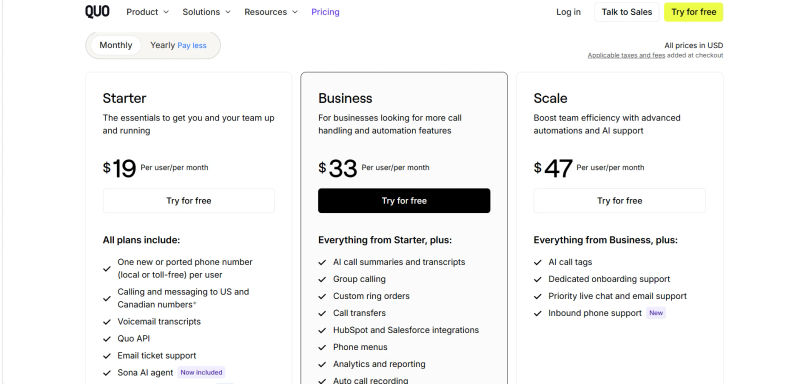
Quo OpenPhone uses a per-user, per-month pricing model across its Starter, Business, and Enterprise tiers. When evaluating this cloud communications software, the critical question is whether its collaborative features justify the cost.
For your monthly fee, Quo OpenPhone transforms a traditional phone number into a shared workspace featuring shared inboxes, internal comment threads, and unified communication views. However, understanding feature gating is essential to avoid unpredictable billing, as tools like CRM integrations require higher-tier upgrades.
Who is this best for? Quo OpenPhone is best for collaborative startup teams requiring shared inboxes and unified communications without the heavy administrative burden of traditional PBX systems.
OpenPhone Team Plans Cost: Starter vs. Business
At $19 per user per month, the Starter plan delivers the core cloud communications software functionality required for a small founding team. This includes one local or toll-free number per user, basic SMS/MMS capabilities, and access to shared numbers. For a two-person team, this tier offers an excellent price-performance ratio. However, the limitations become apparent as you scale. The Starter plan explicitly excludes advanced CRM integrations and AI-driven features, meaning your team will have to manually log calls and messages—a significant hidden administrative cost that lowers long-term ROI.
Priced at $33 per user per month, the Business plan is where OpenPhone unlocks its true cloud communications software value. This tier introduces native integrations with modern startup CRMs like HubSpot, Salesforce, Pipedrive, and Attio, eliminating the need for expensive third-party middleware. More importantly, it includes 2027 AI capabilities such as automated call summaries and basic sentiment analysis, driving immediate ROI through time savings.
Decision-makers must also clarify the distinction between "per user" seat costs and "per additional number" fees. While the $33 seat license covers the user and their primary number, adding dedicated numbers for specific marketing campaigns or regional presence incurs a per additional number fee, typically around $5 per month.
The collaborative ROI of the Business plan is substantial. By utilizing shared inboxes and internal threads, teams eliminate the siloed communication that plagues legacy phone lines. However, a major limitation to watch out for is feature gating. If your startup requires advanced compliance controls, custom analytics, or dedicated account management, you will be forced into the custom-priced Enterprise tier, which can drastically alter your initial budget projections.
Find Perfect Software for Your Business
1. Unitel Voice and Grasshopper: Best Budget Alternatives for Solopreneurs
If your startup operates with a leaner budget or you do not yet need the deep collaborative features of Quo OpenPhone, legacy virtual phone providers still hold a specific place in the 2027 market.
Unitel Voice
Who is this best for? Unitel Voice is best for simple small business setups and solopreneurs who primarily need a professional toll-free number and basic call routing without paying for unused software features.
At a flat rate starting around $14.99 per month, Unitel Voice offers a straightforward, no-frills approach to business telephony.
The pricing difference between Unitel Voice and Quo OpenPhone is significant when calculating the cost for a single user.
However, the value for money rapidly decreases if you attempt to use Unitel Voice for a collaborative team.
Team members cannot seamlessly collaborate on incoming SMS or voicemails, and connecting Unitel Voice to a modern tech stack often requires manual workarounds.
Grasshopper
Who is this best for? Grasshopper is best for mobile-first professionalism, specifically catering to founders who want to keep their personal and business calls separate on a single mobile device.
Grasshopper’s 2027 pricing model remains distinct by charging a flat monthly fee (ranging from $28 to $80) based on the number of phone numbers and extensions, rather than a per-user seat license.
For a startup with five employees who only need call forwarding to their personal cell phones, Grasshopper presents a compelling budget option.
However, compared to the modern ecosystem of Quo OpenPhone, Grasshopper's UI feels legacy, and it functions strictly as a routing tool, not a workspace.
The Migration Dead-End Risk
While Unitel Voice and Grasshopper are cheaper upfront, the lack of a growth path to AI or shared inboxes may create higher long-term costs when the team eventually needs to migrate.
This "migration dead-end" means that as soon as you hire your fifth employee and need collaborative workspaces, you will be forced to rip and replace your entire telephony stack, incurring massive switching costs.
2. Nextiva and RingCentral: Best Enterprise-Grade Upgrades
As startups scale into mid-market companies, their communication needs often outgrow lightweight collaborative tools.
This is where unified communications as a service (UCaaS) giants come into play, offering robust platform consolidation.
Skip the sales pitch. Get a neutral, unbiased review of Quo plans on AuthenCIO's comparison engine.
Nextiva Core vs. Power Pricing
Who is this best for? Nextiva is best for scaling unified communications, particularly for teams that need to combine internal telephony with high-volume customer support and contact-center functions.
Nextiva's 2027 pricing typically ranges from $25 to $35+ per user per month depending on whether you choose their Core or Power tiers.
The value for money here lies in reliability and ecosystem depth.
Nextiva provides advanced call routing, comprehensive video conferencing, and deep workflow automations that Quo OpenPhone’s Business tier may struggle to match at scale.
However, Nextiva’s best advertised rates often require annual contracts and minimum user counts.
Startups value month-to-month flexibility, so locking into a multi-year agreement to secure the best price-performance ratio is a significant hidden constraint.
Furthermore, unlike Quo OpenPhone's self-service provisioning, Nextiva often requires dedicated IT involvement to deploy correctly.
RingCentral Ultra Cost
Who is this best for? RingCentral is best for feature-rich enterprise needs, catering to organizations that require stringent compliance, global deployment, and custom API integrations.
At $30 to $40+ per user per month for their premium Ultra tiers, RingCentral is a massive investment.
It justifies this price tag by offering an unparalleled breadth of features, from advanced agentic AI coaching to massive webinar hosting capabilities.
The primary limitation is feature bloat.
For a standard startup team, 80% of RingCentral's features will go unused, resulting in a poor price-performance ratio.
Additionally, premium integrations and advanced AI analytics are frequently treated as paid add-ons, inflating the base cost well beyond the advertised per-user rate.
3. KrispCall, Dialpad, and Zoom Phone: Best for Global and AI-Driven Teams
Startups in 2027 are increasingly borderless and highly reliant on artificial intelligence to maximize productivity.
If your primary use case involves international expansion or cutting-edge AI, these three competitors offer specific advantages over Quo OpenPhone.
KrispCall
Who is this best for? KrispCall is best for high-volume international teams that require local presence and virtual numbers in over 100 countries.
KrispCall’s pricing starts at a highly competitive $15 per user per month.
Local presence is a specific growth tactic for startups, and KrispCall excels by offering the ease of acquiring local numbers in over 100 countries.
When comparing international expansion costs, KrispCall often beats Quo OpenPhone by offering cheaper rates for adding global numbers and lower per-minute fees for international calling and SMS.
The trade-off is integration depth; while it connects with major CRMs, the data sync is not always as real-time or comprehensive as Quo OpenPhone's native connections.
Dialpad
Who is this best for? Dialpad is best for AI-powered team productivity, specifically for sales and support teams that rely on real-time coaching and sentiment analysis.
Dialpad has positioned itself as the AI leader in the VoIP space.
At roughly $23 to $35 per user per month, Dialpad includes its proprietary Voice Intelligence (Vi) technology in its core plans.
This means real-time transcription, automated post-call summaries, and live manager alerts are built-in.
ROI Calculation: If your startup currently pays $30 per month per user for a third-party transcription tool like Otter.ai or Fireflies, Dialpad’s built-in AI effectively absorbs that cost, making the true effective price much lower.
However, Dialpad often gates its most powerful AI features and CRM integrations behind its Pro tier, which requires a minimum number of user seats.
Zoom Phone
Who is this best for? Zoom Phone is best for video-centric workflows, ideal for teams already deeply entrenched in the Zoom ecosystem for daily meetings.
Zoom Phone offers aggressive pricing, often starting between $10 and $15 per user per month for metered plans, with unmetered options slightly higher.
The primary value proposition is consolidation; if you are already paying for Zoom Workplace, adding Zoom Phone is a frictionless upgrade.
The massive limitation here is the lack of shared threads.
Zoom Phone operates like a traditional PBX mapped onto a modern app.
It does not offer the thread-based, shared inbox collaboration that makes Quo OpenPhone so popular among startups.
Ecosystem Synergy: Slack, Teams, and Mobile Reliability
When calculating the best business phone system value 2027 has to offer, decision-makers must evaluate ecosystem synergy.
A phone system does not exist in a vacuum; it must seamlessly integrate into the tools your team already uses daily.
Slack Integration Depth
Most startups live in Slack.
The quality of that integration is a major cost factor, as context switching destroys productivity.
Quo OpenPhone allows teams to log calls, drop voicemails, and reply to SMS directly within Slack channels.
This depth of integration ensures that external communications are visible to the entire team without forcing them to leave their primary workspace.
Competitors like Unitel Voice and Grasshopper lack this deep synergy, forcing users to constantly switch between apps.
Mobile App Reliability
For a collaborative team, a buggy mobile app is a massive hidden productivity cost.
Startup founders are rarely tied to a physical desk, making mobile reliability paramount.
Quo OpenPhone and Dialpad invest heavily in consumer-grade mobile experiences, ensuring push notifications for calls and texts arrive instantly.
In contrast, legacy systems often struggle with mobile app latency, leading to dropped calls and missed SMS notifications, which can directly impact revenue and client satisfaction.
Hidden Costs: What Virtual Phone Providers Do Not Tell You
When evaluating cloud communications software pricing, the advertised per-seat rate is only the baseline. In 2027, the true Total Cost of Ownership (TCO) for a virtual phone system is dictated by regulatory compliance, usage limits, and premium feature gating.
To accurately calculate your TCO, you must account for the following hidden factors across all platforms.
1. The 2027 Regulatory Landscape and A2P 10DLC Costs
A major hidden factor in cloud communications software pricing is A2P 10DLC (Application-to-Person 10-Digit Long Code) compliance. Carriers mandate strict registration for businesses sending SMS to prevent spam. Providers pass on one-time registration fees (typically $15 to $50) and ongoing monthly campaign fees. While Quo OpenPhone simplifies this registration directly within its dashboard, the carrier fees still apply. Competitors like Nextiva and RingCentral may require more manual, time-consuming registration processes, adding to your administrative burden.
2. Porting Fees and Deployment Overlap
The time-cost of porting numbers often delays deployment. Some legacy providers intentionally complicate the porting-out process, resulting in weeks of overlap where you are paying for two systems simultaneously. Always verify if a provider charges a premium for porting existing business numbers or if they provide dedicated support to ensure zero service interruption.
3. Unpredictable Usage-Based Fees
While base plans often advertise "unlimited" domestic calling and texting, the fine print usually reveals strict fair use policies. Furthermore, international SMS, toll-free minutes, and global calling are almost always billed on a usage basis. If your startup frequently communicates with overseas contractors or clients, these per-minute and per-message rates can cause unpredictable monthly billing.
4. The Cost of AI and Feature Gating
As AI becomes the standard pricing differentiator in 2027, providers use it to drive upgrades. Basic cloud communications software pricing runs $15–$24 per user, but AI-enabled offerings (featuring automated call summaries, sentiment analysis, and live transcription) commonly price at $28–$42. If you purchase a base plan expecting AI tools, you will likely find those features locked behind an unaffordable Enterprise tier.
Try AuthenCIO
Move to faster, smarter software evaluation with AI
Conclusion: Choosing the Best Phone System for Your Startup
Navigating cloud communications software pricing requires aligning a platform's cost-to-feature ratio with your startup's immediate needs.
If your priority is seamless internal collaboration, shared inboxes, and a modern workspace feel, Quo OpenPhone remains the top choice for startup teams, provided you budget for the Business tier to unlock essential CRM and AI features.
If your roadmap includes rapid scaling, high-volume support, or deep AI integration, evaluating the pricing structures of Dialpad, Nextiva, or Zoom Phone is necessary to ensure you do not outgrow your system within the year.
When comparing cloud communications software pricing, always calculate your Total Cost of Ownership (TCO) by factoring in A2P 10DLC fees, porting costs, international rates, and the administrative time required to manage the platform.