

Quo OpenPhone Review 2027: Best Team Phone for Startups?
Welcome to our comprehensive cloud communications software review of Quo OpenPhone for 2027. In this in-depth evaluation, we analyze its core features, pricing, and overall performance to determine if it truly stands out as the premier team phone solution for modern startups and growing businesses.
Introduction: The 2027 Verdict on Quo OpenPhone
Startup founders and operations managers require unified, highly visible cloud communications software to manage client interactions. Quo (the 2027 premium collaborative tier and rebrand of the classic OpenPhone platform) consistently positions itself as the premier all-in-one cloud phone system designed specifically for the modern, distributed workforce. But when evaluating OpenPhone vs competitors 2027, decision-makers must ask a critical question: is this platform truly the best cloud communications solution for collaborative teams, or does it fall short when scaling beyond the initial startup phase?
Streamline your software evaluation process
This comprehensive cloud communications software review strips away the marketing jargon to provide a raw, consultant-level verdict on Quo OpenPhone. We evaluate its shared inbox functionality, VoIP reliability, administrative controls, mobile performance, and overall value proposition to help you determine if it is the right investment for your growing business.
Key Takeaways: Cloud Communications Software Review
Target Audience: Fully remote startups and collaborative support teams needing shared visibility on VoIP calls and SMS without physical hardware.
Software Capabilities: Replaces complex legacy PBX systems with a modern, app-like interface, allowing internal tagging and shared inbox management.
Integration & Scalability: Offers native integrations with HubSpot, Salesforce, and Notion, though highly complex routing needs may require an enterprise alternative.
Cost Efficiency: Transparent pricing ($15-$25+/user/month) makes it highly cost-effective for lean operations, with minimal hidden fees compared to traditional telecom.
To help you make an immediate, informed decision, the table below provides a highly scannable comparison of Quo OpenPhone and its top cloud communications software competitors in the 2027 market, evaluating pricing, use cases, and hidden costs.
Tool | Best For | Pricing (USD $) | Key Features | Use Cases | Native CRM Integrations | Hidden Costs |
Quo OpenPhone | Collaborative Startups | $19 - $47+ /user/mo | Shared inbox, AI transcription, automated workflows | Remote teams needing shared visibility on calls and texts | HubSpot, Salesforce, Notion | $5/mo per extra phone number |
Nextiva | Enterprise Scaling | $21 - $45+ /user/mo | Advanced routing, CRM integrations, robust analytics | Mid-market companies requiring complex PBX setups | Deep Enterprise CRMs (Oracle, NetSuite) | High initial setup and onboarding fees |
Dialpad | AI-Driven Sales | $15 - $23+ /user/mo | Real-time AI coaching, sentiment analysis, voice intelligence | High-volume sales and support teams focusing on call quality | Salesforce, Zendesk, HubSpot | Advanced AI features locked behind highest tiers |
Zoom Phone | Unified Ecosystems | $10 - $20+ /user/mo | Video/voice convergence, global coverage, native Zoom integration | Teams already heavily invested in the Zoom ecosystem | Salesforce, Slack, Microsoft Teams | Metered outbound international calling rates |
RingCentral | Global Enterprises | $20 - $35+ /user/mo | Limitless integrations, enterprise-grade security, global PBX | Large corporations with complex, multi-national telecom needs | Almost all major CRMs and ERPs | Complex IT management and certification costs |
KrispCall | International Reach | $15 - $40+ /user/mo | Unified callbox, global numbers, affordable scaling | Startups with an international client base and remote workforce | Pipedrive, HubSpot, Zapier | Premium rates for specific international regions |
Grasshopper | Solopreneurs | $14 - $80+ /account/mo | Simple call forwarding, virtual receptionist, basic SMS | Small local businesses and solo founders needing a professional number | None natively (relies on third-party connectors) | Highly limited collaborative text capabilities |
Unitel Voice | Bootstrapped Startups | $10 - $30+ /account/mo | Toll-free numbers, auto-attendant, simple setup | Early-stage ventures prioritizing basic, low-cost professional routing | None natively | Per-minute overage charges on basic plans |
*Note: All prices shown reflect typical monthly billing. Vendors often offer lower pricing for annual commitments, but those discounts are excluded here for easier comparison. Actual costs may vary depending on your requirements, usage volumes, and negotiated terms.
Is Quo the best all-in-one phone for your team? Compare it with top virtual phones on AuthenCIO.
The Unfiltered Truth: Quo OpenPhone Pros and Cons
To make an informed decision, you must look past the promotional language and understand both the strengths and the platform's drawbacks.
The 2027 Pros:
Unmatched Collaborative Visibility: The shared inbox fundamentally changes how teams handle customer support and sales, eliminating duplicate efforts.
Intuitive User Experience: The platform requires virtually no training. It feels like a modern messaging app, ensuring high adoption rates among non-technical staff.
Robust Security Standards: In 2027, Quo OpenPhone fully complies with industry standards like SOC2 and GDPR, providing peace of mind for startups handling sensitive client data.
Seamless CRM Integrations: The native integrations with major CRMs are stable, reliable, and deeply customizable.
The 2027 Cons:
Scaling Limitations: While perfect for teams of 5 to 50, managing granular permissions and complex routing hierarchies for 100+ users can become cumbersome.
Internet Dependency: Call quality is entirely dependent on your internet connection. In areas with poor infrastructure, latency and dropped calls remain a risk.
Transcription Flaws: The AI struggles with heavy accents and niche industry terminology.

Software Covered in this Article
The following articles break down the key aspects of Cloud Communications Software, featuring a carefully curated set of key players:







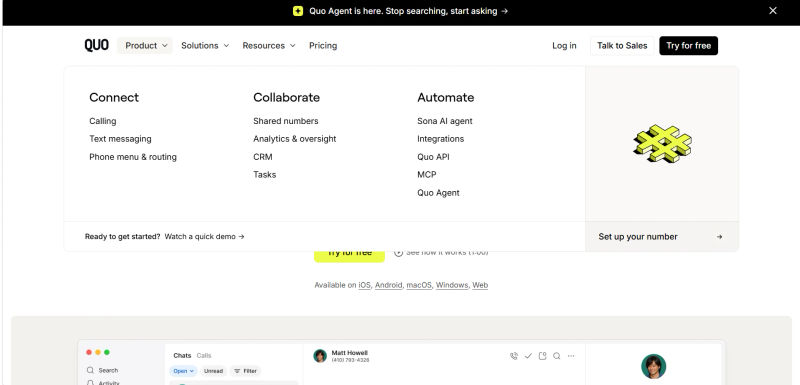
Core Features: How Quo OpenPhone Built for Collaborative Teams
In this 2027 cloud communications software review, Quo OpenPhone stands out by transforming traditional business numbers into shared workspaces. Rather than functioning as a legacy VoIP utility, the platform operates as a modern, cloud-native productivity application. By centralizing voice, SMS, and internal threads, it directly addresses the communication demands of distributed teams. Here is a detailed evaluation of its core capabilities.
Skip the sales pitch. Get a neutral, unbiased review of Quo on AuthenCIO's comparison engine.
1. Unified Team Communication and Shared Contacts
The standout feature of Quo OpenPhone remains its shared inbox. In traditional phone systems, incoming calls or texts to a business number ring a single device, creating a massive bottleneck. Quo OpenPhone allows multiple team members to share a single phone number. When a client texts or calls, everyone with access can see the communication history in real-time.
Where Quo truly shines is its internal threads. Team members can use the "@" mention feature directly within an active call log or text thread to ask a colleague a question without the customer ever seeing it. This eliminates the "who is handling this client?" confusion that plagues growing sales and support teams. Furthermore, the shared business contacts app ensures that your entire team is working from a single, updated directory.
2. Modern Interface and Cross-Platform Performance
For a distributed workforce, mobile app performance is non-negotiable. In 2027, Quo OpenPhone's mobile application is highly refined. Benchmarking stats against top competitors show that Quo has significantly optimized its battery drain, a common complaint in previous years. Whether your team is using iOS, Android, macOS, or Windows, the interface remains consistent and intuitive.
However, an honest assessment of call quality reveals that while latency is virtually non-existent on stable broadband, teams operating in regions with suboptimal internet infrastructure may still experience occasional jitter. This is a limitation inherent to most cloud-based VoIPs but worth noting for international travelers.
3. Advanced Automation and Workflow Integrations
Quo OpenPhone has heavily invested in 2027 AI-driven features. Automated call transcription and real-time sentiment analysis are natively integrated, providing team leads with data for coaching without needing to listen to hours of recordings. Setting up automated workflows between Quo OpenPhone and CRMs like HubSpot, Salesforce, or flexible databases like Notion has been simplified into easy "recipes."
However, decision-makers should be aware of the AI transcription limitations. While excellent for standard conversational English, the AI currently struggles with heavy regional accents and deep technical jargon, occasionally resulting in garbled transcripts that require manual review.
4. High-Volume SMS and MMS Marketing Compliance
Managing business calls on a personal smartphone often leads to compliance nightmares. Quo OpenPhone addresses this by offering robust administrative controls for managing permissions across multiple departments. More importantly, navigating high-volume SMS and MMS marketing compliance (such as A2P 10DLC regulations) is critical. Quo OpenPhone provides built-in trust registration portals, ensuring your startup's marketing messages reach customer inboxes rather than being flagged as spam by mobile carriers.
5. Actionable Implementation: Migration and Technical Requirements
Transitioning to Quo OpenPhone requires careful planning. Here is a step-by-step migration guide for porting existing numbers:
Verify Eligibility: Ensure your current numbers are active and unlocked with your legacy provider.
Submit Port Request: Use Quo OpenPhone's dashboard to submit a Letter of Authorization (LOA) and a recent phone bill.
Set Up Temporary Numbers: Assign temporary Quo numbers to your team and set up your IVR (Interactive Voice Response) menus.
Configure Workflows: Integrate your CRM and set up shared inbox permissions before the ported numbers go live.
Test and Deploy: Once the port completes, run test calls across all devices to ensure routing rules function correctly.
Pro-Tip for Business Continuity: While Quo advertises a 5-7 day porting window, raw industry data shows this can sometimes take up to 14 days depending on your legacy carrier. Always keep your legacy lines active as a "Plan B" until the port is 100% confirmed to avoid catastrophic downtime.
Quo OpenPhone Pricing 2027: Is It Worth the Cost?
Quo OpenPhone remains one of the most cost-effective cloud communications platforms for startups in 2027, provided teams account for add-on costs as they scale. By consolidating voice, SMS, and basic CRM functions, it often eliminates the need for a fragmented tool stack.
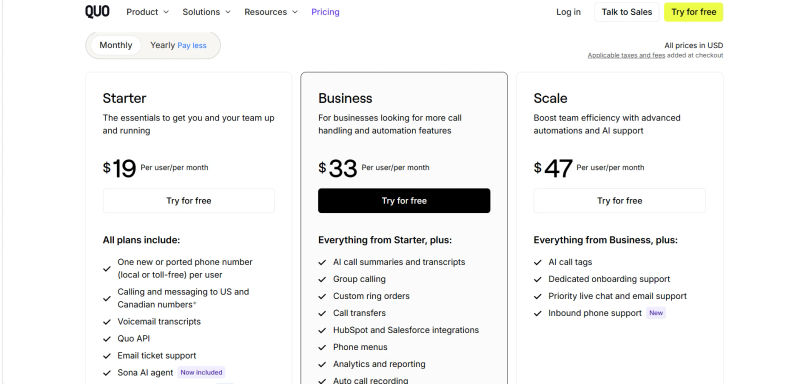
The Starter Tier ($19/user/month) Built for early-stage startups and small teams, the Standard tier includes unlimited calling and texting in the US and Canada, shared phone numbers, and basic integrations (like Slack and email). For a lean team, this is the most affordable way to establish a professional, unified presence.
The Business Tier ($33/user/month) This tier unlocks Quo OpenPhone's collaborative powerhouse features. It adds advanced AI call transcriptions, analytics, ring groups, CRM integrations (HubSpot, Salesforce), and priority support. For teams relying on data visibility, the Premium tier delivers high ROI by eliminating hours of manual CRM logging.
Hidden Scaling Costs and Add-ons Decision-makers must budget for usage-based and add-on fees:
Extra Numbers: Each user gets one included number. Additional numbers (for localized presence or specific campaigns) cost $5 per month per number.
International Rates: Calls and texts outside the US/Canada require pay-as-you-go credits.
Compliance Fees: Standard A2P 10DLC registration fees apply for SMS marketing compliance.
The Enterprise Tier (Custom Pricing) Designed for larger organizations, this tier provides dedicated account management, audit logs, and custom API access. However, enterprises requiring highly complex, multi-level global IVR routing may still find legacy enterprise solutions more accommodating.
Find Perfect Software for Your Business
Top Quo OpenPhone Alternatives to Consider in 2027
No single tool is perfect for every business. Depending on your specific operational needs, one of these top alternatives might be a better fit for your startup.
1. Quo OpenPhone vs. Nextiva
Nextiva is the heavyweight champion of enterprise scalability. While Quo OpenPhone focuses on a modern, app-like experience for shared inboxes, Nextiva is built for complex PBX routing, massive call centers, and deep enterprise CRM integrations. If your startup is rapidly scaling into a mid-market enterprise with hundreds of employees and requires advanced call queuing and legacy hardware support, Nextiva is the superior choice. However, for a lean, agile team, Nextiva's interface can feel bloated and overly complex.
2. Quo OpenPhone vs. Dialpad
Dialpad is the direct competitor to Quo OpenPhone when it comes to modern, AI-driven VoIP. Dialpad's primary advantage lies in its Voice Intelligence (Vi) technology, which offers real-time sales coaching, live sentiment analysis, and automated post-call summaries. If your primary goal is to arm an outbound sales team with real-time AI assistance, Dialpad wins. Conversely, if your goal is collaborative customer support and shared inbox management, Quo OpenPhone's UI is far more intuitive.
3. Quo OpenPhone vs. Zoom Phone
Zoom Phone makes sense for one specific use case: your team already lives entirely within the Zoom ecosystem. By converging video, voice, and chat into a single application, Zoom Phone reduces app fatigue. However, a critical failure point for Zoom Phone is its collaborative SMS functionality. Zoom's text messaging feels clunky and bolted-on, lacking the fluid, shared inbox visibility and internal threading that makes Quo OpenPhone so powerful for team coordination.
4. Quo OpenPhone vs. RingCentral
RingCentral is the legacy giant of the VoIP world. It offers limitless integrations, enterprise-grade security, and a feature list that covers every conceivable telecom need. The trade-off is complexity and cost. RingCentral's interface is dated compared to Quo OpenPhone, and the setup process often requires dedicated IT support. Choose RingCentral only if your startup has highly complex, multinational telecom requirements that Quo cannot handle.
5. Quo OpenPhone vs. KrispCall
KrispCall is an excellent alternative for startups with a heavy international presence. It offers a unified callbox and makes acquiring international numbers incredibly easy and affordable. While Quo OpenPhone is heavily focused on the North American market, KrispCall provides better flexibility for global remote teams. However, Quo OpenPhone's native integrations and AI features are generally more mature than KrispCall's current offerings.
6. Quo OpenPhone vs. Grasshopper
Grasshopper is designed for a completely different audience: solopreneurs and local small businesses. It focuses on simple call forwarding to personal devices and basic virtual receptionist features. It lacks the shared inbox, AI transcriptions, and CRM integrations that define Quo OpenPhone. If you are a solo founder who just needs a professional number to mask your personal cell phone, Grasshopper is sufficient. If you have a team, Quo OpenPhone is mandatory.
7. Quo OpenPhone vs. Unitel Voice
Similar to Grasshopper, Unitel Voice is best for bootstrapped startups that need a basic, low-cost toll-free number and an auto-attendant. It is a no-frills service that gets the job done for early-stage ventures. However, as soon as you hire your first customer support representative or sales agent, you will outgrow Unitel Voice's capabilities and need the collaborative features of Quo OpenPhone.
Use Case Evaluation: Who Should Actually Use Quo OpenPhone?
To drive your decision-making process, let's evaluate how Quo OpenPhone performs across specific business scenarios.
The Remote Startup Team
For a fully distributed startup team of 15 people handling customer inquiries, vendor calls, and internal communications, Quo OpenPhone is arguably the best tool on the market in 2027. The ability to tag team members in a shared text thread, leave internal notes on a call log, and maintain a unified professional image while using personal smartphones perfectly solves the pain points of remote collaboration.
The High-Volume Sales Team
If your startup is heavily focused on outbound sales, the decision is nuanced. Quo OpenPhone's CRM integrations and auto-logging save time, and the AI transcriptions help with post-call review. However, if your sales directors require real-time, on-call AI coaching to guide representatives through objections, Dialpad's specialized features will serve you better. Quo is excellent for sales, but it prioritizes collaboration over real-time individual coaching.
The Scaling Enterprise
As your startup crosses the 50-employee threshold and begins establishing distinct departments with complex routing rules (e.g., "Press 1 for Support, which routes to Tier 1, then cascades to Tier 2 after 30 seconds, unless it's after hours"), Quo OpenPhone's administrative backend can feel restrictive. For highly complex PBX needs, migrating to Nextiva or RingCentral becomes a necessary, albeit painful, operational upgrade.
Try AuthenCIO
Move to faster, smarter software evaluation with AI
Final Verdict: Making Your Decision
In 2027, Quo OpenPhone stands out as a masterclass in collaborative communication. By reimagining the phone number as a shared workspace, it directly solves the visibility and coordination issues that plague growing startups. Its modern interface, robust AI features, and seamless CRM integrations make it an exceptional choice for teams looking to abandon legacy telecom jargon in favor of a productivity-focused app.
However, it is not a universal silver bullet. Startups requiring advanced real-time sales coaching might prefer Dialpad, while those scaling into complex enterprise structures may need the heavy-duty routing capabilities of Nextiva or RingCentral. Your ultimate choice should be dictated by your team's specific workflows, growth trajectory, and integration needs. Do not settle for a generic description; dive into the features that matter most to your daily operations.
Final Recommendation Box: Who Should Buy This Today?
If you are a startup founder or operations manager leading a remote team of 2 to 50 employees, and your primary pain point is a lack of visibility into client communications across fragmented personal devices, Quo OpenPhone is the definitive purchase for you today. It will immediately centralize your communications, streamline your CRM data entry, and professionalize your client-facing image.
Take the time to assess your bandwidth capabilities, map out your ideal customer communication journey, and weigh the long-term costs. By aligning your operational requirements with the right platform, you ensure that your team remains connected, professional, and ready to scale.