
Introduction
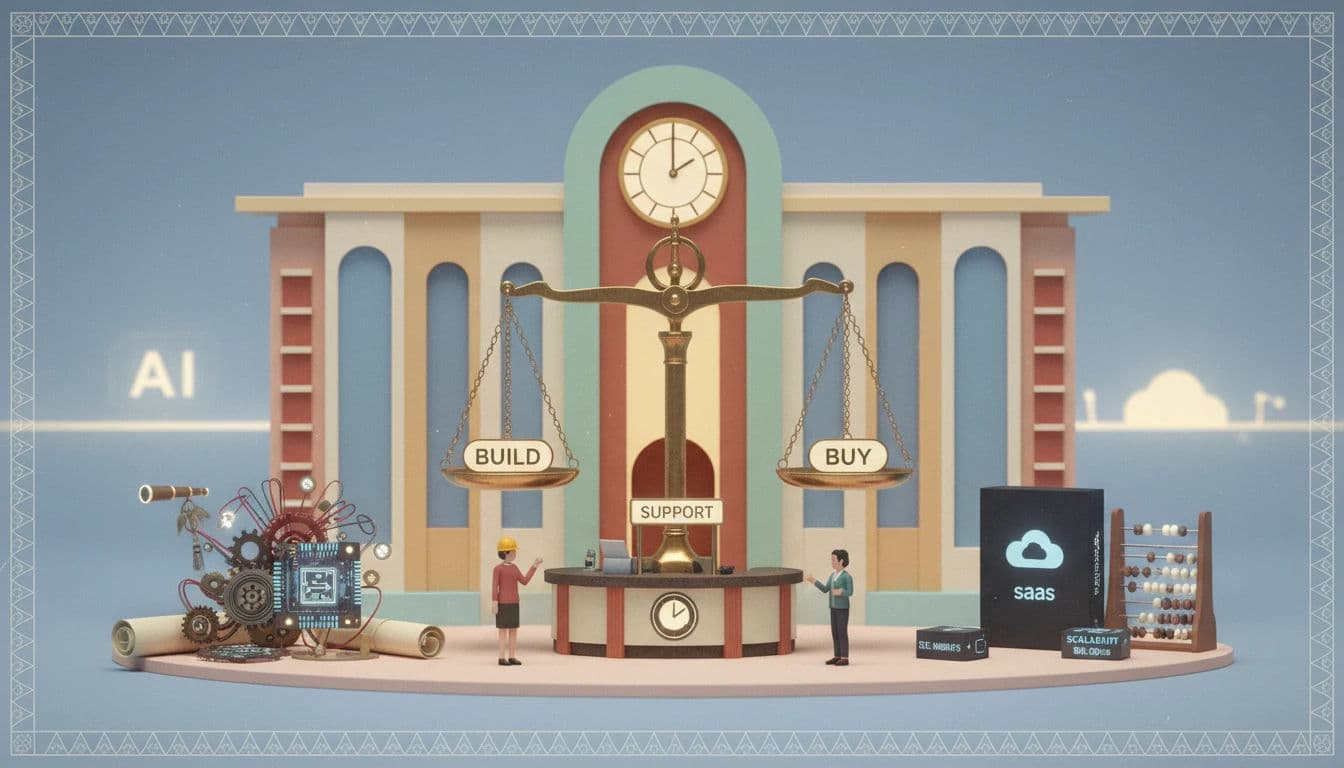
When deciding whether to build a custom customer support solution or buy an off-the-shelf platform, the answer hinges on one core question: Is your support workflow a unique competitive advantage, or is it a standard operational requirement? For most organizations, purchasing a mature SaaS solution is the most cost-effective and scalable choice. However, highly regulated or hyper-specialized industries may still require custom builds.
Streamline your software evaluation process
Engineering teams often fall into the "Not Invented Here" (NIH) trap, assuming commercial products cannot handle their specific workflows. But as demands for AI-driven automation and omnichannel support increase, the cost of maintaining internal tools skyrockets. Best practice dictates preserving your engineering resources for your core product unless a custom support tool directly drives revenue.
To navigate this decision without relying on guesswork, you need a structured approach. This guide breaks down the build vs. buy dilemma into actionable best practices. We will explore a six-pillar evaluation framework, analyze the true Total Cost of Ownership (TCO), and provide real-world scenarios to help you choose the right path for your support infrastructure.
Key Takeaways for Decision Makers
Opportunity Cost is the Real Price: Every hour spent maintaining a support tool is an hour stolen from your core revenue-generating product.
SaaS is No Longer Rigid: Modern API-first platforms offer extensibility that rivals custom builds without the infrastructure overhead.
The AI Gap: Commercial vendors are deploying LLM capabilities faster than most internal teams can scope them.
TCO is Multi-Year: Initial build costs are deceptive; maintenance, compliance, and migration constitute the bulk of long-term expense.
Software covered in this article
For a well-rounded perspective, this review benchmarks the platform against selected alternatives in the same category:






The 'Build' Argument: Control vs. Complexity
Historically, the primary argument for building custom support software was control. Organizations with highly specific workflows—such as a fintech company requiring complex, multi-layered authentication protocols within a support ticket, or a logistics firm needing real-time integration with a legacy mainframe—often found early SaaS offerings too rigid.
Struggling with the build vs. buy decision? Compare the top off-the-shelf solutions on AuthenCIO.
1. The Proprietary Advantage
Building offers the promise of "Proprietary Advantage." When you own the code, you possess absolute data sovereignty and the ability to dictate the roadmap without waiting for a vendor's feature release cycle. You avoid external dependencies, theoretically ensuring that your stack remains flexible to your internal shifts. For companies where customer support is the product (e.g., a BPO or a specialized concierge service), the support interface represents core Intellectual Property (IP).
2. The "Accidental Platform" Risk
Rarely does a company set out to build a massive, monolithic support desk from day one. More often, the "Build" decision is insidious. It starts as a simple internal script to route emails. Then, a database is added to track status. Then, a UI is slapped on for non-technical agents. Six months later, you have an "Accidental Platform"—a mission-critical tool with no documentation, spaghetti code, and a bus factor of one.
3. The Reality of Technical Debt
However, the hidden costs of the "Build" approach are often underestimated during the initial scoping phase. Building software is not a one-time capital expenditure (CapEx); it is a permanent operational expenditure (OpEx). Once the Minimum Viable Product (MVP) is launched, the real work begins.
Developer Churn Risk: When the lead engineer who architected your custom ticketing system leaves, they take institutional knowledge with them. The "bus factor" becomes a critical operational risk.
Hidden Technical Debt: Custom tools rarely receive the same level of security scrutiny as commercial SaaS. Keeping up with GDPR, CCPA, and SOC2 compliance requires dedicated legal and engineering bandwidth. Technical debt accumulates silently until a critical failure occurs.
Opportunity Cost: Every hour a developer spends patching a bug in the internal support tool is an hour they are not working on your revenue-generating product.
Research indicates that maintaining custom software can consume upwards of 60-80% of IT budgets, leaving scant resources for actual innovation.
The 'Buy' Argument: Speed, Scalability, and Ecosystem
What are the trade-offs between building vs. buying an omnichannel support system? The trade-offs building vs buying omnichannel support system solutions center on speed (immediate deployment vs. lengthy development), scalability (inherent elasticity vs. manual infrastructure upgrades), and ecosystem (ready-made integrations vs. maintaining custom APIs). Today, the SaaS vs custom build support desk debate has moved from "flexibility vs. convenience" to "strategic resource allocation."
1. Leveraging Market Maturity
Buying allows organizations to immediately benefit from the R&D budgets of major tech firms. When you subscribe to a platform, you are effectively outsourcing the complexity of AI implementation, uptime reliability, and security patching.
Enterprise Powerhouses: Solutions like Zendesk and Freshdesk** by Freshworks** have set the standard for omnichannel support. They offer robust ticketing, knowledge base management, and SLA tracking out of the box. Replicating their feature parity—including their vast marketplaces of pre-built integrations—would take an internal team years.
Specialized Vertical Solutions: The market has fragmented to serve specific needs. Gorgias, for example, is purpose-built for e-commerce, offering deep integrations with Shopify and Magento that allow agents to edit orders directly from the helpdesk. Building this level of two-way sync internally requires constant maintenance as e-commerce platforms update their APIs.
Modern Communication & AI: Tools like Pylon (focused on B2B support via shared channels like Slack/Teams), Freshchat, Tidio, and Respond.io specialize in conversational support and messaging. They have already solved the complex latency and delivery challenges associated with real-time chat protocols.

Customer-Centric Simplicity: For teams prioritizing a human touch without enterprise bloat, Help Scout offers a shared inbox model that feels like email but scales like a helpdesk.
.webp?tr=w-800%2Cq-80%2Cf-auto%2Cc-at_max)
2. The Hidden Risks of Buying
While buying is often the logical choice, it is not without risks that must be managed during the selection process.
Feature Bloat: Enterprise tools often bundle hundreds of features—forums, chatbots, social listening—that you may never use but will still pay for. This can degrade the Agent Experience (AX) by cluttering the interface.
Vendor Lock-in: Migrating data out of a proprietary SaaS ecosystem can be difficult. While most offer CSV exports, preserving the relational links between tickets, customers, and conversation history often requires complex API scripts.
Generic Workflows: If your business model relies on a highly non-standard interaction (e.g., a ticket that must split into three sub-tickets assigned to different vendors based on geolocation), an off-the-shelf tool may require awkward workarounds.
Find Perfect Software For Your Business
The Customer Support Software Evaluation Framework: 6 Pillars
To move beyond gut feelings, technical leaders should apply this six-pillar customer support software** evaluation framework** to their decision-making process.
1. Core Competency Analysis
Ask the fundamental question: Is the support platform a competitive differentiator for your business?
If you are a streaming service, your core competency is content delivery and recommendation algorithms, not the ticketing system your agents use. If the software does not directly generate revenue or constitute unique IP, it is a utility. Utilities should almost always be bought.
2. Time-to-Market (TTM)
Speed is a feature. A custom build, even using modern frameworks, requires scoping, design, development, QA, and deployment. This cycle can take 6 to 12 months to reach a usable MVP. In contrast, SaaS solutions like Freshdesk by Freshworks or Tidio can be deployed in days or weeks. If your support team is currently drowning in email volume, can you afford to wait six months for relief?
3. Total Cost of Ownership (TCO)
The sticker price of a SaaS license is visible and predictable. The cost of a custom build is opaque and variable. TCO must include:
Direct Costs: Server hosting (AWS/Azure), database management, third-party API fees.
Labor Costs: Salaries for product managers, UI/UX designers, frontend/backend developers, and QA engineers.
Maintenance: The industry standard suggests that annual maintenance costs roughly 20% of the initial build cost, but for high-use internal tools, this often creeps higher.
4. Security & Compliance
Data privacy regulations are tightening globally. If you build, you own the liability. You must implement "Right to be Forgotten" protocols, ensure encryption at rest and in transit, and manage access controls. SaaS vendors like Zendesk and Help Scout amortize the cost of enterprise-grade security (SOC2, HIPAA, ISO 27001) across thousands of customers. For a single company to achieve the same compliance posture for an internal tool is often cost-prohibitive.
5. Scalability and Performance
Custom tools often work well for 10 agents but crumble under the load of 100 agents or a Black Friday traffic spike. SaaS platforms are architected for elasticity. They handle load balancing, redundancy, and database sharding automatically. Ask your engineering lead: "If our ticket volume triples overnight, will our custom server architecture hold, or will we face downtime?"
6. Integration Ecosystem
No support tool exists in a vacuum. It must talk to your CRM, engineering tools, and communication platforms. Building these connections manually is tedious.
A practical build vs buy decision framework for SaaS integrations (Salesforce, Zendesk, Jira) evaluates three criteria:
Maintenance: When Salesforce updates its API, platforms like Pylon and Gorgias push hotfixes automatically. If you build, your engineers are on the hook.
Sync Complexity: Bi-directional data flow requires complex conflict resolution best handled by pre-built tools.
Customization: Buy for standard object mapping. Build only if your workflow relies on highly proprietary custom objects unsupported by native ecosystems.
The AI Factor: Building LLMs vs. Leveraging Vendor Intelligence
The explosive rise of Large Language Models (LLMs) has added a new dimension to the Build vs. Buy debate. Many CTOs are tempted to build their own AI support bots using OpenAI or Anthropic APIs wrapped in custom logic.
However, "wrapping an API" is deceptively simple. The complexity lies in Retrieval-Augmented Generation (RAG), vector database management, hallucination guardrails, and context window optimization. Vendors like Zendesk and Freshchat are currently in an AI arms race, deploying features like sentiment analysis, auto-summarization, and tone shift suggestions at a pace no internal team can match.
Unless your company specializes in AI development, buying a platform that treats AI as a core feature is significantly safer and faster than attempting to train and maintain your own models on customer data.
Financial Analysis: Calculating the True TCO
To visualize the financial disparity, we must compare the predictable Operational Expenditure (OpEx) of SaaS against the heavy Capital Expenditure (CapEx) and ongoing OpEx of a custom build. The following table illustrates a 3-year Total Cost of Ownership comparison for a mid-sized company requiring a support system for 50 agents.
Cost Category | Custom Build (Internal) | Off-the-Shelfs (SaaS) |
Initial Development | $150,000 - $300,000+ (Est. 4-6 months of a 3-person engineering team) | $0 - $5,000 (Implementation & Setup fees) |
Annual License Fees | $0 | $30,000 - $60,000 (Based on ~$50-$100/agent/month) |
Infrastructure & Hosting | $5,000 - $10,000 / year (AWS/Cloud costs, scaling with data) | Included in license |
Maintenance & Upgrades | $60,000+ / year (20% of build cost + developer time for bug fixes) | Included (Vendor handles updates) |
Security & Compliance | $15,000+ / year (Audits, pen-testing, patching) | Included (SOC2/GDPR compliance standard) |
Migration & Training | $10,000 (Internal documentation & training creation) | $5,000 - $15,000 (Data migration & agent onboarding) |
Opportunity Cost | High (Engineers distracted from core product) | Zero (Engineering team focuses on revenue) |
3-Year Total Estimate | $400,000 - $575,000+ | $95,000 - $200,000 |
Note: The "Build" costs do not account for the risk of project failure, which affects a significant percentage of internal software projects.
Save time and money. Start your software search on AuthenCIO.
Navigating the Hybrid Approach: Headless Architecture
The decision does not always have to be binary. For teams evaluating the best alternatives for API-first support infrastructure when migrating from rigid legacy helpdesks, a sophisticated middle ground has emerged: the Headless or API-First approach. This strategy involves buying a robust backend engine (like Zendesk or Freshdesk) to handle the database, routing logic, and agent interface, while building a custom front-end experience for the customer.
Legacy platforms often force compromises on user experience. By adopting a headless architecture, companies escape this rigidity. For example, a mobile gaming company might use respond.io or Freshchat APIs to build a completely custom in-game support overlay that matches the game's UI perfectly. The player sees a "custom" experience, but the support team manages the interaction through a standard, powerful SaaS dashboard. This "Buy the Engine, Build the Chassis" strategy minimizes technical debt while maximizing brand consistency.
Advanced implementations might utilize Zendesk Sunshine or Kustomer's flexible data model to store custom objects (like "Game Servers" or "Crypto Wallets") alongside standard ticket data, giving agents a 360-degree view without requiring a fully custom CRM.
Case Scenarios: When to Build and When to Buy
Evaluating this SaaS category feels risky without verified customer outcomes from real implementations. The following scenarios provide that real-world proof to help clarify your strategic path.
Scenario A: The High-Growth Retailer (Buy)
Context: A D2C fashion brand is scaling rapidly. They use Shopify and have high seasonality. Verdict: Buy.Reasoning: Building a ticketing system that integrates with Shopify to show order details, refund status, and shipping tracking is redundant. Gorgias already offers this with zero setup time. The retailer needs their engineers focused on the e-commerce storefront and conversion optimization, not the helpdesk.

Scenario B: The B2B SaaS Unicorn (Buy/Hybrid)
Context: A company selling enterprise software needs to support customers via shared Slack channels and email. Verdict: Buy. Reasoning: Managing bi-directional Slack syncing is complex. When you evaluate the support platform company Freshdesk on Front vs Pylon, distinct capabilities emerge. Freshdesk handles traditional email but struggles with native shared Slack channels. Front excels at collaborative email inboxes, but its Slack integration focuses on internal team chat.
Conversely, tools like Pylon are architected specifically to map external Slack threads to support tickets seamlessly. Attempting to build a reliable Slack-to-internal-dashboard bridge in-house often results in message loss. The opportunity cost of senior engineers debugging webhooks is unjustifiable.

Scenario C: The Niche Fintech (Build or Heavy Hybrid)
Context: A crypto-exchange requires support agents to perform high-security identity verifications that interact with a proprietary blockchain ledger. Verdict: Build (or Heavy Hybrid).Reasoning: Off-the-shelf tools may not satisfy the strict security protocols required for accessing the ledger. However, even here, the best path is likely a hybrid model: using a SaaS tool for the communication layer and embedding a custom widget (via iframe or API) for the secure verification step. This isolates the proprietary logic while offloading the generic ticketing work.
Try AuthenCIO
Move to faster, smarter software evaluation with AI
Evaluating Complex Integrations: Warehouse Systems and DevOps
When a CTO evaluates build vs. buy for customer-facing warehouse integrations, the recommendation is almost always to buy. Building custom middleware to surface real-time inventory, shipping statuses, and return logistics to end-users introduces massive maintenance overhead and latency risks. Instead of draining engineering resources on API maintenance for legacy Warehouse Management Systems (WMS), organizations should leverage established Integration Platform as a Service (iPaaS) solutions.
If your CTO is assembling a vendor shortlist for warehouse and supply chain integrations, it should include:
Celigo: Highly optimized for e-commerce, ERP, and WMS connectivity.
Boomi: Best for enterprise-grade, complex legacy on-premise to cloud integrations.
MuleSoft: Ideal for organizations already heavily invested in the Salesforce ecosystem requiring robust API management.
Patchworks: A strong contender for composable, MACH-certified retail architectures.
This same logic applies to specialized DevOps platforms. A common scenario is the Copado build vs. buy evaluation for Salesforce release management. Building a custom CI/CD pipeline for Salesforce using generic tools like Jenkins or GitLab requires niche expertise in Salesforce metadata and continuous script maintenance.
When you evaluate Copado on a build vs. buy matrix, buying is the clear winner for organizations prioritizing speed and compliance. Copado provides out-of-the-box automated testing, version control, and compliance tracking specifically tailored for Salesforce environments. Building a custom deployment pipeline is only justifiable if you have a massive, dedicated platform engineering team and require highly non-standard, multi-cloud orchestrations that standard DevOps vendors cannot accommodate.
Conclusion: Focus on Your Core Business
The "Build vs. Buy" debate is ultimately a question of resource optimization. While the idea of owning your entire stack is romantically appealing to engineering cultures, the economic reality favors the "Buy" side for the vast majority of customer support use cases. The market for support software is mature, competitive, and highly specialized.
By selecting a robust platform—whether it is an all-in-one suite like Zendesk, a conversational tool like respond.io, or an e-commerce specialist like Gorgias—you are not just buying software; you are buying speed, reliability, and the freedom to focus your engineering talent on what truly matters: your own product.
Next Steps: Your Evaluation Checklist
Before making your final decision, run through this checklist with your engineering and support leadership:
Conduct a Gap Analysis: List your "must-have" features and compare them against the top 3 SaaS vendors.
Calculate True TCO: Use the table above to estimate the 3-year cost of building, including maintenance.
Audit Integration Needs: Map out every tool your support team uses (CRM, Jira, Slack) and check if the SaaS vendor supports them.
Assess AI Readiness: Determine if you have the internal data science talent to build AI support, or if a vendor's tool is a faster route to automation.
Test the API: If you need custom functionality, have a developer review the vendor's API documentation for extensibility.