
Introduction
Feeling overwhelmed by the crowded HR technology landscape? You're not alone. Choosing the right HR software is one of the most critical, high-stakes decisions a business can make. Get it right, and you unlock new levels of efficiency, elevate the employee experience, and arm your leadership with data-driven strategic insights. Get it wrong, and you're saddled with a costly, disruptive system that creates more problems than it solves. With the global HR technology market projected to reach nearly $81.84 billion by 2032, the sheer volume of options can be paralyzing.
Streamline your software evaluation process
So, how do you choose HR software that truly fits your organization? How do you cut through the noise of compelling sales pitches and compare 'apples to oranges' to find the perfect solution? The answer lies in a structured, objective evaluation framework.
This guide provides a comprehensive, step-by-step process to demystify your selection, assess vendor viability, calculate the true Total Cost of Ownership (TCO), and make a confident, data-driven decision that aligns with your long-term business goals.
Key Takeaways
Objective Frameworks Mitigate Risk: Relying on a structured, four-pillar framework (Organizational Needs, Technical Scalability, Vendor Assessment, and TCO) prevents costly misalignments when selecting HR technology.
Phased Execution is Essential: A systematic 5-phase approach—from initial needs assessment and shortlisting to detailed demos and reference checks—ensures thorough vetting of potential vendors.
Look Beyond the Price Tag: True Total Cost of Ownership (TCO) must account for implementation, training, integration, and hidden maintenance fees, not just the base subscription.
Adoption Drives ROI: Even the best HR software fails without robust change management. Future-proofing your investment requires prioritizing user adoption and continuously measuring post-implementation success.
Software Covered in this Article
To help you understand Core HR Software in the right context, this article refers to a carefully curated set of players:





Why an Objective Framework is Crucial for HR Tech Selection
Relying on gut feelings, impressive demos, or a single stakeholder's preference is a recipe for buyer's remorse. An objective framework removes subjectivity, ensures all departments are aligned, and forces a disciplined evaluation of what truly matters to your organization. Without one, you risk falling into common traps that lead to poor outcomes.
1. The Cost of a Misaligned HR Software Choice
A poor HR tech investment goes far beyond the initial subscription fee. Research suggests that a significant percentage of digital transformations fail, often due to a poor selection process that doesn't align with business needs. The hidden costs are substantial:
Lost Productivity: A rocky implementation and poor user experience (UX) can grind workflows to a halt, frustrating employees and managers alike.
Low Employee Adoption: If the system is clunky or unintuitive, employees won't use it, negating any potential ROI and turning your investment into 'shelfware'.
Data Migration Nightmares: The immense challenge and cost of moving data to yet another new system in a few years is a significant drain on IT and HR resources.
Budget Overruns: Unforeseen costs for implementation, training, and integrations can quickly derail your budget and damage your credibility with leadership.
2. Navigating the Complex HR Tech Landscape
The modern HR tech market is highly fragmented, with many organizations using nine or more distinct HR systems. To navigate this, buyers must first define their intent: do you need an HR partner vs HR software? HR software provides the digital infrastructure and tools for your internal team to manage employee data and workflows. An HR partner (like a PEO or managed service provider) outsources the actual human expertise, legal compliance, and strategic guidance.
If software is your goal, you need a reliable method to vet vendors—from enterprise HCM suites like Zoho, ADP and Paylocity to SMB platforms like Gusto and BambooHR, or global payroll tools like Deel and Papaya Global. A framework is crucial to compare these diverse solutions through a consistent lens focused on your unique needs.
The Four Pillars of an Objective HR Tech Evaluation Framework
Defining the key criteria to evaluate HR technology vendors for a CHRO or HR Director requires a structured methodology. A robust HR tech vendor evaluation framework relies on four pillars: defining internal needs, assessing technical scalability, conducting thorough HR vendor evaluation and due diligence, and calculating the complete financial impact. This approach ensures you evaluate the entire solution—product, platform, partnership, and price.
💡 Want to turn this framework into an actionable shortlist? Discover how AuthenCIO compares HR platforms side by side for you.
Pillar 1: Defining Your Organizational Needs (RFP/RFI)
Before seeing demos, you must document your requirements. Establishing key evaluation criteria for HR technology RFP 2025 or 2026 ensures your formal Request for Proposal (RFP) process, guided by clear HRIS selection criteria, creates a standardized benchmark. Use a weighted scoring matrix to objectively measure vendors against your priorities.
Core HR Functionality & Safety: Document non-negotiable requirements. For your payroll software evaluation, do you need automated multi-state processing? For time and attendance, do you require robust geofencing features, like those offered by Hubstaff or Atto? When determining how to evaluate vendors for integrated HR and workplace safety software, prioritize systems linking incident reporting and OSHA compliance directly to employee records.
Talent Management Capabilities: Evaluate your entire talent lifecycle needs. What are your specific Applicant Tracking System (ATS) requirements? Do you need continuous performance management with 360-degree feedback? Platforms like Multiplier offer strong, user-friendly talent management features for the SMB market.

Employee & Manager Experience: HR tech has shifted to experience-driven platforms. Evaluate intuitive self-service portals, mobile app usability, and peer-to-peer recognition programs. A system that is easy for all users drives higher adoption and ROI.
People Analytics & Culture Insights: To answer how do I evaluate vendors for people analytics and culture insights, look beyond basic reporting. Require vendors to demonstrate real-time dashboards, predictive turnover modeling, and sentiment analysis tools that measure organizational health.
Pillar 2: Technical Considerations and Scalability
A solution's technical foundation is just as important as its feature set. Overlooking these aspects can lead to significant integration headaches, security vulnerabilities, and an inability for the system to grow with your business.
Integration Capabilities (APIs, Ecosystem): No HR system operates in a vacuum. Assess the vendor's ability to integrate with your existing technology stack. During a Salesforce HR technology evaluation B2B, for instance, verify that the HR platform syncs seamlessly with your CRM to align sales performance data with compensation and workforce planning. Look for robust, well-documented APIs and a healthy ecosystem of pre-built integrations. A platform like Rippling, for example, builds its core value proposition on seamlessly connecting HR, IT, and Finance systems.

Data Security & Compliance: Protecting employee data is a non-negotiable legal and ethical responsibility. Vendors must demonstrate an unwavering commitment to security. Ask for compliance certifications (like SOC 2) and inquire about data encryption protocols. If operating in Europe or California, ensure full compliance with GDPR and CCPA. The consequences of non-compliance are too severe to ignore.
Scalability, Usability, and Data Depth: When determining how to compare HR technology vendors scalability usability data depth, evaluate three core areas. Assess scalability by reviewing the vendor's multi-tenant cloud architecture and ability to handle increased headcounts without performance drops. Test usability through hands-on sandboxes to ensure intuitive navigation for admins and employees. Finally, evaluate data depth by examining reporting capabilities, historical data retention, and custom field flexibility to support complex analytics as your business scales.
Pillar 3: Vendor Assessment and Due Diligence
You are not just buying software; you are entering a long-term partnership. The quality, stability, and culture of the vendor are as critical as the product itself.
Vendor Viability and Financial Health: Assess the vendor's stability. Where can you access the latest investor relations materials to assess the financial health of a leading HR tech vendor? For public companies, visit the "Investor Relations" section of their corporate website or search the SEC's EDGAR database for 10-K and 10-Q filings. For private vendors, request audited financials during procurement.
Service Models and Architecture: Understand how the vendor packages its solutions. In HR tech or fintech evaluation, non brand core refers to essential, underlying infrastructure or API capabilities provided behind the scenes without the vendor's primary consumer-facing brand attached. Meanwhile, an IES brand (Integrated Employer Solutions) refers to a vendor's distinctly branded suite dedicated to comprehensive employer services, such as managed payroll, tax filing, and compliance.
Implementation & Support: Evaluate the vendor's deployment methodology. Scrutinize Service Level Agreements (SLAs) for guaranteed response times and check customer reviews on sites like G2 and Capterra.
Vendor Lock-in and Data Portability: Ask pointed questions about data export policies and associated costs. A vendor that makes it difficult to retrieve your data creates a significant lock-in risk.
Pillar 4: Calculating the True Total Cost of Ownership (TCO)
TCO goes far beyond monthly subscriptions. For example, the TCO for enterprise talent management software in 2025 and 2026 must include implementation, data migration, and API maintenance, often doubling 2024 baseline costs. Furthermore, global employment platforms carry the highest TCO due to hidden currency markups and localized compliance fees. A practical TCO calculation includes:
Cost type | What it includes |
One-time costs | Implementation fees, data migration services, and initial user training. |
Recurring costs | Subscription fees (per employee per month, tiered, etc.), charges for additional modules, and fees for ongoing premium support tiers. |
Hidden costs | Internal resource time for project management, fees for third-party integrations, and potential costs for customization or future upgrades. |
💡 Want a clearer TCO picture before you commit?
Let AuthenCIO help you compare pricing, fees, and hidden costs across vendors.
A 5-Phase Guide to Applying the Framework
With the core pillars defined, here is a phased approach to putting the HR tech vendor evaluation framework into action. Essential tips for evaluating HR software platforms in 2025 or 2026 include prioritizing AI automation and API connectivity. Key tips for evaluating HR software platforms for large enterprises in 2025 or 2026 must also emphasize global compliance, multi-region data residency, and enterprise-grade security.
Phase 1: Needs Assessment and Requirements Gathering
Assemble a cross-functional team including HR, IT, Finance, and end-users to document current pain points and future requirements. Structure this process using an HRIS selection checklist that outlines required core capabilities, compliance standards, and IT integrations. Use this checklist to prioritize features into 'must-haves,' 'nice-to-haves,' and 'not needed.' This exercise creates the objective foundation for your vendor scorecard.
Phase 2: Vendor Shortlisting and Initial Vetting
Use your documented requirements to research and identify a longlist of 5-10 potential vendors. Conduct initial 30-minute discovery calls to quickly qualify or disqualify them based on your core needs, company size, and budget. For example, an SMB might shortlist vendors like Gusto that are known for their user-friendly interfaces.
Phase 3: Detailed Demos and Proof of Concept
Invite 2-3 shortlisted vendors for customized demos. Following best practices evaluating HR tech demo 2026, avoid standard sales scripts and demand a proof of concept (POC) sandbox to test workflows firsthand.
Score platforms objectively using an HCM vendor demonstration checklist mid-market:
Usability: Is the UI intuitive for non-technical staff?
Workflows: Can it execute specific scenarios (e.g., PTO requests with accrual checks)?
Mobile: Does the app support core employee self-service?
Reporting: Are out-of-the-box analytics sufficient?
Integrations: Does it connect seamlessly to your IT stack?
Phase 4: Reference Checks and Identifying Red Flags
Speak with current customers of your finalist vendors who are similar to your organization in size and industry. Ask pointed questions about their experience with implementation, support, and any unexpected challenges. Watch for red flags, such as a vendor who promises everything but can't show it in the demo, or references that are only from their biggest, most successful clients.
Phase 5: Decision, Business Case, and Contracting
Make your final selection using your weighted scorecard. Build a compelling business case for leadership, outlining the projected ROI and TCO. During contract negotiation, partner with your legal team to pay close attention to SLAs, renewal terms, data ownership clauses, and exit strategies to avoid vendor lock-in.
👉 You’ve got the framework—now see it in action. Compare your top HR vendors in a structured matrix with AuthenCIO.
HR Software Comparison Guide: Vendors Through the Framework Lens
Different vendors excel in different areas. By applying the framework, you can identify which solution best aligns with your specific priorities. When searching for the best HR platforms integrating payroll time tracking benefits management 2025 2026, the market offers distinct tiers based on company size, IT needs, and global footprint.
ADP & Paylocity: These established leaders in the Human Capital Management (HCM) space offer robust, scalable solutions for large businesses. If you evaluate the HR + IT + spend company ADP on Zoho Expense, ADP's marketplace enables seamless integration, allowing core HR data to automatically sync with Zoho Expense to streamline approval hierarchies and spend management.
Deel & Papaya Global: For companies with a distributed, global workforce, these platforms are purpose-built for international payroll and EOR services. When you evaluate the HR software company Papaya Global on HCM systems, it functions best as a specialized global payroll layer that integrates tightly with your primary HCM (like Workday or SAP) rather than replacing it entirely.
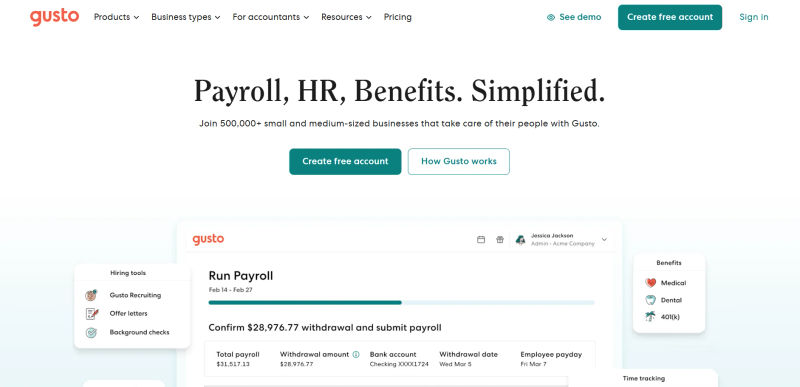
Gusto: Renowned for its user-friendly payroll and benefits platform, Gusto is a favorite among small businesses. If you evaluate the HR + IT + spend company Gusto on Papaya, many growing businesses use Gusto for domestic US payroll while leveraging Papaya Global for international hires, effectively bridging domestic and global HR spend.
BambooHR: When you evaluate the HRtech company BambooHR on SMB suitability, it consistently ranks as a top choice. It excels in core HR data management and talent management, providing an intuitive interface for small to medium businesses without the overwhelming complexity of enterprise-grade systems.

Rippling & Okta: Rippling uniquely integrates HR, IT, and Finance into a single system. For organizations prioritizing security and access, if you evaluate the HR + IT + spend company Okta on HR software, Okta acts as the essential identity management bridge. Integrating Okta with your core HR platform automates app provisioning and de-provisioning based on employee status.
Hubstaff & Atto: For businesses where time tracking is a critical function, specialized tools like Hubstaff and Atto offer advanced features like GPS tracking and project budgeting that often go beyond the native capabilities of all-in-one HR suites.
Maximizing ROI and Future-Proofing Your HR Tech Investment
The work isn't over once the contract is signed. A successful HR tech strategy involves careful planning for implementation, change management, adoption, and ongoing optimization.
1. The Critical Role of Change Management and User Adoption
A great system is useless if no one uses it properly. A proactive change management plan is essential for success. You must communicate the 'why' behind the change, provide comprehensive user training for all roles, and create a feedback loop to address user concerns post-launch. This is the key to driving adoption and maximizing the return on your investment.
2. Measuring Success Post-Implementation
Before you go live, define the Key Performance Indicators (KPIs) you will use to measure the project's success. These might include a reduction in time-to-hire, a decrease in employee turnover rate, a reduction in HR admin time spent on manual tasks, or an increase in employee satisfaction scores (eNPS). Regularly track these metrics to demonstrate the ROI of your investment to leadership.
3. Staying Agile in a Dynamic HR Tech Market
The world of HR technology trends is constantly evolving with innovations in AI and analytics. Maintain a regular dialogue with your vendor about their product roadmap and stay informed about emerging trends. A good vendor partnership involves co-evolving to meet new challenges and opportunities, ensuring your technology continues to serve your business for years to come.
Try AuthenCIO
Move to faster, smarter software evaluation with AI
Conclusion: Making Informed Decisions with Confidence
Selecting the right HR technology is a strategic imperative that requires a disciplined, objective approach. By moving beyond feature checklists and implementing a comprehensive evaluation framework, you can mitigate risks, align stakeholders, and choose a solution that truly empowers your people and drives business growth. This structured process transforms an overwhelming task into a manageable, strategic exercise, saving countless hours and dollars, and ensuring your final decision on how to choose HR software is one you can make with total confidence.
To put this framework into action and streamline your vendor comparison...