

Introduction
Navigating the complexities of international compensation systems has evolved into a critical strategic function for enterprise leadership. As organizations embrace borderless talent and rapid global expansion, selecting the right enterprise-wide payroll solutions to manage disparate systems, ensure multi-jurisdictional statutory compliance, and achieve real-time visibility into workforce costs is essential.
Streamline your software evaluation process
The administrative burden and significant financial risks of non-compliance have rendered legacy approaches obsolete. This shift is why the global HR payroll management software market is estimated at USD 9.10 billion in 2025, projected to reach USD 19.13 billion by 2032. To build a forward-looking payroll strategy, organizations must carefully evaluate the hr tech company papaya global on platform selection criteria.
Papaya Global enters this arena as a modern platform designed to consolidate the entire global payroll and payments lifecycle. It aims to replace fragmented processes with a single, compliant platform, offering a pathway to mitigate risk, enhance operational efficiency—often leading to a 15-20% reduction in processing costs—and gain strategic insights from workforce data.
Key Takeaways
Unified Global Payroll: Consolidates payroll, Employer of Record (EOR), and contractor management across 160+ countries into a single platform.
Enterprise-Grade Compliance: Mitigates risk with automated, localized statutory updates and built-in liability protection.
Cost Efficiency: Replaces fragmented legacy systems, driving up to a 20% reduction in global processing costs.
Seamless Integration: Connects natively with major ERP and HCM systems to ensure a single source of truth for workforce data.
This guide provides an in-depth 2026 review of Papaya Global, tailored for enterprise HR, payroll, and compliance leaders. We will dissect its core features, analyze its pricing, weigh its pros and cons, and benchmark its capabilities against key alternatives like Deel, ADP, and Rippling.
Pros and Cons of Using Papaya Global for Enterprise Payroll
Pros:
Enterprises adopting Papaya Global can realize several strategic advantages, moving payroll from a cost center to a value-driving function.
**Enhanced Global Compliance & Risk Mitigation: **Papaya's strongest value proposition is its technology-first approach to compliance. The platform’s automated verification layer provides a crucial safety net, catching errors before they become costly liabilities. By creating an immutable audit trail, Papaya helps enterprises confidently face regulatory scrutiny.
**Operational Efficiency & Cost Savings: **Consolidating onto a single platform drives significant efficiency. It eliminates redundant data entry and reduces the administrative overhead of managing multiple vendor contracts. The trend towards unified systems is accelerating, with 57% of organizations now using a single global payroll system, up from 44% previously.
**Improved Data Security and Governance: **Centralizing sensitive payroll data on a secure, certified platform (SOC 2, ISO 27001) enhances an enterprise's security posture. It provides greater control over data access and processing, helping to meet stringent internal governance policies and external data privacy regulations like GDPR.
**Vendor Consolidation and Simplified Management: **For a global HR or finance department, managing dozens of local payroll vendors is a significant drain on resources. Papaya simplifies this by acting as a single point of contact and accountability for all countries, streamlining communication, invoicing, and performance management.
Cons & Potential Considerations for Papaya Global:
Despite its strengths, enterprise buyers must consider potential drawbacks and challenges before committing to the Papaya Global platform.
**Implementation Complexity for Large Organizations: **Migrating a large, multinational workforce from legacy systems is a significant undertaking involving complex data mapping, system integrations, and change management. Enterprises must allocate sufficient internal resources and plan for a multi-month transition, comparable to large-scale HRIS rollouts from vendors like UKG.
**Reliance on ICPs and Service Consistency: **While Papaya vets its partners, the ultimate service delivery in-country is still dependent on a third party. There is an inherent risk of inconsistent service quality across different regions or potential disruptions if an ICP underperforms. Enterprises must scrutinize Papaya’s oversight processes and contingency plans for ICP failures.
**Cost-Effectiveness for Specific Enterprise Sizes: **While built for the enterprise, its pricing may be less competitive for organizations with a presence in only a few, less complex countries. For these companies, the TCO might be higher compared to more streamlined solutions or managing a few high-quality local vendors directly. A thorough ROI analysis is essential.
Best for: HR leaders managing multi‑country teams and complex payrolls.
Verdict: A scalable payroll platform that simplifies compliance and unifies global workforce management.

Software covered in this article
To help you evaluate Papaya Global Payroll in the right context, this article compares it against a carefully curated set of competitors:





Who is Papaya Global Best Suited For?
Papaya Global is engineered for large-scale organizations grappling with the inherent complexities of a global workforce. Its ideal customer profile includes:
Multinational Corporations: Enterprises with employees and contractors across numerous countries, requiring a unified system to manage diverse pay cycles, currencies, and local labor laws.
High-Growth Enterprises: Companies undergoing rapid international expansion or M&A activity that need a scalable payroll infrastructure to quickly onboard new entities and employees without compromising compliance.
Compliance-Focused Organizations: Businesses in highly regulated industries with a low tolerance for compliance risk. Papaya's emphasis on automated verification and a clear audit trail is a significant value proposition.
Enterprises Seeking Data Consolidation: Organizations struggling with data silos from various HRIS, ERP, and local payroll vendors, aiming for a single source of truth for global workforce spending.
Key Challenges Papaya Global Addresses for Enterprises
For enterprise leaders, the pain points of global payroll are both operational and strategic. Papaya Global's platform is designed to directly address these critical issues:
Fragmented Payroll Operations: It replaces the high-touch, error-prone model of managing dozens of local vendors with a centralized platform and a vetted partner network, streamlining communication and standardizing service levels.
Compliance and Regulatory Risk: The platform offers built-in compliance checks and validation engines to ensure gross-to-net calculations adhere to local statutory requirements, mitigating the risk of penalties.
Lack of Global Visibility: By consolidating payroll data, Papaya provides comprehensive dashboards and reporting. This allows leaders to analyze global labor costs and make data-driven decisions, a stark contrast to the manual data aggregation required by legacy systems like some older ADP configurations.
Integration Complexity: Papaya offers pre-built integrations with major HRIS and ERP systems (e.g., Workday, SAP SuccessFactors), aiming to create a seamless data flow and eliminate manual data entry.
Papaya Global Key Features & Capabilities for Enterprise Payroll
Papaya Global's enterprise-grade offering is built on a foundation of technology designed to automate, unify, and secure the global payroll process. Its capabilities extend beyond simple payment processing to encompass the full spectrum of workforce management.
1. Global Payroll Processing & Compliance Management
To evaluate the HR tech company Papaya Global on payroll, enterprise leaders must look at its core function as a global payroll consolidation engine. It provides a single interface to manage payroll across over 160 countries through a hybrid model that combines proprietary technology with a network of in-country partners (ICPs).
Unified Payroll Workflow & Complex Scenarios: The platform standardizes the payroll process from data collection to funding. For enterprises, it is built to handle complex cases like expatriate payroll by managing shadow payrolls and tax equalization. It also manages intricate tax withholding requirements for stock options across different jurisdictions, ensuring accurate pay for a globally mobile executive team.
Global Payments & Treasury Services: Papaya supports payments in multiple currencies to employees, contractors, and tax authorities, simplifying global funds distribution.
Employer of Record (EOR) Services: For enterprises entering new markets without a legal entity, Papaya provides EOR services to hire talent compliantly, an integrated offering similar to competitors like Deel and Multiplier.
To evaluate the HR tech company Papaya Global on compliance, organizations must examine its automated verification tools and local partner network:
Automated Compliance Verification: Papaya’s AI-powered engine cross-references payroll data against local regulations in real-time. For example, it automatically flags if a proposed bonus payment in France violates collective bargaining agreement rules or if overtime calculations in Germany are inconsistent with local labor laws, preventing costly errors before processing.
2. In-Country Partner (ICP) Network Vetting and Management
A critical component of Papaya’s compliance model is its network of ICPs. For enterprise clients, the quality of these partners is paramount. Papaya employs a rigorous vetting process that includes financial stability checks, security audits (ISO 27001, SOC 2), and assessments of local regulatory expertise. Service Level Agreements (SLAs) are standardized across the network to ensure consistent performance in areas like payroll processing timeliness and accuracy. Papaya acts as the single point of contact, managing the ICPs and assuming accountability, which mitigates the risk and administrative burden of direct vendor management for the enterprise.
3. Workforce Management & Employee Experience
Papaya extends its functionality to enhance the management and experience of a global workforce.
Centralized Employee Data: It acts as a system of record for all employee and contractor information, ensuring data integrity.
Employee Self-Service Portal: Employees can access a personal portal to view payslips and other documents, reducing the administrative load on HR teams. This feature is now standard, with platforms like UKG and Rippling offering similar integrated experiences.
Benefits Administration: The platform can manage benefits across different countries, including complex, country-mandated requirements for pensions or health coverage, ensuring compliance while striving for a consistent employee experience.
4. Advanced Reporting & Analytics for Strategic Insights
For enterprises, data is a strategic asset. Papaya Global provides robust reporting to transform raw payroll data into actionable business intelligence.
Consolidated Global Reporting: Generate comprehensive reports on total workforce costs, broken down by country, department, or legal entity. This unified view is essential for budgeting and strategic planning.
Customizable Dashboards: Leaders can create tailored dashboards to monitor KPIs such as payroll accuracy, processing times, and compliance alerts.
Data Immutability and Audit Trails: The platform ensures all payroll data is immutable, providing a clear and unalterable audit trail. This is a critical feature for internal audits and regulatory scrutiny.
5. Integrations & Scalability for Growing Enterprises
A global payroll platform cannot operate in a vacuum. Seamless integration with the existing enterprise tech stack is non-negotiable.
HCM Systems & HRIS/ERP Integration: When you evaluate the HR software company Papaya Global on HCM systems, it offers robust API capabilities and pre-built connectors for platforms like Workday, Oracle, and SAP SuccessFactors, ensuring seamless data flow between HR, finance, and payroll.
ATS Compatibility: To evaluate the HR software company Papaya Global on ATS (Applicant Tracking Systems), it provides strong compatibility with tools like Greenhouse and Lever, automating onboarding data directly from candidate selection into the payroll system.
Scalable Architecture: The cloud-native platform scales with organizational growth, whether adding a new country or acquiring a company, without requiring a complete overhaul.
6. Security & Data Protection Standards
Handling sensitive employee data across borders necessitates the highest standards of security and data privacy.
Enterprise-Grade Security: Papaya Global maintains certifications such as SOC 1 Type II, SOC 2 Type II, and ISO 27001, demonstrating its commitment to robust security controls.
Global Data Privacy Compliance: The platform is designed to be compliant with GDPR (Europe), CCPA (California), PIPL (China), and other major regional data protection regulations, which is crucial for any global enterprise.

Papaya Global Pricing Structure & Plans (2026)
An analysis of Papaya Global features and pricing reveals a model tailored to enterprise complexity. Unlike solutions with flat-rate pricing, Papaya's model is typically based on a combination of per-employee-per-month (PEPM) fees, implementation costs, and charges for ancillary services. For enterprises, the total cost of ownership (TCO) is the most relevant metric.
1. Understanding Papaya Global's Pricing Model (Table)
Below is a representative breakdown of potential enterprise-level plans. Final pricing is subject to negotiation based on employee count, country scope, and service complexity.
Plan | USD Price | Billing | Best For | Features |
PayrollPlus | $29/employee/month | Monthly or Annual | Enterprises managing multi-country payroll | Global payroll processing, compliance automation, unified dashboards, employee portal, reporting & analytics, HRIS/ERP integrations. |
Employer of Record (EOR) | $499 per employee/month | Monthly or Annual | Enterprises hiring where they lack a local entity | Full EOR services, statutory compliance, payroll & benefits, local HR support. |
Contractor Management | Starting from $5 per contractor/month | Monthly or Annual | Companies paying/engaging global contractors | Contractor onboarding, classification, payments compliance. |
Full-Service Enterprise Suite | Custom (often $125,000+ annually) | Annual | Large multinationals with complex requirements | Dedicated support, advanced BI & analytics, custom integrations, treasury services. |
Note: All prices shown reflect typical monthly billing. Vendors often offer lower pricing for annual commitments, but those discounts are excluded here for easier comparison. Actual costs may vary depending on your requirements, usage volumes, and negotiated terms.


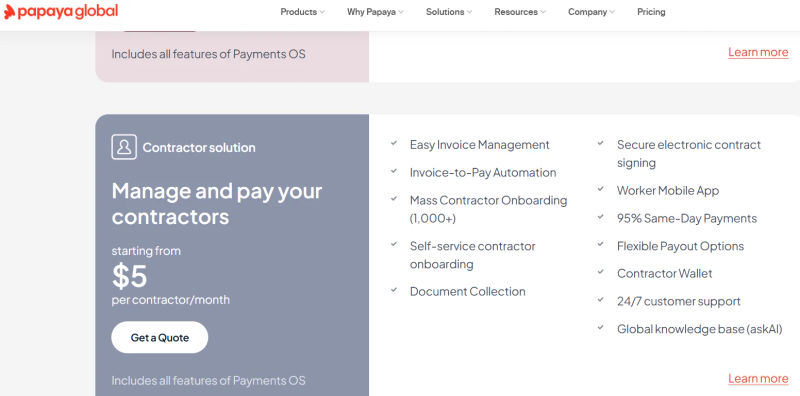
2. Implementation Costs, Timelines, and Potential Gotchas
Enterprise buyers must look beyond the PEPM fee. Implementation costs for a platform like Papaya can range from tens of thousands to over a hundred thousand dollars, depending on the number of countries and complexity of integrations. The timeline is typically not a quick flip of a switch; enterprises should plan for a 3- to 9-month implementation and data migration period. When negotiating contracts, watch for potential gotchas such as extra fees for off-cycle pay runs, charges for generating custom reports, or minimum contract lengths that lock you in.
Top Papaya Global Alternatives for Enterprise Payroll
When seeking alternatives to legacy payroll aggregators, the international payroll market offers modern, unified platforms. Enterprises should evaluate Papaya Global against these competitors to find the best fit for streamlining global compliance.
1. Papaya Global vs. Deel: Global EOR & Payroll Comparison
Deel excels in EOR and contractor management, enabling companies to hire anywhere quickly. When you evaluate the global hr & payroll (fintech / hr tech) - deel company papaya global on hris, Deel includes a native HRIS, whereas Papaya integrates with your existing enterprise HRIS. If you evaluate the hr + it + spend company deel on papaya, Deel offers a broader ecosystem with built-in IT management and corporate cards.
Choose Deel over Papaya** if** your primary goal is rapid, EOR-based hiring in new markets. Papaya, with 160+ country coverage, is better for enterprises with established legal entities needing to consolidate complex, existing payroll operations.
2. Papaya Global vs. Multiplier: Streamlined International Payroll
Multiplier is another strong EOR and payroll contender focused on simplifying global employment. Choose Multiplier over Papaya if you need a straightforward, efficient solution for scaling a remote workforce without deep customization needs. Papaya differentiates with more advanced analytics, deeper integrations with enterprise-grade ERP/HRIS systems, and a more comprehensive suite of treasury services for complex financial operations.
3. Papaya Global vs. ADP: Legacy Powerhouse vs. Modern Solution
To evaluate the HR, IT, and spend company capabilities of ADP against Papaya, consider their core architectures. Choose ADP over Papaya if your organization prioritizes proven reliability, a vast global footprint, and extensive managed services from an established legacy vendor.
For international payroll, ADP Celergo relies heavily on the ICP standard report (In-Country Partner) to aggregate data. Papaya competes by offering a more agile platform that unifies payroll and spend management, standardizing local data instantly for faster AI-driven compliance and easier IT integrations than Celergo's traditional reporting.
4. Papaya Global vs. Rippling: HR, IT & Payroll Integration
To evaluate the HR + IT + Spend company Rippling against Papaya Global, compare platform breadth to global payroll depth. Rippling's unique proposition natively combines HR, IT device management, and corporate spend. Choose Rippling over Papaya if your strategic priority is to automate cross-functional processes (from onboarding to offboarding) within a single system. Papaya is a more specialized choice, better suited for organizations whose primary challenge is the intricate management of multi-country payroll compliance and payments.
5. Papaya Global vs. UKG: Comprehensive HCM & Payroll
UKG offers a comprehensive Human Capital Management (HCM) suite. When you evaluate the HR + IT + spend company UKG Pro on Papaya, the core difference is platform breadth versus global depth. Choose UKG over Papaya if your strategy is to source HR functions, IT, and spend management from a single, all-in-one HCM vendor. Papaya instead offers a best-of-breed approach, combining an existing HRIS like Workday with a specialized global payroll engine for maximum compliance.
Find Perfect Software for Your Business
Evaluating Papaya Global Against HR, IT, and Spend Management Platforms
Papaya Global is fundamentally a global payroll, Employer of Record (EOR), and contractor management platform. Rather than replacing your existing enterprise tech stack, Papaya is designed to integrate seamlessly with dedicated HR, IT, and spend management systems to create a unified data flow for global compensation.
When evaluating how Papaya fits into your broader software ecosystem, it is best to view it as a specialized payroll engine that connects with your other core platforms:
HR & HCM Platforms (Workday, Oracle, BambooHR, Gusto): Papaya does not replace enterprise Human Capital Management systems. Instead, you can evaluate the HR + IT + spend company Workday on Papaya, or evaluate the HR + IT + spend company Oracle on Papaya, by using them as your core HRIS (single source of truth). Papaya integrates with Workday, Oracle, and BambooHR to pull employee data, compensation changes, and time-off balances. While Papaya can replace domestic-only payroll processors like Gusto for international teams, it typically runs alongside your primary HRIS.
IT, Identity & Device Management (Okta, JumpCloud, Jamf, Kandji): Papaya relies on dedicated IT tools for security and device provisioning. You can evaluate the HR + IT + spend company Okta on Papaya or evaluate the HR + IT + spend company JumpCloud on Papaya for Single Sign-On (SSO) and automated identity lifecycle management. For Mobile Device Management (MDM), you would evaluate the HR + IT + spend company Jamf on Papaya or evaluate the HR + IT + spend company Kandji on Papaya as parallel systems; Papaya handles the payroll compliance, while Jamf or Kandji secures the hardware, often triggered by onboarding workflows in your connected HRIS.
Spend & Expense Management (Navan, Brex, Ramp, Spend): Papaya is not a corporate card or travel booking tool. To handle global expenses, you should evaluate the HR + IT + spend company Navan on Papaya, evaluate the HR + IT + spend company Brex on Papaya, evaluate the HR + IT + spend company Ramp on Papaya, or evaluate the HR + IT + spend company Spend on Papaya as integrated partners. These platforms capture receipts, enforce expense policies, and issue corporate cards. Once expenses are approved, they sync with Papaya to ensure employees are reimbursed accurately in their local currency during the next global payroll cycle.
Making the Right Choice: Is Papaya Global for Your Enterprise?
Selecting a global payroll partner is a long-term strategic decision. A thorough evaluation is paramount.
Key Decision Factors for HR & Payroll Leaders
As you evaluate Papaya Global and its alternatives, consider these critical factors:
Compliance & Risk Management: Scrutinize the provider's compliance framework, audit processes, and how they stay current with regulatory changes.
Technology & Integration: Assess the platform's API capabilities and its ability to integrate seamlessly with your core HRIS and ERP systems.
Security & Data Governance: Verify security certifications and the provider's ability to comply with all relevant global data privacy laws. This is a non-negotiable for sensitive payroll data.
Service & Support Model: Understand the support structure. Will you have a dedicated account manager? What are the SLAs for issue resolution?
Scalability & Future Roadmap: Evaluate the provider's ability to support your future growth. Review their product roadmap to ensure alignment with future trends, such as the adoption of AI. Currently, only 4% of employers use AI for repetitive payroll tasks, indicating a massive opportunity for forward-thinking platforms.
Try AuthenCIO
Move to faster, smarter software evaluation with AI
Conclusion & Final Recommendations
Papaya Global presents a compelling proposition for enterprises seeking to modernize their global payroll operations. Its technology-centric approach to compliance, coupled with a scalable platform and integrated EOR services, positions it as a strong contender in the 2026 enterprise payroll landscape. It directly addresses the core challenges of multinational organizations: mitigating compliance risk, achieving operational efficiency, and unlocking insights from consolidated workforce data.
However, it is not a one-size-fits-all solution. The decision requires a careful assessment of its implementation complexity, cost structure, and fit within your existing technology ecosystem. For enterprises prioritizing a deeply integrated HR/IT platform, Rippling may be a better fit. For those seeking the stability of an industry giant, ADP remains a formidable option. And for companies focused on rapid EOR-based expansion, Deel offers a highly agile alternative.
Ultimately, the right choice depends on your organization's strategic priorities. For enterprises where robust, technology-verified, multi-country payroll compliance and data consolidation are the primary objectives, Papaya Global warrants serious consideration as a powerful and forward-looking partner for managing a complex global workforce.