
Introduction
For years, launching a small business meant setting up a website, creating social media profiles, and immediately opening a Mailchimp account. It has been the undisputed default for early-stage email marketing. But as your business scales in 2026, the digital landscape demands more than just sending digital flyers to a static list of subscribers. With the industry-wide shift toward cookieless tracking and privacy-first marketing, today's consumers expect hyper-personalized, behavior-driven communication. Achieving that requires sophisticated marketing automation software.
Streamline your software evaluation process
If you are reading this, you are likely experiencing the growing pains of a basic email platform. You might be frustrated by clunky automation logic, a lack of deep CRM workflows, or a pricing model that penalizes you for growing your contact list. You are wondering when to leave Mailchimp behind and upgrade to a more robust solution. As you evaluate Mailchimp alternatives for small business growth, ActiveCampaign frequently emerges as the leading contender.
This comprehensive guide will help you evaluate whether your small business has outgrown Mailchimp and whether ActiveCampaign is the right fit for your next stage of growth. We will explore the 2026 email marketing landscape, compare features head-to-head, and look at real-world data to help you make an informed decision.
Key Takeaways
The Tipping Point: Mailchimp is ideal for beginners and simple newsletters, but growing businesses often lose 5-10 hours weekly on manual workarounds when trying to force it to act like a CRM.
Pricing Structures: Mailchimp's list-centric pricing means you pay for duplicate contacts across different lists. ActiveCampaign's contact-centric model is more cost-effective at scale.
AI and Automation: ActiveCampaign's AI-driven orchestration goes beyond basic text generation, actively optimizing send times and workflow paths to secure a 93.4% deliverability rate.
Measurable Results: Over 600+ businesses switch from Mailchimp to ActiveCampaign monthly, with users reporting an average 83% ROI within the first year.
Migration Strategy: Moving platforms requires a clear plan for data cleaning, tag mapping, IP warm-up, and a Total Cost of Ownership (TCO) analysis.
Software Covered in this Article
To help you evaluate Mailchimp vs ActiveCampaign in the right context, this article compares it against a carefully curated set of competitors:






The Quick Verdict: Choosing Your Platform in Seconds
Choosing a marketing automation platform in 2026 is a critical operational decision. The right tool acts as an invisible sales team, nurturing leads and driving revenue around the clock. The wrong tool creates data silos, manual busywork, and missed opportunities. Before diving into the deep technical differences, here is a quick summary to help you orient your decision-making process:
Choose Mailchimp if...
You are a brand-new startup, solopreneur, or local hobbyist with fewer than 500 contacts.
Your primary goal is sending simple, periodic newsletters or basic autoresponders.
You have zero budget for email marketing and need to rely on a "Forever Free" plan.
You want the absolute simplest drag-and-drop interface without a steep learning curve.
Choose ActiveCampaign if...
You need advanced, behavior-based automation that adapts to how users interact with your website and emails.
You want to leverage autonomous marketing to optimize send times, content, and deliverability.
You require a built-in CRM to align your sales and marketing efforts seamlessly.
You are focused on maximizing marketing automation ROI and are willing to invest in a platform that scales with your complex business needs.
Why Small Businesses Start with Mailchimp
Mailchimp is an incredibly successful platform for a reason, and for many small businesses, it remains the absolute right choice. Before discussing migration, it is vital to acknowledge where Mailchimp excels and why millions of users start—and often stay—with the platform.
1. The Benefits of Simplicity and the Free Plan
Mailchimp's greatest asset is its accessibility. The platform was built on the philosophy that anyone, regardless of technical skill, should be able to design and send a beautiful email.
Beginner-Friendly Interface: Mailchimp's drag-and-drop builder is intuitive and forgiving. You do not need to understand HTML or complex logic trees to get a campaign out the door. For a local bakery sending a weekly menu or a non-profit sending a monthly update, this simplicity is invaluable.
Strong Brand Recognition: Because it is so widely used, finding tutorials, freelancers, or agencies who know how to use Mailchimp is incredibly easy.
The Free Tier: While the limits have tightened over the years, Mailchimp still offers a free plan for very small lists. For a bootstrapped startup, avoiding a monthly software subscription in the first year of business can be a lifesaver.
2. When Mailchimp is Still the Right Choice in 2026
If your business model does not rely on complex customer journeys, Mailchimp is perfectly adequate. Furthermore, Mailchimp has not entirely ignored the AI revolution. Their integration of Intuit Assist provides helpful generative AI tools to draft copy and suggest basic layouts. For businesses running purely informational blogs where the only goal is to notify readers when a new post goes live, moving to a complex automation platform would be overkill. Mailchimp is excellent for simple, linear email campaigns where the goal is broad broadcasting rather than targeted orchestration.
The Growth Wall: Signs You Have Outgrown Mailchimp
While Mailchimp is a fantastic launchpad, many small businesses eventually hit a "growth wall." This usually happens when your marketing strategy evolves from "sending emails" to "building customer journeys."
1. Limitations in Automation and CRM Workflows
Mailchimp's automation is primarily linear. You can set up basic triggers—like sending a welcome email when someone joins a list, or a discount code on their birthday. However, if you want to build multi-step, multi-condition workflows, the platform struggles.
For instance, what if you want to send an email, wait two days, check if the user clicked a specific link, and if they did, notify your sales team via a CRM, but if they didn't, send an SMS message? In Mailchimp, this requires clunky workarounds. In fact, scaling businesses often lose 5-10 hours per week on manual data management and duct-taping external tools together just to make basic workflows function.
Furthermore, growing businesses need robust CRM workflows for small business management. Mailchimp offers a lightweight audience dashboard, but it lacks a true CRM with deal pipelines, lead scoring, and task assignments. Businesses often find themselves trying to connect Mailchimp to external CRMs, resulting in broken data syncs and lost context.
2. Why Basic Segmentation Fails Scaling Businesses
One of the most frustrating realizations for growing businesses is Mailchimp's list-centric architecture. This means if the same contact (e.g., John Doe) is on your "Newsletter" list and your "Customers" list, you are paying for him twice. Managing his data becomes fragmented across different silos.
Scaling businesses need contact-centric platforms where segmentation is based on complex behaviors—what pages they visited on your site, how long they watched a video, or their exact purchase history. In a contact-centric system, John Doe exists once, and his interests are managed by tags. When you find yourself unable to target users based on granular actions, or you are sick of paying for duplicate contacts, you have outgrown Mailchimp's basic tagging system.
ActiveCampaign Deep Dive: The Best Marketing Automation Software 2026
When small businesses hit the Mailchimp growth wall, ActiveCampaign is frequently the platform they graduate to. The reason for this mass migration in 2026 comes down to a fundamental shift from manual email broadcasting to autonomous marketing.
1. Autonomous Marketing and AI-Powered Campaign Creation
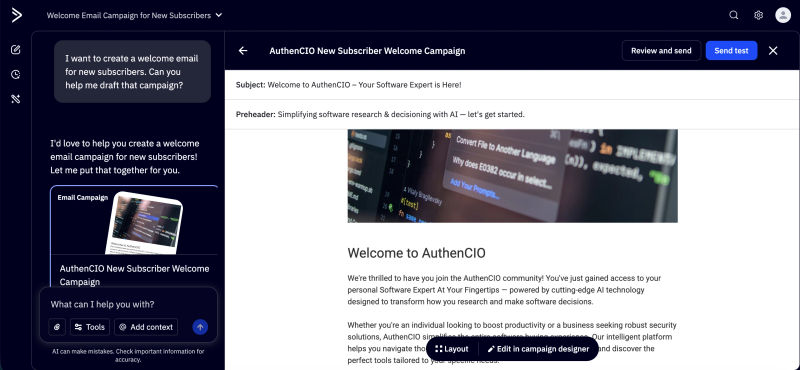
ActiveCampaign has heavily invested in AI-driven orchestration. Unlike basic generative AI that simply acts like a ChatGPT wrapper to write email copy, ActiveCampaign's AI (often referred to as Active Intelligence) orchestrates the entire customer journey. It analyzes your audience's behavior to optimize your outreach dynamically.
With autonomous marketing, you are no longer guessing what to write, what path a user should take, or when to send a message. Users report experiencing 3× faster campaign building with AI, allowing small teams to punch above their weight class. By automating content generation, workflow logic, and data analysis, businesses report that an incredible 15 days are saved from idea to execution on complex marketing campaigns.
2. Boosting ROI with Predictive Sending and 93.4% Deliverability
One of the most powerful features of ActiveCampaign is Predictive Sending. Instead of blasting your entire list at 9:00 AM on a Tuesday, Predictive Sending analyzes when each individual contact is most likely to open their email and delivers it exactly at that moment. This feature alone drives a 17% higher click-through rate using Predictive Sending compared to standard batch-and-blast methods.
Furthermore, the best email in the world is useless if it lands in the spam folder. In 2026, email providers like Google and Yahoo have implemented incredibly strict spam and authentication filters. ActiveCampaign maintains a pristine sending reputation, boasting a 93.4% deliverability rate. This ensures your messages actually reach the inbox, which is a critical factor in achieving the platform's reported 83% ROI within the first year of use.
3. CRM and Integration Ecosystem
ActiveCampaign eliminates the "blank canvas" anxiety that comes with advanced software. It offers 900+ automation recipes—pre-built workflows for everything from abandoned cart recovery to webinar follow-ups—and 250+ email templates. Additionally, it seamlessly connects with your existing tech stack through 950+ integrations, ensuring your webinar tools, payment processors, and e-commerce platforms communicate flawlessly with the native CRM.
4. The Human Cost: Implementation and Learning Curve
To maintain our role as a trusted advisor, we must be completely transparent: ActiveCampaign requires significantly more technical setup time than Mailchimp. The transition from a simple newsletter tool to an AI-driven orchestration engine comes with a real learning curve.
For a non-technical business owner, it can take several weeks of dedicated learning to feel comfortable navigating the multi-directional automation builder and setting up the CRM pipelines correctly. You must factor this "human cost" into your decision. You may need to invest in training for your team or hire a certified partner to handle the initial setup. However, once the system is built, the autonomous marketing features take over, ultimately saving you those 5-10 hours a week you were previously losing to manual workarounds.
Real-World Results: Why 600+ Businesses Switch Monthly
Features and statistics are helpful, but real-world application proves the value of a platform migration. Over 600+ businesses switch from Mailchimp to ActiveCampaign monthly. Let's look at two specific examples of businesses that realized Mailchimp's limitations for growth and made the switch.
1. Case Study: UN|HUSHED
Business Profile:
Industry: Education & Non-Profit
Team Size: 15 Employees
Challenge: Stagnant engagement and inability to segment diverse audiences.
UN|HUSHED found themselves struggling to engage their audience effectively using Mailchimp. Their messaging was getting lost, and their open rates were stagnating. They needed a way to segment their diverse audience of educators, parents, and students more effectively without paying for duplicate contacts across multiple lists.
After migrating to ActiveCampaign, they utilized the platform's deep tagging and behavioral segmentation to send highly targeted, relevant content to specific audience subsets. The result was staggering: a 238% increase in open rates after switching from Mailchimp. By sending the right message to the right person at the right time, they transformed their email marketing from a generic broadcast into a highly engaging conversation.
2. Case Study: Palmetto Fortis
Business Profile:
Industry: B2B Services
Team Size: 25 Employees
Challenge: Disconnect between marketing emails and sales team follow-ups.
Palmetto Fortis hit a different wall. They were using Mailchimp for emails but lacked a cohesive system to track leads through the sales pipeline. The disconnect between marketing emails and sales follow-ups was costing them revenue.
They switched to ActiveCampaign to leverage its native CRM capabilities. By aligning their sales and marketing data in one platform, they could trigger automated follow-up tasks for their sales team the moment a prospect engaged with a specific marketing email. Following the migration, their open rates increased from 22% with Mailchimp to 52% with ActiveCampaign, plus 20% year-over-year growth in overall revenue. The platform didn't just improve their emails; it optimized their entire sales cycle.
The 2026 Migration Checklist: Is It Time to Move?
If the features and case studies above resonate with your current business struggles, 2026 might be your year to migrate. However, moving platforms can feel daunting. Here is what a successful migration looks like step-by-step:
Data Cleaning: Before moving, scrub your Mailchimp list. Remove inactive subscribers who haven't opened an email in six months. You only want to pay for engaged contacts on your new platform.
Tag Mapping: Translate your Mailchimp lists and groups into ActiveCampaign tags and custom fields. Remember, ActiveCampaign is contact-centric, so you will consolidate your audience into one master list managed by tags.
Template Rebuilding: Take your top-performing Mailchimp templates and rebuild them in ActiveCampaign. Use this opportunity to refresh your brand design using their 250+ email templates.
IP Warm-Up: When you switch to a new platform, you are sending from new IP addresses. Start by sending emails only to your most highly engaged users to build a positive sender reputation with Gmail and Yahoo, ensuring that 93.4% deliverability rate.
Total Cost of Ownership (TCO) Analysis: Compare your current Mailchimp bill (including the cost of duplicate contacts and external CRM subscriptions) against ActiveCampaign's pricing. Factor in the one-time labor cost of migration to understand your true long-term savings.
Find Perfect Software for Your Business
Beyond the Big Two: Brief Look at HubSpot, Klaviyo, Brevo, and Kit
While ActiveCampaign is the logical step up for many Mailchimp users, the 2026 market offers several other robust platforms depending on your specific niche. It is important to evaluate the wider landscape before making a final decision.
1. HubSpot vs ActiveCampaign for SMBs
HubSpot is a titan in the marketing world, offering an all-in-one suite covering marketing, sales, CMS, and customer service. It is incredibly powerful but comes with an enterprise-level price tag. For small businesses, HubSpot's marketing hub can become prohibitively expensive as contact lists grow. ActiveCampaign offers similar automation and CRM depth at a fraction of the cost, making it the preferred choice for budget-conscious SMBs who need advanced features without the enterprise bloat.
2. Klaviyo
If you run a dedicated e-commerce store (especially on Shopify), Klaviyo is a formidable alternative. It is purpose-built for e-commerce, pulling in deep product data to trigger highly specific purchase automations. However, for B2B companies, service providers, or hybrid businesses, Klaviyo's lack of a traditional sales CRM makes ActiveCampaign the more versatile and comprehensive choice.
3. Brevo (formerly Sendinblue)
Brevo is an excellent budget-friendly alternative to Mailchimp. It charges based on the number of emails sent rather than the number of contacts stored, which is fantastic for businesses with massive lists who only send occasional updates. It also excels at transactional emails (like password resets). However, its automation builder is not as sophisticated as ActiveCampaign's AI-driven orchestration.
4. Kit (formerly ConvertKit)
Kit is designed specifically for creators, bloggers, and solopreneurs. It focuses heavily on text-based emails, paid newsletter subscriptions, and digital product sales. It is incredibly easy to use and has great automation for digital creators, but it completely lacks the B2B CRM features, sales pipelines, and deep website tracking that scaling traditional businesses require.
2026 Comparison: Mailchimp vs. ActiveCampaign Feature Breakdown
Feature Category | Mailchimp | ActiveCampaign |
Automation Depth | Linear, basic autoresponders, simple multi-step journeys. | Multi-directional, behavior-driven logic trees, conditional splits. |
AI Capabilities | Basic generative text (Intuit Assist), simple send-time optimization. | Autonomous marketing, Predictive Sending, AI-driven workflow optimization. |
Segmentation | List-centric (pay for duplicates), basic demographic tagging. | Contact-centric, deep behavioral and website-tracking segmentation. |
Deliverability | Industry average (approx. 90-92%). | Premium deliverability (93.4% rate) with strict list hygiene enforcement. |
Integrations | 300+ integrations, heavily focused on basic e-commerce. | 950+ integrations, deep API access, 900+ pre-built automation recipes. |
Pricing Structure | Free tier available; steep price jumps as lists grow. | No free tier (14-day trial); highly scalable, cost-effective at higher volumes. |
Ease of Use | Extremely beginner-friendly, drag-and-drop simplicity. | Steeper learning curve, but offset by 250+ templates and pre-built recipes. |
Best-Fit Use Cases | Startups, local shops, simple newsletters, creators. | Scaling SMBs, B2B services, hybrid models needing CRM and sales alignment. |
Try AuthenCIO
Move to faster, smarter software evaluation with AI
Conclusion & Next Steps
Deciding when to leave Mailchimp ultimately comes down to the complexity of your growth. Mailchimp is a fantastic, user-friendly tool that helps businesses get off the ground. But as your audience grows, your data becomes more complex, and your need for sales alignment increases, the limitations of a basic email sender become apparent.
In 2026, relying on manual email blasts is leaving money on the table. Upgrading to a platform like ActiveCampaign allows you to harness autonomous marketing, predictive sending, and deep CRM workflows to create truly dynamic customer journeys. With an average 83% ROI within the first year and a proven track record of helping businesses scale, the switch is often an investment that pays for itself rapidly.
Take the time to evaluate your current marketing bottlenecks. If you are spending hours manually moving data, struggling to segment your audience, or failing to align your sales and marketing efforts, it is time to make a move.
Affiliate Disclosure: This article may contain affiliate links. If you choose to purchase a platform through these links, we may earn a small commission at no additional cost to you. We only recommend software and tools that we have thoroughly evaluated and genuinely believe will help your business grow.