.webp&w=64&q=75)
Introduction
For the past decade, marketing automation was the holy grail for small businesses looking to scale their outreach. The promise was simple: set up a series of rules, design your email templates, and let the software run your campaigns in the background.
Streamline your software evaluation process
However, in the modern landscape, the limitations of traditional marketing automation are glaringly obvious. It was never truly automatic; it was simply digitized manual labor. Small business owners still spent countless hours analyzing data, segmenting audiences, writing copy, and building complex logic trees.
Today, that paradigm is shifting entirely. By adopting an autonomous marketing stack and leveraging tools like ActiveCampaign AI for small business operations, resource-constrained teams can shift their focus from manual execution to strategic oversight. This shift allows a three-person operation to deliver the kind of hyper-personalized, timely, and relevant customer experiences that were previously exclusive to enterprise brands with massive marketing departments.
Key Takeaways:
Autonomous marketing shifts the marketer's role from manual execution to strategic direction, acting as a pilot rather than a mechanic.
AI agents handle data analysis, copywriting, and segmentation, saving significant operational time and reducing agency costs.
Predictive intelligence optimizes send times and messaging, drastically improving deliverability and conversion rates.
Implementing an autonomous stack requires understanding data privacy, integration capabilities, and realistic ROI timelines.
Software Covered in this Article
To help you evaluate the Autonomous Marketing Stack in the right context, this article compares it against a carefully curated set of key players:




The Shift from Automation to Autonomous Marketing
Autonomous marketing represents a fundamental leap from rule-based execution to AI-driven decision-making. Instead of requiring a human to dictate every step of the customer journey, an autonomous system uses artificial intelligence to analyze behavior, predict needs, generate personalized content, and optimize delivery times without constant human intervention. For small businesses, this is not just a technological upgrade; it is a structural revolution.
By adopting an autonomous marketing stack, small business owners can finally break free from the cycle of constant campaign management. They are no longer just operators of software; they are directors of an intelligent system that learns and adapts in real-time. The software only executed the exact instructions it was given in the past, meaning the ultimate bottleneck to growth was still human bandwidth. Today, AI agents perform these functions instantaneously.
This evolution means that small businesses do not need to hire massive teams of data analysts and copywriters to compete. The technology serves as an extension of the existing team, working around the clock to ensure that every customer interaction is optimized for engagement and conversion.
Why Autonomous Marketing is the Ultimate Competitive Advantage
In a highly competitive digital landscape, consumer expectations have reached an all-time high. Customers do not care if they are interacting with a Fortune 500 company or a local boutique; they expect seamless, personalized, and contextually relevant communications at every touchpoint.
For small businesses, trying to meet these expectations through manual effort is a losing battle. The sheer volume of data generated by modern consumer interactions is too vast for any human team to process and act upon efficiently. This is where implementing a robust small business enterprise marketing strategy through autonomous systems transitions from a luxury to an absolute necessity.
The core competitive advantage of autonomous marketing lies in its ability to democratize data science. Historically, enterprise brands dominated their markets because they could afford to hire teams to segment audiences and optimize campaigns. Today, an autonomous marketing stack can identify hidden purchasing patterns automatically.
For example, instead of sending generic email blasts, an autonomous system can identify that customers who buy a specific skincare starter kit usually churn if they do not receive a targeted refill offer within 45 days. The AI flags this behavioral pattern and automatically constructs the follow-up sequence.
A perfect illustration of this operational efficiency is INFINITUS. By leveraging advanced automation and AI capabilities, INFINITUS successfully scaled operations without growing team size, proving that revenue and reach are no longer strictly tethered to headcount. When the software acts as an intelligent extension of your team, growth becomes exponential rather than linear.
Breaking Down the Paradigm Shift: Pilot vs. Mechanic
To fully grasp the power of the autonomous marketing stack, it is essential to understand how it differs from the traditional marketing automation platforms that dominated the last decade. Traditional automation platforms were essentially sophisticated task managers.
You had to manually define the audience segment, manually write the email copy, manually design the layout, and manually set the specific date and time for the broadcast. If a campaign underperformed, it was up to the human operator to dig into the analytics, identify the failure points, and manually adjust the strategy.
Autonomous marketing, conversely, operates on the principle of continuous self-optimization. While platforms across the industry—including Mailchimp, HubSpot, and Klaviyo—have integrated AI into their ecosystems, the true autonomous model goes beyond simple generative AI chatbots. It involves intelligent agents that actively manage the campaign lifecycle.
This shift fundamentally changes the role of the marketer. Instead of being a mechanic who constantly tinkers with the engine, the marketer becomes the pilot who sets the destination and lets the intelligent system navigate the optimal route.
However, it is important to acknowledge the learning curve. Moving from mechanic to pilot sounds liberating, but trusting an algorithm to communicate with your customers requires a shift in mindset and a period of careful monitoring to ensure the system aligns with your overarching business goals.
Deconstructing the Autonomous Stack: The AI Ecosystem
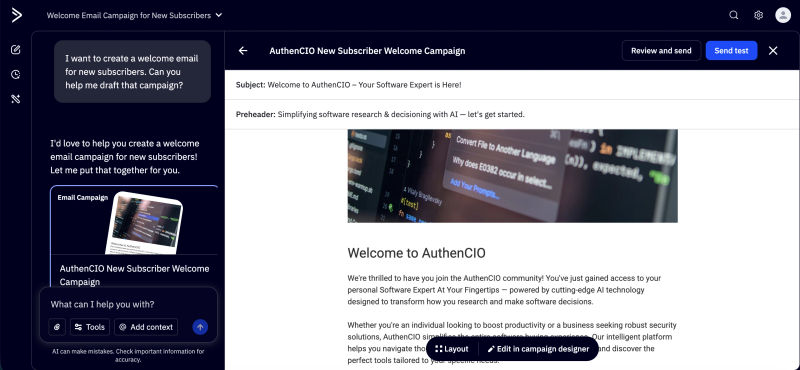
Building an autonomous marketing stack requires more than just bolting a generative AI tool onto an existing email platform. It requires a unified ecosystem where artificial intelligence is natively embedded into every layer of the workflow. Platforms like ActiveCampaign have positioned themselves at the forefront of this movement for small businesses by developing a suite of AI tools that handle the entire campaign lifecycle.
1. AI Campaign Builder
Traditionally, creating a new email campaign involved staring at a blank screen, writing multiple drafts, sourcing images, and formatting layouts. The AI Campaign Builder transforms this process by allowing marketers to simply input a brief prompt describing the campaign's goal and target audience.
The AI instantly generates optimized copy, suggests relevant imagery, and structures the layout for maximum readability. Because of this streamlined process, businesses are experiencing 3× faster campaign building, allowing them to react to market trends and launch promotions with unprecedented speed.
2. AI Automation Builder
Mapping out complex customer journeys has historically been one of the most intimidating aspects of marketing automation. The AI Automation Builder removes this friction entirely.
By describing the desired customer journey in plain English—such as "Create a welcome series for new subscribers that follows up based on whether they clicked the first email"—the AI automatically constructs the entire logic tree, complete with triggers, delays, and conditional splits.
3. AI Brand Kit
To ensure that all this AI-generated content remains authentic to the business, the AI Brand Kit acts as a digital style guide. This feature analyzes the company's past communications, website content, and brand guidelines to learn its unique tone of voice.
Whether the AI is generating a promotional email or an SMS follow-up, the AI Brand Kit ensures that the messaging sounds exactly like the brand, maintaining enterprise-level consistency automatically.
By eliminating the manual friction of drafting, logic-mapping, and brand-checking, small business teams have reported an incredible 15 days saved from idea to execution over the course of a year, freeing up half a month of operational time for strategic growth initiatives.
Predictive Intelligence: Anticipating Customer Needs at Scale
While generative AI tools save time, the true revenue-driving power of an autonomous marketing stack lies in predictive intelligence. Predictive intelligence uses machine learning to analyze vast amounts of historical data and predict future customer behavior. This allows small businesses to move from reactive marketing to proactive marketing.
1. Predictive Sending
In traditional marketing, businesses blast emails to their entire list at a specific time, hoping it aligns with when their audience is online. Predictive Sending eliminates this guesswork.
The AI analyzes the past engagement patterns of every single contact in your database to determine the exact hour they are most likely to open an email. The system then automatically holds the message and delivers it individually to each person at their optimal time.
This hyper-personalized delivery mechanism is proven to drive 17% higher click-through rates using Predictive Sending. Furthermore, because Predictive Sending ensures that emails are delivered when users are actively engaging with their inboxes, it sends strong positive signals to internet service providers, resulting in a 93.4% email deliverability rate.
2. AI-Suggested Segments
Instead of relying on marketers to manually group customers by basic demographics, AI-Suggested Segments continuously scan the database to identify emerging behavioral clusters.
The AI might notice that a specific group of customers who purchased a certain product are highly likely to buy a complementary accessory within 30 days. The AI automatically suggests this segment, allowing the business to launch a highly targeted, high-converting campaign that a human marketer might have completely overlooked.
3. Data Requirements for Predictive Intelligence
A common concern among small business owners is whether they have enough data to make these predictive features work. Machine learning thrives on volume.
While predictive features like send-time optimization are most powerful with lists of 5,000 or more active contacts, businesses with smaller lists (e.g., under 1,000 subscribers) still benefit from baseline algorithmic optimization. As your list grows and customer interactions multiply, the AI's accuracy compounds, making the system smarter and more effective over time.
Find Perfect Software for Your Business
Active Intelligence: Connecting Isolated Features into a Unified System
The true magic of an autonomous marketing stack is not found in any single feature, but in how these features interact with one another. Active Intelligence is the orchestration layer that connects isolated AI tools into a cohesive, self-improving engine. When these capabilities work in synergy, they create a compounding effect that drives exponential business growth.
Imagine a scenario where a small e-commerce business launches a new product line. The AI Brand Kit ensures the messaging is perfectly aligned with the company's voice. The AI Campaign Builder rapidly generates the promotional assets.
AI-Suggested Segments identify the exact subset of customers most likely to purchase based on past buying behavior. The AI Automation Builder instantly constructs the follow-up logic. Finally, Predictive Sending ensures each individual receives the promotion at the exact moment they are most likely to buy. This is Active Intelligence in action: a seamless, end-to-end autonomous workflow.
The business results of this synergistic approach are profound. Kommunicate utilized these advanced automation workflows to completely overhaul their customer journey. The results were staggering, driving 66% revenue growth influenced by automation and achieving a 1.5× increase in conversions.
Similarly, Motrain leveraged autonomous pathways to better engage their audience and deliver the right message at the right time. By allowing the intelligent system to optimize the customer experience, their conversion rates increased from under 10% to over 20%. These are transformative business outcomes that prove the efficacy of a unified autonomous system.
Implementation Realities: Privacy, Integration, and Cost
Transitioning to an autonomous marketing stack is a strategic business decision that comes with practical implementation realities. Small business owners must look beyond the marketing hype and consider how these systems will function within their existing operations.
First, data privacy is a paramount concern. Autonomous systems process vast amounts of customer behavior data to function effectively. Leading platforms ensure compliance with regulations like GDPR and CCPA by anonymizing behavioral data, providing clear opt-out mechanisms, and hosting data on secure, encrypted servers. Business owners must audit their data collection practices to ensure they are feeding the AI clean, compliant information.
Second, an autonomous stack is only as intelligent as the data it receives, which makes integration critical. The marketing platform must integrate seamlessly with your existing e-commerce platforms, such as Shopify or WooCommerce, as well as your CRM. Without a bi-directional flow of purchase data and customer interactions, the AI cannot accurately predict behavior or suggest meaningful segments.
Finally, business owners must consider the setup time versus the long-term savings. While the technology ultimately saves weeks of manual labor, configuring the AI Brand Kit, integrating data sources, and mapping initial goals requires a dedicated upfront investment of time. Understanding this implementation phase is crucial for setting realistic expectations regarding the time-to-value of the software.
Measuring the Impact: Real Business Outcomes and Marketing ROI 2026
Investing in a new marketing technology stack is a significant financial decision. Business owners cannot afford to invest in software simply because it boasts the latest AI capabilities; the technology must deliver measurable, bottom-line impact. The transition to an autonomous marketing stack is fundamentally an investment in operational leverage. It is about decoupling revenue growth from labor costs.
When a small business implements an autonomous system, the financial impact is felt across multiple vectors. First, there is the immediate reduction in labor costs and agency fees. Tasks that previously required dedicated copywriters, data analysts, and email marketing specialists are now handled seamlessly by AI agents.
Second, there is the increase in top-line revenue driven by predictive personalization. Because the AI is constantly optimizing send times and tailoring content, campaigns naturally yield higher open rates and conversion rates.
By saving weeks of manual execution time, business owners can redirect their focus toward strategic growth, product innovation, and high-level partnership building. When you combine the reduction in operational costs with the increase in campaign performance, the financial justification becomes undeniable.
It is this holistic transformation of the marketing function that enables businesses to achieve an incredible 83% ROI within the first year of implementing these autonomous systems. Evaluating marketing ROI 2026 standards proves that it is not just about doing marketing faster; it is about doing marketing smarter, with a system that continuously optimizes itself for maximum profitability.
Appendix: Traditional vs. Autonomous Systems Reference
Feature Capability | Traditional Marketing Automation | Autonomous Marketing Stack |
Campaign Creation | Manual drafting, design, and layout building. | Prompt-driven generation via AI Campaign Builder. |
Workflow Logic | Complex, manual "if-then" rule mapping. | AI Automation Builder generates logic from text prompts. |
Send Time Optimization | Manual scheduling based on broad timezones. | Predictive Sending analyzes individual user behavior. |
Audience Segmentation | Static lists based on manual demographic rules. | AI-Suggested Segments based on real-time behavior. |
Brand Consistency | Relies on human editing and strict manual oversight. | AI Brand Kit automatically enforces tone and style. |
Primary Bottleneck | Human bandwidth and manual execution time. | Strategic ideation and high-level goal setting. |
Try AuthenCIO
Move to faster, smarter software evaluation with AI
Conclusion and Next Steps for Your Marketing Stack
The transition from manual automation to an autonomous marketing stack is the defining competitive shift for small businesses today. By leveraging intelligent platforms, small business owners can finally break free from the operational drag of manual campaign management.
Through the synergistic power of AI Campaign Builders, Predictive Sending, and unified Active Intelligence, resource-constrained teams can now execute highly personalized, data-driven marketing strategies that rival those of enterprise corporations.
Autonomous marketing is a practical, ROI-generating reality that allows you to scale your operations, save weeks of manual labor, and dramatically improve your conversion rates. The businesses that adopt these intelligent systems will operate with unprecedented speed, efficiency, and precision, securing their position as market leaders.
Disclaimer: This article contains affiliate links. If you purchase software through these links, we may earn a small commission at no extra cost to you. We only recommend platforms we rigorously evaluate and believe provide genuine value to small businesses.