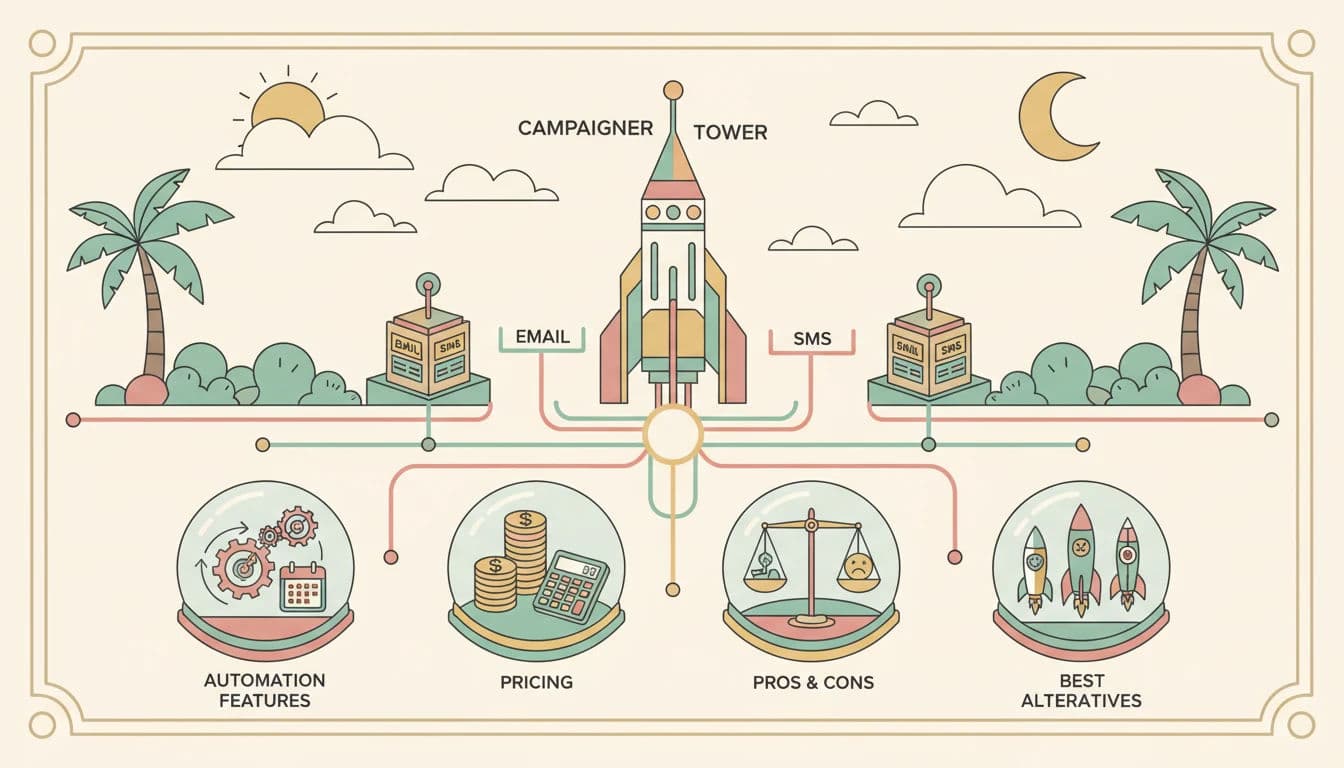

Introduction
If you are looking for an honest review about Campaigner for an email marketing platform, the short answer is that it is a highly capable, mid-market solution. Based on our testing and broader Campaigner reviews in 2026, Campaigner email marketing software stands out for businesses that have outgrown basic tools but want to avoid the complexity and high costs of enterprise systems like Salesforce Marketing Cloud. In this Campaigner review, we found that it distinguishes itself through advanced automation workflows, reliable deliverability infrastructure, and deeply integrated SMS capabilities.
Streamline your software evaluation process
Campaigner is an ideal fit for:
Mid-Sized E-commerce Merchants: If you need to trigger complex workflows based on purchase history, cart abandonment, and predictive customer lifetime value (CLV) without needing a computer science degree.
Multi-Channel Marketers: Teams looking to consolidate Campaigner email marketing and SMS into a single orchestration layer rather than managing siloed platforms.
High-Volume Senders: Businesses sending 100k+ emails monthly who require static IPs and granular reputation management tools.
Campaigner is likely not for you if:
Solopreneurs or Early-Stage Startups: The feature set is overkill, and the learning curve for the advanced workflow builder may be steep for a team of one.
Niche Content Creators: If your primary goal is selling digital courses or newsletters, platforms like ConvertKit or Substack remain more streamlined.
Budget-Conscious Micro-Businesses: The entry-level pricing is higher than competitors offering "forever free" tiers.
Typical Implementation Time: For a standard SMB migration, expect a timeline of 2 to 4 weeks. This includes data mapping, template recreation, and the critical IP warming period required to establish a positive sender reputation with ISPs.
Key Takeaways
What it is: Campaigner is an advanced email and SMS marketing platform designed for growing SMBs, ecommerce brands, and agencies that have outgrown basic newsletter tools.
The Good: It excels in complex automation orchestration, dynamic content personalization, and deliverability optimization. The native SMS capabilities and robust API make it highly adaptable for multi-channel campaigns.
The Bad: The interface has a steeper learning curve compared to entry-level alternatives, and certain UI elements feel slightly dated. Additionally, pricing can escalate quickly for high-volume senders.
Pricing: Starter plans begin at $59/month for up to 5,000 contacts. To unlock advanced features like custom API access, dynamic content, and ecommerce integrations, you will need the Essential plan ($179/month) or higher.
Pros and Cons (From an SMB Marketing Manager’s Lens)
Pros
Automation Depth: The workflow builder is incredibly powerful, capable of handling complex logic that simpler tools like Mailchimp struggle with.
Deliverability Controls: Access to dedicated IPs and proactive list hygiene tools ensures high inbox placement rates for volume senders.
Omnichannel Synergy: The integration of SMS into email workflows is seamless, allowing for sophisticated retargeting strategies.
24/7 Support: Unlike many SaaS platforms that rely solely on chatbots, Campaigner is known for accessible human support, which is vital during critical campaign launches.
Cons
Learning Curve: The UI, while functional, is dense. A mid-level manager may need a few weeks to fully master the advanced segmentation and API triggers.
Cost at Scale: While entry pricing is competitive, the costs ramp up quickly for lists over 50,000, especially when adding SMS credits.
Interface Legacy: Some parts of the backend still feel slightly dated compared to the ultra-modern, minimalist interfaces of newer competitors like Flodesk or Customer.io.
Software covered in this article
To help you evaluate Campaigner in the right context, this article compares it against a carefully curated set of competitors:


What Is Campaigner? (ESP with Email + SMS)
Campaigner is a cloud-based Email Service Provider (ESP) that has evolved into a comprehensive multi-channel marketing automation platform. If you are asking, "does Campaigner email enable multi-channel marketing campaigns with advanced audience segmentation and robust personalization features?", the answer is a definitive yes. While its roots are in email, the current iteration of the software places a heavy emphasis on omnichannel orchestration—specifically the seamless blending of Email and SMS marketing to deliver highly targeted messaging.
For the SMB marketing manager, Campaigner acts as the operational hub for customer communication. It is arguably the best email and SMS marketing** **platform for SMB teams that need to move beyond simple "batch and blast" newsletters to facilitate one-to-one communication at scale. Thanks to its advanced tracking and automated workflows, it consistently ranks among the best email marketing platforms ESPs for increasing customer lifetime value (CLV) in 2025 and 2026. The platform utilizes a sophisticated API to ingest data from CRMs and e-commerce engines, allowing for behavioral segmentation that dynamically updates as customers interact with your brand.
As we navigate 2026, the shift toward AI-driven strategies is undeniable. Campaigner has adapted by integrating predictive modeling and generative content tools, ensuring that whether you are nurturing B2B leads or driving repeat B2C purchases to maximize CLV, you have the infrastructure to automate these multi-channel journeys based on real-time triggers rather than static lists.
Key Features and Capabilities
To justify its position in the market, Campaigner offers a suite of features that rival enterprise tools. Here is a deep dive into the core capabilities available in the current version.
1. Email Builder, Templates, and Dynamic Content
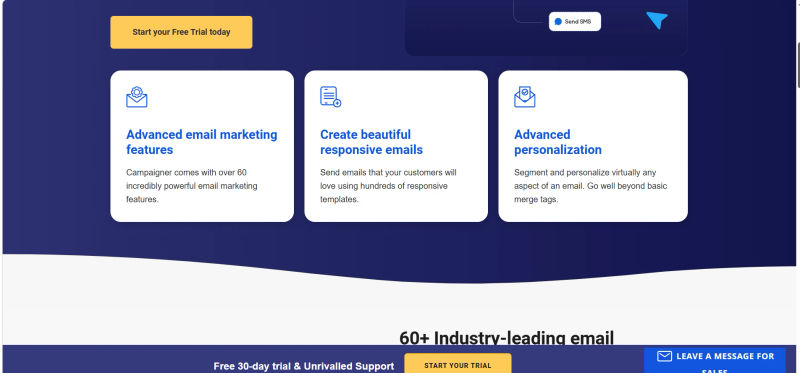
The visual editor in Campaigner strikes a balance between flexibility and ease of use. It employs a drag-and-drop interface that supports responsive design out of the box, ensuring emails render correctly across the fragmented landscape of mobile devices and dark-mode settings.
For teams without a dedicated graphic designer, the Template Library is a critical asset. Campaigner offers over 900 responsive templates. While quantity is high, the quality varies; however, the "Modern" category features sleek, minimalist designs suitable for 2026 design aesthetics. Importantly, for those with coding resources, full HTML editing access is available, allowing for pixel-perfect customization.
The real power, however, lies in Dynamic Content Insertion. Marketers can use conditional logic within the email body to display different images, copy, or CTAs based on the recipient's custom fields. For example, a single campaign sent to your entire database can show men’s shoes to male subscribers and women’s accessories to female subscribers, all determined by the data residing in your CRM. This reduces the need to clone campaigns for different segments, streamlining production time significantly.
2. AI-Powered Optimization
New for the 2026 landscape, Campaigner has introduced a suite of Artificial Intelligence tools designed to augment the marketer's capabilities.
Generative AI for Copy: Stuck on a subject line? The built-in AI writing assistant can generate multiple variations of subject lines and preheaders based on your campaign keywords and desired tone, helping to break writer's block and improve open rates.
Predictive Sending: Going beyond simple time-zone scheduling, the AI analyzes historical engagement data for each individual subscriber to determine their specific "optimal open time." It then holds the email and delivers it at that exact moment, maximizing the probability of engagement.
Churn Prediction: By analyzing engagement decay, the platform can flag subscribers who are at risk of unsubscribing before they leave, allowing you to automatically trigger a re-engagement workflow.
3. Automation & Journey Orchestration
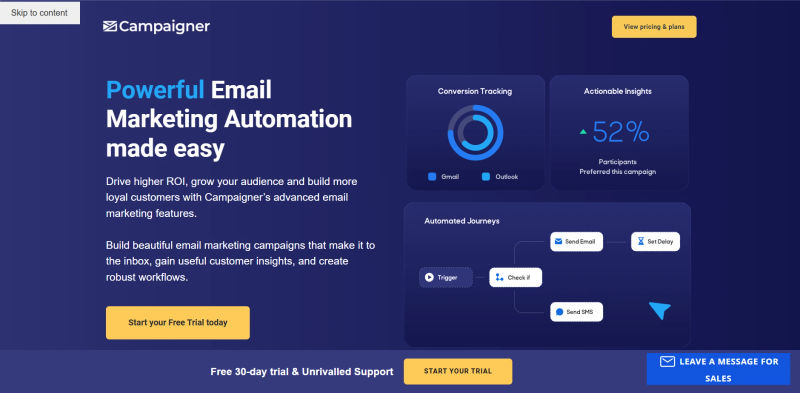
When evaluating Campaigner marketing automation features, the platform's "Workflows" tool serves as the engine room. It provides complex, conditional branching logic that goes far beyond basic autoresponders. Marketers can design visual customer journeys triggered by specific API events, such as a "Video Watched" event, a "Cart Abandoned" signal, or a change in a custom contact field.
The visual builder allows you to orchestrate both email and SMS touchpoints within the same automation path. It includes enhanced wait-step logic and throttling capabilities, allowing you to pace message delivery to avoid overwhelming your support team or hitting API rate limits.
Additionally, Campaigner supports split-testing directly within the automation path. This lets you A/B test not just subject lines, but entire branches of a customer journey to optimize for the highest conversion rates.
4. Segmentation & Personalization
Basic list management is obsolete; Campaigner focuses on hyper-segmentation. You can build segments based on a combination of demographic data, engagement history (opens, clicks), and purchase behavior.
Advanced users can leverage RFM analysis (Recency, Frequency, Monetary) data points to identify VIP customers versus those at risk of churning. The platform’s segmentation engine updates in real-time. As soon as a subscriber meets the criteria for a segment—for instance, spending over $500 in a year—they are automatically added to that group and can trigger a specific "VIP Welcome" workflow without manual intervention.
5. SMS Marketing
For users exploring the Campaigner email marketing platform SMS integration, mobile messaging is treated as a core channel rather than an afterthought. The standout Campaigner SMS marketing feature is its seamless integration into the workflow builder. You can set up cross-channel automations that send an email first, wait 24 hours, and then follow up with a text only if the email remains unopened.
Additional Campaigner SMS marketing features include support for both standard SMS and rich-media MMS delivery. Compliance is robust, automatically handling TCPA requirements and opt-outs (STOP replies) to ensure privacy regulation adherence. The system supports both short codes for high-volume sending and long codes for a more personal touch.
6. Mobile Accessibility
For the modern marketing manager who is rarely tied to a desk, Campaigner offers a mobile companion app. While you wouldn't build a complex workflow on a smartphone, the app is vital for monitoring and crisis management. You can view real-time campaign performance, pause a campaign if an error is detected, and preview drafts on actual mobile devices. This level of accessibility is a key differentiator for teams that need to be responsive 24/7.
7. Testing & Optimization
Yes, Campaigner provides A/B testing, advanced deliverability optimization, and detailed engagement analytics for campaigns. Beyond standard A/B testing for subject lines, Campaigner offers multivariate testing to evaluate combinations of content, design, and send times simultaneously. These tools work alongside advanced deliverability optimization for maximum inbox placement and detailed engagement analytics to track campaign conversions.
8. Deliverability & Compliance
In 2026, inbox placement is harder than ever due to stricter AI filtering by ISPs. Campaigner provides tools to authenticate your domain using DKIM, SPF, and DMARC protocols. The platform includes a "Reputation Defender" add-on that proactively scans your lists for known spam traps and invalid emails before you hit send, protecting your sender score.
For larger accounts, Campaigner offers dedicated IP addresses, giving you full control over your sender reputation rather than sharing it with other clients. This is essential for high-volume senders who cannot afford to be blacklisted due to another user's bad practices.
9. Reporting & Revenue Attribution
The analytics dashboard goes beyond vanity metrics like open rates. It offers Revenue Attribution reporting, linking specific campaigns and workflows directly to dollars generated in your e-commerce store.
Marketers can utilize UTM parameterization to track traffic sources in Google Analytics 4 (GA4) or Adobe Analytics. The reporting suite also includes device breakdowns, heatmaps of click activity, and geolocation reports, providing actionable insights into where and how your audience is engaging.
10. Integrations & API
Can marketers deploy Campaigner email with CRM integration for unified customer communication across all channels? Yes. Campaigner connects natively with major platforms including Shopify, Magento, WooCommerce, Salesforce, and Microsoft Dynamics. By leveraging a Campaigner CRM sync, businesses can use real-time sales data and lead statuses to trigger automated email and SMS workflows, ensuring unified customer communication across all channels.
For custom tech stacks, their REST API is well-documented, allowing developers to push and pull data programmatically. Webhooks can be configured to send real-time data back to your internal systems whenever a subscriber bounces, unsubscribes, or updates their profile.
Find Perfect Software For Your Business
Pricing & Plans
When evaluating campaigner pricing, the platform operates on a tiered model based on contact volume and feature access. Unlike some competitors that hide costs, the campaigner pricing page is transparent, though costs scale significantly as your list grows.
For those conducting a campaign management software pricing and feature comparison 2026 (or updating a campaign management software pricing and feature comparison 2025 2026 analysis), Campaigner offers predictable base rates, but you must account for SMS and eCommerce add-ons.
Contract Flexibility & Discounts: Campaigner offers month-to-month and annual billing. While month-to-month provides flexibility for SMBs wary of lock-in, annual plans include a campaigner discount (usually around 18-20% off the standard campaigner email marketing pricing). Be aware that cancellation policies for annual contracts are strict.
Below is a breakdown of the current plan structures found on the campaigner.com pricing and campaigner email marketing pricing page. Reviewing these campaigner pricing email marketing tiers ensures you align your budget with the right capabilities.
Plan | Price | Best For | Features |
Starter | Free 30-day trial | SMBs starting automation | • Drag-and-drop editor |
Essential | $14 / month | Growing E-commerce | • Dynamic content insertion |
Advanced | $35 / month | High-volume senders | • Advanced workflow automation |
Enterprise | Custom Quote | Large Enterprises | • Dedicated IP reputation management |
*Note: All prices shown reflect typical monthly billing. Vendors often offer lower pricing for annual commitments, but those discounts are excluded here for easier comparison. Actual costs may vary depending on your requirements, usage volumes, and negotiated terms.

Add‑Ons, Limits, and Overages
It is critical to note that SMS credits are typically purchased separately or as an add-on bundle, which can affect the total cost of ownership. Additionally, the "Reputation Defender" list hygiene tool often incurs an extra monthly fee based on the volume of contacts scanned. Be sure to calculate these potential overages when budgeting.
Best Fit Scenarios & Playbooks
1. SMB Ecommerce
For an online retailer using Shopify, Campaigner excels at cart abandonment and browse abandonment flows. By integrating product data, you can dynamically insert the exact item a customer left behind into the email, significantly increasing recovery rates.
2. B2B Lead Gen
B2B marketers can utilize Campaigner for lead nurturing. By scoring leads based on their interaction with whitepapers and webinars, you can automate the handoff to sales. For instance, a workflow can be set to notify a sales rep via email only when a lead reaches a "Hot" lead score threshold.
3. Agencies
Agencies managing multiple client accounts benefit from Campaigner’s sub-account structure. This allows for centralized billing and template management while keeping client data strictly siloed for governance and security.
Onboarding, Migration, and Support
Migrating to a new ESP is often a pain point, but Campaigner offers managed migration services for higher-tier plans. This includes porting over HTML templates, migrating contact lists with their custom fields, and setting up initial IP warming schedules.
1. Campaigner University & Training
For teams worried about the learning curve, Campaigner University offers a robust library of video tutorials, webinars, and certification courses. This is an excellent resource for upskilling junior staff without needing to pay for external consultants. The documentation is searchable and generally up-to-date with the latest API changes.
2. IP Warming Strategy
IP Warming is a critical phase for 2026. If you move 100,000 contacts to a new IP and blast them on day one, you will be blocked. Campaigner’s support team provides a ramp-up schedule, gradually increasing send volume over 2-4 weeks to establish a positive sender reputation with ISPs like Gmail and Outlook.
Don't just take our word for it. See how Campaigner stacks up against the competition on AuthenCIO.
Real‑World Performance & Deliverability
Independent benchmarks for 2026 suggest Campaigner maintains a strong deliverability rate, consistently performing above the industry average of 85%. Their enforcement of double opt-in best practices and strict abuse monitoring helps maintain the integrity of their shared IP pools.
For SMS, Campaigner adheres to strict CTIA guidelines. Their system automatically handles the complex logic required for "quiet hours" (ensuring marketing texts aren't sent at 3 AM) and frequency capping, which protects your brand from being perceived as spammy.
Top Campaigner Alternatives (When to Choose Each)
While Campaigner offers robust email automation, it may not suit every business. If you are evaluating Campaigner alternatives, the market features several specialized competitors. Here is how the top Campaigner alternatives compare regarding core features, ideal use cases, and migration difficulty.
1. Campaigner vs Moosend
Best for: Budget-conscious businesses needing ease of use. Moosend is significantly more affordable and offers a more modern, user-friendly interface. It is excellent for straightforward automation but lacks the granular enterprise-grade controls of Campaigner.
Ease of Migration: High. Moosend’s import tools are forgiving, but you will likely need to rebuild complex automations from scratch as the logic structures differ.
2. Campaigner vs Drip
Best for: DTC E-commerce brands. Drip is hyper-focused on e-commerce. Its visual builder and pre-built "Playbooks" for Shopify are superior for brands that sell physical goods online. If you don't need heavy B2B features, Drip might be a more intuitive choice.
Ease of Migration: Moderate. Drip relies heavily on a tagging system rather than lists. Moving from Campaigner’s list-based hybrid model to Drip’s tag-based model requires a strategic data cleanup before import.
3. Campaigner vs GetResponse
Best for: All-in-one marketing needs. GetResponse goes beyond email to include webinar hosting and landing page builders. If you want a single platform to handle your entire funnel—from lead capture to webinar delivery—GetResponse offers a broader utility belt.
Ease of Migration: High. GetResponse has excellent list import features, though migrating webinar history or landing pages is a manual process.
4. Campaigner vs iContact
Best for: Simplicity and high-touch support. {iContact is a legacy player that excels in customer service. It is less feature-rich regarding advanced automation compared to Campaigner but is very stable and easy to use for non-technical teams.
Ease of Migration: Very High. The data structures are similar (list-centric), making it one of the easiest lateral moves for a basic email program.
5. Campaigner vs Kartra
Best for: Integrated sales funnels and course creators. Kartra is not just an ESP; it’s a business management platform. It includes checkouts, membership sites, and video hosting. Choose Kartra if you need to run an entire digital business, not just send emails.
Ease of Migration: Low. Kartra is a completely different ecosystem. You aren't just moving emails; you are moving your entire business logic, checkouts, and memberships. Expect a 4-8 week transition.
6. Campaigner vs Customer.io
Best for: SaaS and App-based businesses. Customer.io is the gold standard for event-driven automation. If your data relies on app usage (e.g., "User clicked button X inside the app"), Customer.io’s data model is far more flexible than Campaigner’s list-centric model.
Ease of Migration: Low. Customer.io requires a fundamental shift in how you think about data (events vs. attributes). You will likely need developer assistance to map your API calls correctly.
7. Campaigner vs ExpertSender S.A.
Best for: High-volume, complex deliverability needs. ExpertSender specializes in arbitrage and high-volume sending where deliverability is the only metric that matters. It offers deep technical customization for infrastructure that exceeds standard SMB needs.
Ease of Migration: Moderate to Low. This is an enterprise move. ExpertSender typically handles the migration for you because the technical setup of IPs and routing is complex.
8. Campaigner vs AWeber Communications
Best for: Small businesses and beginners. AWeber invented the autoresponder. It remains a solid, reliable choice for small businesses that need simple RSS-to-Email and basic newsletters without the complexity of dynamic workflows.
Ease of Migration: High. AWeber’s import tool is robust, and they offer free migration services for new accounts, making it a painless switch for smaller lists.
Campaigner vs. Competitors: A Quick Comparison
Before diving into the feature snapshot, it is helpful to visualize where Campaigner sits in the broader ecosystem. It occupies the "Power User" middle ground.
Vs. The Simplifiers (Moosend, AWeber, iContact): Campaigner wins on automation depth and API capabilities but loses on price and ease of use.
Vs. The Specialists (Drip, Customer.io): Campaigner is a generalist. It is better for companies that do both B2B and B2C, whereas Drip wins purely on E-commerce and Customer.io wins purely on SaaS/App messaging.
Vs. Klaviyo: When evaluating Campaigner email vs Klaviyo for ecommerce marketers needing advanced audience segmentation and comprehensive marketing automation, Klaviyo wins via deeper native store integrations and predictive analytics. Campaigner serves as a cost-effective alternative for hybrid B2B/B2C models.
Vs. The Platforms (Kartra, GetResponse): Campaigner focuses strictly on messaging (Email/SMS). If you need landing pages, webinars, or checkouts, the "Platform" tools offer better value consolidation.
Feature‑by‑Feature Snapshot
Automation: Campaigner and Drip lead the pack with visual, branching logic; AWeber and iContact trail with simpler linear automations.
SMS Integration: Campaigner provides native, deep integration. Tools like Moosend may require third-party Zapier connections for full SMS functionality.
Analytics: Campaigner and ExpertSender offer the most granular data for data analysts. Customer.io excels in cohort analysis.
Ease of Use: Moosend and AWeber are "plug and play." Campaigner and Customer.io require a technical implementation period.
Methodology & Sources
This review evaluates Campaigner based on feature velocity, pricing transparency, and user sentiment analysis from 2025-2026. We referenced documentation regarding API rate limits, GDPR compliance protocols, and deliverability benchmarks to ensure technical accuracy. Pricing data is based on published tiers as of early 2026 and is subject to change.
Try AuthenCIO
Move to faster, smarter software evaluation with AI
Final Verdict
Campaigner remains a heavyweight contender in the 2026 email marketing landscape. It bridges the gap between simple newsletter tools and complex enterprise clouds. For the SMB Marketing Manager who demands omnichannel orchestration, advanced segmentation, and dedicated deliverability support, Campaigner offers a high ROI.
Your Next Steps:
If you have < 5,000 contacts: Campaigner might be overkill. Start with Moosend or AWeber to save budget.
If you have > 50,000 contacts: Campaigner is a strong contender. We recommend scheduling a demo specifically to ask about their "Reputation Defender" and managed IP warming services.
If you need SMS: Campaigner is superior to most alternatives listed here due to its native integration.