
Introduction
In 2026, the digital landscape for startups and bloggers is more competitive than ever, yet a fundamental truth remains: email marketing is the undisputed king of return on investment. With the global email marketing software market projected to exceed $4 billion this year, the tools available to small businesses have become increasingly sophisticated. However, for a bootstrapped founder or a solo blogger, the challenge isn't just finding a tool—it's finding a solution that doesn't eat into a limited runway.
Streamline your software evaluation process
For many early-stage ventures, the cost of software subscriptions can be a silent killer. You need professional-grade features—automation, segmentation, and analytics—but you cannot afford the enterprise-level price tags that often accompany them. Furthermore, there is the issue of "opportunity cost." As a founder, your time is your most expensive asset. Spending weeks learning a complex enterprise tool when you only need to send a weekly newsletter is a strategic error.
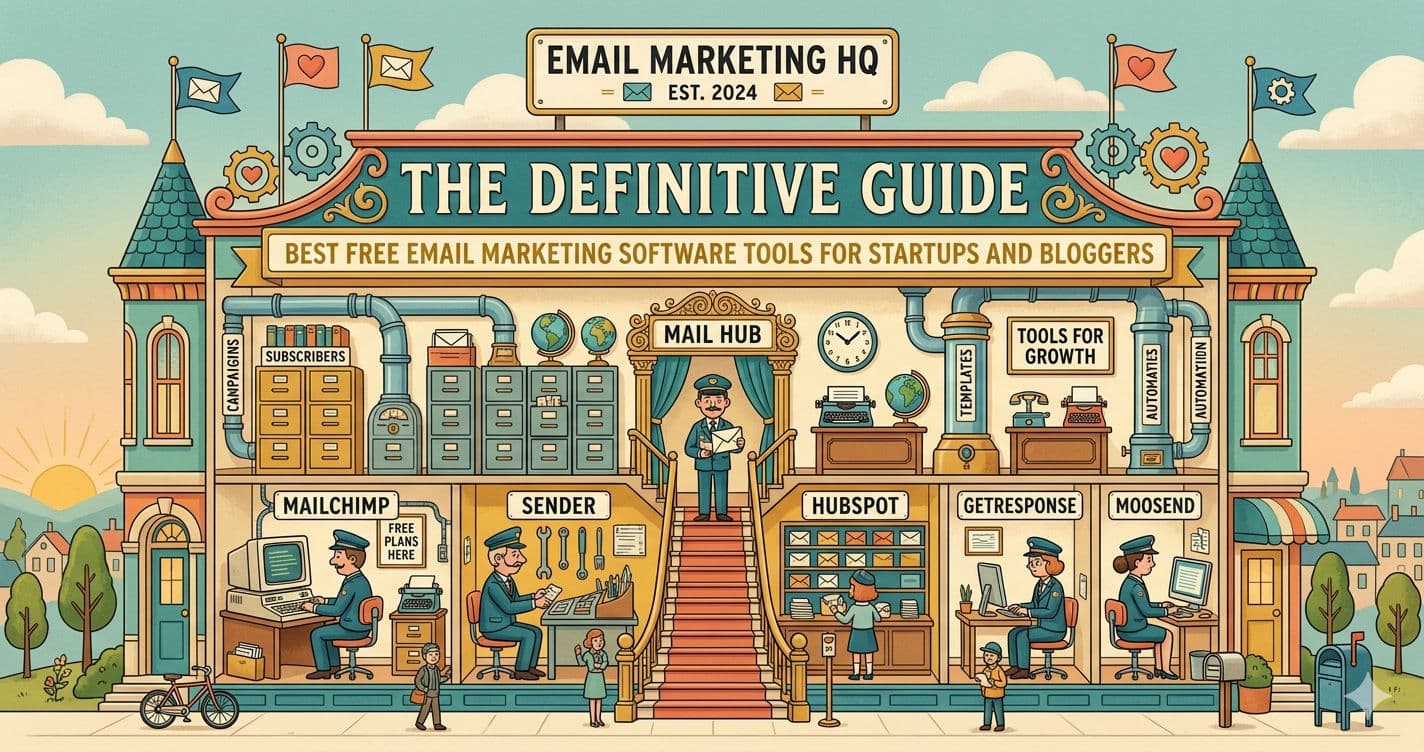
Fortunately, the "freemium" model has evolved. The best free email marketing software in 2026 offers more than just a taste of the product; these platforms provide robust, forever-free plans that allow you to build, nurture, and monetize an audience of thousands without spending a dime. This guide is designed for the pragmatist. We aren't just listing tools; we are analyzing the strategic value of Sender, Moosend, Hubspot Email Marketing, Mailchimp, Brevo, and MailerLite. We will explore which platforms allow you to scale without friction, which offer the best automation for "set it and forget it" marketing, and which impose limits that might hinder your growth.
Leading Email Automation Software Solutions to Know
While this guide explores key industry insights, seeing these principles in action requires the right platform. Here is a snapshot of the most recognized Email Automation Software solutions currently shaping the market.






Why Free Email Marketing is Crucial for Startups in 2026
In the current economic climate of 2026, efficiency is the primary metric for startup survival. Paid acquisition channels like social media ads have seen skyrocketing costs per click (CPC), making organic retention channels vital. Email marketing remains the most direct line to your customer, free from the volatility of social media algorithms.
1. Owning vs. Renting: The Platform Risk
One of the most compelling reasons to prioritize email marketing is the concept of platform risk. When you build an audience on X (formerly Twitter), LinkedIn, or Instagram, you are essentially "renting" access to your followers. A single algorithm change or a shadowban can wipe out your reach overnight. In contrast, an email list is an asset you own. It is portable, direct, and immune to the whims of third-party platforms. For a startup in 2026, owning your distribution channel is not just a marketing tactic; it is an insurance policy for your business continuity.
2. The "Ramen Profitability" Phase
When you utilize a free tier effectively, you lower your customer acquisition cost (CAC) significantly. You can test subject lines, validate product-market fit, and build a loyal community without the pressure of a monthly overhead. This financial breathing room is essential during the "ramen profitability" phase of a startup—where every dollar saved extends your runway. Modern free plans have moved beyond basic newsletters, now including features that were once premium-only, such as behavioral triggers and A/B testing.
3. Forever Free vs. Free Trial: Avoiding the Trap
It is crucial to distinguish between a "forever free" plan and a "free trial." A trial puts a ticking clock on your marketing efforts, forcing a purchase decision (often $20-$50/month) before you may be ready. A forever-free plan, conversely, scales with you, typically capping usage based on subscriber count or daily send limits. Understanding this distinction is the first step in avoiding the "migration headache"—the painful process of moving your list to a new provider because you hit a paywall too early.
Key Evaluation Criteria for Free Email Tools
Before diving into the specific tools, it is vital to establish a framework for evaluation. Not all free plans are created equal, and the "best" tool depends entirely on your specific business model. Here are the critical factors you must weigh when selecting free newsletter software in 2026.
1. Deliverability and Shared IPs
One of the hidden trade-offs of free plans is that your emails are sent via shared IP addresses. This means your reputation is tied to other users on the same server. If another user sends spam, it could theoretically impact your deliverability. In 2026, top-tier providers use sophisticated AI to police their free tiers, ensuring that bad actors are removed quickly to protect the shared pool. We evaluate tools based on their reputation for maintaining high deliverability rates even on free accounts.
2. Automation Capabilities
For a startup founder, time is the scarcest resource. You cannot afford to manually send welcome emails to every new subscriber. The best free email marketing software must offer automation capabilities. Look for tools that allow you to create "drip campaigns"—sequences of emails triggered by user actions (e.g., signing up, clicking a link, or abandoning a cart). Some free plans restrict this feature, while others offer full access to visual automation builders.
3. Ease of Use and Learning Curve
If you are a non-technical founder or a blogger, you likely don't have a dedicated designer. The quality of the drag-and-drop editor is paramount. You need a tool that offers responsive, modern templates that look good on mobile devices without requiring HTML knowledge. Furthermore, consider the "time-to-launch." Can you sign up and send your first email in under 30 minutes, or does the tool require a weekend of tutorials? We assess how intuitive the interface is and whether the "free" templates are high-quality.
4. Scalability and The "Price Cliff"
Eventually, you will grow. The goal of using a free tool is to graduate from it. However, you need to know what that graduation costs. Some tools have a smooth pricing curve, where the first paid tier is $10 or $15 a month. Others have a steep "cliff," jumping immediately to $50 or $100 once you cross the free subscriber threshold. We analyze the "scalability path" to ensure you aren't locking yourself into a tool that becomes unaffordable just as you start to succeed.
5. Support Responsiveness
When things break—and they will—you need help. Unfortunately, support is often the first thing cut from free plans. Some providers offer 24/7 chat support even for free users, while others restrict support to email tickets with 3-day turnaround times, or worse, a knowledge base only. For a novice, lack of human support can be a dealbreaker.
Starting out on a budget? Explore and compare free email marketing software tools on AuthenCIO.
Detailed Review of Top 5 Free Email Marketing Platforms
Based on our analysis of the 2026 market, these five platforms represent the best balance of features, usability, and generosity in their free tiers. We have tested them against the needs of modern startups and bloggers.
1. Sender: High-Volume Sending for Growing Startups
Sender has established itself as a powerhouse for startups that anticipate rapid list growth. Unlike many competitors that cap free plans at 500 or 1,000 subscribers, Sender often offers significantly higher limits, making it one of the most generous free email marketing software options on the market.
The Good: Sender’s interface is exceptionally clean and user-friendly. It focuses heavily on e-commerce and blogger needs, providing excellent integration with platforms like WordPress and WooCommerce. The standout feature is the inclusion of automation on the free plan. You can set up welcome sequences and abandoned cart emails without upgrading. Furthermore, Sender is known for high deliverability, a critical factor often overlooked in free tools.
The Catch: While the features are robust, the template library, while modern, may feel smaller compared to giants like Mailchimp.
The Branding Factor: Sender includes a "Powered by Sender" badge in the footer of free emails. It is relatively subtle compared to competitors but still visible.
Best For: E-commerce startups and bloggers who need to send a high volume of emails and want automation without paying immediately.
2. Moosend: Advanced Automation Features for Bloggers
Moosend is often praised for its sophisticated automation capabilities. In 2026, it remains a favorite for users who want to build complex customer journeys. While Moosend has fluctuated between "forever free" and "free trial" models over the years, its entry-level accessibility for testing advanced features is unmatched.
The Good: The visual automation editor is the star here. You can create complex workflows with multiple triggers and conditions, which is rare for low-cost entry points. Moosend also provides real-time analytics that are deeper than most, offering heatmaps and geographical data to help you understand your audience. The drag-and-drop editor is intuitive, making it easy to design professional newsletters.
The Catch: Depending on the specific offer in 2026, you may find that the "free" experience is a time-limited trial designed to hook you on the features. Users should verify if they are signing up for a 30-day trial or a subscriber-capped free tier. If it is a trial, it is best used by those ready to launch immediately.
The Branding Factor: Moosend’s branding is present on free tiers (or trial emails), typically as a logo in the footer. It is standard for the industry.
Best For: B2B startups and serious bloggers who need to build complex funnels and value data over simple newsletter sending.
Find Perfect Software For Your Business
3. Mailchimp: The Comprehensive Marketing Suite
Mailchimp is the elephant in the room. For over a decade, it has been the default answer to "free email marketing." In 2026, it has evolved into a full-service marketing platform, offering landing pages, social posting, and even physical postcards.
The Good: The ecosystem is massive. Virtually every third-party tool—from CRM to payment processors—integrates with Mailchimp. If you use a diverse tech stack, Mailchimp will likely connect with it out of the box. The drag-and-drop builder is the industry standard for a reason: it is reliable and flexible. The free plan also includes basic CRM features, allowing you to tag and organize your contacts effectively.
The Catch: The "Mailchimp Tax" is real. As you grow, the pricing can become steep compared to competitors. The free plan has also seen restrictions over the years, with limits on the number of audiences and seats. Crucially, human support (email/chat) is often limited to the first 30 days. After that, you are on your own with the documentation.
The Branding Factor: Mailchimp requires a badge in the footer. Because the brand is so recognizable, some users feel it looks professional, while others find it screams "I'm using a free tool."
Best For: Small businesses that need an all-in-one marketing hub and prioritize integrations over the lowest possible scaling cost.
4. HubSpot Email Marketing: Starter Platform With Excellent Scalability Potential
HubSpot’s free email marketing tools are part of the platform’s Marketing Hub product offering. As such, besides a drag-and-drop email builder, automation tools, and health reporting, you also get access to numerous free cross-channel marketing tools, like ad campaign management, web traffic analytics, live chat, and chatbots.
The Good: The platform’s free email marketing tools are rather versatile. You get access to various format-specific templates you can customize through a drag-and-drop interface, CRM-based email personalization, email automation, and AI-powered copywriting assistants. The standout is HubSpot’s native CRM, which allows you to easily segment your contact list based on various criteria, which is perfect for hyper-target email campaigns.
The Catch: You cannot use paid email marketing features independently. Access to more advanced features is only possible through Marketing Hub’s paid plans, which also include multi-channel marketing automation. This may pose a disadvantage for users who are strictly looking for an email marketing solution.
The Branding Factor: HubSpot’s free marketing tools are branded. The option to remove HubSpot branding is available in Marketing Hub Starter, which costs $7/user/month.
Best For: Small business owners and solopreneurs looking for a solid entry-level email marketing solution that also includes the option to scale as business needs grow.
5. Brevo: Best for Transactional and Marketing Synergy
Brevo takes a unique approach to the free model. Instead of capping the number of contacts you can store, they cap the number of emails you can send per day. This is a game-changer for businesses with large lists that don't email daily.
The Good: You can store unlimited contacts. If you have a list of 20,000 users but only want to email them in batches or send a weekly newsletter spread over a few days, this is the perfect tool. It also excels in transactional emails (password resets, order confirmations) and offers SMS marketing integration, which is a rarity in the free space. The platform includes a built-in CRM and chat functionality, allowing you to manage customer relationships beyond the inbox.
The Catch: The daily sending limit (often around 300 emails/day on the free tier) can be a bottleneck if you need to blast a time-sensitive announcement to a large list all at once. You have to plan your campaigns carefully to respect the daily cap.
The Branding Factor: The free plan includes a Brevo logo. To remove it, you generally need to upgrade to a "Lite+" or "Business" tier.
Best For: SaaS companies needing transactional emails and businesses with large contact lists who send infrequent or batched campaigns.
6. MailerLite: Simplicity and Modern Design
MailerLite has cultivated a loyal following by doing exactly what its name suggests: providing a "lite," clean, and highly effective email marketing experience. It strips away the clutter found in heavier platforms to focus on design and usability.
The Good: The interface is arguably the best in class for simplicity. It is modern, fast, and intuitive. The free plan is very generous, typically including access to automation, landing pages, and pop-ups. MailerLite's landing page builder is particularly strong, allowing you to build a subscriber list even before you have a website. The approval process for new accounts is strict, which keeps their server reputation high and ensures excellent deliverability for legitimate users.
The Catch: The strict approval process can be a hurdle; you need to have a legitimate web presence and content to get approved. Additionally, advanced reporting features are sometimes reserved for paid plans.
The Branding Factor: The free plan carries the MailerLite logo in the footer. It is clean and unobtrusive, blending well with most modern website designs.
Best For: Content creators, authors, and bloggers who want beautiful emails and landing pages with zero technical friction.
2026 Comparison of Low Cost Email Marketing Solutions
To help you make a quick decision, we have compiled the essential data points for each platform. This table highlights the exact limitations and features of the free offerings available in 2026.
Software | Plan | Best For | Top Features (Free Plan) |
Sender | Free Forever | High Volume Sending | 2,500 Subscribers, 15,000 Emails/mo, Automation, Popups, No Branding |
Moosend | Free Trial | Testing Automation | Unlimited Emails (Trial), Visual Automation Editor, Landing Pages, Countdown Timers, Real-time Reporting |
Hubspot Email Marketing | Free Forever | Simple Email Automation | 2,000 email sends/month, email personalization, AI copywriting tools, email health reporting |
Mailchimp | Free | Integrations | 500 Contacts, 1,000 Sends/mo, Basic Templates, Marketing CRM, Creative Assistant |
Brevo | Free | Unlimited Contacts | Unlimited Contacts, 300 Emails/day, SMS Marketing, Transactional Emails, Chat Widget |
MailerLite | Free | Clean Design | 1,000 Subscribers, 12,000 Emails/mo, Drag-and-Drop Editor, 10 Landing Pages, Email Automation |
The Integration Ecosystem: Connecting Your Stack
No email tool exists in a vacuum. In 2026, your email software needs to talk to your website, your store, and your other tools. Here is how the top contenders stack up regarding integrations.
WordPress: All five tools offer dedicated WordPress plugins. MailerLite and Sender have particularly well-rated plugins that allow you to embed forms via shortcodes easily. Mailchimp's plugin is robust but can sometimes be resource-heavy.
Shopify: If you are in e-commerce, Sender and Mailchimp are the leaders here. They pull product data directly into your email editor, allowing you to drag and drop product blocks. Brevo also offers strong Shopify synchronization for transactional data.
Zapier: For everything else, there is Zapier. Mailchimp, Moosend, and MailerLite have extensive Zapier libraries, allowing you to connect to Google Sheets, Typeform, or Slack. Brevo's API is also highly accessible for custom connections.
30-Minute Quick Start Checklist for Founders
Time is money. If you are ready to start, follow this checklist to go from zero to "sent" in under 30 minutes.
Select Your Tool: Pick MailerLite for ease of use or Sender for high limits. Create your account.
Verify Your Domain: Do not skip this. Log into your domain registrar (GoDaddy, Namecheap, etc.) and add the TXT records provided by the email tool. This ensures you don't land in spam.
Create a "Master" List: Create one main subscriber list. Do not create separate lists for every small purpose; use tags instead.
Create a Sign-Up Form: Use the tool's form builder to create a simple embedded form. Ask only for "First Name" and "Email Address" to keep conversion rates high.
Set Up the Welcome Email: Create an automation that triggers "When subscriber joins group." Write a simple, text-based email: "Hi [Name], thanks for joining. Here is what you can expect..."
Test and Activate: Sign up using your own personal email. If you receive the welcome email, you are live.
How to Maximize ROI with Free Email Marketing Tools
Choosing the software is only step one. To truly benefit from free email marketing software in 2026, you must use these tools strategically. The goal is to stay on the free plan as long as possible while maximizing the revenue you generate from your list. Here is how to squeeze every drop of value from these platforms.
1. Authenticate Your Domain (SPF/DKIM)
One of the most common mistakes startups make is skipping domain authentication. When you sign up for a free tool, you often send emails via a generic domain (e.g., via sender.net). This looks unprofessional and hurts deliverability. Most free tools allow you to authenticate your domain by adding SPF (Sender Policy Framework) and DKIM (DomainKeys Identified Mail) records to your DNS settings. This tells inbox providers (like Gmail and Outlook) that you are authorized to send emails from your domain, drastically reducing the chance of landing in the Spam folder. It takes ten minutes to set up and provides a massive boost to your open rates.
2. Aggressive List Hygiene
Since most free plans are capped by the number of subscribers (e.g., 500 or 1,000), you cannot afford to have "dead weight" on your list. Subscribers who haven't opened an email in six months are costing you money (or quota) without providing value. Implement a quarterly cleaning routine. Send a re-engagement campaign asking if they still want to receive updates. If they don't click, delete them. This keeps your list size manageable, allowing you to stay on the free tier longer while keeping your engagement rates high.
3. Leverage Welcome Automations
Never let a new subscriber wait. The moment someone signs up, their interest is at its peak. Use the automation features in tools like Sender or MailerLite to trigger an immediate Welcome Email. This email should deliver the lead magnet (if you promised one), introduce your brand's story, and set expectations for future content. A well-crafted welcome sequence can generate revenue on autopilot, proving the ROI of your email marketing efforts before you ever pay a subscription fee. Even a simple 3-email sequence (Welcome -> Value -> Soft Sell) can dramatically increase conversion.
4. Segment to Avoid "Blast" Fatigue
Just because you can send an email to everyone doesn't mean you should. If you are using Brevo with a daily sending limit, segmentation is your best friend. Divide your list based on interests or signup sources. Sending targeted content to smaller groups often yields higher open rates than generic blasts. It also helps you manage daily sending caps effectively. For example, if you have 1,000 subscribers and a 300/day limit, segment your list into three interest groups and send to one group per day.
Start your email marketing journey by choosing the best free tool through AuthenCIO.
Navigating Common Roadblocks
As you begin your journey, you will likely encounter a few common hurdles. Here is how to handle them without upgrading to a paid plan.
The Spam Complaint Fear: If a user marks you as spam, it hurts your reputation. To avoid this, ensure your unsubscribe link is visible. It is better for someone to unsubscribe than to mark you as spam. Most free tools will automatically pause your account if your spam rate exceeds 0.1%, so keep your content relevant.
The Double Opt-in Debate: Should you require users to confirm their email? In 2026, the answer is generally yes. While it adds friction, it prevents fake emails and bots from clogging up your limited free subscriber quota. All the tools reviewed here support double opt-in.
The Migration Headache: Moving from Mailchimp to MailerLite later? The key is to export your contacts as a CSV file including all custom fields (like "Join Date" or "Tags"). Before importing to the new tool, "warm up" your sending by sending to your most engaged users first. This prevents your new IP address from being flagged as suspicious.
Try AuthenCIO
Move to faster, smarter software evaluation with AI
Conclusion: Selecting Your Growth Partner
In 2026, the barrier to entry for email marketing is effectively zero. The tools we have reviewed—Sender, Moosend, Mailchimp, Brevo, and MailerLite—all offer powerful capabilities that can launch a startup or blog without upfront costs. The choice ultimately comes down to your specific constraints and goals.
If you need to send a high volume of emails to a growing list, Sender is likely your best bet. If you are a designer at heart who wants beautiful templates and landing pages, MailerLite is the clear winner. For those with massive lists who send infrequently, Brevo's unlimited contact storage is unbeatable. Mailchimp remains the safe harbor for those who need broad integrations, while Moosend is the playground for automation enthusiasts.
Do not let analysis paralysis stop you. The most important email you will ever send is the first one. Pick the tool that aligns with your immediate needs, set up your first welcome sequence, and start building your audience today. Your future self—and your business's bottom line—will thank you.