.webp&w=64&q=75)
Introduction
If you are searching for the best all in one marketing platform to replace a fragmented tech stack, you need a system that unifies email automation, CRM, and sales funnels. By 2026, agencies are abandoning the costly practice of stitching together disparate SaaS tools—like Zapier, Mailchimp for emails, and standalone CRMs. Instead, they are seeking a true all in one platform to orchestrate autonomous client growth and serve as powerful alternatives to disjointed legacy software.
Streamline your software evaluation process
An all-in-one platform eliminates data silos that obscure the customer journey. For agency owners, finding the right all in one marketing platform means stopping profitability leaks caused by manual reporting and disconnected systems. Today's top alternatives treat email automation and CRM as a synchronized engine, enabling closed-loop reporting from lead generation to final invoice.
In this guide, we evaluate the five most dominant platforms of 2026—HighLevel, HubSpot, Kartra, Keap, and Builderall. Whether you are looking for top software picks for email automation or direct alternatives to your current setup, we analyze these tools specifically through the lens of an agency owner who needs scalability, robust automation, and a single source of truth for client data.
Key Takeaways
Consolidating your agency's tech stack in 2026 reduces overhead and simplifies client management. If you are short on time, here is the bottom line on the top all-in-one marketing platforms for agencies:
HighLevel: The undisputed champion for agency scalability, offering unmatched white-labeling and unlimited client sub-accounts.
HubSpot: The premium choice for scaling agencies that need an enterprise-grade CRM paired with robust inbound marketing and advanced reporting.
Kartra: Best suited for agencies focused on rapid sales funnel deployment, membership sites, and built-in video hosting.
Keap: The go-to platform for agencies that prioritize deep sales pipeline automation and rigorous lead management.
Builderall: The most comprehensive, budget-friendly toolkit for newer agencies needing rapid deployment across multiple digital channels.
Selecting the right platform depends entirely on your agency's specific service offerings, client volume, and requirement for white-labeled solutions.
🏆 Top Software Picks
The top all in one digital marketing tools and email automation software for 2026:
HighLevel — best all in one agency software for white‑label automation and client management.
HubSpot — best all in one marketing software for CRM‑driven marketing and sales automation.
Kartra — best for marketers wanting AI‑powered funnels and centralized campaign control.
Keap — best for small businesses seeking CRM plus email and pipeline automation.
Builderall — best for entrepreneurs building websites and funnels in one platform.
Software covered in this article
For learning and reference, this listicle presents a selective overview of 5 best all-in-one marketing platforms for agencies:




The Shift Toward Unified Marketing: Why Agencies are Consolidating Stacks
The "Subscription Fatigue" of the early 2020s has given way to a demand for platform sovereignty. Agencies historically wasted up to 20% of their monthly recurring revenue (MRR) on software redundancy. Today, Marketing automation relies on behavior-based triggers firing across multiple channels simultaneously.
The core driver of this consolidation is data integrity and cross-channel alignment. When analyzing the evolution of all-in-one marketing platforms email social media seo 2025 2026 trends, siloed systems clearly hinder growth. If your email tool doesn't talk natively to your CRM, you risk pitching a prospect who already converted elsewhere. Unified platforms solve this via a single database. Furthermore, modern all-in-one marketing platforms email social media seo 2026 integrations allow agencies to align outreach, ensuring email campaigns, social media distribution, and SEO strategies work in tandem to capture long-tail queries.
When a contact's status changes, the email automation engine knows immediately to adjust the sequence. This synchronization across all-in-one marketing platforms email social seo workflows separates high-performing agencies from those stuck in manual data entry.
Compare Top Marketing Platforms — Scale Your Agency Smarter in 2026
1. The Rise of Autonomous AI Agents
In 2026, we have moved beyond simple "if/then" automation logic. The leading platforms now feature Autonomous AI Agents capable of reasoning. Instead of a static workflow that sends an email and waits three days, these agents can analyze a lead's sentiment from a reply, decide whether to book a meeting or send a case study, and execute that action without human intervention. This "generative orchestration" allows agencies to scale personalized outreach to thousands of leads without adding headcount.
2. The All-in-One Trap: Mitigating Platform Dependency
While consolidation boosts efficiency, it introduces a single point of failure. If your all-in-one platform goes down, your agency effectively stops running. To mitigate this "All-in-One Trap," savvy agency owners in 2026 prioritize platforms that offer robust data portability. The ability to export your entire CRM database, automation logic, and site assets in standardized formats (CSV, HTML, JSON) is non-negotiable. We also recommend maintaining a "warm backup" of critical client data in a secure, independent cloud storage solution to ensure business continuity during service outages.
Key Selection Criteria for Digital Agency Decision-Makers
Before diving into the platform reviews, it is critical to establish the criteria that matter most to agency owners in 2026. A tool might be excellent for a solopreneur but disastrous for an agency managing 50+ client accounts.
1. Multi-Tenant Architecture & Sub-Accounts
Can you manage multiple clients from a single login without commingling data? The best platforms allow you to switch between client instances instantly (multi-tenant) while keeping billing and permissions distinct. This prevents the nightmare of accidentally sending Client A's email blast to Client B's list.
2. White-Labeling Capabilities
Agencies often want to resell the software as their own proprietary technology. Robust white-labeling goes beyond just adding a logo; it involves customizing the domain, the login screen, and even the CSS of the dashboard to reinforce your agency's brand equity. This transforms software costs into a revenue-generating asset.
3. CRM-Native Automation Logic
The best all-in-one crm marketing tools 2026 offers require advanced conditional logic. True all in one marketing automation must seamlessly split workflow paths based on custom CRM fields and calculate lead scores combining email engagement with website behavior. This CRM-native integration ensures your automation is a core capability, not an afterthought.
4. API Robustness & Integrations
Even "all-in-one" tools sometimes need to connect to niche software. A robust, well-documented API is essential for custom integrations that scaling agencies often require. In 2026, we also look for "AI API" access, allowing your custom bots to interact with the platform's data.
5. Deliverability & Compliance
With 2026 email regulations being stricter than ever, platforms must offer dedicated IPs, automatic list cleaning, and granular control over sender reputation. Furthermore, data privacy laws (GDPR v3, CCPA) require platforms to have automated "Right to be Forgotten" workflows.
6. Ease of Client Onboarding & Migration Support
Time-to-value is critical. How quickly can you spin up a new client environment? Does the platform offer "Snapshots" or templates to clone successful setups? Additionally, does the vendor provide white-glove migration services to move data from legacy systems, or is your team stuck doing manual CSV imports?
Deep Dive: Top 5 All-in-One Marketing Platforms Reviewed
We have selected the following five platforms based on their market dominance, feature density, and relevance to the agency model in 2026.
1. HighLevel: The Agency-Centric Operating System
HighLevel (GoHighLevel) has cemented its position as the de facto operating system and agency marketing platform in 2026. Unlike other platforms that started as small business tools and pivoted, HighLevel was built for agencies from day one. It functions as a comprehensive all in one advertising platform for agencies, allowing teams to manage ad campaigns, lead attribution, and client fulfillment in one centralized hub. Its architecture is fundamentally designed around the "Agency View" vs. "Sub-Account View" structure, making it the top choice for any all in one marketing agency looking to scale.
Unified CRM, Advertising & Automation:
HighLevel’s "Workflows" builder is arguably the most powerful visual automation engine in this lineup. It combines CRM actions, email marketing, SMS, ringless voicemail, and call bridging into a single flow. For paid media teams, it serves as a robust all-in-one advertising platform for agencies by integrating directly with Facebook and Google Ads for closed-loop reporting and automated lead follow-up.
In 2026, HighLevel has integrated Conversational AI Bots directly into the workflow. These bots can handle initial lead qualification via SMS or webchat, answering questions and booking appointments on the calendar without human input. The synergy is flawless; because the CRM and automation are one, there is zero latency in data updates.
Agency-Specific Features:
The standout feature remains the "Snapshot." Agencies can build a perfect setup for a specific niche (e.g., a Dentist Marketing System with pre-built emails, funnels, and automations) and snapshot it to deploy into a new client's account in seconds. Furthermore, its SaaS Mode allows agencies to resell the software at their own price point, effectively turning the agency into a software company and creating a sticky recurring revenue stream.
Pros:
Unlimited sub-accounts on the agency plan.
Full white-labeling capabilities (desktop and mobile app).
Centralized ad reporting and lead attribution.
Native AI Conversational Agents for booking.
Replaces Calendly, ClickFunnels, Kajabi, and more.
Cons:
The learning curve is steep due to the sheer volume of features.
The UI can feel utilitarian compared to more polished competitors.

2. HubSpot: Best CRM and Email Marketing Software for Scaling
HubSpot remains the gold standard for usability and ecosystem maturity. In 2026, it continues to dominate the upper-mid-market and enterprise agency space. While it carries a premium price tag, the stability and depth of its reporting are unmatched, making it the best CRM and email marketing software for agencies that need to prove complex ROI attribution.
Content Creation, CMS & Social Media:
Agencies searching for all-in-one marketing platforms with built-in cms 2025 2026 consistently choose HubSpot's Content Hub. It leads the pack of all-in-one marketing platforms with cms 2026 by natively linking website infrastructure directly to the CRM. When comparing all-in-one marketing platforms email marketing social media content creation, HubSpot’s unified interface excels. It streamlines workflows for teams needing all-in-one marketing platforms email social media content creation by housing blog drafting, social scheduling, and email automation under one roof.
Unified CRM & Automation:
HubSpot’s strength lies in its "Smart Lists" and property-based automation. The CRM is the heart of the beast. You can create incredibly complex active lists that update in real-time based on hundreds of criteria (e.g., "Visited pricing page > 3 times AND opened last 2 emails AND has a deal size > $10k"). The email automation then references these lists dynamically.
The Operations Hub has become indispensable in 2026, using AI to automatically clean data, format names properly, and predict churn risk based on engagement patterns.
Agency-Specific Features:
HubSpot’s Partner Program is legendary, offering tiered commissions and dedicated support. For agencies, the ability to manage multiple client portals is smooth, though it lacks the "SaaS reseller" model of HighLevel. It is best suited for agencies that provide high-touch consulting and implementation services rather than churn-and-burn lead gen.
Pros:
Best-in-class user interface and ease of use.
Extremely powerful reporting and attribution dashboards.
Massive marketplace of native integrations.
Operations Hub automates data hygiene and quality control.
Robust built-in CMS for unified content, social, and email management.
Cons:
Pricing gets exponential as contact lists grow.
Advanced features are gated behind expensive "Professional" and "Enterprise" tiers.

3. Kartra: Streamlined Funnels and Integrated Automation
Kartra has evolved significantly by 2026, positioning itself as the premier platform for agencies focused on direct response marketing and info-products. It shines where the sale happens online via a funnel rather than a sales team.
Unified CRM & Automation:
Kartra’s "BAM" (Behavioral Adaptive Marketing) is its killer feature. It allows you to customize the content of a page based on the visitor's history in the CRM. If a lead is tagged as "VIP" in the database, the landing page they see can dynamically hide the basic pricing tier and only show the premium option.
The email automation is tightly coupled with its video hosting platform, allowing you to trigger emails based on how much of a video a lead watched—a feature often requiring expensive third-party tools in other stacks.
Agency-Specific Features:
Kartra offers an "Agency" feature that allows you to manage client accounts from a centralized dashboard. You can lease your funnels and campaigns to clients, protecting your IP. If you stop working with a client, you can "turn off" the assets you built for them (depending on your contract), which provides significant leverage in retainer negotiations.
.webp?tr=w-800%2Cq-80%2Cf-auto%2Cc-at_max)
Pros:
All tools (video, helpdesk, calendars) are included; no hidden add-ons.
Excellent for selling digital products and memberships.
BAM technology allows for high-level personalization.
Cons:
The page builder can feel clunky compared to modern no-code tools.
Not ideal for B2B sales teams needing a traditional pipeline view.
Find Perfect Software For Your Business
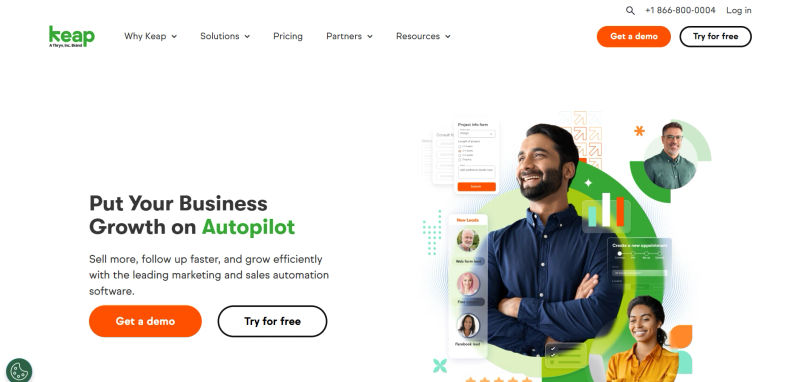
4. Keap: Advanced Lead Management and Sales Automation
Formerly Infusionsoft, Keap has successfully rebranded and modernized its interface while keeping the powerful automation engine that made it famous. In 2026, it serves agencies that focus heavily on small business service providers and sales pipeline management. For agencies seeking all in one marketing for trades, Keap stands out by seamlessly connecting lead capture with job quoting, invoicing, and appointment scheduling tailored to contractors and home service niches.
Unified CRM & Automation:
Keap’s "Campaign Builder" is the grandfather of visual automation and remains one of the most flexible. It handles complex logic branches with ease. The platform excels at moving leads from "Marketing" to "Sales."
The integration between the email marketing tools and the sales pipeline is seamless; a click in an email can automatically create a deal, assign a task to a sales rep, and send a notification SMS.
Agency-Specific Features:
Keap’s Partner Program offers certification and revenue share. For agencies, the "Keap Max Classic" (legacy features) combined with the modern UI provides a good balance of power and usability. A critical update for 2026 is the enhancement of the Dedicated Business Line. It now supports international messaging standards and A2P 10DLC compliance natively, allowing agencies to run global SMS campaigns without fear of carrier blocking.
Pros:
Strongest focus on sales pipeline and CRM hygiene.
Ideal for service niches, offering robust all in one marketing for trades.
Dedicated business line (phone/text) included in higher plans.
Excellent checkout and invoicing integration.
Cons:
Reporting features are less granular than HubSpot.
Can be overkill for simple lead gen campaigns.
5. Builderall: The Comprehensive Toolkit for Rapid Scaling
Builderall is the volume player. It packs more tools into a single subscription than any other platform on this list. For agencies working with budget-conscious clients or those needing a massive array of tools (from eLearning to magazine builders), Builderall is the Swiss Army Knife.
Unified CRM & Automation:
Builderall’s "MailingBoss" is its native autoresponder and CRM. While the UI is less polished than HubSpot or HighLevel, the raw functionality is there. It supports visual workflows, tagging, and scoring.
In 2026, they have improved their predictive sending features, which attempt to deliver emails when users are most likely to open them.
Agency-Specific Features:
The "Agency System" allows you to host sub-accounts for clients. The main draw here is cost. You can host websites and funnels for clients at a fraction of the cost of other competitors. The "Cheetah" website builder is incredibly fast, which is a major SEO plus for client sites. However, agencies should be wary of the "Jack of all trades" trap. While Builderall offers 40+ tools, not all are best-in-class. The CRM depth, for instance, may not satisfy the reporting needs of a complex enterprise client.
Pros:
Unbeatable price-to-feature ratio.
Includes niche tools like app builders, mockup studios, and chatbot builders.
Fast loading speeds for landing pages.
Cons:
"Jack of all trades, master of none"—some tools lack depth.
The interface can be inconsistent across different tools within the suite.

2026 Marketing Automation Comparison Matrix
The following table outlines the specific plans most relevant to agencies. Prices reflect the 2026 standard monthly rates for agency-tier or equivalent professional plans.
Plan | Price | Best For | Features |
HighLevel | Starts at $97.00/mo | Scaling Agencies & Resellers | Unlimited Sub-Accounts, SaaS Mode (Re-billing), AI Conversational Bot, Two-Way SMS/Email, White-Label Desktop/App, Visual Workflow Builder, Reputation Management |
HubSpot Marketing Hub | $894.00/mo | Mid-Market & Corporate Agencies | Omnichannel Automation, Custom Reporting, A/B Testing, Campaign Reporting, Social Media Management, CTA Creation, Salesforce Integration |
Kartra | Starts at $59.00/mo | Funnel & Info-Product Agencies | 12,500 Leads, Unlimited Emails, Agency Portfolio Mode, Video Hosting, Helpdesk, Membership Sites, Affiliate Management |
Keap | Starts at $299.00/mo | Service-Based Client Management | Advanced Automations, Sales Pipeline, Lead Scoring, Dedicated Business Line, Appointment Booking, Analytics & Reporting, E-commerce Payments |
Builderall | Starts at $99.00/mo | Budget-Conscious & Creative Agencies | 10 Domains, Unlimited Subscribers, Cheetah Website Builder, MailingBoss Automation, SMS Messaging, eLearning Platform, Booking Calendar |
*Note: All prices shown reflect typical monthly billing. Vendors often offer lower pricing for annual commitments, but those discounts are excluded here for easier comparison. Actual costs may vary depending on your requirements, usage volumes, and negotiated terms.
Maximizing ROI with Robust Email Automation and CRM Integration
Choosing the platform is only step one. To truly justify the ROI to your clients (and your own CFO), you must leverage the "all-in-one" nature of these tools. The magic happens in the gray area where CRM data meets automation logic.
1. Advanced Lead Scoring Models
Don't just track opens. Use your platform to assign points based on high-intent behaviors. Did they visit the "Pricing" page? Did they watch 50% of the demo video? Did they click the "Book a Call" link but not finish? By aggregating these signals in the CRM, your email automation can trigger a "Hot Lead" sequence that alerts a human sales rep, rather than sending another generic newsletter.
In 2026, predictive scoring uses historical data to flag leads that match the profile of your top 10% of customers, allowing you to prioritize outreach scientifically.
2. Database Hygiene and Deliverability
One of the hidden costs of fragmented stacks is dirty data. When you migrate to a unified platform, utilize the automation engine to clean your list. Create a "Sunset Policy" workflow: if a contact hasn't opened an email in 90 days, the system automatically tags them as "Inactive," attempts a re-engagement campaign, and if that fails, unsubscribes them. This improves your domain reputation and ensures you aren't paying for dead weight.
AI-driven hygiene tools in platforms like HubSpot now also automatically correct capitalization errors and flag disposable email addresses upon entry.
3. Hyper-Personalization via Custom Fields
Since your email tool now has access to your entire CRM database, move beyond "Hi {First_Name}." Use custom fields to reference the client's specific industry, their last purchase date, or their stated pain point from the intake form.
In 2026, generic copy is invisible. Data-driven copy converts. Agencies using this depth of personalization report up to a 40% increase in engagement compared to static blasts.
Implementation Strategy: Moving to a Unified Marketing View
Migrating an agency's tech stack is akin to changing the engine of a plane while it's flying. It requires a calculated approach to avoid data loss and client disruption. Here is a proven four-phase framework.
Phase 1: The Audit & ROI Calculation
Before canceling any subscriptions, map out every single touchpoint your agency currently has. List every form, every landing page, every email sequence, and every zap. Calculate the total cost of your current stack versus the projected cost of the all-in-one platform. Don't forget to factor in the "soft costs" of time saved on login switching and reporting. This audit serves as your baseline for proving success later.
Phase 2: The Data Map & Source of Truth
Define your "Source of Truth." If you are moving from Salesforce and Mailchimp to HubSpot, you need to ensure your field mapping is exact. Create a spreadsheet mapping "Old Tool Field" to "New Tool Field." Pay special attention to tags and lists—these often need to be converted into custom fields or static lists in the new system. Decide which historical data is worth keeping; migrating 10 years of cold leads might clutter your new, clean CRM.
Phase 3: The Sandbox Test & Validation
Never import all client data at once. Pick one internal project or a low-risk client account to migrate first. Build the automations, test the forms, and verify the email deliverability. HighLevel and HubSpot both offer excellent sandbox environments for this purpose. Use this phase to train your team on the new UI without the pressure of a live client fire drill. This is also where you test the learning curve; if your team struggles in the sandbox, invest in training before the full rollout.
Phase 4: The Cutover & Client Communication
Once the sandbox is validated, migrate your data in batches. Import contacts, then recreate the live automations. Crucial Step: Authenticate your email domain (DKIM, SPF, DMARC) on the new platform immediately. Warm up the IP by sending to your most engaged contacts first before blasting your entire list.
Client Communication Tip: Frame this migration as an upgrade to their service. "We are upgrading our technology stack to provide you with faster reporting and more advanced automation capabilities." This turns a potential disruption into a value-add conversation.
Try AuthenCIO
Move to faster, smarter software evaluation with AI
Final Verdict: Which Platform Fits Your Agency Model?
There is no single "best" all in one digital marketing platform, but there is an ideal all in one marketing tool for your specific agency model in 2026.
If you are a scaling agency that wants to resell software, create recurring revenue streams, and manage hundreds of local business clients efficiently, HighLevel is the undisputed winner. Its sub-account structure and white-labeling are unmatched.
If you are a premium inbound marketing agency serving mid-market or enterprise clients who demand deep reporting and a polished user experience, HubSpot is the investment you need to make. It justifies high retainers.
If your agency focuses on funnels, info-products, and paid traffic, Kartra offers the tightest integration between the landing page and the transaction, maximizing cart value.
If you serve service-based small businesses and your primary goal is organizing their sales pipeline and booking appointments, Keap provides the discipline and structure required.
Finally, if you are a creative agency on a budget or need to provide a massive variety of digital assets (apps, sites, courses) to clients without breaking the bank, Builderall offers the most bang for your buck.
The future of agency success lies in consolidation. By choosing the right all-in-one marketing platform, you stop being a software integrator and start being a growth partner. Mastering all in one digital marketing means streamlining your tech stack to drive better ROI and scalable email automation for your clients.