
Introduction
The Startup Dilemma: Scaling Globally in 2026
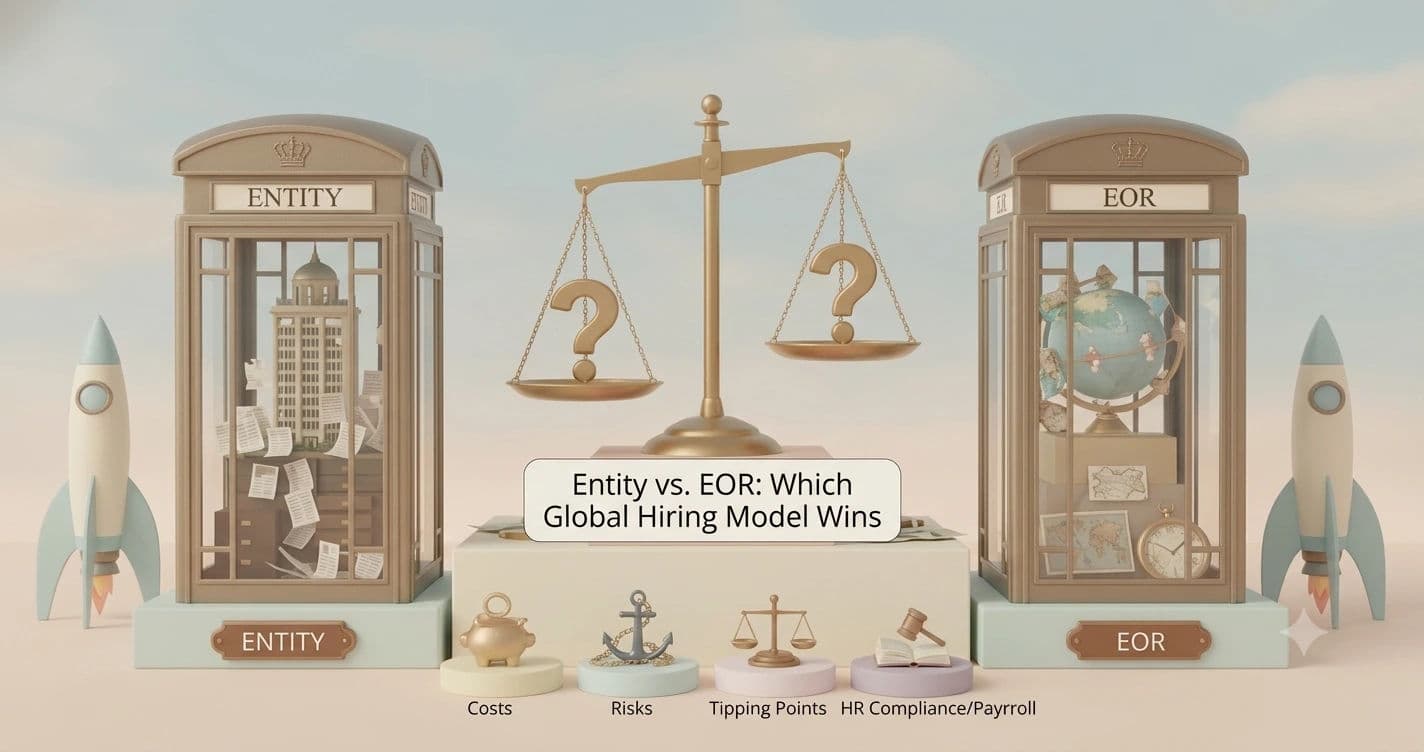
When hiring in another country without an entity, startup founders face a critical operational decision: establish a local legal entity or partner with an Employer of Record (EOR). In 2026, building a world-class team requires looking beyond domestic borders.
Streamline your software evaluation process
However, while sourcing global talent has become highly accessible, the legal and administrative realities of cross-border employment remain complex.
This decision fundamentally impacts your startup's cash flow, legal liability, speed to market, and long-term scalability. The traditional approach of setting up a foreign subsidiary before making a hire is often too slow and capital-intensive for modern, agile startups.
Furthermore, the 2026 landscape—characterized by shifting digital nomad visa regulations and updated cross-border tax treaties—demands flexibility. According to recent industry data, 54% of organizations globally report that they currently use or plan to use an Employer of Record, signaling that outsourced employment infrastructure has moved from a temporary workaround to a mainstream strategy.
Compare global HR, payroll, and Employer of Record software on AuthenCIO to find the right platform for your international hiring needs.
Despite the rising popularity of EORs, they are not a one-size-fits-all solution.
Depending on your startup's growth trajectory, intellectual property concerns, and headcount concentration in a specific region, establishing a local entity might still be the most cost-effective and secure route. This guide breaks down the mechanics, advantages, and hidden operational messiness of both the Entity and EOR models to help you make an informed decision for your first global hire.
Key Takeaways
Establishing a local entity can be more cost‑effective and secure for startups with concentrated regional operations.
An Employer of Record (EOR) simplifies compliance and payroll when hiring abroad without setting up a legal entity.
Choose based on growth trajectory, IP protection needs, and headcount distribution across markets.
Understand the mechanics and hidden operational trade‑offs before committing to either model.
Use this guide to make an informed, risk‑balanced decision for your first global hire.
Software Covered in this Article
To help you understand Core HR Software in the right context, this article refers to a carefully curated set of players:




What is an Employer of Record (EOR)?
An Employer of Record (EOR) is a third-party organization that serves as the legal employer for your international hires in countries where you do not have a registered corporate entity.
While your startup retains full day-to-day operational control over the employee—directing their tasks, managing their performance, and integrating them into your company culture—the EOR handles the legal and administrative burden of the employment relationship.
The EOR market has experienced explosive growth, valued at approximately $5 billion in 2026 and projected to reach $20 billion by 2036.
When you use an EOR, the provider drafts locally compliant employment contracts, processes payroll, withholds local taxes, and administers mandatory statutory benefits, such as healthcare contributions, pensions, or 13th-month salaries.
1. Speed and Mitigating EOR Compliance Risks
The primary advantage of an EOR is velocity. Establishing a local entity can take months, whereas an EOR allows you to onboard a new employee in a matter of days. This speed is crucial for startups that need to secure top talent quickly before they are poached by competitors.
Furthermore, an EOR significantly mitigates EOR compliance risks. Labor laws vary drastically by country.
Navigating notice periods, severance requirements, and mandatory time-off regulations in markets like France, Brazil, or the Philippines requires localized legal expertise.
An EOR absorbs this legal responsibility, shielding your startup from the risk of unintentional misclassification or labor law violations. It also requires zero upfront capital expenditure compared to heavy legal and incorporation fees.
2. The Limitations: Equity, Culture, and Long-Term Costs
However, the EOR model comes with distinct operational friction. The most prominent limitation is the long-term cost. EORs typically charge a flat monthly fee per employee or a percentage of the employee's salary. While cost-effective for one or two hires, these recurring fees can severely impact your margins as headcount grows.
The Equity/ESOP Hurdle: Founders often struggle with granting equity to EOR employees. Because the worker is legally employed by a third party, issuing standard Incentive Stock Options (ISOs) or Non-Qualified Stock Options (NSOs) is legally complex and often triggers massive tax liabilities for the employee. Startups usually have to rely on phantom stock or complex workarounds that lack the appeal of direct equity.
Cultural Friction and Dual-Employment: There is also a "dual-employment" perception risk. Because the EOR is the legal employer, the employee's contract does not bear your startup's name. This can make EOR employees feel like second-class citizens, creating cultural friction. Furthermore, benefits are constrained by what the EOR offers locally, making it difficult to provide a globally uniform employee experience.
Setting Up a Local Entity: When Does It Make Sense?
Setting up a local legal entity involves formally incorporating a subsidiary or branch of your startup in the foreign country where you intend to hire. By doing so, your startup becomes the direct, legal employer of the local workforce. You are solely responsible for compliance, payroll, taxation, and HR administration.
1. The Strategic Tipping Point
Establishing an entity is generally recommended when a startup has a high degree of certainty about its long-term presence in a specific market.
Financially, there is a recognized "tipping point" where an entity becomes more cost-effective than an EOR. Market guidance generally suggests that once you reach 10 to 15 employees in a single country, the amortized cost of running a local entity becomes lower than paying monthly EOR fees.
An entity also provides absolute control over your operations. It allows you to design bespoke local benefits packages, grant direct equity seamlessly, and eliminate cultural friction.
Direct employment also removes ambiguity regarding intellectual property (IP) ownership, which is a critical requirement during late-stage venture capital due diligence.
2. The Drawbacks: Timelines, Costs, and Exits
The barriers to entry for establishing an entity are high. The cost of setting up foreign entity infrastructure can easily range from $10,000 to $30,000 depending on the country, requiring local legal counsel, tax advisors, and incorporation fees.
Worst-Case Timelines: While 3 to 6 months is standard, founders must prepare for worst-case scenarios. In jurisdictions like Brazil or India, incorporation can take 6 to 9 months, often requiring the leasing of physical office space and notarized translations of all parent-company documents.
Permanent Establishment (PE) Risk: You must also manage PE risk. If a local tax authority determines your startup has a continuous, revenue-generating presence in their country, your global corporate profits could be subjected to local taxation. Managing this requires sophisticated transfer pricing agreements.
Winding Down Costs: Finally, founders rarely consider the exit strategy. Closing a foreign entity is notoriously more expensive and legally complex than opening one, often requiring multi-year tax audits and complex severance payouts.
Find Perfect Software for Your Business
Entity vs. EOR: A Side-by-Side Comparison for 2026
To make the best decision for your startup, it is essential to evaluate both models across a variety of operational and financial dimensions. The choice ultimately boils down to a trade-off between speed and simplicity (EOR) versus control and long-term cost efficiency (Entity).
EOR vs local entity comparison 2026
Feature/Dimension | Employer of Record (EOR) | Local Legal Entity |
Initial Setup Time | 1 to 3 weeks | 3 to 9 months (varies by region) |
Upfront Setup Costs | Zero to minimal | $10,000 - $30,000+ (Legal, banking) |
Ongoing Cost Structure | Monthly fee per employee | Fixed operational costs + HR retainers |
Compliance Responsibility | Borne by the EOR provider | Borne entirely by your startup |
Intellectual Property (IP) | Assigned via EOR contract | Direct, airtight ownership by your startup |
Equity/ESOP Support | Limited (Phantom stock often required) | Full (Direct stock option issuance) |
Termination/Severance | Standardized, rigid EOR protocols | Direct control over exit negotiations |
Best Suited For | First hires, market testing, remote teams | Strategic hubs, 10+ headcount, long-term |
Use AuthenCIO to compare software for global hiring, payroll, compliance, and workforce management
Top Software Solutions for Global Hiring
The rapid adoption of global hiring for startups has been facilitated by a new generation of international payroll solutions. These tools digitize the complexities of cross-border employment. While there are numerous providers, four platforms consistently stand out in 2026.
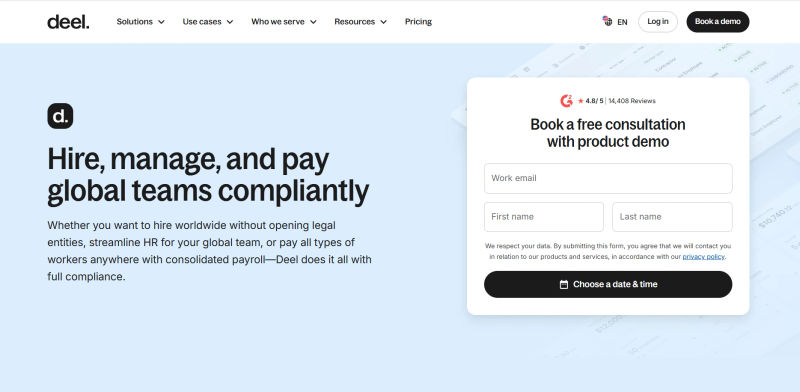
1. Deel
Deel is widely regarded as the primary solution for startups embarking on global expansion, offering EOR services in over 100 countries.
Best For: Startups needing flexibility. Deel provides both EOR services and global payroll software, allowing you to seamlessly transition employees from an EOR to your own entity as you scale.
Potential Drawback: Founders have noted hidden foreign exchange (FX) markups on international payroll transfers, and customer support can feel impersonal during hyper-growth phases.
2. Remote
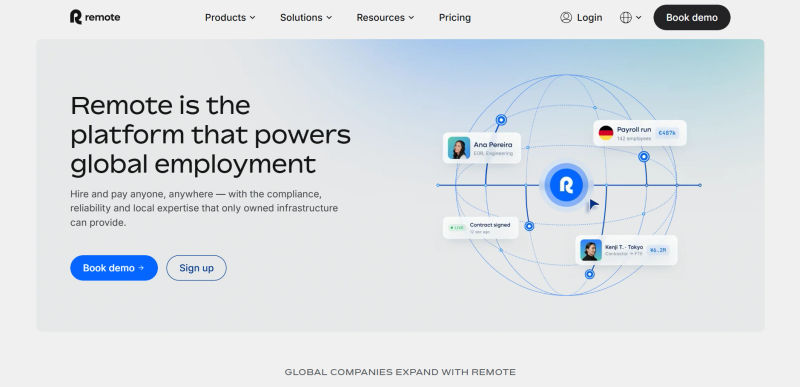
When evaluating Deel vs Remote for startups, Remote differentiates itself through its "owned-entity" infrastructure. Rather than relying on third-party partners, Remote owns its legal entities in the markets it serves.
Best For: Deep-tech startups prioritizing IP protection. Remote's strict adherence to IP security and direct legal control makes it a compelling choice for risk-averse founders.
Potential Drawback: Because they build their own entities, Remote's country coverage is slightly smaller than aggregator EORs, potentially limiting expansion in emerging markets.
3. Rippling
Rippling approaches global hiring from a broader workforce management perspective, unifying HR, IT, and Finance.
Best For: Founders looking for an all-in-one operating system. Rippling automatically provisions software licenses, ships configured laptops, and manages corporate cards alongside global payroll.
Potential Drawback: The platform's extensive features can be overkill—and overly expensive—for an early-stage startup just looking to hire a single international contractor or EOR employee.

4. Papaya Global
Papaya Global is tailored for companies that require enterprise-grade payroll compliance and advanced financial analytics.
Best For: Hybrid operating models. In the debate of Papaya Global vs Deel, Papaya excels when a company uses EORs in some countries and local entities in others, aggregating all global payroll data into a single, standardized financial view.
Potential Drawback: The platform has a steeper learning curve and is generally priced for mid-market to enterprise companies rather than early-stage startups.

Making the Choice: Your Decision Framework
Deciding between an Entity and an EOR is not a static choice; it is an evolving strategy. To navigate this decision, founders should utilize a practical, four-step framework.
Step 0: The Contractor Validation Phase
Before committing to EOR fees or entity costs, many startups begin with the international contractor model. This allows you to validate the working relationship and the employee's cultural fit. However, you must actively manage misclassification risks. Once the worker begins acting like a full-time employee (e.g., working set hours, using company equipment), you must initiate the contractor-to-EOR transition to avoid local labor penalties.
Step 1: Assess Headcount and Timeline
If your goal is to hire a single, highly specialized developer in Germany, setting up a German entity is financially disproportionate. An EOR is the clear choice. Conversely, if you have a mandate to open a 30-person customer success center in the Philippines over the next six months, the upfront investment in a local entity will yield significant long-term savings.
Step 2: Evaluate Budget (CapEx vs. OpEx)
Startups must carefully weigh Capital Expenditure (CapEx) against Operating Expenditure (OpEx). Setting up an entity requires a significant CapEx injection for lawyers and government fees. EORs operate on an OpEx model, requiring no upfront capital but adding a variable monthly cost. For early-stage startups where preserving cash runway is paramount, the EOR model protects capital.
Step 3: Analyze Risk and Equity Needs
Consider the nature of the work. If an employee is actively signing contracts and generating revenue in a foreign market, they may trigger Permanent Establishment risk, potentially legally requiring a local entity. Furthermore, if your compensation strategy relies heavily on stock options, evaluate whether the EOR's phantom equity workarounds will satisfy your prospective hires.
Try AuthenCIO
Move to faster, smarter software evaluation with AI
Conclusion
Hiring your first international employee is a major milestone. In 2026, the Employer of Record model has proven to be the most efficient, risk-averse method for making initial cross-border hires, allowing founders to focus on product-market fit rather than foreign bureaucracy.
However, as your international footprint deepens and headcount hits the 10-15 person tipping point, transitioning to a local legal entity becomes the most scalable strategy.
Your First 30 Days Checklist:
Days 1-10: Validate the hiring market and decide between Contractor or EOR.
Days 11-20: Compare software platforms (Deel, Remote, Rippling) based on IP security and FX fees.
Days 21-30: Finalize the employment contract, clarify equity workarounds, and align on time-zone communication protocols to prevent cultural friction.
By leveraging modern software platforms and continuously monitoring your global hiring metrics, you can seamlessly navigate the complexities of international expansion and build a truly borderless workforce.