Introduction
Managing millions of records in an enterprise CRM requires rigorous, ongoing list hygiene. Scaling email verification quickly becomes a major line item. For Data Protection Officers (DPOs) and CRM Managers focused on ROI, data security, and data residency, evaluating EmailListVerify pricing 2026 is a critical financial decision to optimize email infrastructure costs.
Streamline your software evaluation process
Maintaining large, inactive email lists wastes marketing spend, while high hard bounce rates risk significant deliverability degradation.
This guide strips away the marketing fluff to deliver a hard look at EmailListVerify's 2026 pricing and enterprise volume discounts, comparing it directly against top competitors. We focus strictly on the decision-making factors that impact your bottom line: pricing differences, hidden costs, API limitations, and value for money.
Key Takeaways
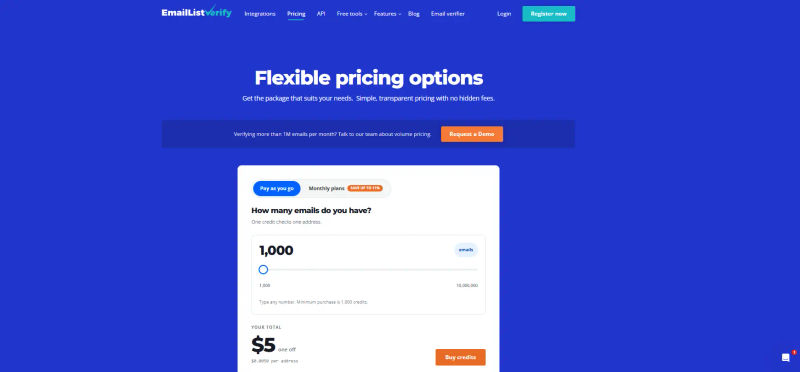
EmailListVerify pricing 2026 starts at $4 for 1,000 pay-as-you-go credits and offers aggressive volume discounts, bringing costs down to $0.00270 per credit for enterprise bulk processing.
Data residency and SOC2 compliance are non-negotiable for enterprise DPOs evaluating bulk cleaning tools in 2026.
Hidden costs like API rate limit upgrades, overage penalties, and false positives significantly impact the total cost of ownership.
Premium tools like Kickbox and Bouncer justify higher prices through strict compliance frameworks and 99.9% accuracy rates.
Choosing the most cost-effective solution requires aligning your CRM's specific latency, volume, and security needs with the right vendor model.
Quick Pricing Comparison
If you need to evaluate pricing quickly and choose the most cost-effective tool for your enterprise workflow, start with the comparison table below.
Tool | Best For | Price ($) | Limitations | Security Certifications |
EmailListVerify | Budget-conscious bulk cleaning | Starts from $5/1000 email | Slower API speeds at massive scale | Standard SSL/GDPR |
Bouncer | High-precision deliverability | Starts from $8/1000 email | Strict overage penalties | SOC 2 Type 1, GDPR |
ZeroBounce | Comprehensive data enrichment | Starts from $39/2000 email | Complex pricing tiers for add-ons | SOC 2 Type 2, ISO 27001 |
NeverBounce | Real-time API integration | Starts from $8/1000 email | Higher base cost for smaller lists | SOC 2 Type 2, GDPR |
Hunter | Integrated cold outreach | Starts from $49/month | Verification is secondary to finding | GDPR Compliant |
Kickbox | Enterprise-grade security | At $10/1000 email | Premium support costs extra | SOC 2 Type 2, GDPR |
Verifalia | Complex credit-based scaling | Starts from $8/month | Unused credits expire quickly | ISO 27001, GDPR |
Note: All prices shown reflect typical monthly billing. Vendors often offer lower pricing for annual commitments, but those discounts are excluded here for easier comparison. Actual costs may vary depending on your requirements, usage volumes, and negotiated terms.
Software covered in this article
To help you understand Email Infrastructure software in the right context, this article refers to a carefully curated set of key players:







Deep Dive into EmailListVerify Cost Structure
The official EmailListVerify pricing structure for email verification is divided into two main models: pay-as-you-go credits and monthly subscriptions. Evaluating EmailListVerify in 2026 requires understanding how these tiers scale, especially for lists exceeding one million records. This cost structure heavily favors organizations committing to high-volume processing, offering significant discounts as database sizes increase.
1. Pay-As-You-Go vs. Monthly Subscription: Which Saves More?
To answer which model is best for automated list cleaning instead of one-time CSV verification: EmailListVerify’s Monthly Subscription is the most cost-effective choice for continuous API hygiene, while Pay-As-You-Go is better for manual CSV uploads.
For one-time CSV verification, pay-as-you-go pricing starts at $0.005 per email. Aggressive volume discounts—like purchasing 10,000 credits for $0.00270 each (a 32% savings)—make bulk buying ideal for CRM managers conducting quarterly audits on dormant lists.
Conversely, the subscription model is strictly designed for continuous, automated list cleaning. Plans start at $139 per month for 5,000 daily verifications and scale to $989 per month for 100,000 daily verifications. (If evaluating other tools, NeverBounce is the top alternative for real-time API automated cleaning).
2. Enterprise Volume Discounts for High-Scale CRM Operations
Who is this best for? EmailListVerify is best for budget-conscious CRM managers who need a reliable bulk email list cleaning tool to process massive legacy databases.
When enterprise teams do bulk email verification or validation and list cleaning by uploading large CSV or TXT files, they typically rely on asynchronous scrubbing rather than ultra-low latency API responses. EmailListVerify's volume discounts make it highly attractive for these high-scale operations. If you are processing hundreds of thousands of records in a single batch, leveraging this platform as a dedicated bulk tool significantly lowers your overall cost per thousand (CPM) compared to premium competitors.
3. Limitations and Custom Negotiations for 5M+ Records
While the pricing is attractive, decision-makers must be aware of the platform's limitations. Once your enterprise exceeds 25,000 daily verifications on standard plans, the out-of-the-box pricing models become less efficient. For massive enterprise lists exceeding 5 million records, you enter the realm of custom negotiations.
In a typical 5M+ record scenario, a vendor might offer a heavily discounted flat rate of $0.0008 per verification, but this often comes with stipulations: you may be restricted to off-peak processing hours to avoid straining their servers, or you might have to accept a lower priority in the support queue.
Furthermore, while EmailListVerify is highly accurate, its processing speed for multi-million record CSV uploads can lag behind premium competitors.
DPOs should also carefully review the data processing agreement (DPA), as budget-tier tools sometimes route data through fewer regional servers, which can complicate data residency compliance if not properly configured.
Find Perfect Software for Your Business
Comparing the Top 7 Alternatives for 2026
When standard bulk cleaning is insufficient, enterprise teams often turn to alternative list cleaning and verification tools. While EmailListVerify offers competitive baseline pricing, these premium platforms command a higher price point but justify the investment through advanced features, superior API latency, and rigorous compliance frameworks.
1. Bouncer: Best for High-Precision Deliverability
Bouncer has positioned itself as a premium tool focused heavily on bounce prevention and actionable list health reporting.
Who is this best for? Bouncer is best for high-precision deliverability teams that require strict bounce prevention, zero downtime, and SOC2-compliant data handling.
Pricing and Value: At the 1 million verification mark, Bouncer averages $0.0020 per email. While more expensive than basic tools, the ROI is realized through a 99.9% accuracy rate, significantly reducing the risk of significant deliverability degradation.
Limitations: Bouncer’s primary limitation is its strict overage penalties. If your automated CRM workflows exceed your monthly enterprise limits, the per-verification cost spikes dramatically unless you have pre-negotiated a buffer.
2. ZeroBounce: Best for Comprehensive Data Enrichment
ZeroBounce offers a fundamentally different value proposition by combining email validation with deep data enrichment.
Who is this best for? ZeroBounce is best for data-driven marketing teams that require comprehensive data enrichment, IP appending, and demographic insights alongside standard verification.
Pricing and Value: ZeroBounce charges approximately $1,045 per month for 1 million credits (roughly $0.0015 per email at scale). The value for money is exceptionally high if your CRM strategy relies on appending missing data to incomplete lead profiles.
Limitations: The pricing structure is notoriously complex. Add-ons like spam trap detection, activity scoring, and inbox placement testing consume credits at different multiplier rates, making it difficult for CRM managers to forecast exact monthly spend.
3. NeverBounce: Best for Real-Time API Integration
NeverBounce is engineered for speed, offering sub-50ms response times for point-of-capture verification.
Who is this best for? NeverBounce is best for enterprise developers and CRM architects who require real-time API integration to validate emails at the point of capture, such as lead generation forms and SaaS signups.
Pricing and Value: Pricing hovers around $0.0030 per email at the 1 million volume tier. It operates strictly on a pay-as-you-go model. The value lies in preventing invalid data from ever entering the CRM, reducing the technical debt of downstream cleaning.
Limitations: The base cost is higher than competitors, and their volume discounts are less aggressive than EmailListVerify. For purely retroactive list cleaning, NeverBounce is an expensive option.
4. Hunter: Best for Integrated Cold Outreach
Hunter is primarily an email discovery tool, but its verification capabilities are deeply integrated into its platform.
Who is this best for? Hunter is best for integrated cold outreach teams who need to discover and verify prospects within a single, unified platform rather than managing separate vendor contracts.
Pricing and Value: The Enterprise plan costs $399 per month, which includes a set pool of search and verification credits.
Limitations: Verification is a secondary feature. Using Hunter purely to clean an existing 5-million-record CRM database is highly inefficient and cost-prohibitive, as you are paying a premium for the discovery engine rather than high-volume scrubbing.
5. Kickbox: Best for Enterprise-Grade Security
For DPOs, the legal implications of data transfers between regions are a primary concern. Kickbox addresses this with rigorous compliance frameworks.
Who is this best for? Kickbox is best for enterprise DPOs and compliance officers who require enterprise-grade security, strict DPAs, and verified SOC 2 Type 2 compliance.
Pricing and Value: Kickbox charges roughly $0.0040 per email at high volumes. The value for money is realized entirely in risk mitigation. For heavily regulated industries like finance and healthcare, avoiding a compliance breach easily justifies the premium price.
Limitations: Kickbox’s hidden costs often manifest in support. Premium support SLAs, dedicated account management, and custom implementation engineering come with hefty additional fees.
6. Verifalia: Best for Complex Credit-Based Scaling
Verifalia utilizes a unique, complex credit-based system that allows users to choose the depth of their verification.
Who is this best for? Verifalia is best for technical teams that require complex, credit-based scaling with customizable verification depth (Standard, High, Extreme passes) depending on the risk profile of the campaign.
Pricing and Value: The Ultimate plan at $499 per month offers substantial daily credits. The ability to use a "Standard" pass for low-risk lists and an "Extreme" pass for high-risk lists allows for granular budget control.
Limitations: Unused credits expire quickly, making it difficult to stockpile verifications for quarterly audits. Furthermore, calculating the exact cost per email is challenging because different quality passes consume different amounts of credits.
Catch-all Handling and Data Retention: The DPO’s Checklist
When evaluating bulk email verification tools in 2026, the conversation must extend beyond simple syntax checks. DPOs must scrutinize how vendors handle "catch-all" (or accept-all) servers and what their specific data retention policies entail.
Catch-all servers are configured to accept all emails sent to a domain, regardless of whether the specific mailbox exists. Budget validation tools often flag these as "valid," leading to devastating hard bounces when the email is eventually routed to a non-existent inbox.
Premium tools use advanced SMTP handshakes and historical bounce data to accurately categorize catch-all addresses. The inability to properly identify and segment catch-all emails is a massive hidden cost, as it directly impacts your sender reputation and skews your marketing analytics.
Equally critical is the vendor's data retention policy. When you upload a CSV containing five million customer records, you are transferring massive amounts of Personally Identifiable Information (PII). A compliant vendor must offer automated data deletion post-verification.
If a vendor retains your sensitive PII on their servers for 30, 60, or 90 days for "machine learning purposes" without explicit consent, they are violating core GDPR principles.
DPOs must verify exactly how long data is stored, where it is geographically located (data residency), and whether the platform allows for immediate, automated purging the moment the verification API returns its result.
Is EmailListVerify the best value for your enterprise? Compare it now on AuthenCIO.
Decision Factors: Hidden Costs and Plan Limitations
Email verification pricing becomes expensive for large lists because base rates exclude critical scaling infrastructure. When evaluating EmailListVerify against competitors in 2026, CRM Managers must calculate the Total Cost of Ownership (TCO). Hidden costs rapidly inflate budgets through strict API rate limits, steep overage charges for exceeding monthly credit caps, mandatory compliance audit fees, and the premium support SLAs required for enterprise-volume processing.
1. API Rate Limits and Infrastructure Upgrades
Many budget-friendly tools throttle API requests. If your CRM automation attempts to verify 50,000 emails concurrently, you may hit rate limits, causing system timeouts.
To resolve this, vendors often require you to upgrade to a dedicated infrastructure tier or purchase a dedicated IP node. This can add hundreds or even thousands of dollars to your monthly bill, completely negating the initial savings of a low cost-per-verification.
2. Overage Charges and Credit Multipliers
Subscription models are dangerous if your volume fluctuates. If a marketing campaign generates an unexpected surge of leads, exceeding your monthly limit can trigger punitive overage charges.
Additionally, tools that use credit multipliers—charging 2x or 3x credits for catching spam traps, identifying toxic domains, or appending demographic data—will drain your balance significantly faster than anticipated. This forces mid-month top-ups and ruins budget predictability.
3. Premium Support and SLAs
Basic plans usually include standard email support with 48-hour response times. For enterprise operations, a stalled verification API can halt global marketing campaigns and disrupt downstream sales cadences. Upgrading to an enterprise Service Level Agreement (SLA) with 24/7 phone support, guaranteed uptime, and a dedicated Customer Success Manager is rarely included in the advertised price per email.
4. Compliance and Audit Fees
DPOs must verify vendor data processing agreements. Some vendors charge administrative fees to execute custom DPAs, complete extensive vendor security questionnaires, or provide third-party SOC2 audit reports.
Furthermore, if a vendor does not offer automated data deletion post-verification, your team incurs the operational cost of manually purging data to maintain GDPR compliance.
5. The Financial Impact of False Positives
One of the most overlooked hidden costs in email verification is the false positive rate. If a budget tool is overly aggressive and marks valid, high-value enterprise emails as "invalid" or "do not send," you lose the ability to market to those prospects.
The financial impact of lost lead revenue can far exceed the money saved by choosing a cheaper verification tool. A cost-effective email validation strategy must balance high accuracy with minimal false positives to protect your sales pipeline.
Try AuthenCIO
Move to faster, smarter software evaluation with AI
Final Verdict: Choosing the Best Value Tool for Your 2026 Budget
Choosing the best bulk email verification tool in 2026 requires balancing budget constraints with the need for real-time accuracy, data security, and compliance. EmailListVerify remains a highly competitive option for mid-to-large enterprises seeking straightforward volume discounts for massive, asynchronous list scrubbing.
Its pay-as-you-go tier dropping to $0.00270 per credit makes it incredibly cost-effective for quarterly CRM audits.
However, if your enterprise requires sub-50ms API latency at the point of capture, NeverBounce is the superior choice. If your DPO mandates SOC2 Type 2 compliance and strict regional data processing, Kickbox justifies its premium pricing.
Ultimately, the most cost-effective solution is the one that aligns perfectly with your specific CRM architecture and compliance risk profile, ensuring you aren't paying for features you don't need or risking deliverability issues due to inadequate hygiene.
Next Steps for DPOs and CRM Managers: To ensure you make the right choice for your enterprise, follow this evaluation checklist:
Request a DPA Sample: Before discussing price, request the vendor's standard Data Processing Agreement to verify data residency and compliance standards.
Audit Your API Needs: Determine if you need real-time point-of-capture verification (sub-50ms) or if asynchronous bulk CSV processing is sufficient.
Run a 1,000-Record Pilot Test: Upload a sample list of known valid, invalid, and catch-all emails to benchmark the vendor's accuracy and false-positive rate.
Calculate Total Cost of Ownership: Factor in potential overage charges, API rate limit upgrades, and premium support fees to find the true monthly cost.
Verify Data Retention Policies: Ensure the platform allows for immediate, automated purging of PII post-verification.