
Introduction
Key Takeaways:
Architectural Reliability: SMTP.com maintains 99.99% uptime with global edge nodes, but requires custom wrappers for modern SDK circuit-breaking.
Compliance & Deliverability: Strong support for RFC 8058 List-Unsubscribe, DMARC alignment, and automated dedicated IP warmup schedules.
Enterprise TCO: Cost-effective at the 50M+ monthly volume tier, particularly when factoring in the engineering hours saved on deliverability management.
Data Sovereignty: Fully equipped for 2026 compliance with SOC2 Type II, HIPAA readiness, and strict EU data residency options for GDPR.
Direct Comparisons: Holds its ground against SendGrid and Mailgun for high-volume relay, though it lacks the advanced inbound parsing of developer-first alternatives.
The State of Transactional Email in 2026
Streamline your software evaluation process
In this comprehensive SMTP.com review 2026, we evaluate whether this veteran infrastructure provider still meets the rigorous demands of modern enterprise SaaS applications. For scaled platforms, transactional email infrastructure is no longer a mere utility—it is a mission-critical component of the core application architecture. When multi-factor authentication (MFA) tokens, password resets, and automated billing receipts are delayed, the immediate result is degraded user experience, spiked support tickets, and potential churn.
The benchmark for success has shifted entirely. Standard inbox placement is assumed; the new battleground is millisecond-level latency, zero-downtime reliability, and navigating highly aggressive, AI-driven spam filters deployed by Google and Yahoo. Choosing the right partner requires a deep technical evaluation of API responsiveness, global edge network distribution, and strict data sovereignty.
SMTP.com has long been a recognized name in the email relay space. But does its modern SMTP.com transactional email API hold up against the scalability and developer-experience demands of high-volume SaaS companies today? We will stress-test its capabilities against industry heavyweights to determine if it truly belongs in your enterprise stack.
Before diving into the deep technical analysis of SMTP.com's architecture, here is a high-level review summary comparing the top transactional email APIs available to enterprise decision-makers this year.
Tool | Best For | Pricing ($) | Key Features | Use Cases |
SMTP.com | High-volume relay & legacy integrations | Custom Enterprise Tiers (starts ~$90/100k) | Robust SMTP relay, dedicated IPs, reputation monitoring | High-volume SaaS, legacy on-prem to cloud bridges |
Twilio SendGrid | Feature-rich API & marketing hybrid | Custom Enterprise (starts ~$90/100k) | Event webhooks, advanced templating, deep analytics | Complex SaaS workflows, hybrid transactional/marketing |
Mailgun | Developer-centric routing | Custom Enterprise (starts ~$90/100k) | Inbound routing, email validation, robust APIs | API-first applications, complex inbound parsing |
Amazon SES | Bare-metal cost efficiency | ~$0.10 per 1,000 emails | Deep AWS integration, raw infrastructure, high scalability | Cost-sensitive high-volume sending, AWS-native stacks |
Postmark | Lightning-fast delivery & reliability | Custom Enterprise (starts ~$125/100k) | Strict transactional separation, 10s time-to-inbox | Latency-critical SaaS (MFA, password resets) |
Bird | Predictive analytics & high volume | Custom Enterprise (starts ~$100/100k) | Deliverability analytics, predictive insights | Enterprise senders requiring granular data |
MailerSend | Modern UI/UX & ease of use | Custom Enterprise (starts ~$75/100k) | Drag-and-drop builders, modern REST API | Rapid deployment, cross-functional team access |
SMTP2GO | Reliable fallback & ease of setup | Custom Enterprise (starts ~$85/100k) | Outbound filtering, visual tracking, high uptime | Redundancy layers, simple API integration |
Note: All prices shown reflect typical monthly billing. Vendors often offer lower pricing for annual commitments, but those discounts are excluded here for easier comparison. Actual costs may vary depending on your requirements, usage volumes, and negotiated terms.
Software covered in this article
To help you understand Email Infrastructure software in the right context, this article refers to a carefully curated set of key players:

.webp?tr=w-112%2Cq-80%2Cf-auto%2Cc-at_max)


.webp?tr=w-112%2Cq-80%2Cf-auto%2Cc-at_max)
.webp?tr=w-112%2Cq-80%2Cf-auto%2Cc-at_max)
.webp?tr=w-112%2Cq-80%2Cf-auto%2Cc-at_max)

Evaluating SMTP.com? Use AuthenCIO to compare it with other top transactional APIs for free.
SMTP.com Core Architecture & API Performance
When evaluating an email infrastructure partner, CTOs must look beyond simple delivery rates and examine the underlying architecture. High-volume email delivery uptime and API responsiveness are non-negotiable when your SaaS application processes millions of background jobs daily.
1. API Latency and Global Edge Delivery
In 2026, industry benchmarks establish a median delivery speed of 1.9 seconds for latency-critical transactional workflows. SMTP.com for enterprise SaaS is built on a globally distributed network designed to minimize connection times. To reduce cross-region latency, SMTP.com utilizes edge nodes strategically placed in major cloud availability zones, including proximity to AWS us-east-1 and eu-central-1.
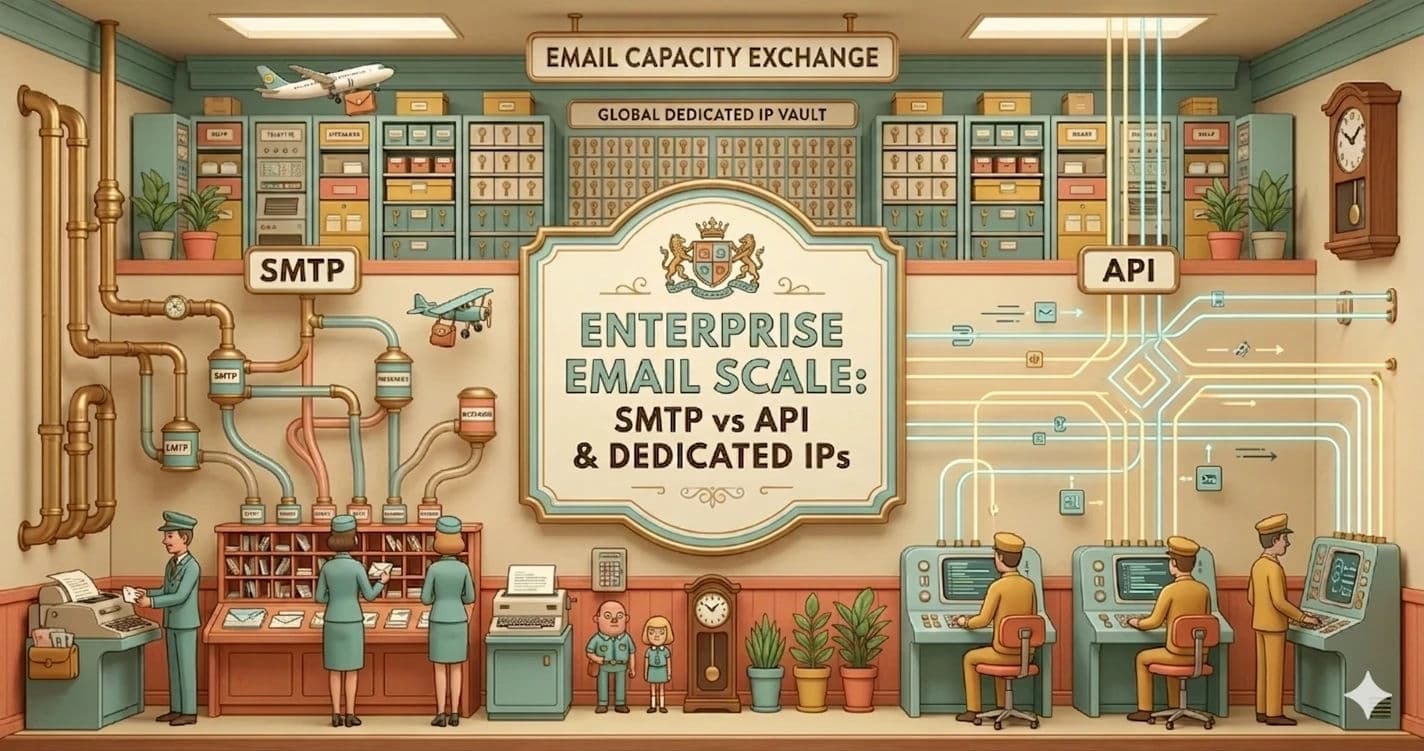
2. REST API vs. SMTP Relay: Integrating via the SMTP.com REST API offers superior performance for modern SaaS applications compared to legacy protocols. The API reduces the overhead associated with the SMTP protocol's sequential command-and-response structure (EHLO, MAIL FROM, RCPT TO, DATA). For high-throughput environments, the API supports persistent connections and bulk endpoint submissions, allowing your application to offload payloads rapidly without tying up worker threads.
3. Circuit-Breaking and SDK Resilience
During peak events—such as a system-wide notification or a sudden influx of user registrations—your application might need to push 10,000 requests per second. SMTP.com’s infrastructure handles burst traffic efficiently, utilizing load balancers and message queues to ingest payloads without returning 429 Too Many Requests errors prematurely.
However, developer experience (DX) requires attention. While standard libraries are provided, teams using Go, Rust, or TypeScript may need to implement their own circuit-breaking logic. To ensure resilience, your engineering team should wrap the SMTP.com SDKs with custom retry logic utilizing exponential backoff and jitter to prevent thundering herd problems during rare network partitions.
4. Webhook Infrastructure for Real-Time Sync
Effective transactional email requires a bidirectional data flow. SMTP.com’s webhook infrastructure allows your application to listen for real-time events via standard JSON POST requests.
Bounce Handling: Automatically deactivate users or flag accounts in your database when a hard bounce webhook is received, keeping your CRM pristine.
Complaint Processing: Instantly suppress addresses that hit the spam button to protect your sender reputation.
Delivery Confirmations: Log exact timestamps of inbox placement for compliance and audit trails, seamlessly piping this data into your internal observability tools.
Find Perfect Software for Your Business
Deliverability & Dedicated IP Management at Scale
Sending an email is easy; landing it in the primary inbox at scale is an engineering challenge. Specialized transactional email services with optimized server infrastructure significantly reduce spam filter placement compared to standard SMTP. For enterprise SaaS, deliverability hinges on reputation management and IP architecture.
1. Mitigating the Noisy Neighbor Syndrome
Shared IP pools are a massive risk for high-volume senders. If another company on your shared IP sends a poorly targeted blast that hits spam traps, your critical MFA emails will be throttled or blocked by ISPs. SMTP.com mitigates this by enforcing strict compliance rules and immediately suspending accounts that violate CAN-SPAM or GDPR regulations. However, for true enterprise reliability, dedicated IPs are mandatory.
2. Dedicated IP Allocation and Warmup Schedules
When migrating to SMTP.com, you will be assigned dedicated IP addresses. In 2026, mailbox providers employ aggressive machine learning algorithms to detect anomalies in sending volume. You cannot simply flip a switch and send 5 million emails on day one.
Automated Warmup Heuristics: A proper technical migration requires an automated warmup schedule. SMTP.com provides frameworks to throttle outbound volume on the new IPs. A standard enterprise schedule starts with 50,000 highly engaged transactional messages on Day 1, scaling exponentially by 15-20% daily over 30 to 45 days. SMTP.com’s administrative dashboard allows you to manage multi-tenant sub-accounts, enabling you to isolate different mail streams (e.g., separating EU customer receipts from US application alerts) onto different IPs to protect your core reputation.
3. List-Unsubscribe and 2026 Compliance
Deliverability-first architecture requires continuous monitoring and strict adherence to modern header requirements.
RFC 8058 List-Unsubscribe: Google and Yahoo now mandate one-click unsubscribes for bulk senders. SMTP.com handles the List-Unsubscribe and List-Unsubscribe-Post headers efficiently. Enterprises can choose between automated handling (where SMTP.com intercepts the POST request and updates the suppression list) or API-driven handling (where webhooks forward the request to your application database for internal compliance syncing).
BIMI and DMARC Alignment: Strict DMARC enforcement (p=reject) is the standard. SMTP.com’s infrastructure fully supports SPF, DKIM, and DMARC alignment. Furthermore, they facilitate the technical requirements for BIMI (Brand Indicators for Message Identification), ensuring your authenticated emails display your verified logo in the recipient's inbox.
Security, Compliance, and Data Sovereignty
For enterprise CTOs, technical performance is irrelevant if the vendor fails security audits. In 2026, SMTP.com has hardened its compliance posture to meet the demands of highly regulated industries.
Certifications and Audits: SMTP.com maintains SOC2 Type II compliance, ensuring that their internal security controls, data processing, and infrastructure access are rigorously audited. For healthcare SaaS platforms, they offer Business Associate Agreements (BAAs) to ensure HIPAA readiness, encrypting ePHI both in transit (via TLS 1.3) and at rest.
GDPR and EU Data Residency: Global data privacy regulations dictate where Personally Identifiable Information (PII) can be processed. To satisfy GDPR requirements, SMTP.com offers data residency options, allowing enterprises to route and store European user data exclusively through EU-based nodes (such as Frankfurt), preventing unauthorized cross-border data transfers. Furthermore, their log retention policies (typically 15-30 days) are fully configurable via API to comply with localized data minimization laws.
Pricing Analysis: Is SMTP.com Cost-Effective for Enterprises?
Pricing at the enterprise level is rarely as simple as the sticker price on a vendor's website. When calculating the Total Cost of Ownership (TCO) at the 10M, 50M, and 100M monthly email tiers, CTOs must account for hidden volume-based pricing tiers, overage penalties, and the engineering overhead required to maintain the system.
The Enterprise TCO Framework
SMTP.com operates on a volume-based subscription model. While public pricing is transparent for lower volumes, SMTP.com pricing for enterprises requires custom negotiation.
TCO Breakdown at 50M Emails/Month:
Base Volume Cost: Negotiated flat rate for the 50M bucket, typically benefiting from steep volume discounts compared to self-serve tiers.
Dedicated IP Fees: Costs for maintaining a pool of 5-10 dedicated IPs for load balancing and redundancy (usually around $30/month per IP).
Egress and Data Transfer: Unlike AWS, which charges heavily for outbound data transfer, SMTP.com typically bundles bandwidth into the base cost, making financial forecasting more predictable.
Premium Support SLAs: Guaranteed 30-minute response times for P0 incidents and access to a dedicated Technical Account Manager (TAM) add to the TCO but provide critical risk mitigation.
Compared to bare-metal solutions, SMTP.com carries a premium. However, this premium pays for managed deliverability, ISP relations, and automated suppression management. The engineering hours saved by not having to manually debug Microsoft Office 365 throttling rules often offset the higher per-email cost, making the ROI highly favorable for lean infrastructure teams.
SMTP.com vs. Top Alternatives for Enterprise SaaS
To make an informed decision, we must evaluate SMTP.com against the broader market. A critical factor for modern engineering teams is observability; integrating email metrics into Datadog, New Relic, or Prometheus is essential for full-stack visibility. Let's see how the competition stacks up.
1. SMTP.com vs SendGrid: The Feature-Heavy Giant
Twilio SendGrid is the behemoth of the industry. It offers a massive suite of features, including advanced drag-and-drop template builders and a highly sophisticated Event Webhook.
Where SendGrid Wins: Developer tooling, SDK availability across all modern languages, and hybrid use cases (transactional + marketing). Their Datadog integration is practically plug-and-play.
Where SMTP.com Wins: Ease of setup for pure SMTP relay use cases and often more aggressive pricing at the absolute highest volume tiers (100M+) where SendGrid’s feature bloat becomes unnecessary overhead.
2. SMTP.com vs Mailgun: The Developer-Centric Choice
Mailgun was built by developers, for developers. Its API is exceptionally robust, and it leads the market in inbound email routing.
Where Mailgun Wins: Complex inbound parsing (e.g., converting a user's email reply into a JSON payload for a support ticketing system) and granular API control.
Where SMTP.com Wins: Simpler administrative interfaces for non-technical stakeholders and legacy system integrations that rely strictly on standard SMTP protocols rather than API-first architectures.
3. SMTP.com vs Amazon SES for SaaS: The Bare-Metal Cost Leader
AWS Simple Email Service is the raw infrastructure play. It is incredibly cheap (roughly $0.10 per 1,000 emails) and scales infinitely.
Where Amazon SES Wins: Unbeatable cost efficiency and native integration with the AWS ecosystem (SNS, Lambda, CloudWatch).
Where SMTP.com Wins: Deliverability management. With SES, you are entirely on your own for IP warmup, reputation monitoring, and handling ISP blocks. SMTP.com provides the managed services that prevent your engineering team from becoming full-time deliverability experts.
4. Postmark vs SMTP.com Comparison: The Deliverability Speed King
Postmark is famous for its strict separation of transactional and broadcast emails, resulting in industry-leading time-to-inbox metrics.
Where Postmark Wins: Absolute lowest latency for critical transactional emails and a pristine shared IP reputation due to draconian compliance enforcement.
Where SMTP.com Wins: Flexibility. Postmark strictly forbids bulk/marketing email. If your SaaS needs a unified infrastructure for both transactional triggers and occasional bulk notifications, SMTP.com is far more accommodating.
5. Bird, MailerSend, and SMTP2GO
Bird: Best for predictive analytics. If your enterprise requires deep data science applied to email deliverability, Bird’s analytics suite is superior.
MailerSend: Best for modern teams. If product managers need to frequently edit transactional templates without deploying code, MailerSend’s UI is vastly superior.
SMTP2GO: A highly reliable alternative that often serves as a redundant failover layer. It matches SMTP.com in ease of use but often provides better visual tracking tools out of the box.
Best Use Cases: When to Choose SMTP.com
While the market is crowded, SMTP.com remains a highly viable option for specific enterprise scenarios in 2026.
1. Legacy Infrastructure Modernization: If your enterprise is migrating from on-premise Exchange servers or legacy applications that can only communicate via traditional SMTP protocols, SMTP.com provides one of the most reliable, frictionless relay services available. You can bridge legacy systems to the cloud without rewriting core application code.
2. High-Volume, Compliance-Heavy Workloads: For SaaS companies in fintech or healthcare that generate massive volumes of automated reports, billing statements, or audit logs, SMTP.com provides the dedicated IP architecture, BAA readiness, and robust log retention required to maintain compliance.
3. Multi-Tenant SaaS Architectures: SMTP.com’s administrative dashboard allows for clean segregation of sub-accounts. If you are a white-label SaaS provider sending emails on behalf of thousands of clients, you can isolate their sending reputations, ensuring that one bad actor does not compromise the deliverability of your entire platform.
Try AuthenCIO
Move to faster, smarter software evaluation with AI
Final Verdict: The Best Transactional Email Service 2026?
Choosing the right transactional email API is a foundational architectural decision. Our analysis concludes that SMTP.com is a highly robust, enterprise-grade platform that excels in uptime, dedicated IP management, and high-volume relay capabilities.
However, it is not a one-size-fits-all solution. If your engineering team demands cutting-edge SDKs with native circuit-breaking, complex inbound parsing, or advanced drag-and-drop templating, platforms like Mailgun or Twilio SendGrid may offer a better developer experience. If absolute lowest cost is the only metric, Amazon SES remains unmatched.
But if your SaaS requires rock-solid reliability, excellent deliverability for high-volume transactional triggers, and a managed service layer that keeps your engineers focused on building your product rather than debugging ISP throttling rules, SMTP.com is a formidable contender that justifies its place in the enterprise stack. It remains a strong candidate for the best transactional email service 2026 for teams prioritizing managed deliverability over raw API feature bloat.
Technical Proof-of-Concept (POC) Checklist
If you are considering a migration, use this checklist to structure your POC with SMTP.com:
Provisioning: Request a sandbox environment with at least two dedicated IPs.
Authentication: Configure and verify SPF, DKIM, and DMARC (
p=reject) on a staging subdomain.Integration: Build a wrapper around the SMTP.com API incorporating exponential backoff and jitter.
Webhook Sync: End-to-end test the bounce and complaint webhooks against your internal CRM/database.
Observability: Pipe webhook JSON payloads into Datadog or New Relic to visualize latency and delivery rates.
Warmup: Execute a 7-day micro-warmup schedule (starting at 1,000 emails/day) to validate ISP acceptance rates.