.webp&w=64&q=75)
Introduction
Key Takeaways:
Cost of 1 Million Emails: For teams asking, "show me pricing for sending 1 million transactional emails per month with an email api," expect baseline costs around $500 (like SMTP.com) up to $800+, excluding dedicated IPs and premium support. (Also relevant for international teams evaluating email api ราคา).
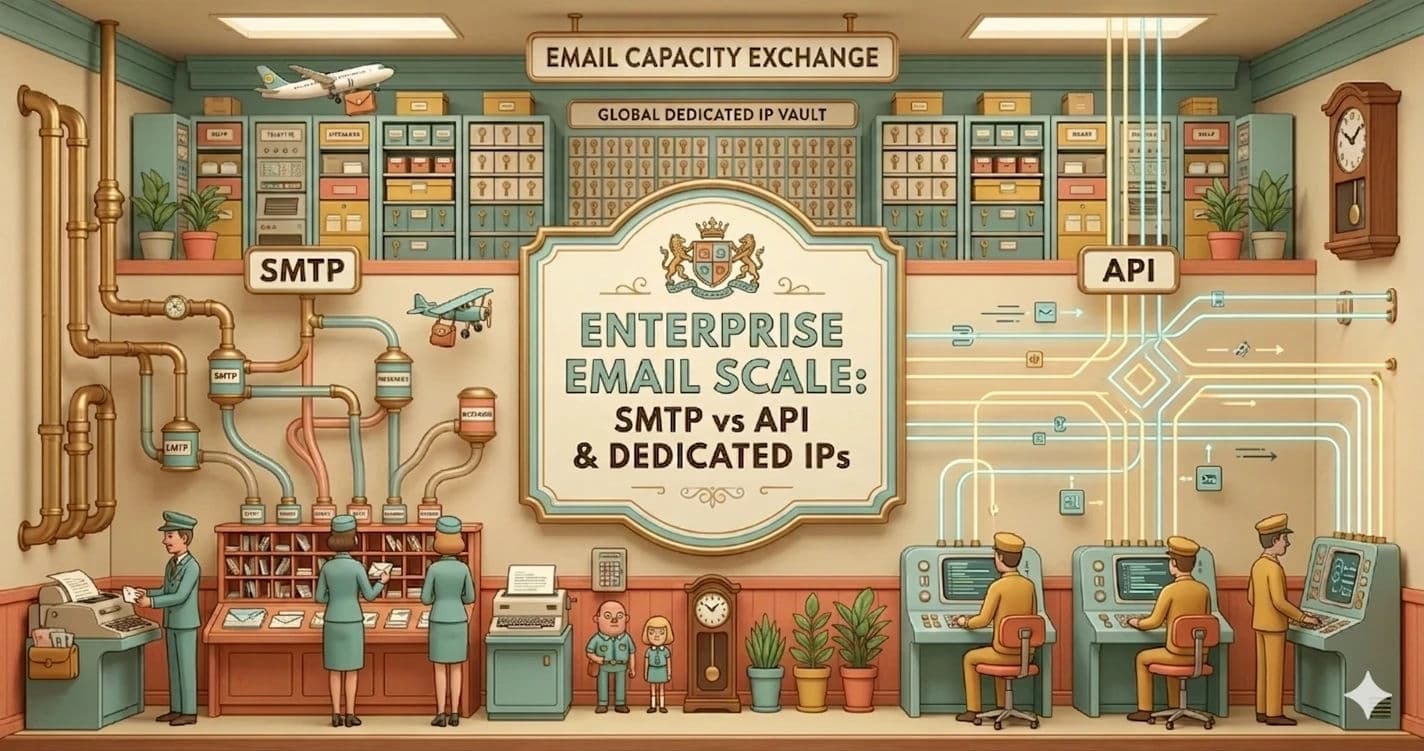
Understanding email api vs smtp relay for b2b applications: An SMTP relay uses standard protocols for quick, universal email dispatch, whereas an Email API provides deeper app integration, webhooks, and advanced analytics for complex workflows.
Total Cost of Ownership (TCO) exceeds raw CPM: Factor in dedicated IPs, log retention, and engineering maintenance when evaluating providers.
Amazon SES requires heavy DevOps: While it boasts the lowest raw cost, the engineering hours required to build bounce handling and analytics often negate the savings.
Streamline your software evaluation process
For Engineering Leads at high-growth SaaS companies, scaling infrastructure is a constant balancing act between performance and cost.
When your application scales to millions of active users, transactional email volume grows exponentially. Password resets, multi-factor authentication (MFA) tokens, billing receipts, and system alerts become mission-critical pathways that cannot fail.
However, the challenge is rarely just delivering the emails; it is managing the unpredictable cost spikes, overage fees, and hidden infrastructure costs associated with high-volume sending. Before diving into specific email api pricing, understanding email api vs smtp relay for b2b applications is essential. While SMTP relays offer a plug-and-play pipeline for legacy systems, modern B2B platforms often require Email APIs for granular tracking, dynamic template rendering, and automated bounce handling.
Today, many enterprises are shifting towards "Deliverability as a Service," seeking platforms that manage the complexities of inbox placement rather than just providing a raw pipeline.
Evaluating enterprise email API pricing requires looking far beyond the advertised monthly subscription. You must account for dedicated IP costs, sub-account management fees, log retention limits, and the engineering hours required to maintain the integration.
This guide provides a comprehensive, decision-focused breakdown of SMTP.com’s pricing and evaluates how it stacks up against the top transactional email alternatives in the market. Our goal is to help you cut through the marketing fluff, analyze the hard numbers, and choose the most cost-effective architecture for your 10M+ monthly email workloads.
Tool | Best For | Price ($) | Key Plan | Limitations | API Protocol | Log Retention |
SMTP.com | Pure, high-volume SMTP relay | $500/mo (1M emails) | Enterprise | Lacks advanced inbound parsing | SMTP/REST | 30 days |
Twilio SendGrid | Unified email infrastructure | $100/mo (100K) | Advanced | Support response times lag | REST/SMTP | 3-7 days |
Mailgun | Developer routing & parsing | $90/mo (100K) | Scale | Steep overage costs | REST/SMTP | 30 days |
Amazon SES | Raw, low-cost pipeline | $0.10 per 1,000 | Pay-as-you-go | Zero out-of-the-box UI | SMTP/REST | None (via AWS) |
Postmark | Mission-critical speed | $1.20 per 1,000 | Pay-as-you-go | Rigid content policies | REST/SMTP | 45 days |
Bird | Predictive AI insights | Custom Pricing | Enterprise | High barrier to entry | REST/SMTP | 10-30 days |
MailerSend | Cross-functional teams | $31/mo (50K) | Starter | Fewer enterprise certs | REST/SMTP | 7 days |
SMTP2GO | Global fallback routing | $75/mo (100K) | Professional | Less feature-rich API | SMTP/REST | 30 days |
Note: All prices shown reflect typical monthly billing. Vendors often offer lower pricing for annual commitments, but those discounts are excluded here for easier comparison. Actual costs may vary depending on your requirements, usage volumes, and negotiated terms.
Optimize your transactional email costs. Compare SMTP.com side-by-side with rivals on AuthenCIO.
Software covered in this article
To help you understand Email Infrastructure software in the right context, this article refers to a carefully curated set of key players:



.webp?tr=w-112%2Cq-80%2Cf-auto%2Cc-at_max)
.webp?tr=w-112%2Cq-80%2Cf-auto%2Cc-at_max)
.webp?tr=w-112%2Cq-80%2Cf-auto%2Cc-at_max)
.webp?tr=w-112%2Cq-80%2Cf-auto%2Cc-at_max)

SMTP.com Pricing Breakdown: Is It Built for Enterprise Scale?
When evaluating SMTP.com, the official SMTP.com pricing stands out for its straightforward, volume-based model. Unlike competitors that gate essential deliverability features behind complex enterprise tiers, SMTP.com provides full feature access across its plans, scaling purely by the number of emails sent.
For enterprise scale, SMTP.com’s flagship offering is the $500 per month tier, which includes 1,000,000 emails. This equates to a highly competitive $0.50 per 1,000 emails (CPM). As you scale beyond the 1M mark towards 10M+ monthly emails, SMTP.com relies on custom contract negotiations. Historical data indicates volume discounts can drive the CPM down significantly, often approaching $0.35 to $0.40 per 1,000 emails depending on your sender reputation and commitment length.
A common question from engineering leads managing API rate limits and burst capacity is: does SMTP.com scale email volume for millions of messages daily across distributed teams and enterprise-wide workflows? Yes. SMTP.com handles burst traffic exceptionally well, which is vital for applications triggering massive concurrent alerts or MFA tokens during peak usage. While some developer-focused APIs throttle aggressive bursts, SMTP.com’s infrastructure absorbs sudden volume spikes without dropping connections, ensuring time-sensitive transactional messages are not delayed in a local queue.
Who is this best for? SMTP.com is best for engineering teams at SaaS companies prioritizing a pure, reliable SMTP relay with straightforward volume-based pricing, without needing complex marketing automation add-ons. If your primary goal is injecting high volumes of system-generated emails into a reliable pipeline with minimal API overhead, SMTP.com is highly cost-effective.
However, decision-makers must factor in the platform's limitations. SMTP.com focuses heavily on outbound relay. If your application relies heavily on inbound email parsing—such as a helpdesk software converting customer replies into support tickets—you will find their inbound routing capabilities lacking compared to developer-first platforms.
Furthermore, overage fees on SMTP.com typically range from $0.85 to $1.00 per additional 1,000 emails. During high-burst transactional workloads, such as a major system outage triggering millions of notification emails, these overages can cause unpredictable billing spikes if hard caps are not implemented.
Find Perfect Software For Your Business
Twilio SendGrid vs. Mailgun: The High-Volume Heavyweights
To compare email API providers for deliverability and pricing, Twilio SendGrid and Mailgun are the primary alternatives evaluated alongside SMTP.com. When evaluating SMTP.com vs. SendGrid—specifically, which transactional email platform offers transparent deliverability for enterprise revenue and operations teams—SendGrid typically wins on granular analytics. Both have matured into massive enterprise platforms, but their pricing models and core engineering philosophies differ significantly from SMTP.com's raw volume approach.
1. Twilio SendGrid: Best for Scalability and High-Volume Infrastructure
When evaluating sendgrid pricing email api 2026, the platform divides its infrastructure into Essentials, Pro, and Premier tiers. For enterprise SaaS, the Pro plan is the baseline, starting at $89.95/month for 100,000 emails and scaling up to $749/month for 1.5 million emails. Overage API costs on the Pro plan are billed at $0.001 per additional email.
For developers looking into sendgrid inbound parse pricing 2026, inbound messages processed through the Inbound Parse Webhook are not billed as a separate line item. Instead, each parsed inbound email counts directly against your monthly API email volume limit.
Beyond 1.5 million emails, you enter the Premier tier, which requires custom pricing but includes dedicated Customer Success Managers and prioritized support SLAs.
Who is this best for? Twilio SendGrid is best for high-growth SaaS companies needing a unified platform for both transactional and marketing emails with robust API endpoints. If your product and marketing teams want to share a single underlying infrastructure while maintaining separate sub-accounts and IP pools, SendGrid offers the most mature ecosystem.
From a cost perspective, SendGrid’s API rate limits and webhook ingestion capabilities are top-tier, but the Total Cost of Ownership (TCO) increases when you factor in support. Engineering leads frequently cite SendGrid’s lower-tier support response times as a bottleneck during critical deliverability incidents. To get a 1-hour response SLA, you must be on a custom Premier contract, which significantly inflates the baseline cost.
2. Mailgun: Best for Developer Flexibility and Routing
Mailgun’s pricing heavily favors its Scale and Custom plans. The Scale plan starts at $90/month for 100,000 emails, which includes features like Send Time Optimization and dedicated IP pools.
Scaling to 1,000,000 emails on Mailgun costs approximately $700/month, making it roughly 40% more expensive than SMTP.com’s equivalent volume tier.
Who is this best for? Mailgun is best for developer-centric teams requiring advanced inbound routing, complex payload parsing, and granular sub-account management for multi-tenant architectures. If your SaaS application processes millions of incoming emails, parses the JSON payloads, and routes them to specific microservices, Mailgun’s routing rules engine is unparalleled.
The hidden cost of Mailgun lies in its overage structure. Mailgun’s pay-as-you-go overage rates can be steep, and without strict internal alerting mechanisms, a sudden spike in user activity can result in a monthly bill that is double or triple the expected subscription cost.
Amazon SES & Bird: Raw Scale and Developer Flexibility
When evaluating transactional email pricing, the conversation often splits between raw infrastructure providers and fully managed enterprise deliverability suites. Amazon SES and Bird represent the extreme ends of this spectrum.
4. Amazon SES: Best for Lowest Raw Cost at Scale
When evaluating amazon ses smtp pricing 2026, Amazon Simple Email Service (SES) remains the undisputed leader in raw affordability. At just $0.10 per 1,000 emails, an enterprise sending 10,000,000 emails per month will pay a base smtp server cost of just $1,000. Additionally, under the updated AWS Free Tier, users get 3,000 free messages per month for the first 12 months.
However, comparing this raw smtp price against fully managed providers requires factoring in engineering friction. All new SES accounts are placed in a restrictive "Sandbox" environment, limiting you to 200 emails per 24-hour period and restricting sending to verified addresses only.
Requesting a production limit increase requires a detailed technical justification of your bounce and complaint handling architecture. For teams seeking the lowest smtp pricing for developers, this initial setup phase can delay deployment timelines by several weeks if AWS support rejects the initial request.
Who is this best for? Amazon SES is best for engineering teams with the DevOps resources to build and maintain their own deliverability infrastructure and bounce handling on top of a raw, low-cost pipeline.
The $0.10 CPM smtp server price is highly deceptive when calculating Total Cost of Ownership (TCO). SES provides zero out-of-the-box deliverability management.
To use SES at an enterprise scale, your engineering team must build and maintain Amazon SNS topics for bounce and complaint handling, configure Amazon Kinesis for log streaming, and manually manage IP reputation.
If an engineer costing $150,000/year spends just 10 hours a month maintaining this custom infrastructure, the true cost of SES instantly surpasses the cost of a fully managed service like SMTP.com or SendGrid.
5. Bird: Best for Predictive Insights and Analytics
Bird offers secure, scalable email delivery with native SDKs, automation, predictive AI insights, and compliance support—ideal for cross‑functional teams needing multi‑channel orchestration and advanced analytics.
Who is this best for? Bird is best for organizations that value developer agility, predictive intelligence, and cross‑channel collaboration over raw CPM savings. It’s the opposite end of the spectrum from Amazon SES’s bare‑metal scale.
The limitation here is its connection rules, header precision, compliance gating, and higher enterprise costs can challenge teams expecting plug‑and‑play simplicity.
Postmark, MailerSend & SMTP2GO: Reliability and Specialized Use Cases
Beyond the massive legacy providers, several specialized platforms offer unique pricing models tailored to specific engineering requirements.
6. Postmark: Best for Delivery Speed and Reliability
Postmark has built its reputation on strict separation of transactional and broadcast emails, resulting in industry-leading time-to-inbox speeds. Postmark’s pricing remains premium. Sending 1,000,000 emails costs roughly $800/month, and additional emails cost $1.25 per 1,000.
Who is this best for? Postmark is best for applications where time-to-inbox is mission-critical (e.g., password resets, MFA tokens, financial trade confirmations) and volume is moderate to high, but not hyper-scale.
Their strict content policies mean you cannot send any promotional material, ensuring their shared IP pools remain pristine. If you prioritize absolute reliability over raw cost savings, Postmark is the premium choice.
7. MailerSend: Best for Simple API Integration and UX
MailerSend, built by the team behind MailerLite, focuses on developer experience and cross-functional usability. Their Premium plan starts at $25/month for 50,000 emails. Scaling to 1,000,000 emails places you in their custom pricing tier, generally hovering around the $500 to $600 mark.
Who is this best for? MailerSend is best for cross-functional teams where product managers or designers need to edit transactional email templates without deploying code.
Their intuitive drag-and-drop builder syncs seamlessly with their GraphQL API, reducing the engineering bottleneck for template updates. However, for massive enterprise scale, they lack some of the deep compliance certifications offered by older competitors.
8. SMTP2GO: Best for Global Infrastructure and Support
SMTP2GO offers a highly resilient global infrastructure with aggressive failover capabilities. Their Professional plan costs $75/month for 100,000 emails, scaling to $520/month for 1,000,000 emails—pricing that directly rivals SMTP.com.
Who is this best for? SMTP2GO is best for distributed systems requiring resilient fallback SMTP relays with aggressive global redundancy.
They offer excellent customer support even on lower tiers, making them a strong alternative for teams tired of the slow response times from SendGrid or Mailgun. Their limitation lies in their API ecosystem, which is less feature-rich for complex multi-tenant SaaS applications compared to developer-first platforms.
Ready to choose a plan? Get a vendor-neutral cost evaluation on AuthenCIO today.
Niche and Hybrid Solutions: Mailpit, Authmailer, and Calendar APIs
What are the costs associated with using email and calendar APIs? In 2026, hybrid mail APIs that combine email routing with calendar scheduling (such as Nylas or Cronofy) typically charge per connected account rather than per email sent. Hybrid mail API pricing usually starts around $1.00 to $2.50 per connected user per month for standard syncing. Enterprise volume discounts often drop this per-user cost closer to $0.40 at high scale, though premium features like bi-directional calendar sync and advanced scheduling UI components can add 20% to 30% to the base rate.
For developers looking to test emails safely before deploying to production, Mailpit has emerged as the standard open-source alternative to Mailhog. Mailpit pricing is completely free. Because it is a self-hosted SMTP testing tool rather than a production delivery service, enterprises do not pay volume-based sending fees; the only associated costs are internal server hosting and routine maintenance.
Conversely, Authmailer pricing caters to highly specific authentication and transactional needs, focusing exclusively on secure OTP (One-Time Password) and password reset delivery. In 2026, Authmailer operates on a predictable flat-rate tier system starting at $25 per month for up to 50,000 authentication emails. This makes it a cost-effective, specialized microservice to run alongside a larger SMTP.com or SendGrid deployment.
Hidden Costs: Dedicated IPs, Support Tiers, and Overage Penalties
When optimizing transactional email costs, Engineering Leads must look beyond the base CPM. The true cost of enterprise email infrastructure is often buried in the add-ons and penalties.
1. Dedicated IP Addresses and Reputation Management
Once your volume exceeds 100,000 emails per month, a dedicated IP address becomes mandatory to protect your sender reputation from bad actors on shared pools. Most providers, including SMTP.com, include one dedicated IP in their enterprise tiers.
However, at 10M+ emails, you will need an IP pool (typically 3 to 5 IPs) to handle the throughput and maintain reputation. Additional IPs cost between $20 and $50 per month per IP across the industry.
Furthermore, warming up these IPs requires engineering time to slowly ramp up traffic, a hidden labor cost that must be factored into migration planning.
2. Service Level Agreements (SLAs) and Premium Support
Basic plans offer standard email support, which is insufficient for enterprise SaaS. If your transactional pipeline goes down, you cannot wait 24 hours for a ticket response.
Upgrading to a 1-hour response SLA or acquiring a dedicated Technical Account Manager (TAM) often requires signing a custom enterprise contract. Providers like SendGrid and Bird typically charge a premium—often 15% to 20% of your total contract value—for guaranteed response times and 99.99% uptime SLAs.
3. Overage Penalties and Log Retention
Unpredictable billing spikes are the primary pain point for SaaS engineering teams. If you are on a 1M email plan and a system event causes you to send 2.5M emails, the overage fees (often $1.00+ per 1,000 emails) can result in a massive invoice.
Providers like Amazon SES avoid this with pure pay-as-you-go models, while others require you to build automated cost-capping mechanisms via their APIs to pause non-essential sends when approaching limits.
Additionally, default log retention for email delivery data is often limited to 3 to 7 days.
If your compliance or security teams require 30 to 90 days of searchable email logs for audit purposes, you will either pay a premium add-on fee to the provider or incur AWS costs to stream and store those webhooks in your own data warehouse.
4. Compliance and Data Residency
For enterprise SaaS platforms, compliance is non-negotiable. Security certifications like SOC2 Type II, HIPAA Business Associate Agreements (BAAs), and strict GDPR data residency often act as pricing gates.
A direct comparison of SMTP compliance costs reveals stark differences among providers. Amazon SES includes basic compliance at no extra charge, whereas Twilio SendGrid and Mailgun restrict HIPAA BAAs to custom enterprise tiers (often starting at $1,000+/month).
Additionally, if European customers require local data hosting, expect data residency surcharges. Routing emails exclusively through EU-based servers can carry a 10% to 15% premium over standard US-based routing, directly inflating your total cost of ownership.
Try AuthenCIO
Move to faster, smarter software evaluation with AI
Conclusion: Which Transactional Email Tool Wins in 2026?
Evaluating the best email services for SMTP vs API comparison 2025 2026 reveals a clear divide: APIs offer superior routing and analytics for modern apps, while SMTP relays remain the standard for legacy system integration. Choosing the best email infrastructure for API vs SMTP ultimately requires aligning your engineering capacity with the vendor’s pricing model.
A final transactional email pricing comparison (SendGrid, Mailgun, Amazon SES, Postmark 2026) highlights distinct enterprise tiers:
Amazon SES: Unbeatable raw cost ($0.10 per 1,000 emails) for teams with dedicated deliverability engineers.
Twilio SendGrid & Mailgun: The high-volume heavyweights, balancing robust APIs and managed deliverability (typically $80–$100+ per 100,000 emails).
Postmark: Premium pricing ($1.25 per 1,000 emails) justified by unmatched delivery speed and reliability.
SMTP.com: Highly competitive for pure SMTP relay, offering 1,000,000 emails for $500 without marketing bloat.
To optimize costs, engineering teams should adopt a "Crawl-Walk-Run" approach. Start with a fully managed provider like SMTP.com or SendGrid to ensure deliverability during your growth phase. As you scale past 10M+ emails and your DevOps team matures, migrating non-critical workloads to raw infrastructure like Amazon SES can drastically reduce costs.
Ultimately, the best choice depends on your specific volume, your need for dedicated IPs, and your tolerance for hidden support costs.