
Introduction
The 2026 Enterprise Email Landscape: Complexity at Scale
In 2026, enterprise email infrastructure 2026 is defined by strict operational demands, where 99.99% uptime and microsecond latency are baseline expectations. For technical decision-makers, CTOs, and IT procurement managers, scaling high-volume transactional and marketing email streams requires navigating a complex labyrinth of protocol choices, infrastructure configurations, and deliverability safeguards. The focus has shifted away from simply procuring bandwidth toward optimizing the Total Cost of Ownership (TCO) and ensuring absolute reliability in the face of increasingly stringent Internet Service Provider (ISP) filtering.
Streamline your software evaluation process
As organizations scale to sending millions of emails daily, legacy on-premise systems frequently hit throughput bottlenecks. Today, the vast majority of enterprise business email relies on cloud-based deployments due to their inherent scalability and reduced IT overhead. However, moving to the cloud introduces a new set of architectural dilemmas. Technical leaders must decide whether to rely on traditional SMTP relays for their legacy compatibility or adopt modern RESTful APIs for superior speed and deep integration. Furthermore, as sending volumes surge, the decision of when to migrate from shared IP pools to dedicated IP addresses becomes a critical strategic pivot that directly impacts an enterprise email deliverability strategy.
This guide provides a comprehensive, highly technical playbook for enterprise buyers. We will dissect the architectural trade-offs between SMTP and API integrations, establish the exact tipping points for moving to dedicated IP pools, and evaluate the core infrastructure providers necessary to build a resilient tech stack.
Software covered in this article
To help you understand Email Infrastructure software in the right context, this article refers to a carefully curated set of key players:

.webp?tr=w-112%2Cq-80%2Cf-auto%2Cc-at_max)
.webp?tr=w-112%2Cq-80%2Cf-auto%2Cc-at_max)
.webp?tr=w-112%2Cq-80%2Cf-auto%2Cc-at_max)
.webp?tr=w-112%2Cq-80%2Cf-auto%2Cc-at_max)

.webp?tr=w-112%2Cq-80%2Cf-auto%2Cc-at_max)

.webp?tr=w-112%2Cq-80%2Cf-auto%2Cc-at_max)

Master your enterprise scaling strategy. Find the right technical email partner on AuthenCIO.
SMTP vs. API: Decoding the Integration Trade-offs
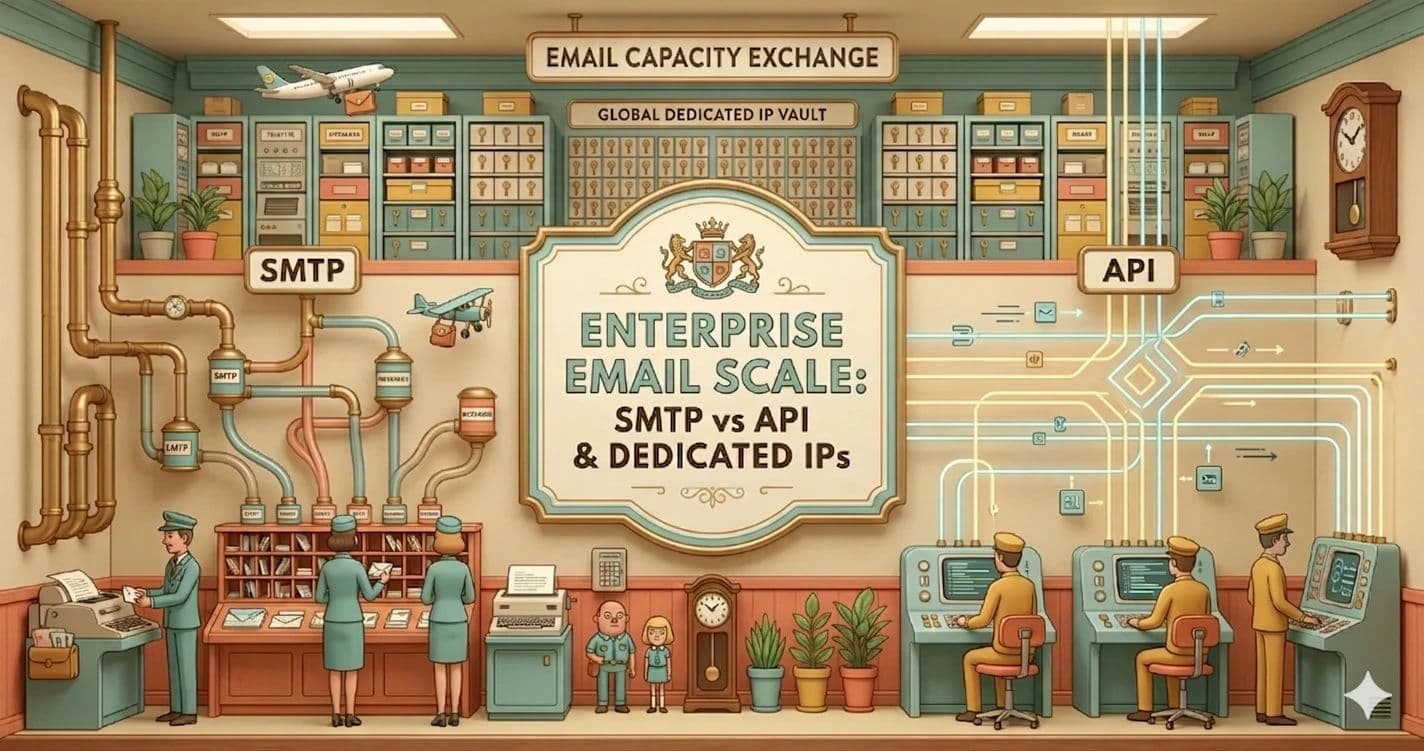
Choosing between Simple Mail Transfer Protocol (SMTP) and an Application Programming Interface (API) is the foundational decision in modern email architecture. While both methods ultimately deliver mail to an inbox, the way they inject messages into an infrastructure provider's network differs fundamentally, impacting latency, scalability, security, and developer experience.
1. The Case for SMTP Relays: SMTP Relay for Large Scale Sending
SMTP remains the universal standard for email transmission. Its primary advantage is frictionless integration with legacy systems. Many Enterprise Application Integration (EAI) platforms, legacy CRMs, and on-premise billing systems are hardcoded to output communications via standard SMTP ports (25, 587, or 465).
Universal Compatibility: SMTP requires minimal development effort. If a legacy system can send an email, it can use an SMTP relay. You simply update the host, port, and authentication credentials to route traffic through a cloud provider.
Standardized MIME Construction: With SMTP, your application is responsible for assembling the Multipurpose Internet Mail Extensions (MIME) parts. This gives you absolute control over the raw message format, which is critical for highly regulated industries.
The Latency Trade-off: The major drawback of SMTP at an enterprise scale is that it is a "chatty" protocol. A single email transmission requires multiple back-and-forth network round trips (e.g., EHLO, MAIL FROM, RCPT TO, DATA, QUIT). In high-volume scenarios, especially across high-latency WAN links, this handshaking process creates significant throughput bottlenecks.
2. The API Advantage: Speed, Flexibility, and Modern Development
Scalable SMTP API solutions bypass the chatty nature of traditional protocols by compiling the entire email payload—including headers, HTML content, and attachments—into a single HTTP POST request.
Speed and Throughput: By utilizing persistent HTTP/2 or HTTP/3 connections and lightweight JSON payloads, APIs dramatically reduce injection latency. This is critical for time-sensitive transactional emails like password resets or multi-factor authentication (MFA) codes.
Deep Integration and Webhooks: APIs offer native access to advanced features that SMTP cannot easily support. This includes real-time webhooks for delivery events (opens, clicks, bounces, spam complaints), allowing enterprises to build automated feedback loops directly into their applications.
3. Security Management: API Keys vs. SMTP Credentials
In 2026, security posture is a major differentiator when evaluating SMTP vs API for enterprise scale. Managing static SMTP credentials across a large engineering organization poses significant risks. If an SMTP password is leaked, malicious actors can easily hijack the relay to send spam.
Conversely, APIs integrate seamlessly with modern CI/CD pipelines and secret management tools (like HashiCorp Vault or AWS Secrets Manager). APIs allow for the use of short-lived, scoped access tokens. You can restrict an API key so it only has permission to send transactional templates, completely blocking it from accessing billing data or marketing lists. This granular, role-based access control (RBAC) makes API integrations inherently more secure for enterprise deployments.
Evaluating Top Infrastructure Providers for Your Stack
Selecting the right infrastructure provider requires aligning their technical strengths with your specific architectural needs. The 2026 landscape is dominated by several key players, each offering distinct advantages.
1. Transactional Email API Comparison: Reliability and Legacy Compatibility
For enterprises migrating complex, legacy on-premises systems to the cloud, seamless SMTP integration is paramount. Providers like SMTP.com and SMTP2GO excel in this arena. They offer highly resilient SMTP relay services designed to handle massive concurrency without the need to rewrite legacy application code. Their infrastructure is optimized to accept traditional SMTP traffic, apply necessary authentication (SPF, DKIM), and route it efficiently, making them ideal for traditional enterprise application integration where rewriting code to support REST APIs is cost prohibitive.
2. Speed, Flexibility, and Data Sovereignty
When developer experience and API throughput are the primary drivers, Twilio SendGrid and Mailgun by Sinch are the industry standards. Twilio SendGrid offers unparalleled scale, processing billions of emails with a highly documented, robust REST API that developers favor for custom application integration.
Mailgun by Sinch is particularly renowned for its advanced inbound email routing capabilities. Its API allows developers to parse incoming emails, extract data, and post it directly to their applications via webhooks. Furthermore, both providers now offer robust regional data center options. To comply with strict data sovereignty laws like GDPR in the EU or localized regulations in Asia-Pacific, enterprises can mandate that their email payloads and metadata are processed and stored exclusively within specific geographic boundaries.
3. Amazon SES vs Postmark: Cost vs. Speed Trade-offs
For organizations where raw scale and email infrastructure cost optimization 2026 are paramount, Amazon SES (Simple Email Service) is a formidable choice. It provides a bare-metal, highly scalable infrastructure that integrates deeply with the broader AWS ecosystem. While it requires more internal DevOps expertise to configure properly, its cost-to-volume ratio is unmatched for enterprise scale.
Conversely, Postmark focuses obsessively on time-to-inbox. By strictly separating transactional and promotional email streams at the infrastructure level, Postmark guarantees lightning-fast delivery times. While the cost per thousand emails is higher than Amazon SES, Postmark is the premier choice for critical alerts and application notifications where a five-second delay is unacceptable.
The Tipping Point: When to Move to Dedicated IP Pools
One of the most critical decisions an enterprise will make is determining when to transition from a shared IP pool to a dedicated IP address—or a pool of dedicated IPs. In 2026, major ISPs utilize advanced, AI-driven filtering algorithms that scrutinize both domain reputation and IP reputation.
1. Identifying the Volume Threshold
Shared IP pools are excellent for low-to-medium volume senders because the collective volume of all users keeps the IPs "warm" in the eyes of ISPs. However, shared pools expose enterprises to the "noisy neighbor" problem; if another sender on your shared IP violates anti-spam policies, your deliverability can suffer collateral damage.
The industry consensus dictates that an enterprise should migrate to dedicated IP pools for high volume email when they consistently send over 100,000 to 200,000 emails per month. Consistency is the operative word. ISPs view erratic sending volumes from a dedicated IP with deep suspicion. If you have sustained, high-volume traffic, a dedicated IP allows you to isolate your sender reputation, ensuring that your deliverability is dictated solely by your own sending practices.
2. Managing Multi-IP Strategies for Global Deliverability
At the enterprise level, a single dedicated IP is rarely sufficient. High-volume senders must implement multi-IP strategies, often referred to as IP pooling. The most critical best practice is separating transactional mail from marketing mail. Transactional mail typically enjoys open rates above 50%, generating incredibly positive engagement signals. Marketing mail has lower engagement and higher complaint rates. Mixing these streams on a single IP will degrade the delivery of your critical transactional messages.
3. Handling Volume Spikes in Auto-Scaling Environments
A crucial consideration when moving to dedicated IPs is how your infrastructure handles sudden volume spikes. In an auto-scaling environment, a sudden 500% surge in traffic (e.g., a major breaking news alert or a flash sale) can trigger ISP rate limits if pushed through a small dedicated IP pool. Shared pools naturally absorb these spikes better because your surge is a small percentage of the pool's total daily volume. Enterprises using dedicated IPs must implement intelligent load balancing and traffic shaping, queuing non-critical messages to ensure high-priority alerts do not bounce due to rate limiting.
Find Perfect Software for Your Business
Mitigating Risk: IP Warm-up and List Verification
Transitioning to a dedicated IP is fraught with risk. A brand-new IP address has no reputation. If you immediately blast a million emails from a "cold" IP, ISPs will instantly throttle the traffic or blacklist the IP entirely, resulting in catastrophic delivery failures.
1. Automated IP Warming Strategies and 2026 ISP Algorithms
To protect your infrastructure investment, you must execute rigorous dedicated IP warm-up best practices. This involves starting with a very small sending volume and gradually increasing the volume over 30 to 60 days. This controlled ramp-up proves to ISPs that you are a legitimate sender.
To accelerate this process, some enterprises utilize reputation management tools like WarmupInbox and InboxAlly. These platforms use networks of seed accounts to interact with your emails, automatically opening messages and rescuing them from the spam folder.
Technical Disclaimer: In 2026, ISP algorithms (particularly Gmail and Microsoft) have become highly sophisticated at detecting purely synthetic engagement. Relying solely on automated warming tools is risky. Enterprises must blend this synthetic engagement with highly targeted organic traffic—sending to their most engaged, active human subscribers during the warming phase—to build a durable IP reputation management for enterprises.
2. Maintaining List Hygiene at Scale
Even with a perfectly warmed IP, sending emails to invalid addresses will destroy your deliverability. Hitting a high hard bounce rate signals to ISPs that you have poor list acquisition practices, leading to immediate throttling.
List hygiene is a non-negotiable prerequisite. Before migrating lists to a new infrastructure, enterprises must utilize automated email list verification services. Bouncer and EmailListVerify provide enterprise-grade APIs that validate email addresses in real-time. They check DNS records, verify SMTP connections, and identify disposable or spam-trap addresses before a message is ever sent. Integrating these tools at the point of capture ensures that your dedicated IPs are only processing pristine data.
Comparing Auxiliary Deliverability Tooling
While your core SMTP or API provider handles the actual transmission of data, maintaining high-volume inbox placement strategies requires an ecosystem of auxiliary tools. These platforms sit alongside your core infrastructure, providing the necessary list hygiene, reputation monitoring, and inbox placement testing required to sustain enterprise-scale operations.
Tool Name | Main Function | Enterprise Use Case | Key Integration Focus |
Bouncer | Real-time Email Verification | Scrubbing massive legacy databases prior to IP migration to prevent hard bounces. | Native API integration for real-time form validation. |
EmailListVerify | Bulk List Cleaning | Routine hygiene of marketing lists to identify and remove spam traps and dormant accounts. | Bulk CSV processing and CRM webhook integration. |
WarmupInbox | Automated IP Warming | Generating synthetic engagement to build reputation on newly provisioned dedicated IPs. | Connects directly via SMTP/IMAP to simulate human behavior. |
InboxAlly | Seed Testing & Deliverability | Rescuing domains from spam folders by forcing positive engagement signals across major ISPs. | Advanced placement testing for high-stakes marketing campaigns. |
Join thousands of enterprise leaders using AuthenCIO to eliminate guesswork in their tech stack.
Evaluating Enterprise SLAs and Support Models
Beyond technical specifications, enterprise buyers must critically evaluate the Service Level Agreements (SLAs) and support models offered by infrastructure providers. At an enterprise scale, community forums and standard ticketing systems are insufficient.
High-volume senders require dedicated Technical Account Managers (TAMs) and deliverability consultants. If a dedicated IP gets blacklisted by a major ISP during a critical product launch, waiting 24 hours for a support response translates to massive revenue loss. Providers that offer 15-minute critical response times, custom routing rules, and proactive deliverability monitoring are essential. When calculating TCO, the cost of premium enterprise support should be factored in as a mandatory insurance policy for your revenue-generating communication streams.
Future-Proofing Your Email Architecture
As we look toward the future, the complexity of enterprise email will only intensify. Regulatory landscapes are shifting, and security protocols are becoming increasingly stringent. Technical leaders must design architectures that are not only scalable today but resilient against future disruptions.
1. Building a Multi-Vendor Strategy
Relying on a single infrastructure provider is a single point of failure. Enterprises are increasingly adopting multi-vendor strategies, utilizing intelligent routing layers to distribute traffic. For example, an enterprise might use Twilio SendGrid for its primary marketing API, Postmark for critical transactional alerts, and maintain Amazon SES as a high-volume failover. If one provider experiences an outage or a sudden IP blacklisting, traffic can be seamlessly routed to the backup provider, ensuring uninterrupted uptime.
2. Advanced Security and Compliance Protocols
In 2026, basic SPF, DKIM, and DMARC configurations are merely table stakes. Major ISPs now demand advanced security configurations for high-volume senders. Enterprises must implement the following to ensure maximum deliverability:
MTA-STS (Mail Transfer Agent Strict Transport Security): Enforces TLS 1.3 encryption in transit, preventing man-in-the-middle attacks and ensuring payload integrity.
TLS 1.3 Requirements: Mandating the latest encryption standards across all SMTP relays and API endpoints to comply with modern data protection regulations.
BIMI (Brand Indicators for Message Identification): Displays your verified corporate logo in the inbox. This not only increases brand trust and open rates but also serves as a visual indicator to ISPs that your domain has undergone rigorous security audits.
3. AI-Driven Deliverability Optimization
Finally, the most advanced enterprise architectures are incorporating AI-driven deliverability optimization. Rather than relying on static rate limits, these systems use machine learning to analyze historical ISP throttling data in real-time. If the AI detects that Yahoo is beginning to defer connections, it will dynamically shape the traffic, slowing down the send rate to Yahoo while simultaneously accelerating delivery to Gmail, thereby maximizing overall throughput without triggering permanent blocks.
Try AuthenCIO
Move to faster, smarter software evaluation with AI
Conclusion: Building a Resilient Email Strategy
Navigating the complexities of enterprise email infrastructure requires a strategic balance between technological capability and operational discipline. The choice between SMTP and API integrations should be dictated by your specific latency requirements, security postures, and legacy system constraints. Transitioning to dedicated IP pools is a powerful step toward controlling your sender reputation, but it demands precise timing, intelligent load balancing, and rigorous warm-up protocols.
By carefully evaluating core providers like Twilio SendGrid, Amazon SES, and SMTP.com, and fortifying your stack with auxiliary tools like Bouncer and InboxAlly, you can construct a highly resilient architecture. In 2026, email deliverability is an engineering discipline. Treat your email infrastructure with the same architectural rigor as your core product, and you will ensure that your critical communications consistently reach the inbox at any scale.